Ecology and Evolution · Skim version
History of Life: Transitions, Extinctions and Radiations
Read the full lesson → Skim the whole course →
The guiding idea
Species have been dying out for as long as there has been life. So how did a planet of microbes end up with so many kinds of living things?
The number of kinds of living things changes by births minus deaths of lineages: speciation adds them and extinction removes them.
From the film: Births Minus Deaths
- The number of lineages changes by births minus deaths, speciation minus extinction (r = λ − μ); a slowly changing count alone cannot show whether the two rates are high or low.
- For most of its history life was microbial; many-celled eukaryotes, animals and land plants came later. Each fossil date means by this time, at the latest, while the oxygen date is bracketed from both sides.
- By a widely used benchmark, a mass extinction loses more than three-quarters of species in a geologically short interval; the Big Five are the standard list, though how sharply each stands out is debated.
- Iridium at distant sites, a crater of the right age and dating that ties impact to extinction point to an impact as the trigger of the end-Cretaceous extinction.
- In still broth one genotype of Pseudomonas fluorescens diversified into new heritable types; in shaken broth it did not.
From the film: Floors and Brackets
- Fossils are rarely dated directly; often minerals in nearby rocks are, such as zircon carried into volcanic ash.
- Each atom decays at random, so in each half-life about half the remaining parent atoms decay; in a closed mineral that started with no daughter, the parent left tells how many half-lives have passed.
- Dated layers below and above a fossil bed, in undisturbed rock, give a bracket, not a single date.
- The oldest fossil of a group is a minimum age: the group existed by then and may be older.
- The clock must fit the age: carbon-14 has a half-life of about 5,730 years, and after about 50,000 years too little remains to measure, so dinosaur bones are not carbon-dated.
-
Major transitions: new lineages, and a new atmosphere
-
Mass extinctions: when losses far outrun new species
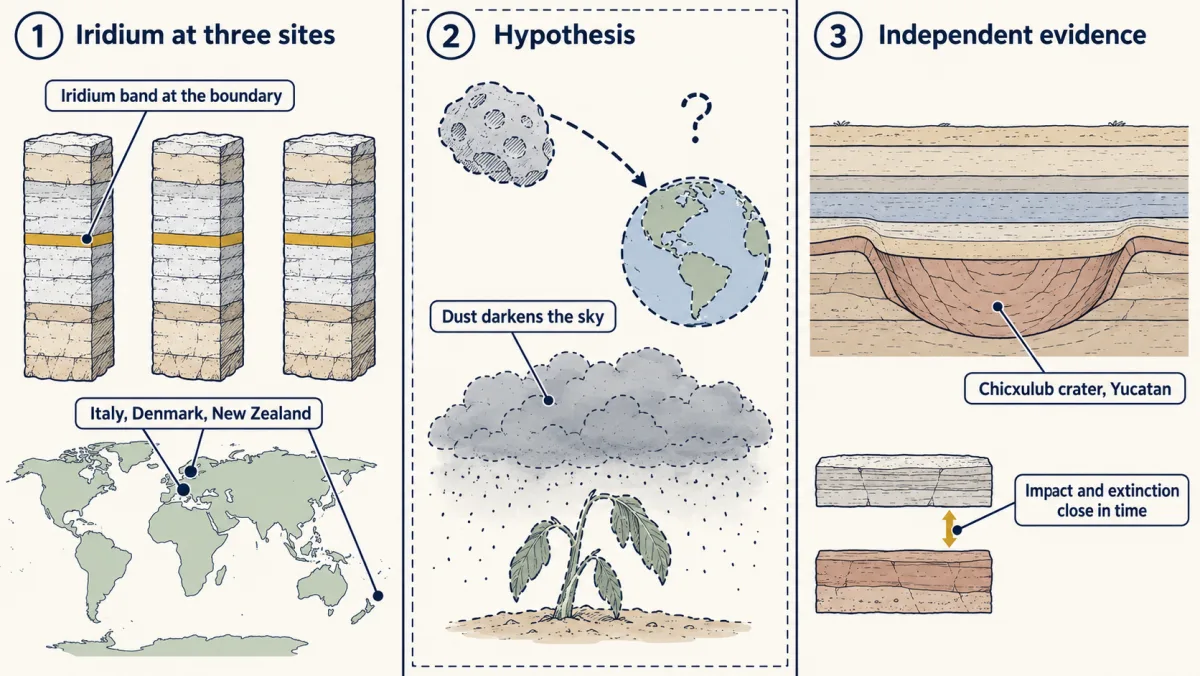
Three independent links carry the impact verdict. The dating shows that impact and extinction happened at about the same time, not how long the dying took. AI-generated illustration -
Radiations: ecological opportunity in a flask and in the record
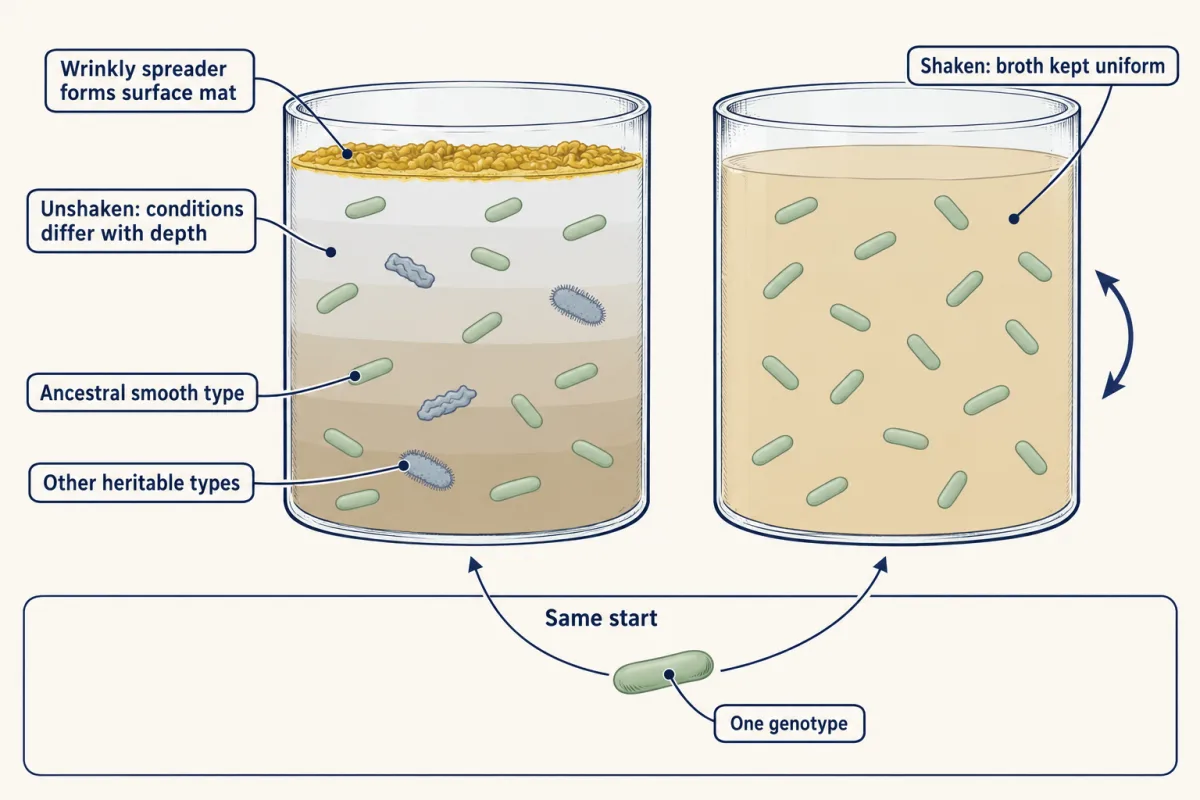
Shaking removes the zones, not the mutations: in uniform broth the new types had no different zone to hold. Schematic, not to scale. AI-generated illustration -
How the dates are measured
-
What rates the record can and cannot give
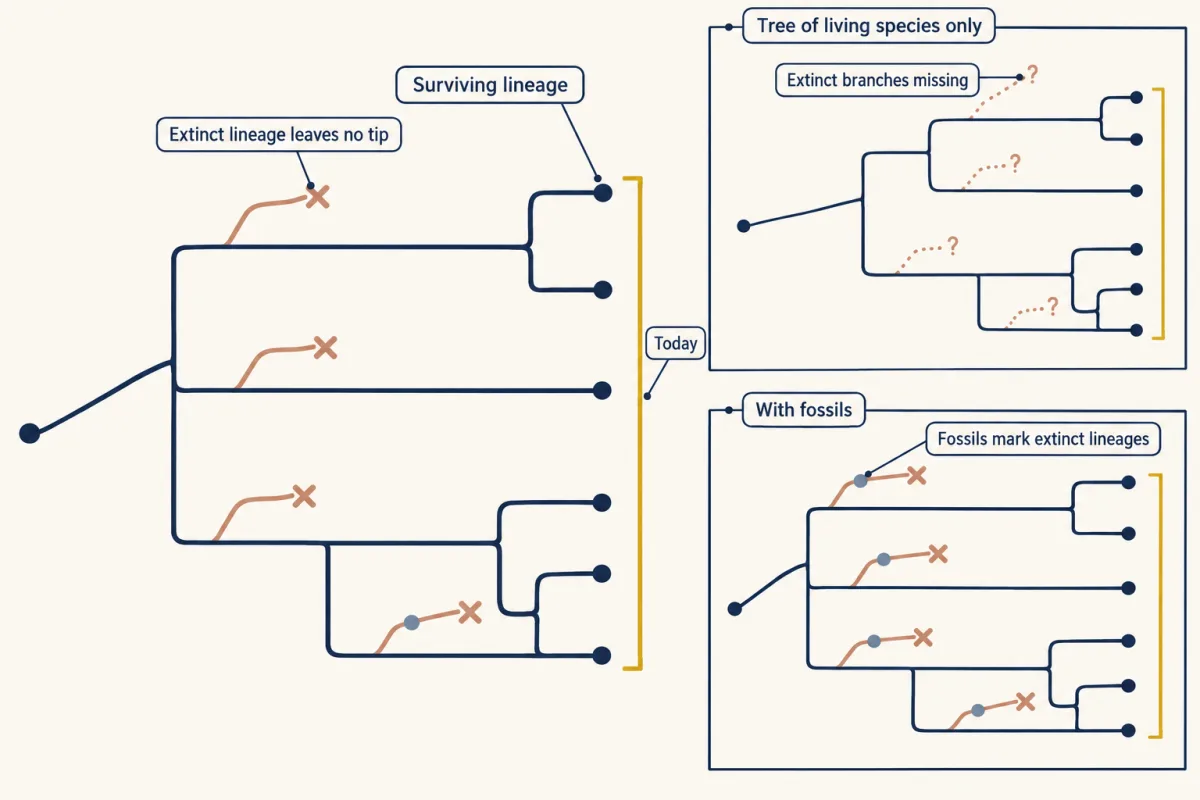
A time tree of living species is missing every lineage that died out, so without constraints justified from outside the tree it cannot separate speciation from extinction histories. In deep time, fossils are the main direct record of the missing branches. Schematic, not real data. AI-generated illustration -
Going deeper
Where this lesson fits
Before thisReview first
- Reading Phylogenetic TreesThis course · Lesson 2
You need to read a time tree and its nodes to follow what a tree of living species can show.
- Molecular EvolutionThis course · Lesson 5
Molecular clocks that date splits from DNA differences are used here to place the mammal radiation.
- Speciation: How Barriers to Gene Flow EvolveThis course · Lesson 7
Speciation is the rate λ that adds lineages in the birth-death bookkeeping used here.
After thisStudy next
- Demography and SurvivorshipThis course · Lesson 13
Survival and birth rates per age class extend the births-minus-deaths bookkeeping from lineages to individuals.
- Population Growth and RegulationThis course · Lesson 14
The exponential growth rate r and doubling time used for lineage counts are developed fully for populations.
- Global Change: Species on the MoveThis course · Lesson 24
Modern species losses and range shifts are judged against the extinction and recovery patterns seen in the fossil record.
Elsewhere on the siteFilms, simulations and method films in other courses
- How Rocks Put Fossils in OrderFilm · Biology
It shows how rock layers order fossils and how radioactive dating adds ages in years.
- Who Makes It Through the Change?Film · Life Science
It shows who survives when the environment changes, the survivors that later diversify.
- Rock layers and DNASimulation · Biology
It lets you place fossils in rock layers, the ordering that dated ash layers then bracket.
Suggested by an AI model from the lessons themselves, then checked. How we use AI