How Rocks Put Fossils in Order
Read the transcript of “How Rocks Put Fossils in Order”
Film transcript: How Rocks Put Fossils in Order
How can a whale with legs be older than a whale built for open water? Imagine a cliff that holds both kinds of fossil, then read its layers like a record of events. A fossil is preserved evidence of past life, such as a bone, shell, tooth, or footprint. Watch sediment bury one fossil, settle, then bury another. The lower layer formed before the layer above it. That order is relative dating. It tells which layer is older, without giving an age in years. In an undisturbed stack, lower layers formed first. The time arrow points upward toward younger rock. The fossil record is every fossil found so far, arranged by age. It shows kinds of life appearing, changing, and often going extinct.
One cliff holds only a small piece of that record. Now the cliff tilts, and one block turns almost upside down. Which fossil is older after the rocks move? Follow the matching layers, not simply the bottom edge. Tilting changes the angle, not the order of formation. Folding, flipping, or faults can move old rock above young rock. Geologists reconstruct the stack before using the lower-means-older rule. Relative order is not an age. Radioactive dating adds ages in years to certain minerals. Starting atoms change into product atoms at a steady rate. Their measured amounts estimate when the mineral formed. Watch two volcanic ash layers close around one fossil layer.
The lower ash formed earlier, and the upper ash formed later. Their dates bracket the fossil, but neither gives its exact age. More often, no volcanic layer sits nearby. Scientists can match a fossil layer to dated rocks elsewhere.
Index fossils help when their species lived during a known span of time. The cliff is not a complete diary. Most remains rot, are eaten, or never get buried quickly. Water and sediment favor some environments over others. The fossil record is a book with many missing pages. Even with gaps, an ordered sequence can test a history.
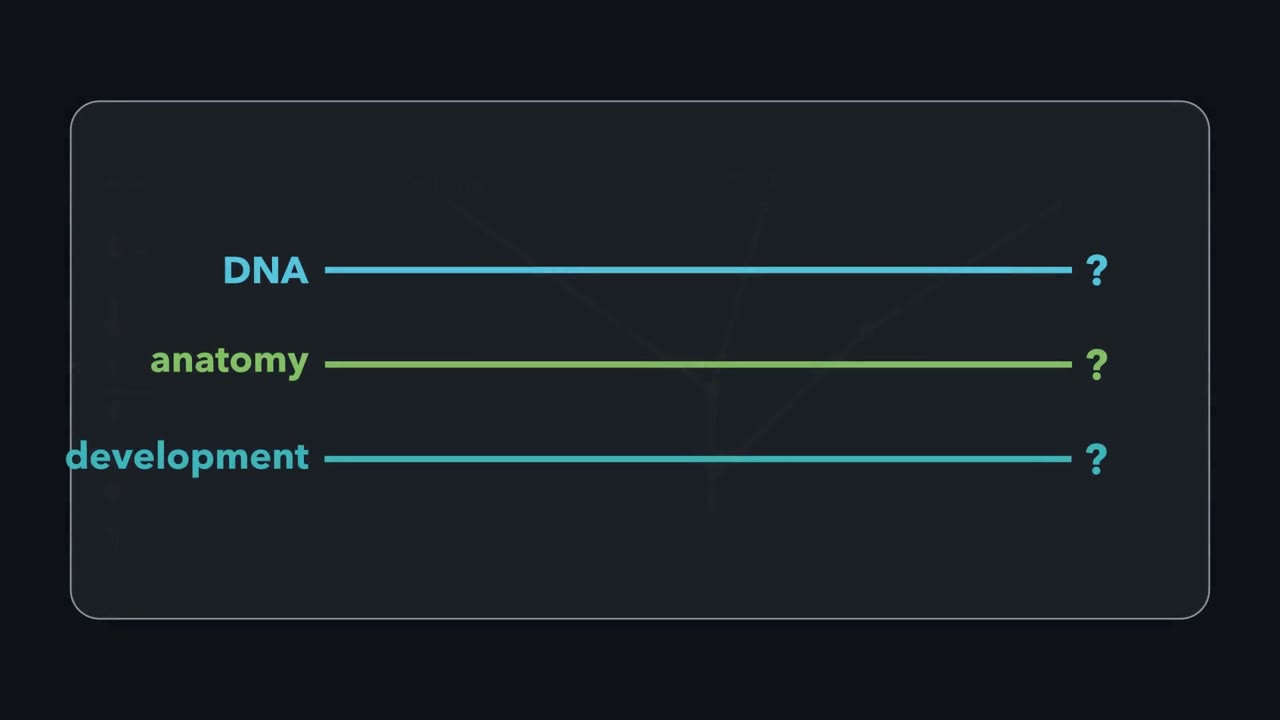
Older whale fossils retain legs and feet. Later forms have smaller hind limbs. The sequence shows change, not that one named fossil was the direct ancestor of the next. One line of evidence can mislead. Rocks may be disturbed, dates may only bracket, and fossils may be missing. A different method can check the same history. Independent evidence that agrees strengthens an explanation of common descent. This film built a rock timeline. Bodies and inherited information can test the same branching history.
If whales live their whole lives in water, why do some fossil whales have legs, and why do living whales still carry small hip bones?
Continue in the lesson: Evidence for Evolution →
3:25 · Free, with captions and a transcript. The lesson has the full text, the questions and the sources.
More films from this lesson
How this film was made. Narration: written from this lesson's text and read by an AI narrator voice (Kokoro, af_heart). Animation: AI-generated in code (Manim) by Claude, a schematic with no drawn molecular structures. Captions come from the narration script. See something wrong? Report it.