Cell Signaling · Unit 5: Signals that build and defend an animal
Hedgehog and the Primary Cilium
Rewritten on : new text, flashcards and film. Your notes and highlights stay, but the text around them may have moved.
How does one signal tell the cells of an embryo where they are, and why do a lamb-deforming plant and a skin cancer drug hit the same protein?
The main idea, the figures and what the films show. Under each heading, "Read this part" opens it.
Both films in order, 7 minutes. Each one ends with what to take from it.
The whole lesson: about 17 minutes of reading and 7 of film.
Pause when the reading reaches a film, and offer to play it. Saved on this device.
Watch the film now, or keep listening
That is the end of the reading
This idea at other levels
This lesson teaches the primary cilium in Cell Signaling, a graduate course. Simpler: read a short college version here.
The college version · about 1 minute to read
Hedgehog is a secreted morphogen that carries two lipids: cholesterol, attached when the precursor protein cleaves itself, and palmitate on its amino-terminal cysteine. Its receptor, the twelve-pass protein Patched, restrains the seven-pass protein Smoothened without binding it, and Hedgehog inactivates Patched, so the pathway is a double negative. With Smoothened off, PKA, CK1 and GSK3 phosphorylate the transcription factor Gli (Ci in flies), an E3 ligase tags it with ubiquitin, and the proteasome trims it to a repressor. With Smoothened on, Gli stays full length and becomes an activator. In vertebrates these steps take place at the primary cilium: Patched leaves it and Smoothened enters it when Hedgehog arrives, and a cell that cannot build a cilium cannot switch on Hedgehog target genes in response to the signal. Loss of Patched gives basal cell carcinoma, and cyclopamine and vismodegib both block Smoothened.
See nearby ideasHide nearby ideas
This lesson also teaches one more idea; its ladder is below.
The primary cilium
Many cells carry one hairlike projection that does not beat and works as an antenna for signals.
Taught at one level so far: graduate level.
Graduate · the level you chose
Hedgehog and the Primary Cilium · this lesson
Smoothened enters the cilium: mutants that cannot build one cannot answer Hedgehog.
Cell Signaling · about 17 min · 3 practice questions
Next door to the primary cilium
- Hedgehog signaling (Sonic hedgehog)In vertebrates, the steps of Hedgehog signalling happen on the cilium, so a cell without one cannot read the signal.Nearest lesson: Ventral to Dorsal: Sonic Hedgehog and BMP in the Neural Tube (graduate level)
- Sensory transductionMany sense organs are built around modified cilia that turn light, scent or force into an electrical signal.Nearest lesson: Five Ways to Turn a Stimulus into a Current (graduate level)
Hedgehog signaling (Sonic hedgehog)
A secreted signal tells embryo cells where they are by switching off Patched, a brake that holds Smoothened off.
Taught at one level so far: graduate level.
Graduate · the level you chose
Hedgehog and the Primary Cilium · this lesson
A double negative: Hedgehog switches off Patched, so Smoothened and Gli switch on.
Cell Signaling · about 17 min · film 3:25 · 3 practice questions
Ventral to Dorsal: Sonic Hedgehog and BMP in the Neural Tube
Graft a notochord for a second floor plate, then name the signal: Shh.
Developmental Neuroscience · about 33 min · film 2:55 · 3 practice questions
Next door to Hedgehog signaling
- The primary ciliumIn vertebrates the Hedgehog steps happen on the primary cilium, the cell's antenna.
- Morphogen gradientsHedgehog from one source gives neighbours different fates depending on how much of it they receive.Nearest lesson: Ventral to Dorsal: Sonic Hedgehog and BMP in the Neural Tube (graduate level)
Short versions inside this lesson
The plainest version · about 1 minute to read
Every cell in a growing baby animal has a little switch that says "build this part here." A guard called Patched keeps the switch off. Hedgehog is a message from nearby cells that keeps the guard busy, so the switch can turn on. Cells close to the message get a lot of it and cells far away get a little, and that is how each cell knows what to become.
Find an idea: every idea, searchable
Which lessons teach an idea, and the notes on each level, were written by AI models from the lessons and checked by a second model. A person has not yet read every one. How we use AI
About this lesson goals, parts
What you'll learn
- Explain how a protein that carries cholesterol and palmitate acts as a morphogen, giving different answers at different concentrations and exposure times.
- Explain the Hedgehog pathway as a double negative, in which Patched holds Smoothened off and Hedgehog switches Patched off, and predict what loss of each part does.
- Describe how the Gli transcription factor (Ci in flies) is cut to a repressor without the signal and stays whole as an activator with it.
- Relate the vertebrate pathway to the primary cilium, and connect it to holoprosencephaly, basal cell carcinoma and the drug vismodegib.
Builds on:Lipids as Anchors and Addresses (read)Phosphorylation: Kinases and Phosphatases (read)cAMP and Protein Kinase A (read)Why these?
Rewritten on : new text, flashcards and film. Notes and highlights stay, but the text around them may have moved.
The main idea. Hedgehog switches off Patched, letting Smoothened keep Gli whole and active; in vertebrates the cilium houses the switch, and downstream steps decide.
The films
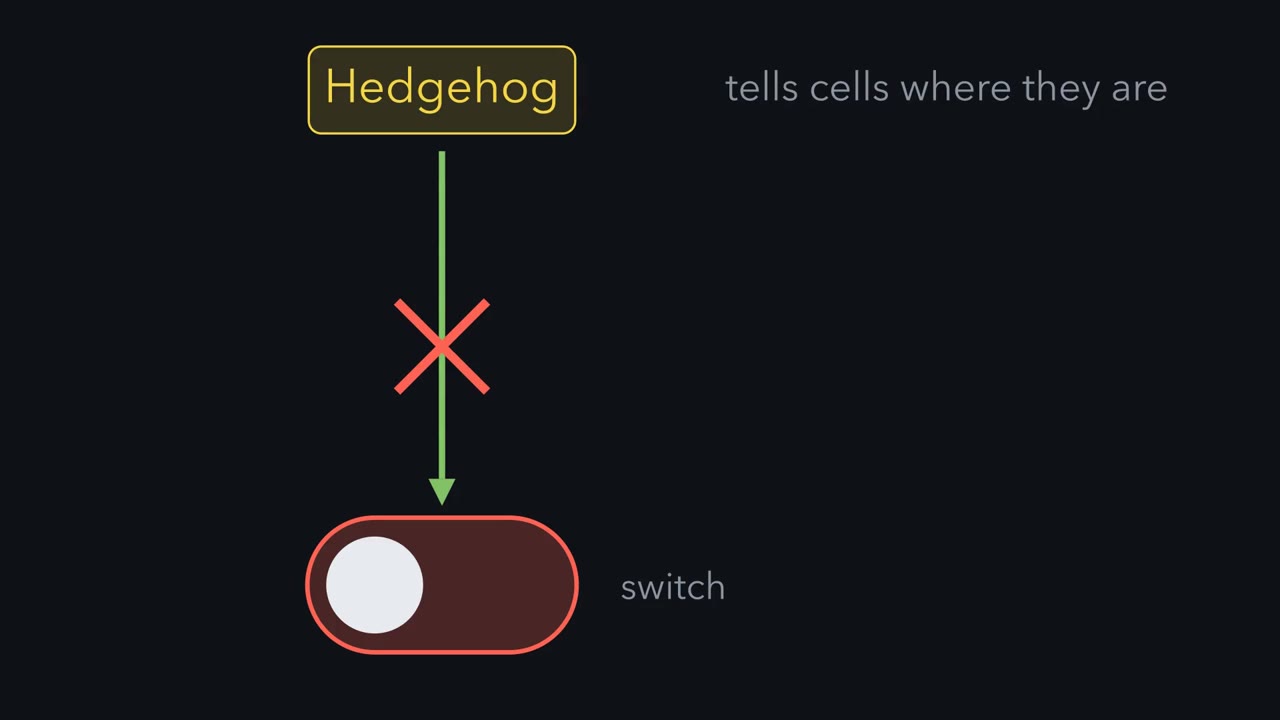 ▶ Watch Hedgehog Releases a Brake · 3:25
Read the transcript of “Hedgehog Releases a Brake”
Film transcript: Hedgehog Releases a Brake
How can one secreted signal tell embryonic cells what to become? And why does it work by switching off a brake? Most pathways you know add an active signal. Hedgehog instead removes a brake. Start across this row of developing cells. The source on the left releases Hedgehog, which spreads outward and fades with distance. Near cells see a high dose for longer, while distant cells see less. Each cell converts that reading into a distinct fate. Because concentration and duration steer cell identity, Hedgehog is a morphogen. Now zoom into the membrane of one receiving cell. Two membrane proteins run the switch: Patched and Smoothened. Without Hedgehog, Patched stays active and holds Smoothened off.
Notice that Patched never touches Smoothened. A single Patched molecule can keep many Smoothened molecules quiet from a distance. How can a brake work without grabbing its target? Patched resembles a membrane transporter. In the leading model, Smoothened needs a sterol, likely cholesterol, to turn on. Active Patched keeps that sterol out of reach. What Patched actually moves, and what powers it, remain open questions. Now Hedgehog arrives and binds Patched. Hedgehog carries lipid tails, and one plugs into Patched, switching the brake off. In the model, accessible sterol now reaches Smoothened, which lights up and turns on. Hedgehog never pressed an accelerator.
It switched off an off-switch, which is why the pathway is a double negative. What does Smoothened control inside the cell? Follow the transcription factor called Gli. While Smoothened is off, kinases add phosphates to Gli, marking it for the proteasome. The proteasome shreds only its back activating half. The front DNA-binding piece survives and silences target genes as a repressor. Now pause and predict. Hedgehog arrives, Patched switches off, and Smoothened turns on. Does the cell glue cut repressors back together, or spare newly made Gli from being cut?
It spares newly made Gli from cutting. Once Smoothened turns on, kinase marking stops. Cut repressors are never glued back together. Instead, freshly made Gli avoids the proteasome, keeps its activating half intact, and moves into the nucleus whole. There, full-length Gli switches target genes on. Compare both states side by side. Without Hedgehog, Patched stays active, Smoothened stays off, and trimmed Gli silences genes. With Hedgehog, Patched turns off, Smoothened turns on, and intact Gli activates them. In short, Hedgehog switches off Patched, letting Smoothened keep Gli whole and active.
From the film: four take-homes
- Hedgehog switches off Patched, letting Smoothened keep Gli whole and active.
- Hedgehog acts as a morphogen: cells read both its concentration and how long it arrives.
- Patched holds Smoothened off without touching it, likely by keeping a sterol out of reach.
- With Smoothened off, kinases mark Gli and the proteasome trims it to a repressor; with Smoothened on, newly made Gli escapes cutting.
One secreted signal tells embryonic cells where they are—and a lamb-deforming plant and a common skin cancer drug hit the same protein in its pathway. The first film animated the core switch; here we follow the biochemistry behind it, the organelle where vertebrates run it, and the genetics linking birth defects to tumours.
A lipid-anchored protein becomes a morphogen
The pathway’s odd names come from Christiane Nüsslein-Volhard and Eric Wieschaus’s 1979 fruit-fly screen at EMBL Heidelberg. Breaking embryonic genes at random, they found a larva lacking smooth cuticle—spiny from end to end—and named its gene hedgehog. Grouped with it in their 1980 paper were patched, cubitus interruptus and wingless (fly Wnt), before anyone knew which encoded the signal, receptor or transcription factor. Going deeper outlines the screen’s scale.
The newly made Hedgehog precursor cuts itself in two: its back part acts once as an enzyme, breaking the chain and joining cholesterol to the front part’s new end. A second enzyme adds palmitate, a 16-carbon fatty acid, to the other end. That dual-lipidated front part is the signal.
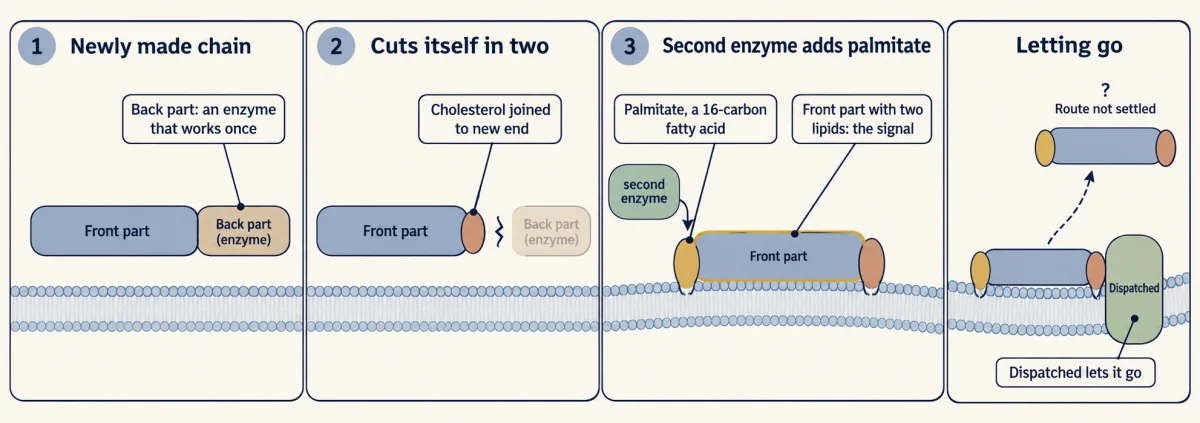
As with Ras in the lesson on lipid anchors, both lipids tether Hedgehog to a membrane, so sending cells need a membrane protein, Dispatched, to release it. How freed Hedgehog then crosses tissue is unsettled—lipoprotein particles, multimeric clusters and thin cell extensions have all been proposed—but it clearly reaches many cell diameters away in a declining gradient.
That makes Hedgehog a morphogen: a signal spreading from a source that draws different responses at different concentrations. Mammals have three Hedgehog genes; the best studied is Sonic hedgehog, named after the video-game character. Made along the limb bud’s future little-finger edge and the neural tube’s ventral midline, it specifies digits and spinal neurons as transcription-factor networks read both dose and exposure time.
Predict. In a simplified exponential gradient, a morphogen starts at 8 arbitrary units and halves every 10 micrometres; cells above 2 units adopt fate A (to 20 micrometres). If source output doubles to 16 units with the same halving distance, does fate A reach 40 or 30 micrometres?
Check your prediction
30 micrometres. From 16 units, levels fall to 8 at 10 micrometres, 4 at 20, and 2 at 30. Under exponential decay, doubling source output shifts every boundary outward by one halving distance, not twofold.
A catalytic brake and a transcription factor cut in two
The first film animated the double-negative switch; here are its protein parts and biochemical mechanism.
Patched crosses the membrane twelve times and resembles a transporter, related to bacterial pumps and NPC1 (which moves cholesterol out of human lysosomes). Smoothened crosses seven times, like Unit 3 G-protein-coupled receptors. In logic, Hedgehog releases a car’s handbrake rather than pressing an accelerator—which is why losing Patched mimics constant Hedgehog.
Patched acts as a brake in logic, not by clamping Smoothened: one Patched keeps many Smoothened molecules off. The working model is that Smoothened needs a sterol, most likely cholesterol itself, to switch on, and that Patched uses its transporter-like body to keep that sterol out of reach. Cryo-electron microscopy shows sterol-like densities in both proteins and Hedgehog’s palmitate plugging into Patched. What Patched moves and what powers it remain unsettled.
Predict. Compare a 1:1 physical clamp with catalytic sterol removal. If a cell makes fivefold more Smoothened while Patched stays constant, in which model is Smoothened more likely to activate without Hedgehog?
Check your prediction
The 1:1 clamp model. Excess Smoothened would outnumber Patched and escape restraint, whereas depleting a shared sterol pool lets one Patched silence many Smoothened molecules.
What Smoothened controls: one protein, two opposite outputs
The first film animated Gli trimming; here are the kinases behind it and how vertebrates split the work.
The pathway ends at Gli in vertebrates and Cubitus interruptus (Ci) in flies. Flies use Ci for both roles; mammals divide them across Gli3 (mostly repressor), Gli2 (mostly activator) and Gli1 (a direct target gene).
When Smoothened is off, PKA adds priming phosphates to full-length Gli, letting casein kinase 1 (CK1) and glycogen synthase kinase 3 (GSK3) add more. An E3 ligase ubiquitin-tags the phosphorylated cluster for the proteasome, which degrades only the back activating domain and releases the front DNA-binding fragment as a repressor silencing target genes.
Predict. In Unit 3, protein kinase A (PKA) drove hormone responses forward, and in Wnt, CK1 and GSK3 target β-catenin for complete destruction. Without Hedgehog, how does blocking PKA change repression—and what would differ if the proteasome destroyed Gli completely?
Check your prediction
Blocking PKA prevents priming phosphorylation, so less Gli repressor forms and repression weakens: resting PKA acts as a brake here. Complete destruction (as with β-catenin) would leave no repressor fragment to actively silence target genes.
With Smoothened on, priming stops. Newly made Gli escapes trimming and enters the nucleus whole as an activator. Even then a downstream brake, SUFU, binds full-length Gli and restrains it. Unlike Notch, which cuts the receptor to free an activator, Hedgehog prevents a cut on the transcription factor.
How vertebrate Smoothened silences PKA leads straight to the organelle where these proteins meet—and to why downstream steps decide what mutations and drugs do.
Read the transcript of “Inside the Antenna: Cilia and Downstream Control”
Film transcript: Inside the Antenna: Cilia and Downstream Control
The first film showed how Hedgehog turns off Patched so Smoothened keeps Gli whole. In vertebrate cells, where does that switch actually sit? And why can one Smoothened blocker both deform an embryo and shrink a skin tumour? Pull back from the plasma membrane to see that hair-like antenna. Most non-dividing vertebrate cells carry a single primary cilium. It does not beat like a motile whip.
Motor shuttles called intraflagellar transport continuously build and maintain its microtubule core. In vertebrates, the Hedgehog switch runs inside this tiny compartment. Without Hedgehog, Patched sits along the ciliary membrane while Smoothened waits outside in the cell body. Meanwhile, trimming Gli, mainly the form called Gli3, into a repressor also depends on this cilium. Quiet cells actively silence target genes. When Hedgehog binds Patched, the traffic reverses. Patched exits the primary cilium, and Smoothened moves inside and switches on. Full-length Gli proteins gather at the ciliary tip, escape trimming, and travel to the nucleus as activators.
Both sides of Gli processing therefore depend on the psyllium. Glee proteins gather at the ciliary tip, escape trimming, and travel to the nucleus as activators. Now trace the pathway as a chain of switches. Hedgehog turns off Patched, Patched holds back Smoothened, and Smoothened governs Gli inside the cilium. In a linear chain like this, a block or fault acting later overrides everything upstream of it. Watch that rule in an early vertebrate embryo. The forebrain starts with a single central eye field. Sonic hedgehog, a vertebrate Hedgehog, comes from the midline and switches on Smoothened to split that field in two. Now predict. The plant alkaloid cyclopamine locks Smoothened off while Sonic hedgehog still arrives.
Will the eye field divide, or stay as one? It stays as a single central eye. Even though Hedgehog still turns off Patched, Smoothened sits downstream of both. Locking Smoothened off overrides the signal above it. Ewes grazing corn lily bore one-eyed lambs. The plant's cyclopamine later led researchers to Smoothened as a drug target. The same downstream rule explains a common human skin cancer. Most basal cell carcinomas lose Patched, leaving Smoothened running without Hedgehog. The drug vismodegib binds Smoothened and shuts it off. Because Smoothened acts downstream of Patched, blocking Smoothened silences the tumour pathway. But if a tumour's fault lies below Smoothened, vismodegib cannot stop it.
Notice how location and order unite the whole story. The primary cilium gathers Patched, Smoothened, and Gli into one signalling hub. By contrast, most fly cells run this pathway without any cilium. Along that chain, downstream steps override upstream ones. In vertebrates, the cilium houses the switch, and downstream steps decide.
From the film
- In vertebrates the cilium houses the switch, and downstream steps decide.
- Without Hedgehog, Patched sits in the primary cilium while Smoothened stays out; Hedgehog reverses their positions.
- In vertebrates, both making full-length Gli activators and trimming Gli3 to a repressor depend on the primary cilium.
- Blocking Smoothened overrides signals or faults upstream of it—deforming embryos and shutting off Patched-loss tumours—but cannot stop a fault downstream.
In vertebrates the pathway runs inside an antenna
The second film showed Patched exiting and Smoothened entering the primary cilium—a single non-motile microtubule-based projection with its own membrane, built by intraflagellar transport (IFT) motor shuttles. Here is the evidence placing Hedgehog there, and the tissue paradox that proves both Gli outputs require it.
In 2003, Kathryn Anderson’s laboratory at Sloan-Kettering identified two mutagenized mouse lines with neural-tube and limb defects mimicking broken Sonic hedgehog signalling. Both carried damaged IFT genes, and crosses placed them after Patched and before target genes—without revealing where in the cell they acted.
In 2005, Kevin Corbit in Jeremy Reiter’s laboratory at UCSF tracked tagged Smoothened into the primary cilium upon pathway activation. Mutating Smoothened’s ciliary targeting stretch kept it in the cell body, and it could no longer pass the signal on.
Inside the cilium, two mechanisms link Smoothened to protein kinase A (PKA): without Hedgehog, ciliary GPR161 keeps cAMP and PKA high until Hedgehog clears it; active Smoothened also uses an internal decoy sequence to block PKA’s catalytic site. How these two steps fit together is still being worked out.
Predict. Both Gli activator maturation and Gli3 repressor trimming require the primary cilium. Predict how a cilia-less mouse embryo fares in the ventral neural tube (activator-dependent) versus the limb bud (where Gli3 repressor restricts digit number).
Check your prediction
It shows opposite defects: too little Hedgehog response in the ventral neural tube (ventral cell types lost without activator) and signs of too much in the limb bud (extra digits without Gli3 repressor).
| Condition | Gli2 activator | Gli3 repressor | Ventral neural tube | Limb bud |
|---|---|---|---|---|
| Normal, −Hh | Off | High | Dorsal fates | Digits restrained |
| Normal, +Hh | High | Low | Ventral fates induced | Posterior digits induced |
| No cilia (IFT mutant), −Hh | Off | Lost | Dorsal fates | Extra digits (no repressor) |
| No cilia (IFT mutant), +Hh | Lost | Lost | Ventral fates lost | Extra digits (no repressor) |
Most fly cells lack a primary cilium and run the pathway without one; Going deeper notes a 2014 exception in ciliated fly olfactory neurons.
Blocking Smoothened deforms an embryo and treats a tumour
As before, switching off Patched lets Smoothened keep Gli whole and active—and because downstream steps decide, a drug’s target determines which faults it can override.
In the 1950s, Idaho ranchers reported lambs born with one central eye. US Department of Agriculture investigators traced it to corn lily (Veratrum californicum) eaten around day 14 of pregnancy and purified cyclopamine. Mouse embryos lacking Sonic hedgehog show the same single eye: cyclopamine binds Smoothened and blocks the midline Sonic hedgehog signal that splits the early forebrain and its single eye field into left and right. In humans, failure of that split is holoprosencephaly, and inheriting one faulty SHH copy is one known cause.
The opposite fault—constitutive activation—drives basal cell carcinoma, the most common human cancer. The large majority of these tumours run the pathway with no Hedgehog present: most carry mutations inactivating PTCH1 (human Patched), while a smaller share carry Patched-resistant Smoothened. Most people with Gorlin syndrome inherit one faulty PTCH1 copy in every cell and develop many basal cell carcinomas starting young.
Predict. In Gorlin syndrome, every skin cell inherits one broken PTCH1 copy, yet tumours appear in scattered patches rather than across all skin at once. Why—and once a tumour forms, why can a Smoothened blocker shut its pathway down?
Check your prediction
The remaining normal PTCH1 copy still supplies enough Patched brake until a skin cell loses that second copy too. Because Smoothened lies downstream of Patched, nothing upstream matters once Smoothened is blocked, so the drug silences the tumour.
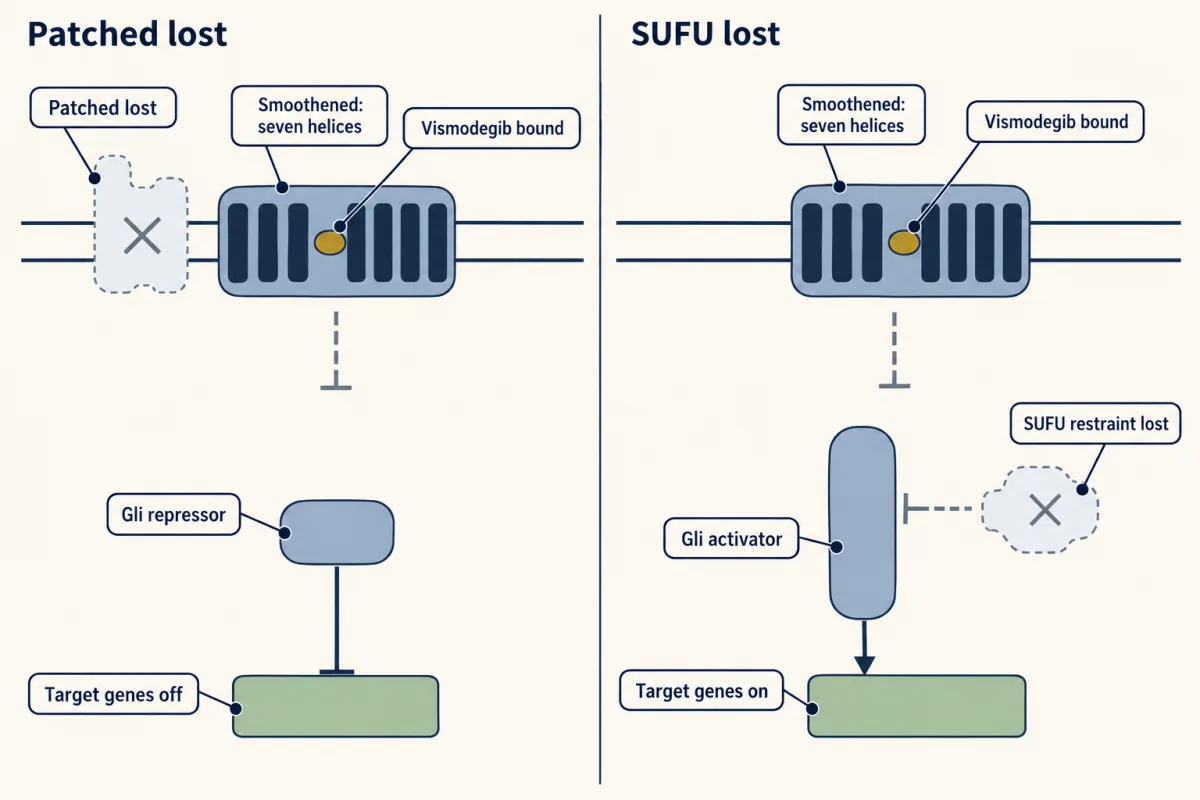
Vismodegib binds among Smoothened’s seven helices and holds it off. Approved in the United States in 2012, it treats adults with metastatic basal cell carcinoma, or locally advanced tumours that recurred after surgery or cannot be treated by surgery when radiation is not an option either. Tumours can escape through a Smoothened mutation blocking drug binding or a downstream fault—and the label repeats the lambs’ warning against pregnancy.
Design problem
Hedgehog switches off Patched, and Patched switches off Smoothened. Predict whether the pathway is on or off, with and without Hedgehog, in four cells: no Patched, no Smoothened, neither, and a Patched-resistant Smoothened. Then say which tumour a Smoothened blocker treats: one that lost Patched, or one that lost a brake acting after Smoothened.
Saved in this browser only.
One way to do it
Ask one question per cell: what state is Smoothened in?
- No Patched. Nothing restrains Smoothened: on with or without Hedgehog.
- No Smoothened. Nothing passes the signal on, so Gli is cut to repressor: off both ways.
- Neither. Off both ways. Without Smoothened, missing its brake changes nothing—the later step decides (epistasis).
- Patched-resistant Smoothened. On both ways.
A Smoothened blocker shuts down the Patched-loss tumour because Smoothened is free and downstream of Patched. A tumour lacking a later brake—such as SUFU, which holds full-length Gli in the cytoplasm—stays on regardless.
Going deeper
How the fly screen worked and its size
In 1979, Nüsslein-Volhard and Wieschaus fed male flies a DNA-damaging chemical and bred nearly 27,000 lines, each carrying one damaged chromosome, until embryos carried two broken copies of the same gene. Healthy larvae have segmental belts of tiny spines separated by smooth cuticle, so missing, doubled or reversed belts revealed lost patterning genes. In his Nobel lecture Wieschaus reported 580 describable mutations falling into 139 genes; their 1980 paper described fifteen.
A cilium-based branch in flies
A cilium-based branch of Hedgehog signalling was reported in 2014 in ciliated fly olfactory neurons. Why vertebrates route the same brake and switch through this compartment is not known.
How cyclopamine was tied to Smoothened
In 1996, mouse embryos lacking Sonic hedgehog were found to have the same single eye seen in affected lambs. In 1998, Philip Beachy’s and Henk Roelink’s laboratories showed cyclopamine blocks Sonic hedgehog responses, and in 2002 Beachy’s group showed it binds Smoothened directly.
Your notes
Select any text in the lesson to highlight it or add a note to it. Your highlights and notes are saved in this browser and collected in your notebook.
This browser is not letting the site save anything (a private window or strict privacy settings), so highlights and notes will be lost when you leave the page.
Try the Predict questions again
Five Predict questions from this lesson, on their own. Answer each one first, then open its check.
In a simplified exponential gradient, a morphogen starts at 8 arbitrary units and halves every 10 micrometres; cells above 2 units adopt fate A (to 20 micrometres). If source output doubles to 16 units with the same halving distance, does fate A reach 40 or 30 micrometres?
From: A lipid-anchored protein becomes a morphogen
Check your prediction
30 micrometres. From 16 units, levels fall to 8 at 10 micrometres, 4 at 20, and 2 at 30. Under exponential decay, doubling source output shifts every boundary outward by one halving distance, not twofold.
Compare a 1:1 physical clamp with catalytic sterol removal. If a cell makes fivefold more Smoothened while Patched stays constant, in which model is Smoothened more likely to activate without Hedgehog?
From: A catalytic brake and a transcription factor cut in two
Check your prediction
The 1:1 clamp model. Excess Smoothened would outnumber Patched and escape restraint, whereas depleting a shared sterol pool lets one Patched silence many Smoothened molecules.
In Unit 3, PKA drove hormone responses forward, and in Wnt, CK1 and GSK3 target β-catenin for complete destruction. Without Hedgehog, how does blocking PKA change repression—and what would differ if the proteasome destroyed Gli completely?
From: A catalytic brake and a transcription factor cut in two
Check your prediction
Blocking PKA prevents priming phosphorylation, so less Gli repressor forms and repression weakens: resting PKA acts as a brake here. Complete destruction (as with β-catenin) would leave no repressor fragment to actively silence target genes.
Both Gli activator maturation and Gli3 repressor trimming require the primary cilium. Predict how a cilia-less mouse embryo fares in the ventral neural tube (activator-dependent) versus the limb bud (where Gli3 repressor restricts digit number).
From: In vertebrates the pathway runs inside an antenna
Check your prediction
It shows opposite defects: too little Hedgehog response in the ventral neural tube (ventral cell types lost without activator) and signs of too much in the limb bud (extra digits without Gli3 repressor).
In Gorlin syndrome, every skin cell inherits one broken PTCH1 copy, yet tumours appear in scattered patches rather than across all skin at once. Why—and once a tumour forms, why can a Smoothened blocker shut its pathway down?
From: Blocking Smoothened deforms an embryo and treats a tumour
Check your prediction
The remaining normal PTCH1 copy still supplies enough Patched brake until a skin cell loses that second copy too. Because Smoothened lies downstream of Patched, nothing upstream matters once Smoothened is blocked, so the drug silences the tumour.
How we measure it
Saturation mutagenesis screen
Damage genes at random with a chemical mutagen, breed thousands of separate lines so that each mutation can be seen in two copies, and inspect every line for a chosen defect. When the same genes keep turning up, the list is close to complete, and it was made with no prior idea of what the genes encode.
Complementation test
Cross two mutants that have similar defects. Normal offspring mean each parent supplied a working copy of the gene the other lacked, so the mutations lie in different genes. A repeat of the defect means they lie in the same gene. The test turns a pile of mutations into a count of genes.
Epistasis analysis with double mutants
Combine two mutations that push a pathway in opposite directions and see which outcome wins. In a chain of switches like this one, the double mutant looks like the mutant in the gene that acts later, which gives the order of the parts. It placed Smoothened after Patched, and the cilium-building genes between Patched and the target genes.
Fluorescent tagging and imaging of the cilium
Fuse a protein to a fluorescent tag, or stain it with an antibody, and photograph cells together with a marker for the cilium. Comparing cells with and without Hedgehog shows where each pathway protein sits and how the signal moves it.
Method films · the methods library
- Complementation (cis-trans) test 2:48
- Cryo-electron microscopy 4:06
- Engineered mutants: site-directed, dominant-negative and constitutively active 4:25
- Epistasis analysis 3:41
- Fluorescent protein tags and biosensors 3:33
- Forward genetic screens 4:07
- Gene targeting: knockout and knock-in mice 4:13
- Immunohistochemistry and immunofluorescence 4:06
- Pharmacological blockade and inhibitors 4:10
- X-ray crystallography 4:06
Practice questions on this lesson (3) → MCAT-style, original, each with an explanation
Where this lesson fits
Before thisReview first
- Lipids as Anchors and AddressesThis course · Lesson 11
This lesson relies on lipid anchors holding Hedgehog on membranes, as with Ras, and does not re-teach them.
- Phosphorylation: Kinases and PhosphatasesThis course · Lesson 6
You need kinases adding phosphates to a protein to follow how PKA, CK1 and GSK3 mark Gli for cutting.
- cAMP and Protein Kinase AThis course · Lesson 13
The resting PKA activity that keeps Gli cut into a repressor builds on how cAMP switches PKA on.
After thisStudy next
- Oncogenes: When the Switch SticksThis course · Lesson 41
A pathway stuck on, such as loss of Patched in basal cell carcinoma, is a case of an oncogenic switch.
- Drugs Against a PartThis course · Lesson 42
Vismodegib blocking Smoothened and tumours escaping it show how a drug targets one part of a pathway.
- The Shape of a Signal: Size, Duration, Frequency and PlaceThis course · Lesson 35
Cells reading both the amount and the duration of Hedgehog is an example of decoding signal shape.
Elsewhere on the siteFilms, simulations and method films in other courses
- The Tube Gains a Second FloorFilm · Developmental Neuroscience
It shows Sonic hedgehog from the notochord acting as a graded signal that sets cell types along the neural tube.
- Reading Sonic hedgehog: level and timeSimulation · Developmental Neuroscience
It lets you vary Sonic hedgehog level and time to see how both set what a cell becomes.
Suggested by an AI model from the lessons themselves, then checked. How we use AI
That is the skim: you have the shape of it.
That is both films: the lesson in pictures.
The rest of the lesson is here when you want it.
Finish line
Test yourself
8 questions
Practice and MCAT-style, with explained answers.
Next · Lesson 27
Integrins and Rho GTPases
How does a cell hold on to what it stands on, feel how hard it is pulling, and use that grip to crawl?
Continue →Rewritten on : new text, flashcards and film. Notes and highlights stay, but the text around them may have moved.