Cell Signaling · Unit 5: Signals that build and defend an animal
Notch: Signaling by Contact and by Cutting
How do two identical cells, side by side, decide which one becomes the nerve cell?
Pause when the reading reaches a film, and offer to play it. Saved on this device.
Watch the film now, or keep listening
Builds on:Ubiquitin and Regulated Proteolysis as SignalsCytokine Receptors and JAK–STATTGF-β and SmadsWhy these?
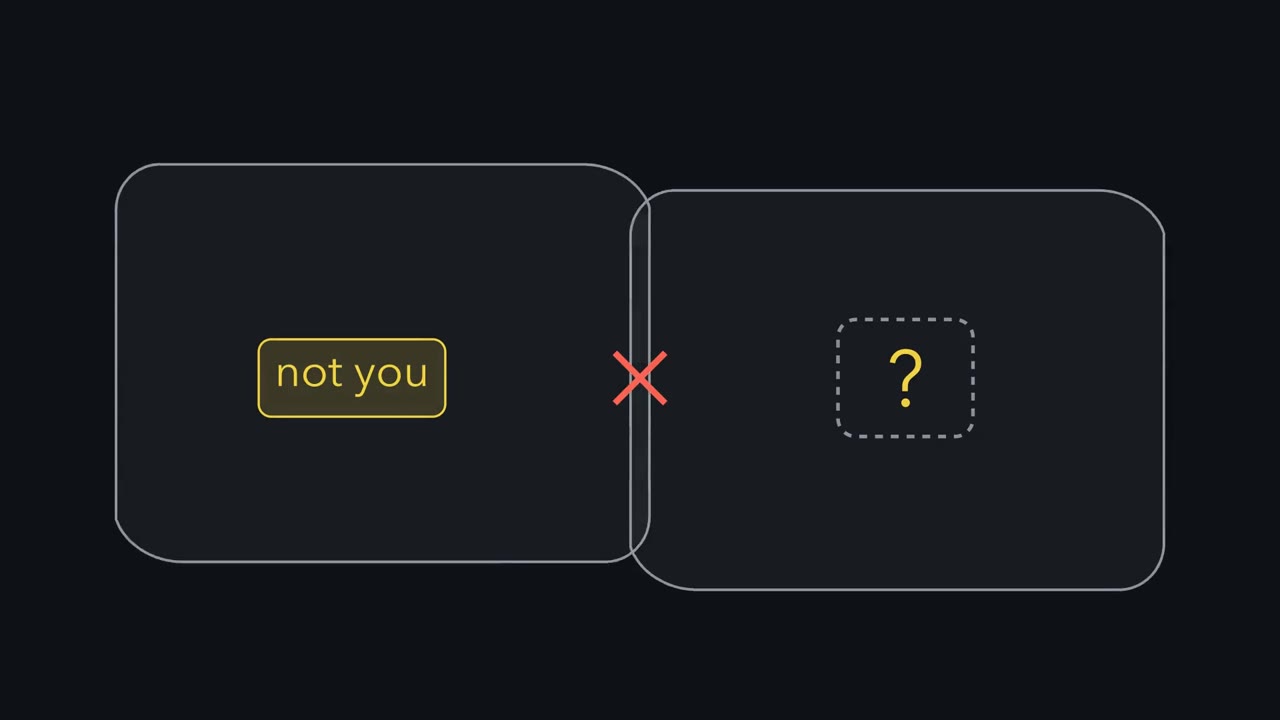 ▶ Watch The Receptor Is the Message · 2:45
Read the transcript of “The Receptor Is the Message”
Film transcript: The Receptor Is the Message
Without Notch, a fly embryo builds too much nervous system and too little skin. Notch is what lets a cell be told, not you. But the message never leaves the cell that makes it. The ligand is a protein fixed in that cell's membrane, and the receptor is fixed in its neighbour's. The two usually meet where cells touch. Binding is not enough. Just outside the membrane, Notch is folded into a lock that hides the spot where it can be cut. In the standard account, the receptor must be pulled. The sending cell draws its ligand back inside, and the tug passes to the receptor it holds. The pull peels the lock open. In mammalian cells, the first cut comes while the receptor is made, and it carries no signal. After the pull, an atom protease makes the second cut, just outside the membrane. The outer part leaves with the ligand, and a stub stays in the membrane.
Then gamma γ-secretase makes the third cut, inside the membrane. It accepts a membrane protein only after most of the outer part is gone, so the second cut comes first. That cut frees the inner part of the receptor, which is called NICD. It enters the nucleus, where CSL binds target genes only briefly until signal arrives. In the standard account, CSL keeps those genes off with co -repressors. NICD binds CSL, displaces the co -repressors, and recruits a co -activator called Mastermind. The genes turn on. In a kinase cascade, each active enzyme modifies many substrates, so the signal grows at every step. Notch has no second messenger and no kinase relay.
Between the membrane and the gene, nothing multiplies. One cut receptor gives one inner part. A cut cannot be undone, so each receptor signals once. What this design buys the cell is a count. The amount of inner part made follows, one for one, the number of receptors a neighbour has pulled and cut. A cell mostly hears Notch from the cells it touches. Keep this rule: one receptor, pulled and cut, gives one inner part and one message.
A fruit fly with one broken copy of a gene called Notch has nicks in the edges of its wings. An embryo with no working copy builds too much nervous system and too little skin.
The nicked wing, first described in 1914, gave the gene its name. The embryo tells more. In the part of the embryo’s outer layer that gives rise to the nervous system, each cell chooses between becoming a nerve precursor and becoming skin. Normally only some choose nerve. Without Notch, far too many do. So Notch is not what makes a nerve cell. It is what lets a cell be told “not you”.
The fly gene was sequenced in 1985 by the laboratory of Spyros Artavanis-Tsakonas, and soon after by that of Michael Young. It encodes a large protein that crosses the membrane once, with 36 repeats on its outer part that resemble epidermal growth factor. In the same issue of Cell, Iva Greenwald reported the same kind of repeat in lin-12, a worm gene whose mutants make one cell take the fate of its neighbour. A fly and a worm use one family of receptors to settle what two touching cells become. The sequence did not say how. The answer has two parts: contact, and cutting.
The idea: the signal is a touch and a pull
Most signals you have met leave the cell that makes them. Notch’s ligands do not. In flies they are Delta and Serrate; in mammals, the Delta-like and Jagged proteins. Each crosses the membrane of the sending cell and stays anchored there, while the receptor is anchored in the receiving cell. The two can meet only where two cell surfaces meet, so a cell hears Notch from cells it touches. That contact can be made through long, thin cell extensions, and worms have a few secreted ligands, but the main fly and mammalian ligands work only by contact. In one early test, cultured fly cells that do not normally stick together were made to produce either Notch or Delta, and the Notch cells clumped with the Delta cells.
Binding is not enough. In culture, a piece of ligand free in solution generally fails to switch Notch on, while the same piece fixed to a dish works. In the standard account the receptor has to be pulled. After binding, the sending cell draws its ligand back inside by endocytosis, the pinching-in of membrane to form a vesicle, and the tug passes to the receptor it holds.
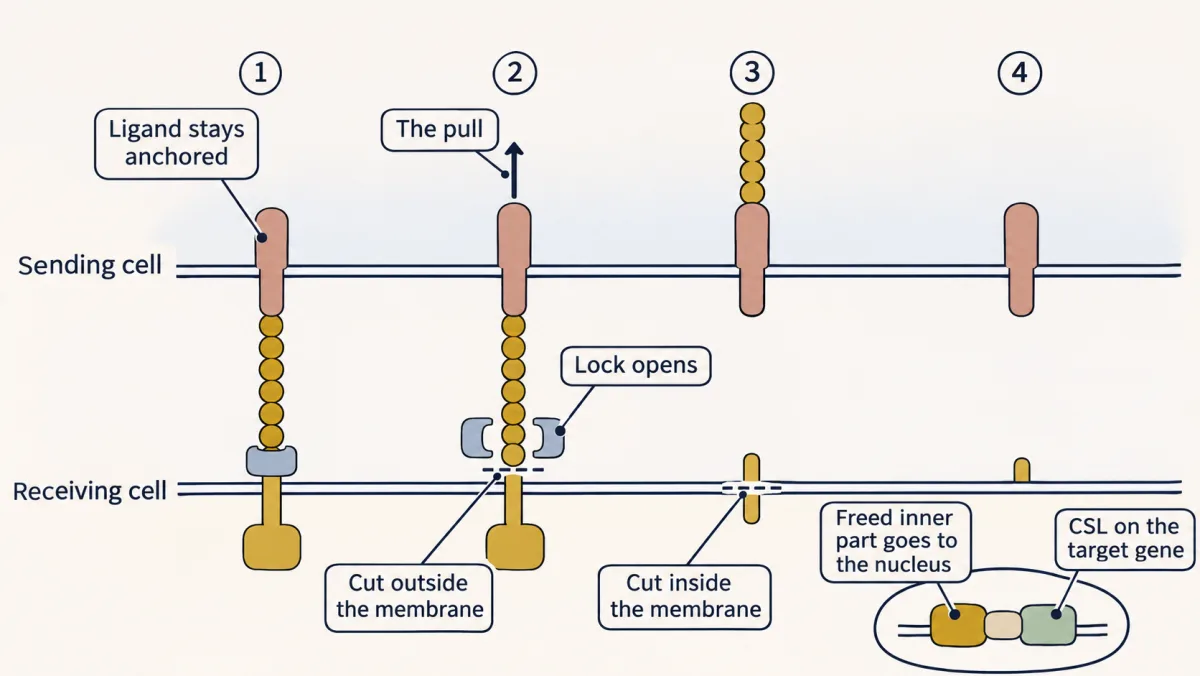
Just outside the membrane, Notch folds into a compact lock called the negative regulatory region. Three small modules wrap around the spot where the receptor can be cut and hide it from proteases. The pull peels the lock open. At this point the receptor has registered one fact: a neighbour is holding on and pulling.
Three cuts: how the receptor becomes the message
- While the receptor is made. In mammalian cells a furin-like protease in the Golgi cuts the new receptor once in its outer part. The two pieces stay clasped together and reach the surface that way. This cut prepares the receptor and carries no signal.
- After the pull. An ADAM protease (ADAM10 in mammals) cuts at the newly exposed site, just outside the membrane. The outer part leaves with the ligand, and a stub stays in the membrane.
- Inside the membrane. γ-Secretase, a complex of four proteins whose cutting subunit is presenilin, cuts the stub within its membrane-spanning segment. It accepts a membrane protein only after most of the outer part has been trimmed away, which is why the second cut must come first.
The third cut happens in a strange place. Cutting a peptide bond uses water, and the middle of a membrane is oily, so presenilin keeps its two catalytic aspartates in a pocket that water can reach.
That cut frees the inner part of the receptor, the Notch intracellular domain (NICD), which enters the nucleus. A DNA-binding protein called CSL binds at the target genes and, in the standard account, keeps them off with co-repressors. Live imaging in flies refines this: without signal, CSL binds DNA only briefly, and it stays far longer once NICD and Mastermind arrive. NICD binds CSL, displaces the co-repressors and recruits a co-activator called Mastermind. The genes turn on. Many encode repressors of the Hes family.
How was it shown that the cut-off inner part is the signal? In steps, each answering an objection to the one before.
In 1993 Gary Struhl, Kevin Fitzgerald and Iva Greenwald made flies and worms that produced only the inner part of Notch or LIN-12, with nothing left to bind a ligand. It changed cell fates as an activated receptor does, and in flies it was in the nucleus. Other fly laboratories reported active truncated Notch that year.
But a fragment made in excess can end up anywhere. In 1996 Raphael Kopan, Eric Schroeter, Harold Weintraub and Jeffrey Nye used a mouse Notch1 that lacked its outer part and was still anchored in the membrane. It was cut, its inner part went to the nucleus, and protease inhibitors stopped the cut.
In 1998 Struhl and A. Adachi tested the intact receptor in a living fly, where too little reaches the nucleus to see by staining. They placed a transcription activator inside Notch, so that a reporter gene turned on only if that part of the receptor reached the nucleus. It did, and only with ligand. Kopan’s laboratory reported ligand-induced release from mouse Notch1 the same year, and two other fly laboratories (Lecourtois and Schweisguth; Kidd, Lieber and Young) reported ligand-dependent processing of Notch.
In 1999 Struhl and Greenwald showed that flies without Presenilin cannot signal through Notch; other laboratories reported the same need in flies and in mouse cells at the same time.
What this design gives up, and what it buys
Set Notch beside a kinase cascade. There, each active enzyme modifies many substrates, so the signal grows at every step, and phosphatases can reset it. Notch has no second messenger and no kinase relay. Between the membrane and the gene nothing multiplies: one cut receptor gives one Notch intracellular domain (NICD). A cut cannot be undone, so each receptor signals once.
Set it beside the signal transducer and activator of transcription (STAT) and Smad routes from Unit 4. There too a protein travels from the membrane to the nucleus and acts on genes. But those receptors are kinases, or borrow one, and one active receptor can phosphorylate one STAT or Smad after another. In Notch the traveller is a piece of the receptor itself.
What the cell buys is a count. The amount of NICD made follows, one for one, the number of receptors a neighbour has pulled and cut. The signal itself does not diffuse; it reaches only cells in contact. It is also brief: a kinase in the nucleus marks NICD’s tail, an E3 ligase adds ubiquitin, and the proteasome destroys it (see the lesson on ubiquitin and proteolysis), so many direct target genes go quiet soon after the cutting stops.
The price is sensitivity to dose. With no amplification to cover a shortfall, half the normal amount of a component can show. That is a likely reason a fly with one working copy of Notch has nicked wings.
Two equal neighbours, two fates
Read the transcript of “Two Equal Cells, Two Fates”
Film transcript: Two Equal Cells, Two Fates
In the gonad of a worm larva, two cells lie side by side. They are named Z1.ppp and Z4.aaa. In every worm, one becomes the anchor cell. The other becomes a ventral uterine precursor. But which is which varies. Each cell takes the anchor fate in about half of animals. Kill Z1.ppp with a laser, and Z4.aaa becomes the anchor cell. Kill Z4.aaa instead, and Z1.ppp does. Whichever one you kill, the survivor always becomes the anchor cell. So the other fate needs a neighbour. Greenwald's thesis work, with Paul Sternberg and Robert Horvitz, tied the choice to a gene called lin-12. With no lin-12, both cells become anchor cells. With overactive lin-12, neither cell does.
Now take mosaic worms, in which only one of the two cells lacks lin-12. That cell always becomes the anchor cell. What circuit between two equal cells could produce that?
In the gonad of a worm larva two cells, Z1.ppp and Z4.aaa, lie side by side. In every normal hermaphrodite one becomes the anchor cell and the other a ventral uterine precursor, but which is which varies: each takes the anchor fate in about half of animals. Kill either one with a laser and the survivor always becomes the anchor cell, so the other fate needs a neighbour. Greenwald’s thesis work with Paul Sternberg and Robert Horvitz tied the choice to lin-12. With no LIN-12, both cells become anchor cells. With overactive LIN-12, neither does.
Design problem
Two neighbouring cells start out the same. One must become a nerve cell and the other a skin cell, and nothing outside tells them which. Design a circuit between the two cells that turns a small chance difference into opposite fates. Then predict what the tissue looks like if the receptor in your circuit is missing from every cell.
Saved in this browser only.
One way to do it
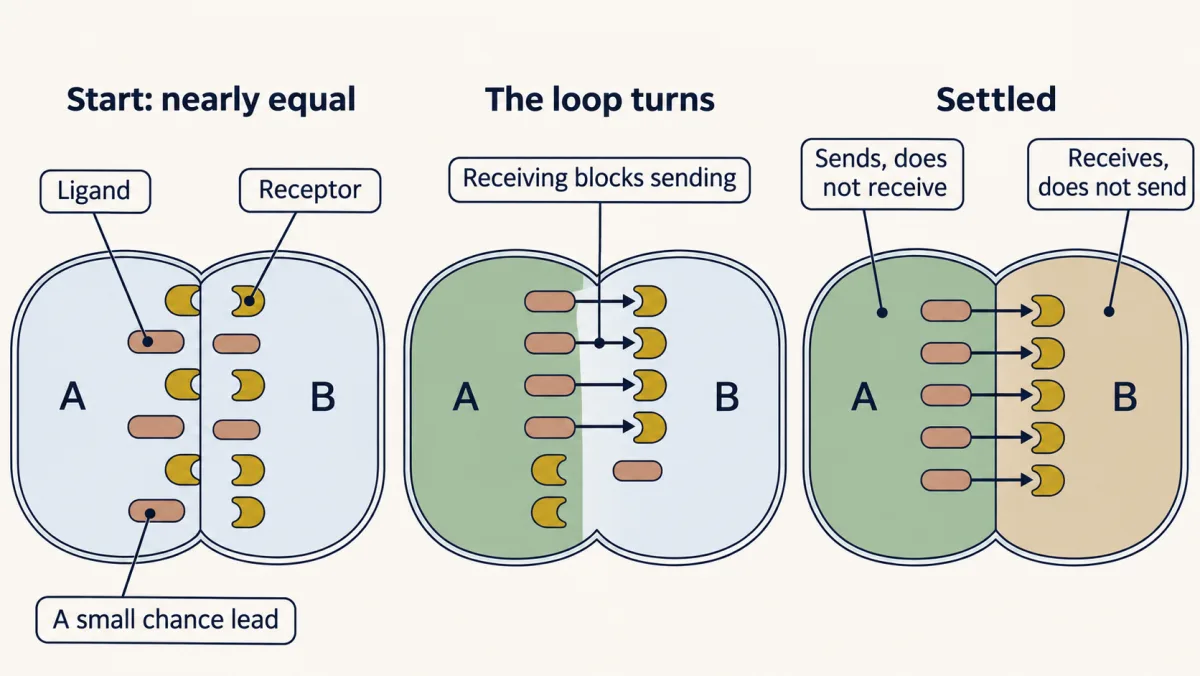
Give each cell a ligand on its surface and a receptor for that ligand. Add two rules. First, signal received through the receptor blocks the nerve program, so a cell that receives enough becomes skin. Second, the same received signal lowers the cell’s own production of ligand.
Now let chance give cell A slightly more ligand. Cell B receives more signal and makes less ligand. Cell A then receives less signal and makes more. Each turn of the loop widens the gap, until A sends without receiving (nerve) and B receives without sending (skin). Two inhibitions in a row make positive feedback, the switch-making loop from the lesson on signaling circuits, here stretched across two cells.
Without the receptor, no cell can be told “not you”. Every cell runs the nerve program, and the tissue has too many nerve cells and too little skin. That is the fly embryo at the top of this lesson. It is also the worm with no LIN-12, where both cells take the same fate.
Real cells are wired much like this, and the arrangement is called lateral inhibition. In the worm, both cells at first make LIN-12 and its ligand, LAG-2. Before the fates are fixed, the future uterine precursor keeps the receptor and loses the ligand, and the future anchor cell does the reverse. In mosaic worms in which only one of the two cells lacks LIN-12, that cell always becomes the anchor cell: the cell that cannot hear ends up as the sender. In the textbook model of the fly, received signal turns on Hes-type repressors, which shut off the genes that drive both the nerve fate and Delta production. Because the signal neither diffuses nor multiplies, each cell compares itself only with the cells it contacts, and the pattern comes out fine-grained: one nerve precursor among cells that become skin. On the fly’s back, cells also reach cells a few diameters away with thin, moving extensions, and live imaging shows that these contacts help set the spacing of bristles.
When Notch is stuck on, or missing
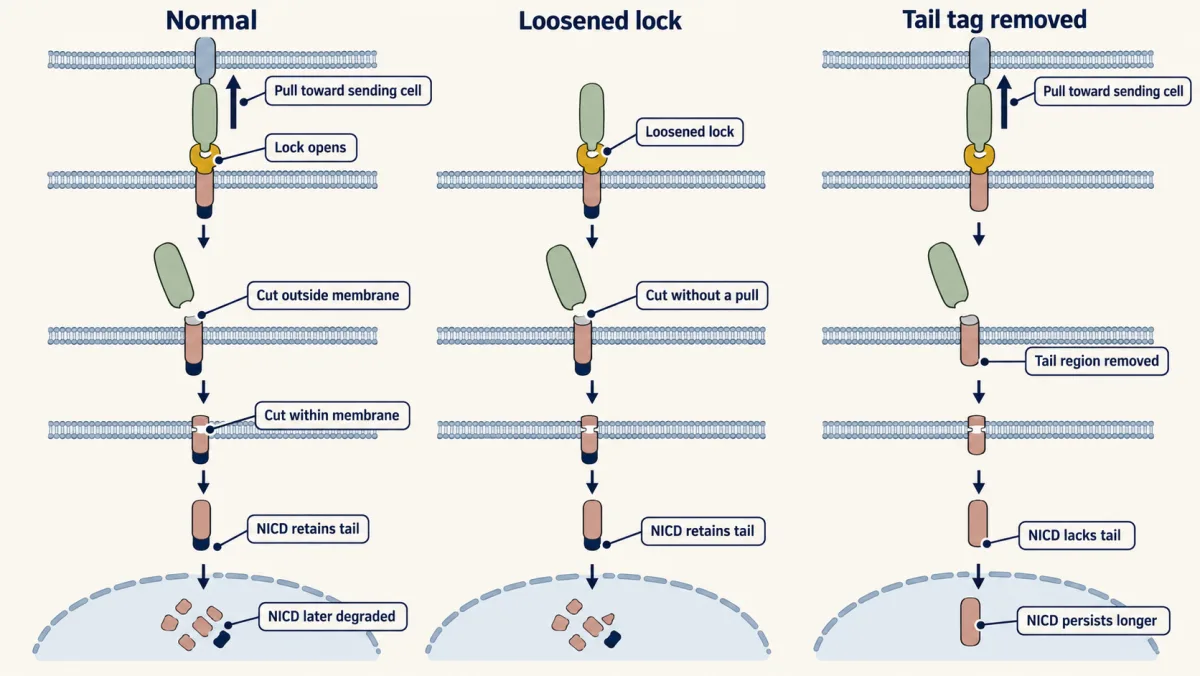
Stuck on. In 1991 the human gene NOTCH1 was found broken by a chromosome rearrangement in rare cases of T-cell acute lymphoblastic leukaemia, leaving a shortened receptor. In 2004 mutations in NOTCH1 were reported in more than half of cases. They cluster in two places. Some loosen the lock near the membrane, so the second cut happens without a pull. Others remove the part of the tail that marks Notch intracellular domain (NICD) for destruction, so each NICD lasts longer.
Missing. Alagille syndrome is a dominant genetic disease. In most cases one copy of JAG1, the gene for the ligand Jagged1, is broken. Most affected children have too few bile ducts in the liver, and many have a heart defect; severity varies widely. As in the fly’s wing, one good copy is not enough.
Shared scissors. γ-Secretase also cuts the amyloid precursor protein, and one product is the peptide that builds up in the brain in Alzheimer’s disease. A worm made the connection in 1995, when Diane Levitan and Greenwald found that sel-12, a gene that helps lin-12 signal, resembles a human gene whose mutations cause an inherited, early-onset form of the disease. Drugs that block γ-secretase were developed to lower the peptide, and they block the Notch cut as well. In rodents they turned dividing cells of the gut lining into mucus-secreting goblet cells, the change expected when Notch is lost there. A large trial of one such drug, semagacestat, was stopped in 2010 after patients taking it did worse than those on placebo.
Your notes
Select any text in the lesson to highlight it or add a note to it. Your highlights and notes are saved in this browser and collected in your notebook.
This browser is not letting the site save anything (a private window or strict privacy settings), so highlights and notes will be lost when you leave the page.
How we measure it
Laser ablation of single cells
A laser focused through a microscope kills one chosen cell in a living, transparent worm. What the remaining cells then do shows what they needed from the cell that is gone. Here it showed that the choice between anchor cell and uterine precursor depends on a neighbour.
Genetic mosaics
An animal is made in which some cells carry a working gene and others do not. Asking which cell must have the gene shows where the gene acts. For lin-12, the cell that lacks the receptor always takes the anchor cell fate, so the receptor acts in the cell that receives.
Truncated receptors
Parts of a receptor are deleted and what remains is produced in cells or animals. If a fragment acts like the activated receptor with no ligand present, that fragment carries the signal. The inner part of Notch passed this test in flies, worms and mouse cells.
Nuclear-access reporter
A transcription activator such as Gal4-VP16 is inserted into the receptor, and a reporter gene responds to it. The reporter turns on only if that part of the receptor reaches the nucleus, which detects amounts too small to see by antibody staining.
Method films · the methods library
- Cryo-electron microscopy 4:06
- Engineered mutants: site-directed, dominant-negative and constitutively active 4:25
- Forward genetic screens 4:07
- Gene cloning: vectors, libraries and screening 4:04
- Immunohistochemistry and immunofluorescence 4:06
- Optical trap (optical tweezers) 2:52
- Pharmacological blockade and inhibitors 4:10
- Reporter gene assays 2:42
- Targeted cell ablation 3:58
- X-ray crystallography 4:06
Practice questions on this lesson (3) → MCAT-style, original, each with an explanation
Where this lesson fits
Before thisReview first
- Ubiquitin and Regulated Proteolysis as SignalsThis course · Lesson 8
NICD is marked by a kinase and an E3 ligase and destroyed by the proteasome, which that lesson explains.
- Cytokine Receptors and JAK–STATThis course · Lesson 22
The lesson compares Notch with the STAT route, so you need to know how a receptor kinase sends STAT to the nucleus.
- TGF-β and SmadsThis course · Lesson 23
Notch is set against the Smad route, where one active receptor phosphorylates many Smads that carry the signal to genes.
After thisStudy next
- Hedgehog and the Primary CiliumThis course · Lesson 26
Another developmental signal that tells embryonic cells their fate, which lets you compare how it reads position without a cut receptor.
- The Shape of a Signal: Size, Duration, Frequency and PlaceThis course · Lesson 35
Notch's brief, one-for-one dose signal is an example of how duration and size shape what a cell reads.
- Reverse Signaling: When the Ligand Is Also a ReceptorThis course · Lesson 39
Notch ligands are membrane proteins on a neighbour, and that lesson asks which cell gets the message when ligand and receptor are both anchored.
Elsewhere on the siteFilms, simulations and method films in other courses
- Equal Cells, One WinnerFilm · Developmental Neuroscience
It shows how Notch picks one winner from equal cells, the lateral inhibition used here.
- Two Jobs, One DivisionFilm · Developmental Neuroscience
It shows Numb marking one daughter so Notch signaling differs between sisters.
Suggested by an AI model from the lessons themselves, then checked. How we use AI
Finish line
Test yourself
8 questions
Practice and MCAT-style, with explained answers.
Next · Lesson 26
Hedgehog and the Primary Cilium
How does one signal tell the cells of an embryo where they are, and why do a lamb-deforming plant and a skin cancer drug hit the same protein?
Continue →