Cell Signaling · Skim version
Hedgehog and the Primary Cilium
Read the full lesson → Skim the whole course →
The guiding idea
How does one signal tell the cells of an embryo where they are, and why do a lamb-deforming plant and a skin cancer drug hit the same protein?
Hedgehog is a secreted signal that tells the cells of an embryo where they are: each cell reads how much of it arrives, and for how long, and becomes a different cell type.
-
The pathway was found by breaking genes and reading the damage
-
The signal: a protein that carries two lipids and spreads in a gradient
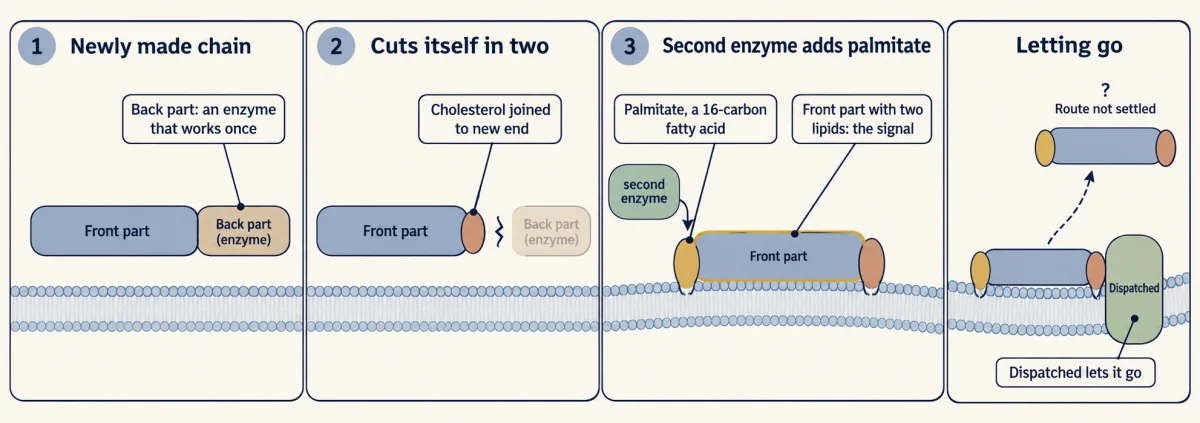
Hedgehog makes itself: the chain cuts itself in two, cholesterol joins the front part, a second enzyme adds palmitate, and the front part with a lipid at each end is the signal. Because the lipids hold it on a membrane, Dispatched is needed to let it go. AI-generated illustration -
The idea: Hedgehog works by switching off an off-switch
-
In vertebrates the pathway runs inside an antenna
-
Blocking Smoothened deforms an embryo and treats a tumour
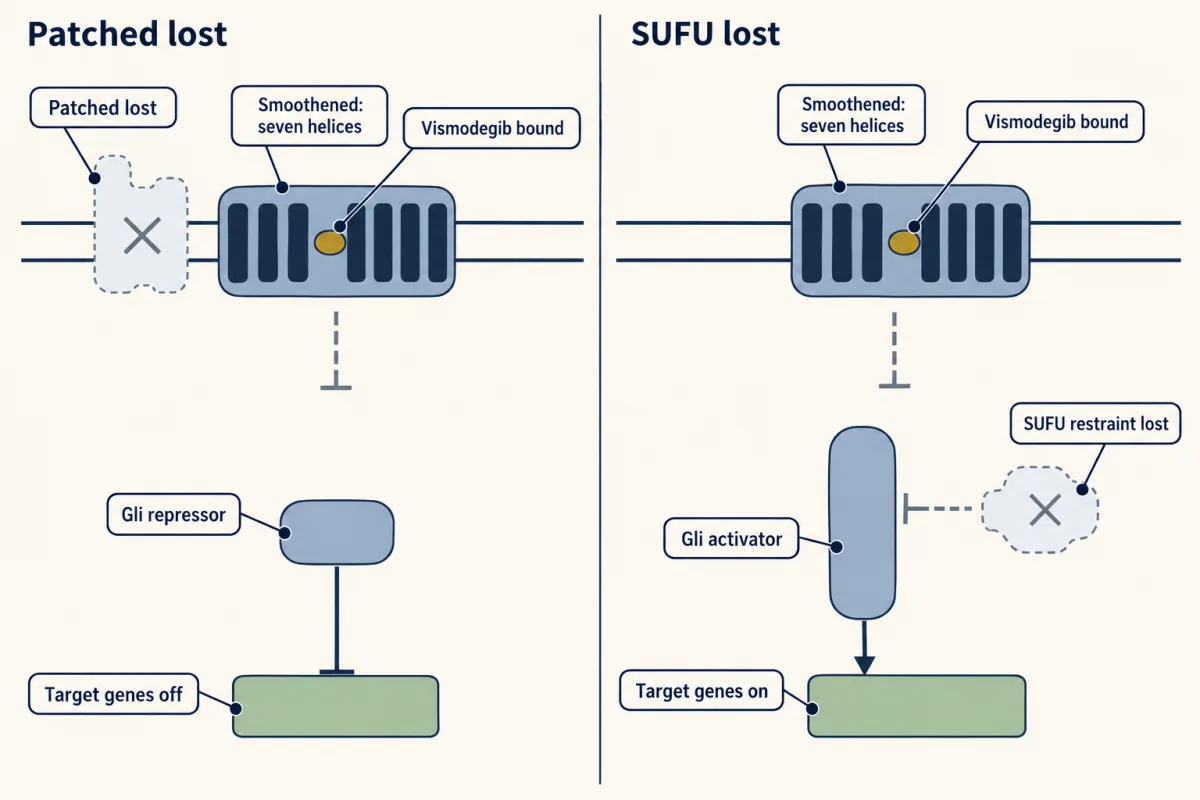
Vismodegib holds Smoothened off. That shuts the pathway off in a tumour that lost Patched, but a tumour that lost a brake further down the pathway stays on whatever Smoothened does. AI-generated illustration -
Going deeper
Where this lesson fits
Before thisReview first
- Lipids as Anchors and AddressesThis course · Lesson 11
This lesson relies on lipid anchors holding Hedgehog on membranes, as with Ras, and does not re-teach them.
- Phosphorylation: Kinases and PhosphatasesThis course · Lesson 6
You need kinases adding phosphates to a protein to follow how PKA, CK1 and GSK3 mark Gli for cutting.
- cAMP and Protein Kinase AThis course · Lesson 13
The resting PKA activity that keeps Gli cut into a repressor builds on how cAMP switches PKA on.
After thisStudy next
- Oncogenes: When the Switch SticksThis course · Lesson 41
A pathway stuck on, such as loss of Patched in basal cell carcinoma, is a case of an oncogenic switch.
- Drugs Against a PartThis course · Lesson 42
Vismodegib blocking Smoothened and tumours escaping it show how a drug targets one part of a pathway.
- The Shape of a Signal: Size, Duration, Frequency and PlaceThis course · Lesson 35
Cells reading both the amount and the duration of Hedgehog is an example of decoding signal shape.
Elsewhere on the siteFilms, simulations and method films in other courses
- The Tube Gains a Second FloorFilm · Developmental Neuroscience
It shows Sonic hedgehog from the notochord acting as a graded signal that sets cell types along the neural tube.
- Reading Sonic hedgehog: level and timeSimulation · Developmental Neuroscience
It lets you vary Sonic hedgehog level and time to see how both set what a cell becomes.
Suggested by an AI model from the lessons themselves, then checked. How we use AI