Ecology and Evolution · Skim version
Drift, Gene Flow and Competing Explanations
Read the full lesson → Skim the whole course →
The guiding idea
Sixteen flies bred each generation, yet the flies drifted as if there were only nine. Why?
Across replicate populations, drift spreads allele frequencies apart without pushing their average; gene flow and consistent selection push the average.
From the film: Mean and Spread
- Genetic drift is change in allele frequency from the chance sampling of parents; it needs no difference in fitness.
- Across replicate populations, drift spreads allele frequencies apart without pushing their average.
- Gene flow pulls replicates that start alike and receive the same immigrants toward the immigrants' frequency by the same amount.
- Consistent selection, favouring the same allele everywhere, pushes the average toward it, while drift still scatters each population.
- How fast the replicates spread depends on the effective population size, Ne, not simply the number of animals you count.
From the film: 107 Bottles
- Buri started 107 fruit-fly lines at an allele frequency of 0.5 and kept 16 parents in each, generation after generation.
- Over 19 generations the lines spread toward 0 and 1, and many ended with only one allele.
- The frequency pooled over all the lines showed no systematic change: spread without a push on the average, the pattern drift predicts.
- From how fast the lines spread, Buri estimated an effective size of about 9, below the 16 flies in each bottle.
- One line on its own wanders and tells you little about cause; replicates show whether the average was pushed.
-
Drift is sampling error
-
Buri’s 107 fly lines: drift as a distribution
-
Founders and frontiers: anoles on islands, bacteria on agar
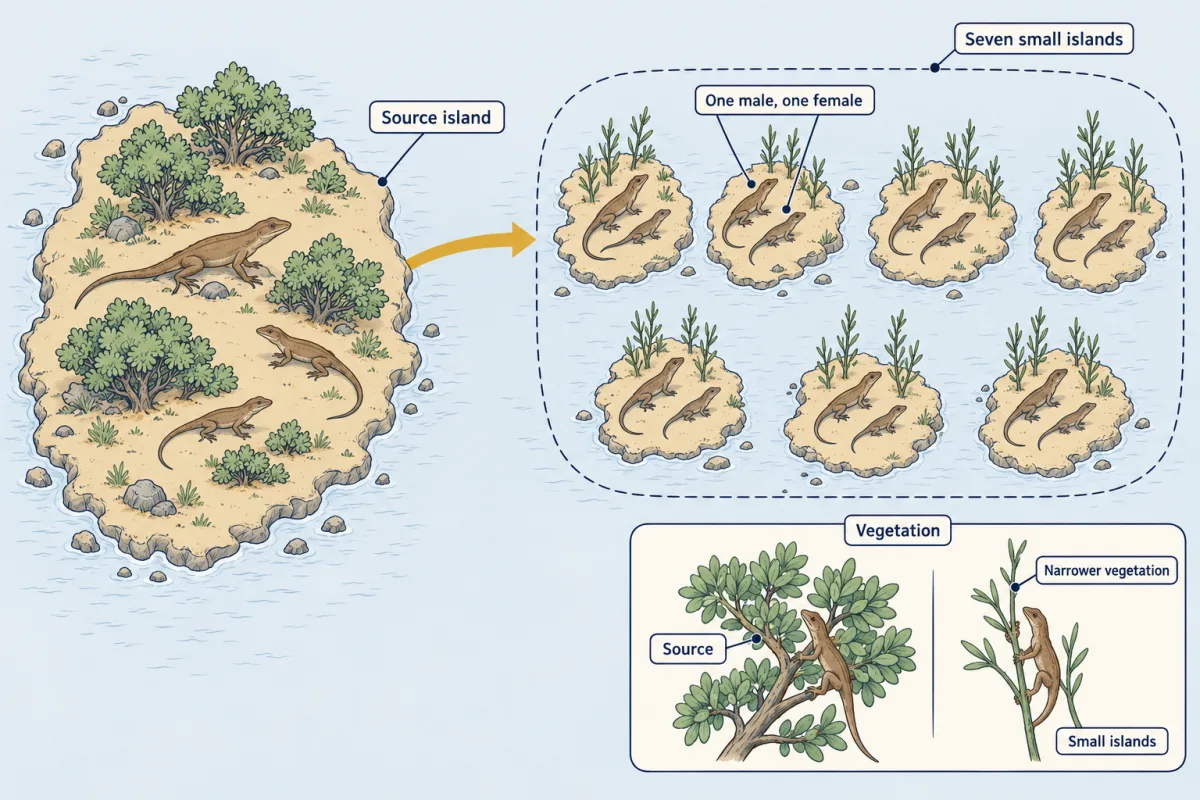
Seven small Bahamian islands with narrow vegetation, each founded by one random brown anole pair from a single source: founder effects show as islands that differ, selection as a shift they all share. Schematic, not to scale. AI-generated illustration 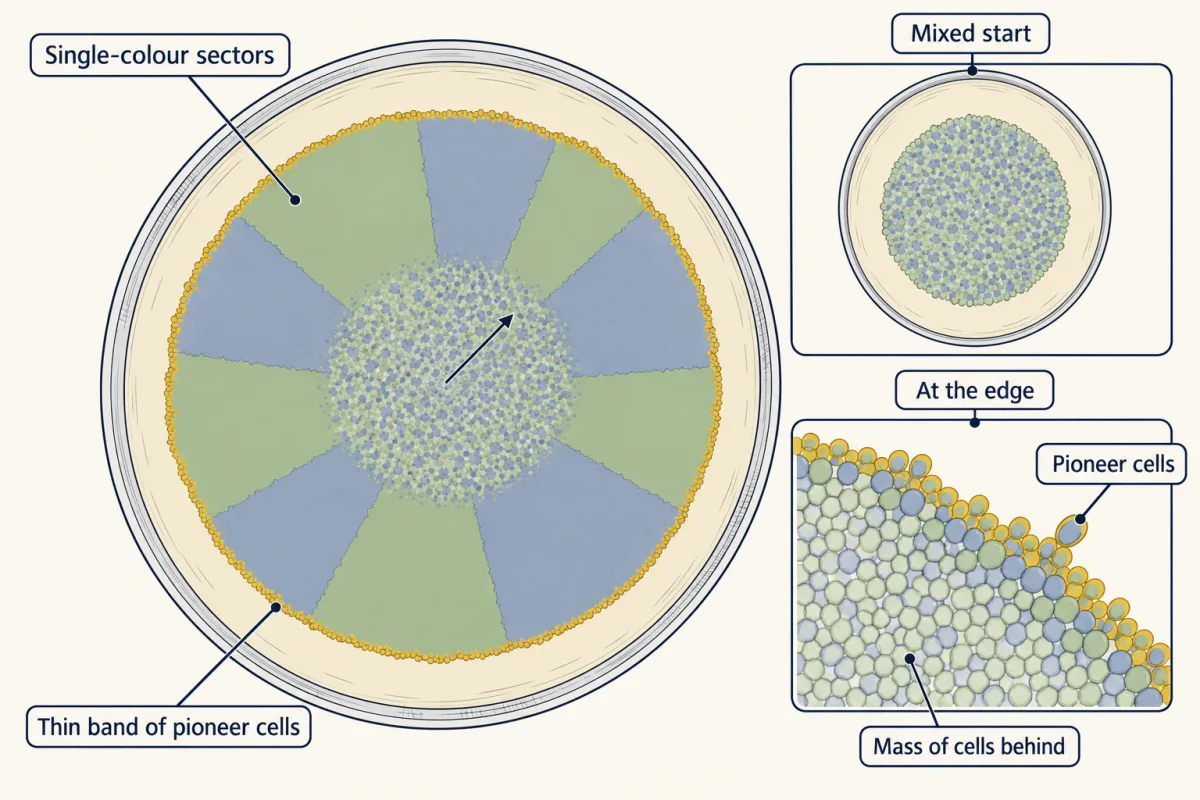
Only a thin band of pioneer cells at the edge founds each new stretch of colony, so chance in that band, not the mass of cells behind it, decides which colour is carried outward, even in an enormous population. Schematic. AI-generated illustration -
Gene flow: swamping or rescue
-
Three explanations for one pattern
-
Going deeper
Where this lesson fits
Before thisReview first
- How to Test an Evolutionary ExplanationThis course · Lesson 1
You need its logic of separating chance from selection with replicates and a null before applying it to drift and gene flow.
- Natural Selection in Ecological ContextThis course · Lesson 3
You need selection acting on allele frequencies from there to set against drift's prediction here.
After thisStudy next
- Speciation: How Barriers to Gene Flow EvolveThis course · Lesson 7
It uses gene flow and its reduction between populations to explain how barriers to exchange evolve.
- Conservation and RestorationThis course · Lesson 25
It applies effective size and genetic rescue to small populations, as with the Florida panther.
- Molecular EvolutionThis course · Lesson 5
It uses neutral drift as the null for how substitutions accumulate and tick like a clock.
Elsewhere on the siteFilms, simulations and method films in other courses
- Drift and selection: replicate populationsSimulation · Genetics and Molecular Biology
It lets you run replicate populations under drift and selection to see spread versus a push on the average.
- Why Dominance Does Not Spread an AlleleFilm · Genetics and Molecular Biology
It uses Hardy-Weinberg and evolutionary forces to explain why dominant alleles do not spread, and shows drift and selection at work.
- Before the Phage ArrivesFilm · Genetics and Molecular Biology
It shows that variation arises before selection, giving the raw material drift and selection act on.
Suggested by an AI model from the lessons themselves, then checked. How we use AI