Neuroscience · Unit 1: Neurons and their signals
The Action Potential and Conduction
Rewritten on : new text, figures, flashcards and film. Your notes and highlights stay, but the text around them may have moved.
At the peak of a squid axon's impulse the inside turns positive. What lets charge in faster than it leaks out?
Pause when the reading reaches a film, and offer to play it. Saved on this device.
Watch the film now, or keep listening
Builds on:The Resting Membrane and Passive SignalsNeurons and Glia at WorkWhy these?
 ▶ Watch The Spike and Its Puzzles · 2:20
Read the transcript of “The Spike and Its Puzzles”
Film transcript: The Spike and Its Puzzles
What does a nerve signal look like, and what makes it? Here is the membrane potential of a model squid giant axon, over a few milliseconds. The trace starts flat. This is rest, at about minus −65 mV. Now we nudge it. A small nudge dies away. So does another. A slightly bigger nudge crosses a line. For this stimulus, that line is threshold. Past it, the voltage keeps rising on its own. It shoots up in a fraction of a millisecond. This is the rising phase. It crosses zero and keeps going. At the peak the inside is positive, about plus +40 mV. Going past zero is the overshoot. Then the falling phase brings it back down, past rest. It dips below rest for several milliseconds.
That is the undershoot. Then it settles back. The whole event is an action potential, or spike. It lasts a few milliseconds. In 1939 Alan Hodgkin and Andrew Huxley recorded this from inside a squid giant axon. The overshoot was a surprise. The leading theory said the voltage should stop near zero. It did not.
A question to hold. If we push much harder, will the spike be bigger? No. It comes sooner, but it is essentially the same size. With brief pushes from rest, the height barely changes. This is all-or-none. Now two pushes close together. The first fires. The second fails. This is refractoriness. So we have puzzles. Why the overshoot? Why a threshold? Why all-or-none? Why refractoriness? And why does the spike travel along the axon without turning back? One rule, three gates and a little cable theory answer all five. A spike is all or none. It has a threshold. And it needs a rest before the next one.
From the film
- In the squid axon model, the voltage rises past zero to a peak of about +40 mV, then falls back below rest.
- A spike has a threshold, and with brief pushes from rest its size stays essentially the same however hard the push.
- Soon after one spike a second push can fail to fire another, which is refractoriness.
In 1939 Alan Hodgkin and Andrew Huxley pushed a fine electrode down the inside of a squid giant axon and found that, at the peak of the action potential, the inside became positive.
The leading theory held that an impulse was the membrane briefly losing its selectivity, so the voltage should have stopped near zero. It overshot. Something let positive charge in faster than it could leak out, then reversed. What that something is explains threshold, refractoriness and speed.
The spike and its puzzles
Start with the thing to be explained. An action potential is a brief, stereotyped swing in the membrane potential. It is also called a spike; this lesson uses both words for the same event.
Picture a recording from Hodgkin and Huxley’s model of the squid giant axon. Throughout the lesson, numbers marked “in the model” come from this standard Hodgkin-Huxley squid model at 6.3 °C. Membrane potential runs up the vertical axis, and time in milliseconds runs along the bottom. Read the trace from left to right.
- It starts flat at rest, about −65 mV. The resting membrane lesson explains why.
- A stimulus nudges the voltage up. Small nudges die away. A big enough nudge reaches threshold, the point past which the voltage keeps rising on its own.
- In the rising phase the voltage shoots up in a fraction of a millisecond, crosses zero and keeps going.
- At the peak the inside is positive, about +40 mV in the model. Going past zero is the overshoot.
- In the falling phase the voltage drops back down past rest. This return toward the resting level is called repolarization.
- In the undershoot it dips below rest for several milliseconds, then settles back.
In the model the whole spike lasts a few milliseconds.
The trace raises five puzzles, and each has a name.
- Overshoot. Why does the inside go positive instead of stopping at zero?
- Threshold. Why do small nudges fade while a slightly larger one sets off a full spike?
- All-or-none. Why is every spike from a resting membrane essentially the same size, whether a brief stimulus was just enough or far more than enough?
- Refractoriness. Why can’t the membrane fire a second spike right after the first?
- Travel. Why does the spike move along the axon at a set speed, away from where it started, without turning back? And why are some axons about a hundred times faster than others?
One rule, three gates and a little cable theory answer all five. The rule comes first, and it needs two terms. An ion’s equilibrium potential is the voltage at which that ion has no net push in or out. Its conductance says how open its path through the membrane is, which mostly means how many of its channels are open.
The one idea to carry through this lesson. Once a stimulus is over, with no current injected, the voltage at each moment moves toward a balance point: the average of the ions’ equilibrium potentials, weighted by their conductances. Every phase of the spike comes from this rule plus channels that open and close with voltage and time.
The tug of war: where the voltage goes
Read the transcript of “Tug of War: Why the Voltage Goes Where It Goes”
Film transcript: Tug of War: Why the Voltage Goes Where It Goes
At the peak of a spike, the inside of the axon turns positive. What could pull it there? Start with a voltage scale. At the left is potassium's equilibrium potential, minus −77 mV. At the right is sodium's, plus +50 An equilibrium potential is the voltage where an ion has no net push. A marker on the scale shows the membrane potential. Each ion's rope pulls it toward that ion's end. Each rope's pull is that ion's current. It depends on two things. First, conductance: how open the ion's path is. More open channels make a thicker rope. Second, the distance from the marker to the ion's own end. The farther the marker, the harder that rope pulls.
So current equals conductance times driving force, and the driving force is that distance. Try it at 0 mV, with equal conductances. Sodium's end is 50 mV away. Potassium's is 77 away. So potassium pulls harder. The marker slides until the pulls cancel. That spot is the balance point, where the voltage holds still. The balance point is an average of the equilibrium potentials. Each one is weighted by its conductance. The more open an ion's channels, the closer the point sits to its end. When a conductance changes, the balance point jumps at once. The voltage chases it, a moment behind. At rest, potassium has the largest conductance. So the balance point sits near potassium's end, at about minus −65 That is about 12 mV above potassium's end, mainly because of leak, a path that is always open.
In the squid model, leak conductance nearly matches resting potassium's, and leak's equilibrium potential is about minus −54 Now a question. Suppose sodium conductance rises far above potassium's. Where does the balance point go?
It slides toward plus +50 With enough sodium, it passes zero, and the voltage follows it positive. if potassium conductance rose above rest? The point would drop below rest, toward minus −77 That is the rule for this whole lesson. With no stimulus pushing on it, the voltage moves toward the balance point. In this squid model, a big, brief rise in sodium conductance makes the overshoot. potassium conductance staying above rest makes the undershoot. So the conductances change, fast and briefly. What makes them change? And why only for a moment? The voltage chases a balance point, set by the conductances. Change a conductance, and the point moves.
From the film
- Each ion's current is its conductance times its driving force, and the voltage moves toward a balance point.
- The balance point is the average of the ions' equilibrium potentials, each weighted by its conductance.
- In the squid model, a big, brief rise in sodium conductance makes the overshoot, and potassium conductance staying above rest makes the undershoot.
You met the rule for ionic current in the resting membrane and passive signals:
In words An ion's current equals how open its channels are, times how far the voltage sits from that ion's own balance point.
- Iion“I sub ion”
- the current carried by that ion. In this lesson outward current is positive and inward current is negative.µA/cm²
- gion“g sub ion”
- the ion's conductance: how open its path through the membrane is, mostly how many of its channels are openmS/cm²
- Vm“V m”
- the membrane potential, the voltage inside the cell relative to outsidemV
- Eion“E sub ion”
- the ion's equilibrium potential, where it has no net push in or out (from the Nernst equation). In the squid model ENa is +50 mV and EK is −77 mV.mV
Sanity check The part in brackets, Vm − Eion, is the driving force. If no channels are open (gion = 0) there is no current. If Vm sits exactly at Eion the driving force is zero, so there is no current either, however many channels are open.
Try one number
Take potassium in the squid model at a resting voltage of −65 mV, with a round conductance of 1 mS/cm² to keep the arithmetic easy.
Driving force: Vm − EK = −65 − (−77) = +12 mV.
Current: 1 mS/cm² × 12 mV = 12 µA/cm². It is positive, so it is outward: potassium leaves the cell, and that pulls the voltage down toward EK.
Units: a millisiemens times a millivolt is a microampere (mS × mV = µA). The 1952 papers flipped the signs of both voltage and current; the anecdote “Read the signs before the traces” gives the conversion.
Need a refresher? subscripts and Greek letters · units and prefixes
Predict. The membrane sits at 0 mV and sodium channels are open. Which way does sodium move, and what does that do to the voltage?
Check your prediction
The driving force is 0 − (+50) = −50 mV. The current is negative, so it is inward. Sodium flows in and makes the inside more positive, so sodium’s contribution pulls Vm up toward +50 mV. Whether Vm actually rises depends on the sum of all the currents, which is where the balance point comes in.
Notice what that current did: it pulled Vm toward ENa. The same holds for every ion: open channels pull the voltage toward that ion’s equilibrium potential.
Picture a voltage scale running from EK at −77 mV on the left to ENa at +50 mV on the right. A marker on the scale shows Vm. A rope for each ion pulls the marker toward that ion’s end. How hard a rope pulls is that ion’s current, g × (Vm − E): its conductance times the marker’s distance from the ion’s own end. So a rope pulls harder the more open its channels are and the farther the marker sits from its end.
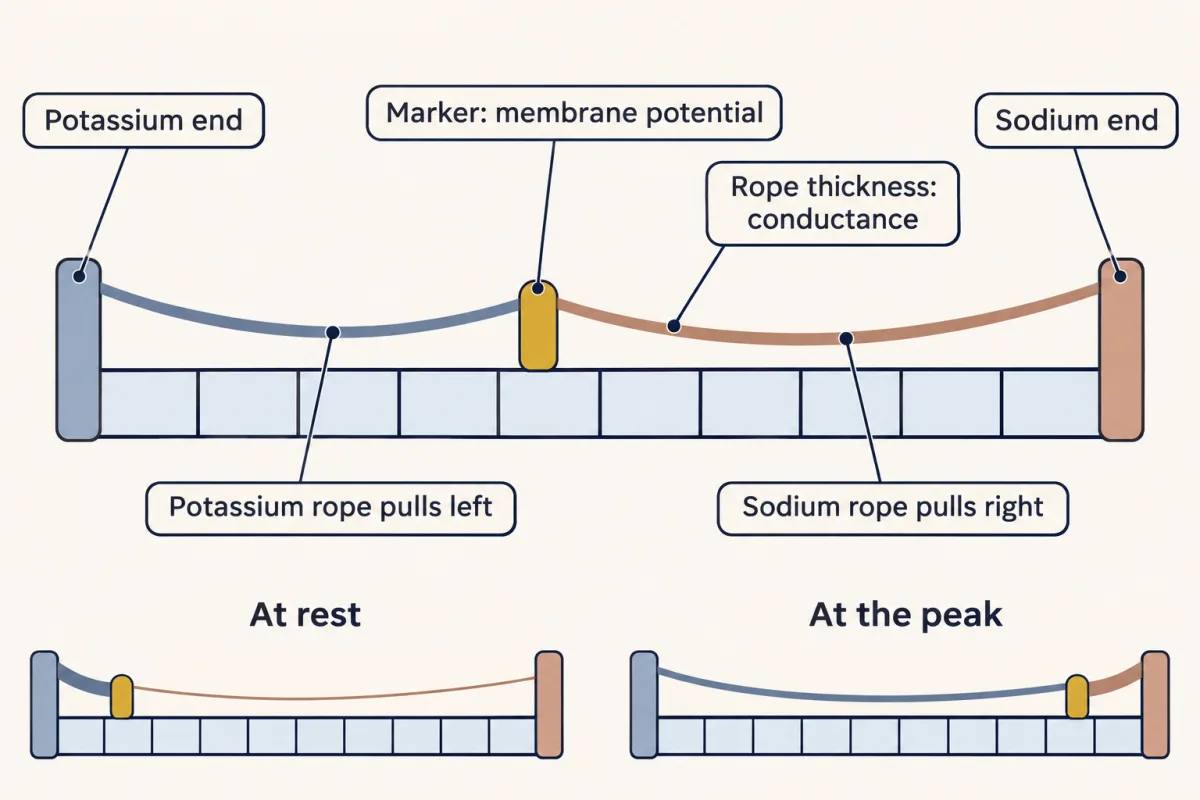
The marker settles where the pulls balance. Write I = g × (Vm − E) for each ion, set the sum to zero, and solve for Vm (open “Where it comes from” on the card for the three steps). It comes out as an average of the equilibrium potentials, each weighted by its conductance:
In words The balance point is the average of the ions' equilibrium potentials, each counted in proportion to its conductance.
- Vm“V m”
- the membrane potential at the balance point, where the net ionic current is zeromV
- gK“g sub K”
- potassium conductancemS/cm²
- EK“E sub K”
- potassium's equilibrium potential, −77 mV in the squid modelmV
- gNa“g sub Na”
- sodium conductancemS/cm²
- ENa“E sub Na”
- sodium's equilibrium potential, +50 mV in the squid modelmV
- gleak“g sub leak”
- leak conductance, always open (described just below)mS/cm²
- Eleak“E sub leak”
- leak's effective equilibrium potential, about −54 mV in the squid modelmV
Sanity check If one conductance is far larger than the others, the balance point sits near that ion's equilibrium potential. If sodium and potassium had equal conductances and leak were ignored, it would sit exactly halfway between EK and ENa. Scaling every conductance up or down together does not move it.
Try one number
Ignore leak, with gK = 10 and gNa = 1 mS/cm².
Top: 10 × (−77) = −770, and 1 × 50 = +50. Their sum is −720.
Bottom: 10 + 1 = 11.
Vm = −720 / 11 = −65.5, about −65 mV. It sits close to EK because potassium has ten times the conductance.
Where it comes from optional
Step 1, set the net current to zero: gK × (Vm − EK) + gNa × (Vm − ENa) + gleak × (Vm − Eleak) = 0.
Step 2, multiply out the brackets and move the E terms to the right: Vm × (gK + gNa + gleak) = gK × EK + gNa × ENa + gleak × Eleak.
Step 3, divide both sides by the total conductance, gK + gNa + gleak.
Need a refresher? subscripts and Greek letters · rates and “per”
Here leak is a conductance that is always open, with an effective equilibrium potential, Eleak, of about −54 mV in the squid model. The formula holds for a patch of membrane with no current injected and none flowing along the axon. It is a conductance-model formula, not the Goldman-Hodgkin-Katz permeability equation.
When the conductances change, the balance point moves, and Vm chases it. That is the rule: with no stimulus or other current injected, Vm moves toward the balance point, and when it gets there the currents cancel and the voltage holds still. Apply it to three cases.
- At rest, potassium has the largest conductance, so the balance point sits near EK. It sits about 12 mV above EK, at about −65 mV, mainly because of leak. In the squid model the leak conductance, 0.3 mS/cm², is nearly as large as the resting potassium conductance, about 0.37 mS/cm², and Eleak lies well above EK. A very few open sodium channels add a little more. At rest the leak current is inward: with the small sodium current, it balances the outward potassium current.
- If sodium conductance rose far enough, the balance point would slide toward ENa. For the balance point to pass 0 mV, sodium must outweigh potassium. Ignoring leak, the top of the average, gK × (−77) + gNa × 50, must turn positive, so 50 × gNa must beat 77 × gK. Divide both sides by 50: gNa must exceed 77 / 50, about 1.5 times gK. If sodium conductance stayed that high long enough, the inside would turn positive.
- If potassium conductance rose above its resting level, the balance point would move closer to EK at −77 mV, and Vm would drop below rest.
Now return to the opening puzzle. In this squid model, a large, brief rise in sodium conductance produces the overshoot, and potassium conductance staying above its resting level produces the undershoot. So the conductances change, fast and only for a moment. Two questions follow. What makes them change? And why only for a moment? To answer, Hodgkin and Huxley had to watch conductances change. That took a trick.
Holding the voltage still: the voltage clamp
Read the transcript of “Holding the Voltage Still”
Film transcript: Holding the Voltage Still
How do you watch a conductance change, when the voltage keeps running away? In a free axon there is a loop. Depolarization opens sodium channels, and their current depolarizes the membrane further. During a free spike, voltage and channel opening change together. To see how a conductance changes with time, hold the voltage still. Picture a leaky bathtub you must keep at one exact level, by adjusting the tap. If the drain opens wider, you run the tap faster. The tap's flow tells you how fast the drain leaks. If water pours in through a crack instead, the tap must run backwards, like a pump, and remove it. The voltage clamp works the same way. A feedback amplifier holds your chosen voltage and supplies whatever current that takes.
Why does that current equal the channel current? The membrane is a capacitor, and it takes current only while the voltage changes. Hold the voltage fixed, and the capacitor takes none. So the amplifier's current matches the channel current. When channel current flows out, the amplifier supplies charge. When it flows in, the amplifier withdraws it. Now step the voltage up and hold it. If the conductances stayed fixed, what would the current do?
It would jump to a new level and stay flat. Here is what Hodgkin and Huxley saw, with inward current drawn downward. First, a brief blip at the step. That is the membrane charging. It stops once the voltage is steady, so set it aside. Next, an early inward current. It grows fast, then dies away, though the voltage is still held. Last, a delayed outward current. It rises slowly and lasts as long as the step. Here is the key step. With the voltage fixed, the driving force is fixed. Only the conductance can change. So the conductance itself is opening and closing with time. Which ions carry these currents? Hodgkin and Huxley replaced most outside sodium with choline, which the membrane passes poorly.
If sodium carries the early current, what happens when most sodium is gone? It reversed. The early current turned outward. The delayed outward current was little affected. Why? Less sodium outside lowers sodium's equilibrium potential. In the cold squid axon, a tenfold drop moves it from plus +50 to about minus −5 mV. A step to zero now sits above sodium's equilibrium potential. So sodium flows out, and the early current reverses. Plot the early current against step voltage. It crosses zero near sodium's equilibrium potential. Low sodium moved the crossing more negative. That is just what a sodium current should do. So the early current was assigned to sodium.
The delayed current was assigned to potassium on other evidence, including tracer measurements of potassium leaving stimulated axons. Early inward current: sodium. Delayed outward current: potassium. Both change with time at a fixed voltage.
From the film
- A voltage clamp holds the voltage still, so the current it supplies matches the channel current and any change in current must come from conductance.
- In the squid axon, the clamp showed an early inward current and a delayed outward current, both changing with time at a fixed voltage.
- Sodium substitution and reversal potentials assigned the early current to sodium, and the delayed current was assigned to potassium on other evidence.
Measuring a free spike runs into a loop. Depolarization opens sodium channels. Their current depolarizes the membrane further, which opens more channels. During a free spike, voltage and channel opening change together, so their effects are hard to separate.
The voltage clamp breaks the loop. It pins the membrane at a voltage you choose and holds it there.
An analogy shows how it also measures current. Suppose you must keep the water in a leaky bathtub at exactly one level. You watch the level and open the tap just enough to hold it steady. If the drain opens wider, you must run the tap faster. If water starts pouring in through a crack instead, your tap must run backwards, like a pump, and remove it just as fast. Either way, the flow through your tap is a direct readout of how fast water is leaving or entering.
In the clamp, a feedback amplifier plays your part. It holds the membrane at a commanded voltage and supplies whatever current that takes. Why does that current equal the current crossing the membrane? The bilayer is a capacitor (see membrane structure and function). Current goes into charging it only while the voltage changes, as capacitive current, Cm × dV/dt. Here Cm is the membrane capacitance, and dV/dt (“d V by d t”) means how fast the voltage is changing, for example in mV per ms. At a fixed voltage dV/dt is zero, so no current goes into the capacitance, and the amplifier’s current must match the current through the channels. When the net ionic current is outward, the amplifier supplies charge to replace what leaves. When it is inward, as during the early sodium current, the amplifier withdraws the charge that enters.
Hodgkin, Huxley and Bernard Katz built a clamp for the squid giant axon and published their records in the Journal of Physiology in 1952.
What the record looks like
Predict. Step the voltage from rest to a depolarized level and hold it there. If every conductance stayed fixed, what would the current do after the step?
Check your prediction
It would jump to a new value and stay flat. With the voltage held, the driving force is constant, and with g fixed, I = g × (Vm − E) cannot change.
The real record does not stay flat. Picture the current trace drawn under the voltage step, with inward current plotted downward. It has three parts.
- A brief blip right at the step. This is capacitive current charging the membrane. It flows only while the voltage is changing, and it is gone once the voltage is steady. Set it aside: what remains is ionic current.
- An early inward current. It grows fast, then dies away, even though the voltage is still held.
- A delayed outward current. It rises slowly and lasts as long as the step does.
In the squid axon, depolarizing steps of about 15 to 110 mV gave this pattern.
The key inference. The voltage is fixed, so the driving force (Vm − E) is fixed. In I = g × (Vm − E), the only thing left that can change is g. So when a current grows and then shrinks at one steady voltage, the conductance itself is opening and then closing. The conductances change with voltage and with time. Measuring how they change is what Hodgkin and Huxley set out to do.
Which ions carry the two currents?
A current trace does not say which ion carries it. Hodgkin and Huxley used two tests.
The first is the reversal potential, the voltage at which a current changes sign. For a current carried by one ion, it sits at that ion’s equilibrium potential. Picture a graph of peak early current against the voltage of the step. In normal sea water the early current is inward for modest steps. It shrinks as the step nears +50 mV and turns outward above it. The line crosses zero near ENa.
The second test is ion substitution. They replaced most of the sodium in the sea water with choline, a cation the membrane passes poorly.
Predict. If the early current is carried by sodium, which way should its zero crossing move when external sodium falls? If it were carried by potassium, would the crossing move at all?
Check your prediction
Less sodium outside lowers ENa, so a sodium current’s crossing should slide to more negative voltages. A potassium current would not care about sodium, so its crossing would stay put.
In the experiment the early current reversed, while the delayed outward current was little affected. The reversal potential of the early current moved with external sodium, as expected for a current carried by sodium. So the early current was assigned to Na+.
Sodium independence alone could not name the carrier of the delayed current. It was assigned to K+ on other evidence, including tracer measurements of potassium leaving stimulated axons.
Worked problem. Take a model squid axon under an ideal clamp, outward current positive, ENa = +50 mV and EK = −77 mV (the Hodgkin-Huxley model constants once rest is placed at −65 mV). The conductances are illustrative round numbers, not readings from a published figure. Step from −65 mV to 0 mV.
Step 1: the early current. Suppose gNa peaks at 20 mS/cm². The driving force is 0 − 50 = −50 mV, so
INa = 20 mS/cm² × (−50 mV) = −1000 µA/cm², inward
Step 2: the late current. Suppose that at 5 ms gK is 15 mS/cm². The driving force is 0 − (−77) = +77 mV, so
IK = 15 mS/cm² × 77 mV = +1155 µA/cm², outward
Step 3: the choline prediction in numbers. Cut external Na+ to 10% with choline, at 6.3 °C: a tenfold fall. Less sodium outside means less push inward, so ENa falls. By how much? The Nernst equation makes E depend on the log of the concentration ratio, so every tenfold change moves E by the same step (log scales). That step is about 58 mV near 20 °C and about 55 mV in the cold squid preparation, so ENa drops from +50 mV to about 50 − 55 = −5 mV. Assume, as a simplification, that gNa is unchanged. Then
INa ≈ 20 mS/cm² × (0 − (−5) mV) ≈ +100 µA/cm²
The early current is now outward, because 0 mV lies above the new ENa. Treat the size as rough. The sign is the point.
Step 4: what the amplifier does. On the plateau dV/dt = 0, so the amplifier’s current matches the net ionic current: it withdraws charge while the inward sodium current of Step 1 dominates, and supplies charge once the outward potassium current of Step 2 dominates.
How three gates make one spike
Read the transcript of “Three Gates, One Spike”
Film transcript: Three Gates, One Spike
Sodium conductance turns on fast, then shuts itself off. Potassium turns on slowly and stays on. What channel does that? It takes three processes: fast sodium activation, slower sodium inactivation, and slow potassium activation. Picture them as gates. A sodium channel has two gates in a row, like two doors in one hallway. The fast gate, for activation, is shut at rest and snaps open on depolarization. The slow gate, for inactivation, is open at rest and shuts several times more slowly. Sodium passes only while both are open: a brief window before the slow gate shuts. The squid's delayed potassium channel behaves as if it has one slow gate.
This is a cartoon. The 1952 equations track the three processes with variables called m, h and n. Their powers were fitted to the data, not counted from gates. Now let the axon run free. A ghost marker shows the balance point. Moment one, the rise. Activation gates open, sodium flows in, and the inside gets more positive. That opens more gates. This is positive feedback. Sodium conductance soon dwarfs potassium's. The balance point leaps toward plus +50 and the voltage races after it. Even during the rise, the slow processes begin. Inactivation is already developing, and potassium gates start to open. Here is a question. Why does the spike stop short of plus +50 mV?
The voltage stops where it meets the balance point. There, inward sodium current equals outward potassium and leak current. Sodium still has about 12 times potassium's conductance. But its pull is weak, because the voltage is near its end. Potassium and leak keep the balance point below plus +50 During the rise, inactivation lowers sodium conductance, and potassium conductance climbs. In the model, the risen potassium conductance matters most. The peak is about plus +40 Moment three, the fall. Sodium conductance collapses as inactivation closes channels, while potassium conductance keeps rising. The balance point drops below the voltage, so the voltage falls.
At first, sodium may still have the larger conductance. Soon potassium becomes the largest, and the balance point sinks toward potassium's end. This is negative feedback. The same depolarization that started the spike also ends it, a little later. Moment four, the undershoot. Potassium conductance stays above rest, because its gates close slowly. The balance point and voltage dip toward minus −77 Fast sodium activation makes the rise. Slower inactivation and potassium activation end it.
From the film
- Three processes shape the spike: fast sodium activation, slower sodium inactivation and slow potassium activation.
- The rise is positive feedback from sodium activation, and the fall comes as sodium inactivation and rising potassium conductance take over.
- The gates are a cartoon of these processes, and the fitted equations describe conductances without proving a mechanism.
The clamp records showed two behaviours. Sodium conductance switched on fast and then switched itself off, even though the voltage was held steady. Potassium conductance switched on slowly and stayed on for as long as the step lasted. That takes three processes: fast sodium activation, slower sodium inactivation and slow potassium activation. A cartoon of gates pictures them.
Picture each sodium channel as a pore with two gates in series, like two doors in one hallway.
- The activation gate is the fast gate. It is shut at rest and swings open within a fraction of a millisecond when the membrane depolarizes.
- The inactivation gate is the slow gate. It is open at rest. It swings shut when the membrane depolarizes, but several times more slowly. A channel with this gate shut is inactivated.
Sodium can pass only while both gates are open. So after a depolarization there is a brief window: the fast gate has opened and the slow gate has not yet shut.
The squid’s delayed potassium channel behaves as if it has one slow gate. It opens slowly when the membrane depolarizes and closes slowly when the voltage falls again.
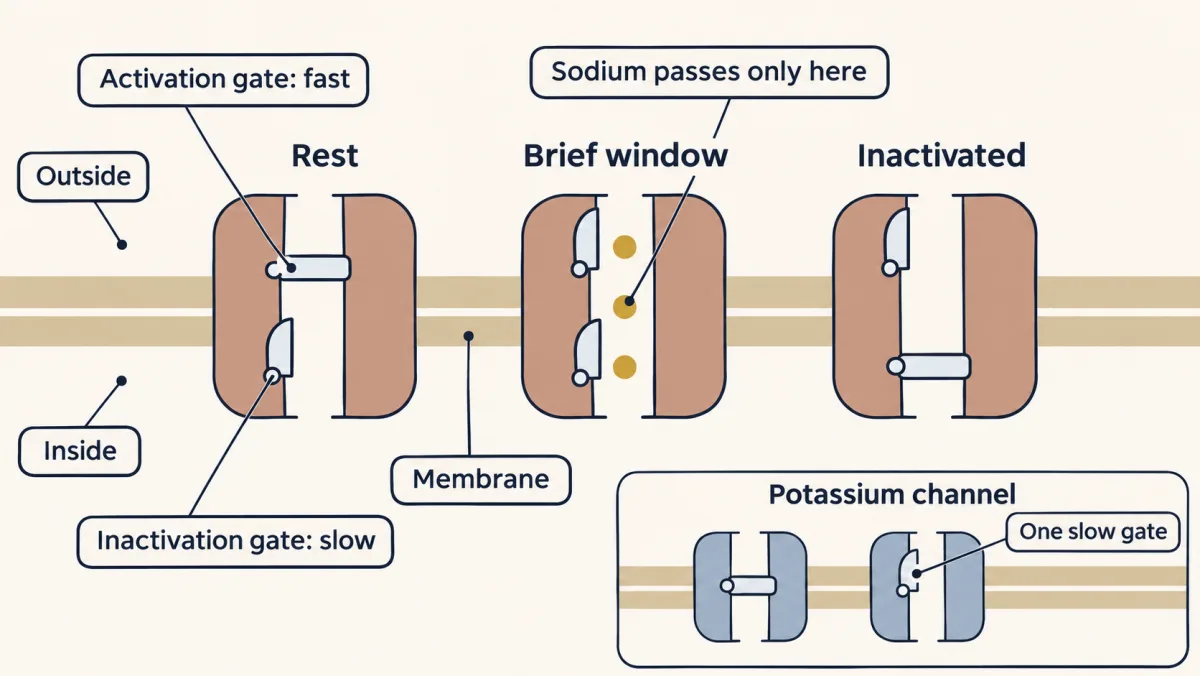
Hodgkin and Huxley’s equations track the three processes, not physical gates, with variables that run from 0 to 1. m tracks sodium activation, h the fraction of sodium channels not inactivated, and n potassium activation. Depolarization drives m up fast, h down more slowly, and n up slowly. Sodium conductance follows m³h and potassium conductance n⁴. The exponents were fitted to the S-shaped onset of the currents; they are not counts of gates or subunits.
Hodgkin and Huxley did not know what a channel looked like, and their equations describe conductances without proving how a gate works. Still, the gate picture predicts the right behaviour, and voltage sensors and inactivation machinery were later found in channel proteins; see ion channels as receptors.
Inactivation is not deactivation. Two different processes can close a sodium channel, and they leave it in different states.
- Deactivation is activation reversing as the voltage falls: the fast gate swings shut. If the channel has not inactivated, it is closed but ready to open again. If it has inactivated, deactivation alone does not make it available; it must also recover from inactivation.
- Inactivation means the slow gate is shut. The channel is closed and not ready until that gate reopens at negative voltage.
Repolarize early in a clamp step, before much inactivation, and the sodium current shuts off within a fraction of a millisecond as m falls, leaving the channels ready to reopen. Inactivated channels stay unavailable until h recovers, which paired pulses at varying intervals reveal.
Four moments of one spike
Now take the clamp away and let the axon run free. Remember the rule: Vm moves toward the balance point set by the conductances. It chases that point with a slight lag, because changing the voltage means moving charge onto or off the membrane capacitance, and that takes current and time. A stimulus pushes Vm from rest past threshold. Follow four moments.
-
Rising phase. Sodium activation gates open, sodium flows in, and the inside becomes more positive. That opens more activation gates, which lets in more sodium. This is positive feedback: each step makes the next one bigger, and it is why the rise is so steep. Within a fraction of a millisecond sodium conductance dwarfs potassium conductance, so the balance point leaps toward ENa at +50 mV and Vm races after it. Even during the rise, the slow processes have begun: inactivation is already developing, and potassium gates are starting to open.
-
Peak. Vm stops short of +50 mV, at about +40 mV in the model. It stops where it meets the balance point: there the inward sodium current equals the outward potassium and leak current, and the voltage holds still for an instant. Sodium still has much the larger conductance at the peak, about 12 times gK in the model. Two things hold the balance point below ENa. Potassium and leak conductances stay open, so the average is never pure sodium. And during the rise, inactivation lowers gNa while potassium activation raises gK, which pulls the balance point down toward the rising Vm. In the model, the risen potassium conductance does the most to keep the peak short of ENa. Sodium’s large conductance can be balanced at the peak because Vm is close to ENa, so each open sodium channel pushes only weakly, while potassium, far from EK, pushes hard. In rope terms: sodium’s rope is about 12 times thicker, but at +40 mV it is stretched only about 10 mV, while potassium’s is stretched about 117 mV.
-
Falling phase. Inactivation now closes more and more sodium channels, so sodium conductance collapses, while potassium conductance keeps rising. The balance point drops below Vm, so Vm starts to fall. At first sodium may still have the larger conductance, but, as at the peak, its pull is weak and potassium’s is strong. Soon potassium becomes the largest conductance, and the balance point sinks toward EK. This is negative feedback: the same depolarization that started the spike also ends it, a little later.
-
Undershoot. As Vm falls, the potassium gates begin to close, but slowly. For several milliseconds potassium conductance stays higher than at rest, while sodium conductance is close to zero. With potassium dominating even more than usual, the balance point sits below rest, near EK at −77 mV, and Vm dips toward it. As the extra potassium gates close, Vm settles back to rest.
| Moment | Sodium activation gate | Sodium inactivation gate | Potassium gate | Largest conductance | Vm and the balance point |
|---|---|---|---|---|---|
| Rest | almost all shut | more than half open | a few open | potassium, with leak close behind | Vm sits at it: about 12 mV above EK |
| Rising phase | opening fast | inactivation already developing | starting to open | sodium | point leaps toward ENa; Vm chases it |
| Peak | mostly open | partly inactivated | partly open | sodium (falling) | meets the balance point: inward current = outward current |
| Falling phase | open, then closing | mostly shut | open | sodium early, then potassium | point below Vm, sinking toward EK |
| Undershoot | shut | shut, slowly reopening | open, slowly closing | potassium, more than at rest | point below rest, near EK |
So the spike is a race between one fast process, sodium activation, and two slow ones, sodium inactivation and potassium activation. The fast process wins first, which gives the rise. The slow processes catch up, which gives the fall.
Notice what is missing: the Na+/K+ pump. The model has no pump, yet it repolarizes. In a large axon like the squid’s, one spike moves so few ions that the concentrations barely change. The pump restores the gradients over many spikes.
The squid axon is one design among many: some axons repolarize with almost no potassium current (see Going deeper).
The equations passed tests they were not fitted to. They reproduced the squid action potential’s shape and refractoriness with fair accuracy. For one fibre at 18.5 °C they predicted conduction at 18.8 m/s against 21.2 m/s measured. That speed belongs to an axon about half a millimetre across.
Threshold, all-or-none and refractoriness
Read the transcript of “Threshold and Refractoriness”
Film transcript: Threshold and Refractoriness
Why does a small nudge fade, while a slightly bigger one fires a full spike? Nudge the membrane 5 mV, to minus −60 A few sodium channels open, and a little sodium flows in. Potassium current flows out. Leak is still inward here, below its equilibrium potential. Together they give more outward current. Net current is outward, so the voltage drifts back. Nothing happens. Now nudge it 12 mV, to minus −53 More sodium channels open, and inward current beats outward. The voltage rises, which opens still more sodium channels. Inward current grows faster than potassium and leak can oppose it. That is threshold. Past it, sodium feedback sustains itself, and the rise runs away.
Inward current at one instant is not enough. What matters is whether sodium keeps outgrowing the opposing currents. So threshold is not a fixed voltage. A slow depolarization inactivates sodium channels and opens potassium channels, raising it.
Once the rise sustains itself, the spike runs its course. Its size is set by the channels and the equilibrium potentials. With brief pushes from rest, a bigger push brings the spike sooner. Its size stays essentially the same. That is all-or-none. Right after a spike, most inactivation gates are shut. No stimulus, however strong, fires a second spike. That is the absolute refractory period.
As those gates reopen, a stronger stimulus can fire a spike, often a smaller one. That is the relative refractory period. A stronger push is needed then, because some sodium channels are still inactivated and potassium conductance is still raised. At long intervals, the second spike is full size again. One more question. Block the potassium channels with TEA. What happens to the falling phase?
From the same starting voltage, the rise is little changed. The fall is slower, relying on inactivation and leak, so the spike broadens. The undershoot is shallower too, because it comes from raised potassium conductance. Threshold is sodium feedback that sustains itself. Inactivation makes refractoriness. Blocking potassium broadens the spike.
From the film
- Threshold is where sodium feedback sustains itself because inward current grows faster than potassium and leak current can oppose it, and it is not a fixed voltage.
- Inactivation makes refractoriness: no stimulus fires a spike in the absolute period, and a stronger one is needed in the relative period.
- Blocking potassium channels with TEA broadens the spike and makes the undershoot shallower.
Threshold: sodium feedback that sustains itself
Threshold is the voltage past which the extra sodium current from newly opened sodium channels grows faster than potassium and leak current can oppose it, so depolarization becomes self-sustaining. The test is whether the inward excess keeps growing. A tally makes this concrete; the numbers are illustrative, made up for teaching, in arbitrary units.
- Nudge the membrane 5 mV, from −65 to −60 mV. A few sodium channels open: say 2 units of inward current. Potassium current is outward. Leak current is still inward at −60 mV, because that is below Eleak. Say potassium’s outward current outweighs leak’s small inward current, so together they give 3 units outward. Outward wins, so there is no inward excess to grow: the voltage drifts back and nothing happens.
- Nudge it 12 mV, to −53 mV. Now say 6 units in and 4 out. The voltage rises, and each millivolt opens more sodium channels, so the inward excess grows faster than potassium and leak can add outward current. The rise feeds itself and runs away.
- Threshold lies between the two, where the sodium feedback first sustains itself. A momentary excess of inward current is not enough on its own: if the opposing currents grow faster, the voltage still turns back.
All-or-none follows. Once depolarization is self-sustaining, the spike runs its course. Its size is set by the channels and the equilibrium potentials, not by the stimulus. With brief stimuli, a bigger push gets there sooner, and the spike is essentially the same size. This holds for a membrane that starts from rest. Just after a spike the rules change, as the next part shows.
Threshold moves. Threshold is not a fixed voltage. If a depolarization creeps up slowly, sodium channels inactivate along the way and potassium channels open, so threshold moves higher. In conductance-based models, threshold can depend on the recent history of stimulation through sodium inactivation (Platkiewicz and Brette, 2010). A figure such as −55 mV belongs to one cell under one protocol.
Refractoriness comes from inactivation
After a spike most sodium channels are inactivated. Their inactivation gates reopen only once the membrane is back at negative voltage, and that takes time.
Picture a paired-pulse experiment. Fire one spike. Then give a second stimulus after a chosen interval, and repeat with different intervals. Plot the height of the second spike against the interval.
- At the shortest intervals there is no second spike. Turning the stimulus up does not help. This is the absolute refractory period. No stimulus, however strong, triggers a second spike, because too few sodium channels are available to drive a runaway inward current.
- At intermediate intervals a stronger stimulus can fire a spike, often a smaller one. This is the relative refractory period. A spike needs a stronger stimulus than at rest, because some sodium channels are still inactivated and gK is still raised.
- At long intervals the second spike is full size again.
How long recovery takes depends on the cell and its temperature.
Watch it in the model
Before you touch the simulation, here is what to look for. The top panel is the computed membrane potential. The bottom panel shows the two conductances on the same time axis. Sodium conductance shoots up and falls back first. Potassium conductance rises later and more slowly, and it is still raised during the undershoot. Line up each moment of the trace with the conductances beneath it.
In this sketch: one isopotential patch of squid giant-axon membrane, no propagation, 1952 Hodgkin–Huxley equations at 6.3 °C (gNa,max 120, gK,max 36, leak 0.3 mS/cm², Cm 1 µF/cm², ENa +50 mV, EK −77 mV, rest −65 mV). The leak reversal is set in each run so that rest sits at −65 mV. A blocker is modelled as a smaller gmax. Outward current is positive (the 1952 papers used the opposite sign). There is no Na⁺/K⁺ pump. The 1 ms pulse shape, the 5 ms onset and the 30 µA/cm² range are this sketch’s own choices, not from the lesson.
- Vm (computed)
- gNa
- gK
- same stimulus, no blocker (shown when a blocker is set)
- Peak Vm (model)
- —
- Lowest Vm after the spike (model)
- —
- Smallest 1 ms pulse that fires from rest (model)
- —
- Smallest second pulse that fires at this interval (model)
- —
- Time above 0 mV (model) · no blocker, same stimulus
- —
Rule to keep: in this sketch one isopotential patch, no propagation, squid values at 6.3 °C. The equations describe conductances, not how a gate works: m, h and n are formal variables, not proteins.
Three things to try, one for each idea above.
- Threshold. Lower the stimulus until the spike fails, then raise it in small steps. Near threshold, a small change switches the response from almost nothing to a nearly full spike. A much larger stimulus gives a spike of about the same size, only sooner.
- Refractoriness. Turn on the second pulse and shorten the interval until the second spike fails. Then raise the stimulus. In the relative refractory period a stronger pulse brings the second spike back; in the absolute refractory period no increase will.
- Blockers. Reduce gNa (as with tetrodotoxin) or gK (as with TEA). Predict the result first; the drill near the end of the lesson has the answers.
Moving down the axon
Read the transcript of “Moving Down the Axon”
Film transcript: Moving Down the Axon
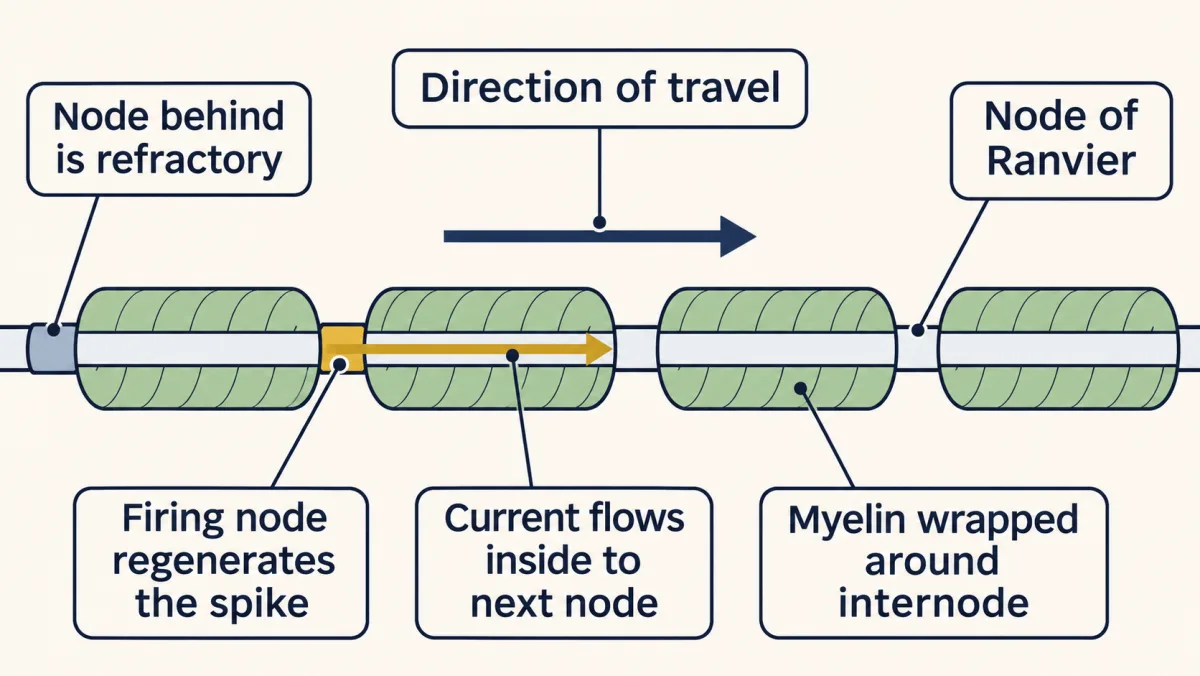
A spike fires at one spot. How does it reach the far end, and why doesn't it come back? Inward current at the active patch spreads along the core of the axon. It brings the next stretch of membrane to threshold. That stretch fires, and its current spreads on to the next. The spike moves along, patch by patch. Here is a question. Current spreads both ways from the active patch. So why doesn't the spike turn back?
The membrane just behind has just fired. Its sodium channels are inactivated. It is refractory, so it cannot be excited again. The axon itself has no preferred direction. Stimulate the middle, and spikes travel both ways. A spike travels away from wherever it started. Speed depends first on diameter. A wider axon has lower internal resistance, so current spreads farther before leaking away. Think of a wide pipe against a narrow, leaky one. Farther spread means a faster spike, which is why the squid giant axon is so wide. The other way to speed up is myelin, glial membrane wrapped around the axon. Picture a leaky garden hose wrapped in tape. Less current leaks out.
Myelin also lowers capacitance. Think of a narrow water tank: the same pour raises its level more. With less capacitance, the same charge raises the voltage more. The voltage climbs as the charge arrives. So current from one gap reaches the next fast and strong. The gaps are nodes of Ranvier, where sodium channels regenerate the spike. This is saltatory conduction, from the Latin for leap. Excitation skips the wrapped stretch. Current does not. It flows through the axon from node to node. Speeds vary widely. In mammalian nerve, unmyelinated C fibres conduct at about walking pace. The largest myelinated fibres are roughly a hundred times faster.
Now strip the myelin from one stretch. What happens to the spike? The bare stretch leaks current and has more membrane to charge. The next node is reached late, or not at all. Conduction slows or blocks. It does not always block. In some fibres the bare stretch develops sodium and potassium currents of its own. Then it conducts slowly and continuously. Back to the puzzles. Overshoot: sodium briefly pulls the balance point above zero. Threshold: sodium feedback sustains itself. All-or-none: brief pushes from rest give spikes of about the same size. Refractoriness: inactivated sodium channels need time to recover. Travel: current spreads ahead, and refractory membrane behind blocks the way back.
Spread ahead, refractory behind. Wider and myelinated means faster.
From the film
- The spike moves forward because the membrane behind it is refractory, but a stimulus in the middle of an axon sends spikes both ways.
- A wider axon conducts faster because current spreads farther before leaking away.
- Myelin raises membrane resistance and lowers capacitance, so excitation leaps from node to node in saltatory conduction.
- Stripping myelin from one stretch can slow or block conduction, though in some fibres it conducts slowly and continuously.
Spread ahead, refractory behind
A spike at one patch of axon does not stay there. Its inward current spreads along the axon’s core and brings the next stretch of membrane to threshold. That stretch fires, and its current spreads on to the next. How far the current reaches is set by the length constant, the distance over which a steady voltage change decays to about 37% of its starting size. The longer it is, the farther ahead the spreading current can bring membrane toward threshold, which matters for speed below.
Why doesn’t the spike turn back? The membrane just behind it has just fired, and its sodium channels are inactivated. That membrane is refractory, so it cannot be re-excited. The spike can only move into fresh membrane ahead. The axon itself has no preferred direction: a stimulus applied mid-axon sends spikes both ways. A spike travels away from wherever it started.
Diameter: a wider pipe
A wider axon has lower internal resistance, so current spreads farther along it before leaking away. Water behaves the same way: it carries farther down a wide pipe than down a narrow, leaky one. Current that spreads farther brings membrane farther ahead to threshold, so the spike moves faster. In unmyelinated axons velocity rises roughly with the square root of diameter. That is why the squid giant axon is so wide.
Myelin: a hose wrapped in tape
Myelin is glial membrane wrapped around the axon (myelination covers how it is made). Think of a leaky garden hose wrapped in tape.
- Myelin raises the resistance of each internode, the wrapped stretch between gaps, so less current leaks out.
- It also lowers the internode’s capacitance, so less charge is needed. Think of capacitance as the width of a water tank: pour in the same amount, and a narrow tank’s level rises more than a wide one’s. The voltage rises as charge arrives, and with less capacitance the same charge gives a bigger rise.
So current from one active gap reaches the next gap fast and still strong.
The gaps are the nodes of Ranvier. Sodium channels there regenerate the spike, so the nodes act as boost stations. This is saltatory conduction, from the Latin for “leap”. Huxley and Robert Stämpfli found evidence for it in single frog fibres in 1949. Excitation skips the internode, but current does not: it flows continuously through the axon from each firing node to the next, which fires in turn. Going deeper adds that the internode is not perfectly sealed.
In myelinated fibres velocity rises roughly in proportion to diameter. In mammalian peripheral nerves the range is wide, with exact values depending on species and temperature:
| Fibre | Conduction velocity |
|---|---|
| Unmyelinated C fibres | about 0.6 to 2 m/s |
| Largest myelinated fibres | about 70 to 120 m/s |
That is roughly a hundredfold range: walking pace against a fast train.
Demyelination
Demyelination strips the sheath from an internode. The bare axon has more membrane to charge and leaks more current. In rabbit nerve, loosening the myelin at the nodes also uncovers potassium channels in the paranodal axon, which the sheath normally covers (Chiu and Ritchie, 1980). So current reaches the next node late or too weak: conduction slows or blocks.
It does not always block. Acutely demyelinated rabbit internodes developed sodium and potassium currents of their own (Chiu and Schwarz, 1987). Hugh Bostock and Tom Sears (1978) produced segmental demyelination in rat ventral roots and recorded the current flowing along single fibres at many points. In some fibres the inward current moved smoothly along the bare internode, as along an unmyelinated axon, at 1.1 to 2.3 m/s: continuous conduction.
Multiple sclerosis damages central myelin and Guillain-Barré syndrome peripheral nerve; neurodegeneration covers disease, and synaptic transmission picks up the spike at the terminal.
Predict, then check: tetrodotoxin, TEA and demyelination
Use the balance point and the gates to predict each result before you open the answer. Then try the first two in the simulation above, where a dashed line shows the same stimulus with no blocker.
Tetrodotoxin (TTX), a toxin found in pufferfish, blocks the sodium current. Is there a spike? What happens to the resting potential?
Check your prediction
There is no spike. A stimulus still depolarizes the membrane a little, a graded response without a spike, but without sodium conductance nothing can pull the balance point up toward ENa, so there is no regenerative rise. The resting potential survives, because it is set mainly by potassium and leak. The model predicts this, and experiment agrees: tetrodotoxin blocked the action potential of lobster giant axons while sparing the resting potential (Narahashi, Moore and Scott, 1964).
TEA (tetraethylammonium) blocks the delayed potassium current. Predict the rise, the fall and the undershoot.
Check your prediction
From the same starting voltage, the rise is little changed, because the sodium current is intact. The fall is slower: with the potassium channels blocked, repolarization depends on sodium inactivation and leak alone, so the spike broadens. The undershoot is shallower, because it comes from raised potassium conductance. TEA can abolish the delayed potassium current of frog nodes (Hille, 1967).
Demyelination of one internode makes the spike beyond the lesion arrive late or not at all, or, in some fibres, conduct continuously and slowly across the bare stretch. The design problem puts numbers on it.
Design problem
A nerve holds many fibres, so stimulating it gives a compound action potential, the summed spikes of all the fibres excited, and its earliest part comes from the fastest fibres because their spikes arrive first. In an invented experiment, stimulate a nerve at two sites 10 cm apart and record the compound action potential at a fixed electrode. The latency difference is 2.0 ms. After a 1 cm demyelinating lesion between the sites it is 7.0 ms, and the response is half as large. Find the velocity before and within the lesion, interpret the smaller response, and design a test of continuous conduction against slowed saltation.
Saved in this browser only.
One way to do it
Put everything in metres and seconds first: 10 cm = 0.10 m and 2.0 ms = 0.0020 s. Before injury, velocity = 0.10 m / 0.0020 s = 50 m/s for the fastest fibres.
Assume the 9 cm of intact nerve is unchanged: it takes 0.09 m / 50 m/s = 1.8 ms. The lesion takes 7.0 − 1.8 = 5.2 ms, so its velocity is 0.01 m / 0.0052 s, about 1.9 m/s.
A halved response means fewer fibres arrive together. Some may block, while others conduct slowly; unequal slowing also spreads arrival times and lowers the peak.
To separate the two modes, record longitudinal action currents at closely spaced points along the lesion, as Bostock and Sears did. Continuous conduction shows inward current moving smoothly along the bare internode; slowed saltation shows it only at the old nodes, with long delays between. Then apply TTX to one bare internode only, keeping its flanking nodes in normal solution: continuous conduction that depends on sodium channels in the bare membrane should fail, while slowed saltation, which relies on the nodes, should survive.
This describes the experimental lesion in this nerve, not how far conduction recovers in multiple sclerosis.
Going deeper
Where the voltage clamp came from
Kenneth Cole, working with George Marmont, developed the method in the late 1940s. The squid clamp of Hodgkin, Huxley and Katz was their own version.
The exact shift in Step 3
A tenfold fall in external sodium shifts ENa by 2.303RT/F, which at 279.45 K (6.3 °C + 273.15) is 55.4 mV. (R is the gas constant, T the temperature in kelvin and F Faraday’s constant; 2.303 is ln 10, which converts the natural log to tenfold steps. See e and ln.) So ENa moves to 50 − 55.4 = −5.4 mV. With gNa assumed unchanged,
INa = 20 mS/cm² × (0 − (−5.4) mV) = +108 µA/cm²
The 1952 equations
Optional: you can skip this the first time. Hodgkin and Huxley drew the membrane as a capacitor in parallel with sodium, potassium and leak conductances, and wrote each conductance as a maximum times gating variables:
In words Sodium conductance equals its maximum, times the activation variable cubed, times the inactivation variable.
- gNa“g sub Na”
- the sodium conductance at this momentmS/cm²
- gNa,max“g sub Na max”
- the largest sodium conductance possible, with every channel open: 120 mS/cm² in the 1952 modelmS/cm²
- m3“m cubed”
- m tracks sodium activation and runs from 0 to 1; the cube was fitted to the S-shaped onset of the current
- h“h”
- the fraction of sodium channels not inactivated, from 0 to 1
Sanity check If h = 0 (every channel inactivated), gNa is zero however large m is. If m = h = 1, gNa reaches its maximum. Potassium follows the same pattern with one variable: gK = gK,max × n⁴.
Try one number
Take m = 0.5 and h = 1, round values to keep the arithmetic easy.
m3 = 0.5 × 0.5 × 0.5 = 0.125.
gNa = 120 × 0.125 × 1 = 15 mS/cm².
Half-way activation gives only an eighth of the maximum conductance, which is why the cube makes the onset slow at first and then steep.
Need a refresher? powers and roots
Each of m, h and n relaxes toward a voltage-dependent value with first-order kinetics: at a fixed voltage, each approaches its target along an exponential curve. The 1952 model used gNa,max = 120 mS/cm², gK,max = 36 mS/cm², leak 0.3 mS/cm² and Cm = 1 µF/cm², with rates for 6.3 °C scaled by 3 per 10 °C.
Why a fourth power? After a depolarizing step, current through the potassium channels already open changes at once, but the extra potassium conductance rises slowly, then faster. Raising n to the fourth power reproduces that S-shaped onset.
How fast sodium channels recover
In one squid axon at 4.5 °C, Hodgkin and Huxley found sodium-current recovery roughly exponential, with a time constant near 12 ms: one cold axon, not a general value.
Not every axon needs potassium channels to repolarize
In rabbit nodes recorded at 14 °C, potassium current is almost entirely absent and leak accounts for repolarization after the brief sodium current (Chiu, Ritchie and colleagues, 1979). The balance-point rule still holds: once sodium channels inactivate, leak is the largest conductance left, so the balance point falls back toward leak’s equilibrium potential and Vm follows.
How potent the blockers are
At frog nodes, TEA blocks the delayed potassium current with a dissociation constant near 0.4 mM (Hille, 1967), and tetrodotoxin blocks sodium current with an apparent dissociation constant of about 1 nM (Hille, 1968).
The internode is not sealed
In rat cortical axons, recordings, electron microscopy and cable models support a conductive pathway beneath the myelin (Cohen and colleagues, 2020).
Your notes
Select any text in the lesson to highlight it or add a note to it. Your highlights and notes are saved in this browser and collected in your notebook.
This browser is not letting the site save anything (a private window or strict privacy settings), so highlights and notes will be lost when you leave the page.
How we measure it
Voltage clamp
A feedback amplifier holds the membrane at a voltage you command and supplies whatever current that takes, which equals the current crossing the membrane. Fixing the voltage breaks the loop between voltage and channel opening, so you can measure how each conductance changes with time at one voltage.
Ion substitution and channel blockers
Replacing an ion in the bathing solution (sodium with choline, for example) or adding a blocker such as tetrodotoxin or tetraethylammonium changes one current while you repeat the same clamp steps. A component that reverses or disappears, while the others stay, is assigned to that ion or channel.
Two-site stimulation and longitudinal current recording
Stimulating a nerve at two points and dividing the distance between them by the difference in latency gives a conduction velocity. Recording the current that flows along a single fibre at many points shows where inward current appears, which separates conduction at nodes from continuous conduction.
Practice questions on this lesson (3) → MCAT-style, original, each with an explanation
Where this lesson fits
Before thisReview first
- The Resting Membrane and Passive SignalsThis course · Lesson 3
You need the I = g × (Vm − E) current rule and the resting potential from there to follow every phase of the spike.
- Neurons and Glia at WorkThis course · Lesson 2
It introduces the potassium and sodium equilibrium potentials and ion gradients that set the balance point used here.
After thisStudy next
- Synaptic Transmission and Quantal ReleaseThis course · Lesson 5
The spike arriving at the terminal is what triggers transmitter release, so this lesson's impulse is the starting point there.
- Motor Units, Reflexes and LocomotionThis course · Lesson 15
Conduction velocity and myelin from here explain why reflex and motor signals travel at the speeds they do.
- When Mature Neurons Fail: NeurodegenerationThis course · Lesson 26
Demyelination and failed conduction from here are the starting point for understanding how disease breaks neural signalling.
Elsewhere on the siteFilms, simulations and method films in other courses
- Adding up a reflexSimulation · Organismal Biology
It adds up a reflex arc's latencies, using conduction along the axon as one timed step.
- Every Response Has a Running TimeFilm · Organismal Biology
It shows the all-or-none signal along an axon as one step in a reflex route.
Suggested by an AI model from the lessons themselves, then checked. How we use AI
Finish line
Test yourself
8 questions
Practice and MCAT-style, with explained answers.
Next · Lesson 5
Synaptic Transmission and Quantal Release
A resting frog muscle fibre shows small voltage blips at its endplate with no nerve impulse at all. Those blips are the units of the evoked response at this junction.
Continue →