Neuroscience · Skim version
The Action Potential and Conduction
Read the full lesson → Skim the whole course →
The guiding idea
At the peak of a squid axon's impulse the inside turns positive. What lets charge in faster than it leaks out?
Left to itself, the membrane potential moves toward a balance point, the average of the ions' equilibrium potentials weighted by their conductances, and this rule, with voltage-gated channels, explains the spike.
From the film: The Spike and Its Puzzles
- In the squid axon model, the voltage rises past zero to a peak of about +40 mV, then falls back below rest.
- A spike has a threshold, and with brief pushes from rest its size stays essentially the same however hard the push.
- Soon after one spike a second push can fail to fire another, which is refractoriness.
From the film: Tug of War: Why the Voltage Goes Where It Goes
- Each ion's current is its conductance times its driving force, and the voltage moves toward a balance point.
- The balance point is the average of the ions' equilibrium potentials, each weighted by its conductance.
- In the squid model, a big, brief rise in sodium conductance makes the overshoot, and potassium conductance staying above rest makes the undershoot.
From the film: Holding the Voltage Still
- A voltage clamp holds the voltage still, so the current it supplies matches the channel current and any change in current must come from conductance.
- In the squid axon, the clamp showed an early inward current and a delayed outward current, both changing with time at a fixed voltage.
- Sodium substitution and reversal potentials assigned the early current to sodium, and the delayed current was assigned to potassium on other evidence.
From the film: Three Gates, One Spike
- Three processes shape the spike: fast sodium activation, slower sodium inactivation and slow potassium activation.
- The rise is positive feedback from sodium activation, and the fall comes as sodium inactivation and rising potassium conductance take over.
- The gates are a cartoon of these processes, and the fitted equations describe conductances without proving a mechanism.
From the film: Threshold and Refractoriness
- Threshold is where sodium feedback sustains itself because inward current grows faster than potassium and leak current can oppose it, and it is not a fixed voltage.
- Inactivation makes refractoriness: no stimulus fires a spike in the absolute period, and a stronger one is needed in the relative period.
- Blocking potassium channels with TEA broadens the spike and makes the undershoot shallower.
From the film: Moving Down the Axon
- The spike moves forward because the membrane behind it is refractory, but a stimulus in the middle of an axon sends spikes both ways.
- A wider axon conducts faster because current spreads farther before leaking away.
- Myelin raises membrane resistance and lowers capacitance, so excitation leaps from node to node in saltatory conduction.
- Stripping myelin from one stretch can slow or block conduction, though in some fibres it conducts slowly and continuously.
-
The spike and its puzzles
-
The tug of war: where the voltage goes
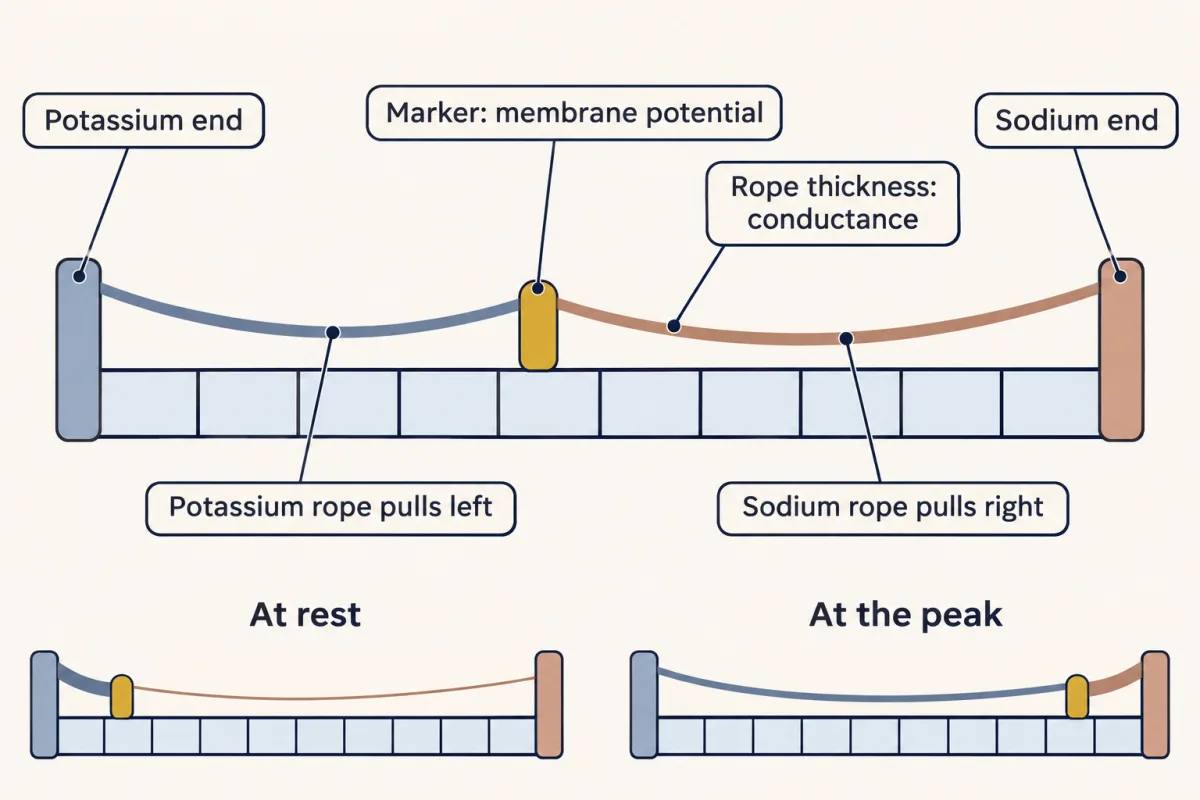
Each ion's open channels pull the voltage toward that ion's end of the scale, harder the more conductance it has, so the marker sits near potassium's end at rest and near sodium's end at the peak. AI-generated illustration -
Holding the voltage still: the voltage clamp
-
Which ions carry the two currents?
-
How three gates make one spike
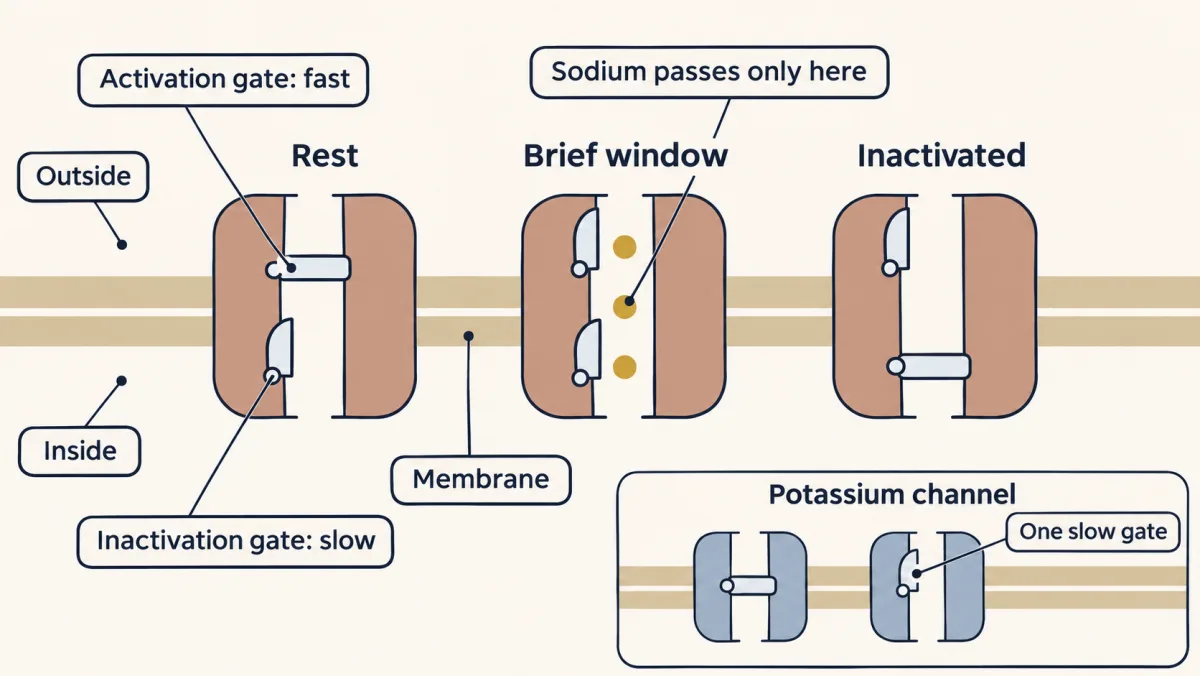
Sodium passes only in the brief window after the fast activation gate opens and before the slow inactivation gate shuts, while the potassium channel acts as if it has one slow gate. The gates are a cartoon of the gating processes, not of the channel protein. AI-generated illustration -
Threshold, all-or-none and refractoriness
-
Moving down the axon
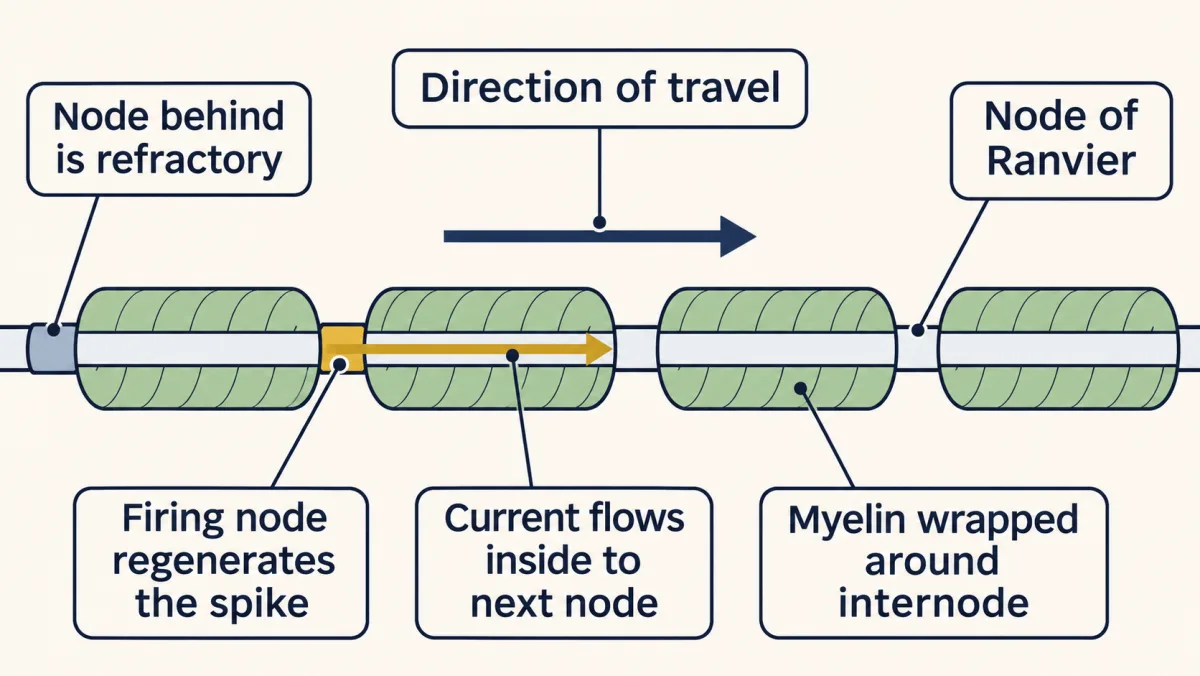
In a myelinated axon the firing node regenerates the spike and current flows on inside the axon to the next node, while the node behind is refractory, so the spike moves only forward. AI-generated illustration -
Predict, then check: tetrodotoxin, TEA and demyelination
-
Going deeper
Where this lesson fits
Before thisReview first
- The Resting Membrane and Passive SignalsThis course · Lesson 3
You need the I = g × (Vm − E) current rule and the resting potential from there to follow every phase of the spike.
- Neurons and Glia at WorkThis course · Lesson 2
It introduces the potassium and sodium equilibrium potentials and ion gradients that set the balance point used here.
After thisStudy next
- Synaptic Transmission and Quantal ReleaseThis course · Lesson 5
The spike arriving at the terminal is what triggers transmitter release, so this lesson's impulse is the starting point there.
- Motor Units, Reflexes and LocomotionThis course · Lesson 15
Conduction velocity and myelin from here explain why reflex and motor signals travel at the speeds they do.
- When Mature Neurons Fail: NeurodegenerationThis course · Lesson 26
Demyelination and failed conduction from here are the starting point for understanding how disease breaks neural signalling.
Elsewhere on the siteFilms, simulations and method films in other courses
- Adding up a reflexSimulation · Organismal Biology
It adds up a reflex arc's latencies, using conduction along the axon as one timed step.
- Every Response Has a Running TimeFilm · Organismal Biology
It shows the all-or-none signal along an axon as one step in a reflex route.
Suggested by an AI model from the lessons themselves, then checked. How we use AI