Every Response Has a Running Time
Read the transcript of “Every Response Has a Running Time”
Film transcript: Every Response Has a Running Time
Tap the tendon below your kneecap, and your leg kicks before you decide anything. How long does that take, and where does the time go? The signal runs a route with five stations. First, a receptor in the thigh muscle detects the stretch. Then a sensory neuron carries the signal up to the spinal cord. In the spinal cord, the integrating centre, it crosses one synapse. A motor neuron carries it back down the leg. Then the effector, the thigh muscle, contracts. Zoom in on the motor neuron. Its dendrites receive signals, and the cell body gathers them. One long axon carries the signal away, in a large mammal sometimes a metre or more. Its terminals pass it on.
Along the axon the signal is an impulse. It is all or none: full size, or nothing at all. On many axons it hops between short bare gaps in a wrapping called myelin. At most synapses, the terminal releases a chemical that crosses a narrow gap. But how fast does the impulse run? In 1850, Hermann von Helmholtz asked that of a frog. He stimulated its nerve near the calf muscle and timed the twitch. Then he moved the stimulus farther up the same nerve, and timed it again. Every time, the twitch came a little later than before. Each delay includes time at the junction and in the muscle. One part of these two delays belongs to the nerve alone. Which part?
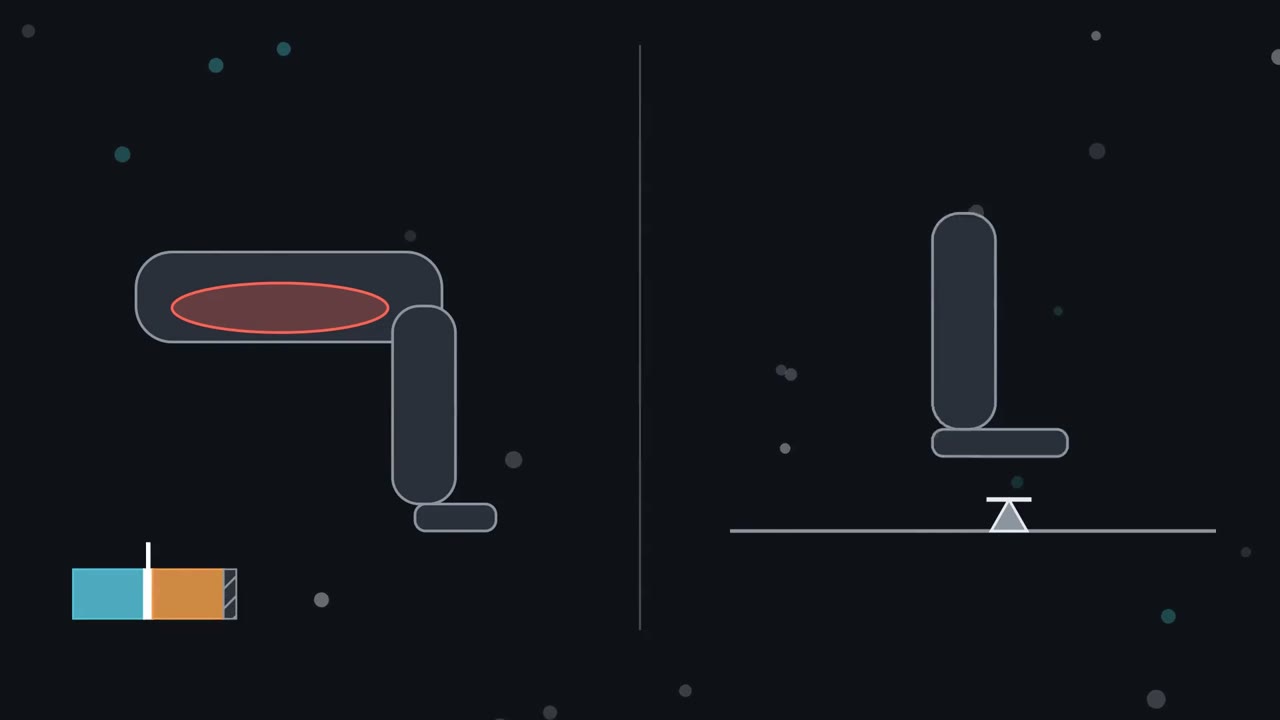
The difference. The junction and the muscle take the same time in both trials, so they cancel. The extra delay belongs to the extra length of nerve. Divide that extra length by that extra time, and you get the nerve's own speed. Helmholtz found a few tens of metres per second, about a car on a motorway. Now back to the knee. Each axon's time is its length divided by its speed. In this model, each synapse in the cord adds about a millisecond. The junction and the muscle add a little more. The bar's legs add up to just under the measured time, when the thigh muscle's electrical signal starts. The bar leaves out the brief tap and stretch before the spindle fires.
The kick itself comes later. Nearly all of the bar is time on the two axons. So a response is a route, and its time is the sum of its legs. Change a length, a speed, or the number of synapses, and the time changes.
A doctor taps the tendon below your kneecap and your leg kicks before you decide anything. What route does the signal take, and how fast does it run?
Continue in the lesson: Nervous Control: A First Look →
3:06 · Free, with captions and a transcript. The lesson has the full text, the questions and the sources.
More films from this lesson
How this film was made. Narration: written from this lesson's text and read by an AI narrator voice (Kokoro, af_heart). Animation: AI-generated in code (Manim) by Claude, a schematic with no drawn molecular structures. Captions come from the narration script. See something wrong? Report it.