Sensory Systems · Skim version
Five Ways to Turn a Stimulus into a Current
Read the full lesson → Skim the whole course →
The guiding idea
In turtle hair cells, transduction channels can activate with a time constant as short as about 50 microseconds. A rod's response to one photon takes of order a tenth of a second or more to peak, yet the rod can report that single photon. Why would a sensory cell accept being slow, and what exactly does a quoted speed measure?
With no enzyme between stimulus and pore, a current can start as fast as the channel changes shape; with enzymes between, one event changes thousands of molecules, usually at a cost in time.
From the film: Nothing in Between, or Enzymes in Between
- Every sensory cell turns a stimulus into a current, and what sits between the stimulus and the pore sets what the cell can do.
- Where no enzyme sits in between, as in a hair cell, the current can start very fast; in turtle hair cells channels can activate with a time constant as short as about 50 microseconds.
- Where enzymes sit in between, as in a rod, one stimulus event can change thousands of molecules, usually at a cost in time.
- Ask two questions of every sensory cell: what sits between stimulus and pore, and how does the signal leave the cell?
From the film: Forty Microseconds: What a Fast Number Measures
- The 40-microsecond delay is a tissue response latency, the corrected summed response of the bullfrog sacculus at 22 degrees C, not the opening time of one channel.
- Channel activation was measured directly later, with time constants as short as about 50 microseconds in turtle hair cells.
- A tissue latency, a channel time constant, a molecular gain and a behavioural latency are different kinds of number, so check what kind before comparing two speeds.
From the film: Where the Gain Sits, and What It Costs
- In mouse rods, about 2000 cGMP molecules are hydrolysed per absorbed photon, so a rod cascade can multiply one event many times.
- The receptor step need not amplify: in frog olfactory neurons one bound receptor rarely activates even one G protein, and the gain is thought to come at later steps.
- The price of a cascade is time, because every rung is a molecular encounter or an enzyme turning over, and a cascade can also amplify spontaneous receptor activity.
-
Two questions for any sensory cell
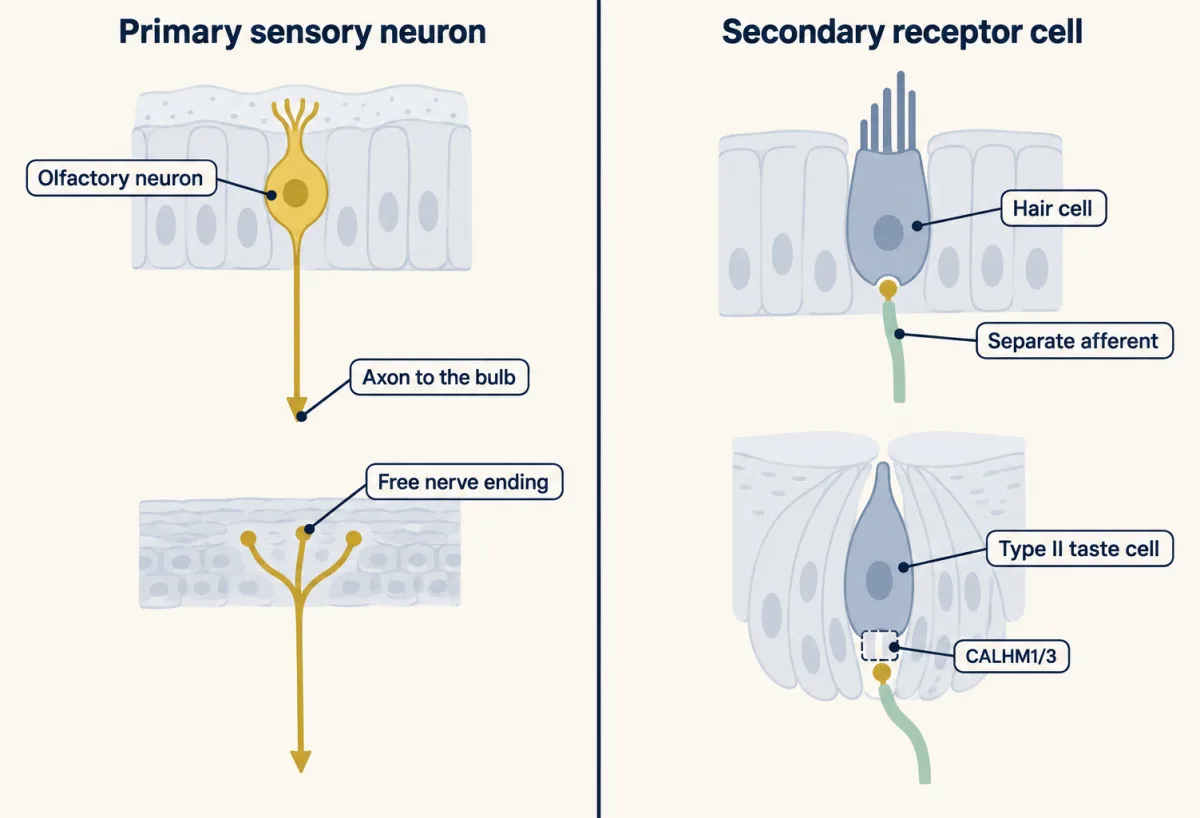
Primary sensory neurons (an olfactory neuron, a free nerve ending) carry the signal into the nervous system themselves; secondary receptor cells (a hair cell, a type II taste cell) pass it to a separate afferent. AI-generated illustration -
Forty microseconds: what a fast number measures (Corey and Hudspeth 1979)
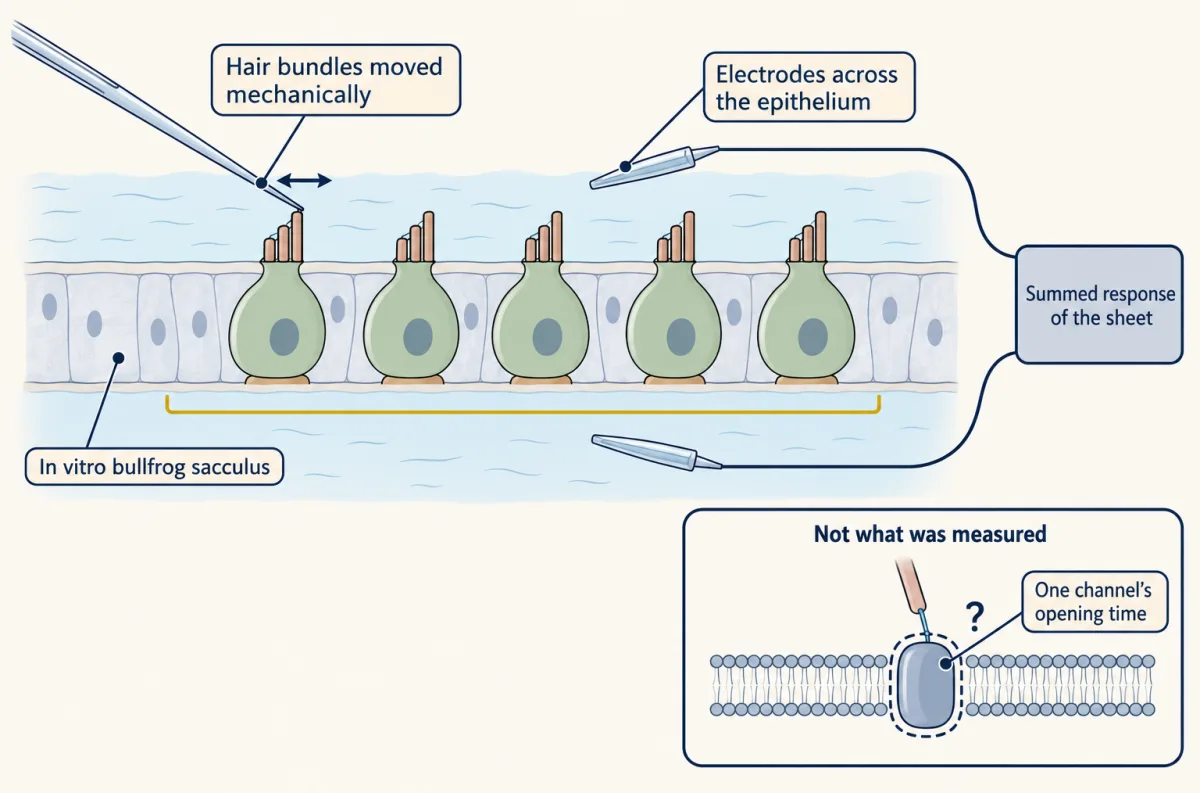
The 40-microsecond delay (22 degrees C) is the summed response of the whole sheet after correction for the epithelium's own time constant: a tissue latency, not the opening time of one channel. AI-generated illustration -
Where a cascade’s gain comes from, and what it costs
-
Detect, then send: CALHM1/3 (2018)
-
The checklist for calling something the transducer
-
Going deeper
Where this lesson fits
Before thisReview first
- The Action Potential and ConductionNeuroscience · College: going further
You need how channels open and carry current to read a channel time constant and a receptor current here.
- Sensing the World: Vision, Smell, Nitric Oxide and cGMPCell Signaling · Graduate school and beyond
The rod and olfactory cascades are used here as the enzyme-in-between design, with no re-teaching.
- Ion Channels as ReceptorsCell Signaling · Graduate school and beyond
You need direct gating of a channel by a stimulus, such as heat on TRPV1, to read the no-enzyme design.
After thisStudy next
- Piezo Channels and the Physics of ForceThis course · Lesson 2
This takes the force-gated channel case further, asking how Piezo2 meets the transducer checklist.
- The Hair Cell's Transduction ChannelThis course · Lesson 22
It takes the TMC1 evidence and the fast hair-cell current further, testing what is needed to call it the pore.
- Merkel Cells: Touch Receptors That Are Not NeuronsThis course · Lesson 5
It develops the two-site model where a non-neuronal cell and its afferent share touch transduction.
Elsewhere on the siteFilms, simulations and method films in other courses
- Cascade amplifierSimulation · Cell Signaling
It shows how a chain of enzyme steps multiplies one photon's signal, the gain that a cascade buys at a cost.
- The Timer Inside the SwitchFilm · Cell Signaling
It shows how a G protein times its own signal, the delay inside the rod and olfactory cascades.
- How One Photon Becomes a Cellular SignalFilm · Cell Signaling
It shows how a photon's signal grows through a chain of steps, the rod gain ladder used here.
Suggested by an AI model from the lessons themselves, then checked. How we use AI