The Timer Inside the Switch
Read the transcript of “The Timer Inside the Switch”
Film transcript: The Timer Inside the Switch
A receptor has let go, yet a G protein remains active. What decides when that already-loaded switch stops? Follow that molecule beneath the membrane and watch its active interval. The answer lies inside the nucleotide the protein carries.
Start with the switch off. It holds GDP, shown as a slate token with its phosphate tabs. The protein grips that token tightly, so exchange is slow without help. That resting complex waits beside the receptor in the membrane. An occupied receptor acts as a guanine nucleotide exchange factor, or GEF. It opens the grip and promotes GDP release.
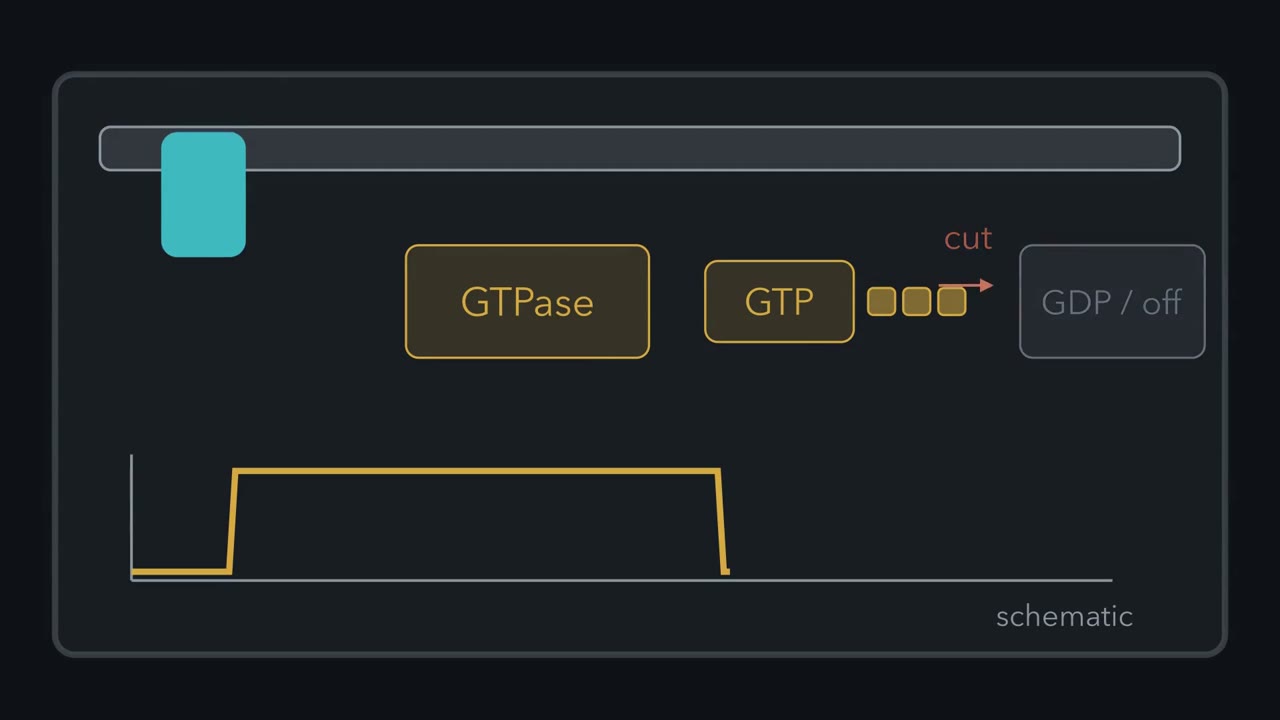
GTP, far more plentiful than GDP, then takes the empty place. The receptor promotes exchange; it does not hand over GTP. GTP changes the protein's shape. The block turns gold, its activity trace rises, and a target beside it switches on. This GTP-bound interval is the state we will time. Alpha and beta-gamma can each regulate targets after the rearrangement. The G protein is also an enzyme, a GTPase. After a variable wait, it cuts off GTP's last phosphate. GDP remains, the shape relaxes, and the target turns off.
Cutting always returns this switch to its GDP-bound state. Here is the rule for that loaded molecule. Faster GTP cutting shortens an already-loaded GTPase's time on. Loading starts the interval; hydrolysis ends it. The rule does not say how often loading begins. Now compare matched gold switches. A GAP approaches only the lower switch and accelerates its cutting reaction. Both begin with the same GTP and target. Which gold interval should end sooner? Hold your answer.
The lower interval ends first. The GAP does not remove GTP or supply fuel. It helps the GTPase reach the cutting transition faster, then leaves GDP behind. The products are unchanged; only the speed differs. For first-order cutting, the average active time is the reciprocal of the cutting rate constant. A larger rate constant means a shorter mean interval. The exact wait still varies among molecules.
Fewer molecules remain active at each later time. A whole-cell response has other clocks. Receptors can reload many switches, targets can turn off, and messengers can be cleared. Those clocks also shape the pathway-level trace. Our rule isolates a single already-loaded GTPase's lifetime. That distinction makes experiments readable. Change loading, and you change how often switches start. Change GTP cutting, and you change how long each loaded switch remains active. Keeping those controls separate prevents a common reasoning error.
After a receptor lets go, what decides how long an already-loaded G protein keeps signaling?
Continue in the lesson: GTPase Switches: The Timer →
3:40 · Free, with captions and a transcript. The lesson has the full text, the questions and the sources.
More films from this lesson
How this film was made. Narration: written from this lesson's text and read by an AI narrator voice (Kokoro, af_heart). Animation: AI-generated in code (Manim) by Claude, a schematic with no drawn molecular structures. Captions come from the narration script. See something wrong? Report it.