How One Photon Becomes a Cellular Signal
Read the transcript of “How One Photon Becomes a Cellular Signal”
Film transcript: How One Photon Becomes a Cellular Signal
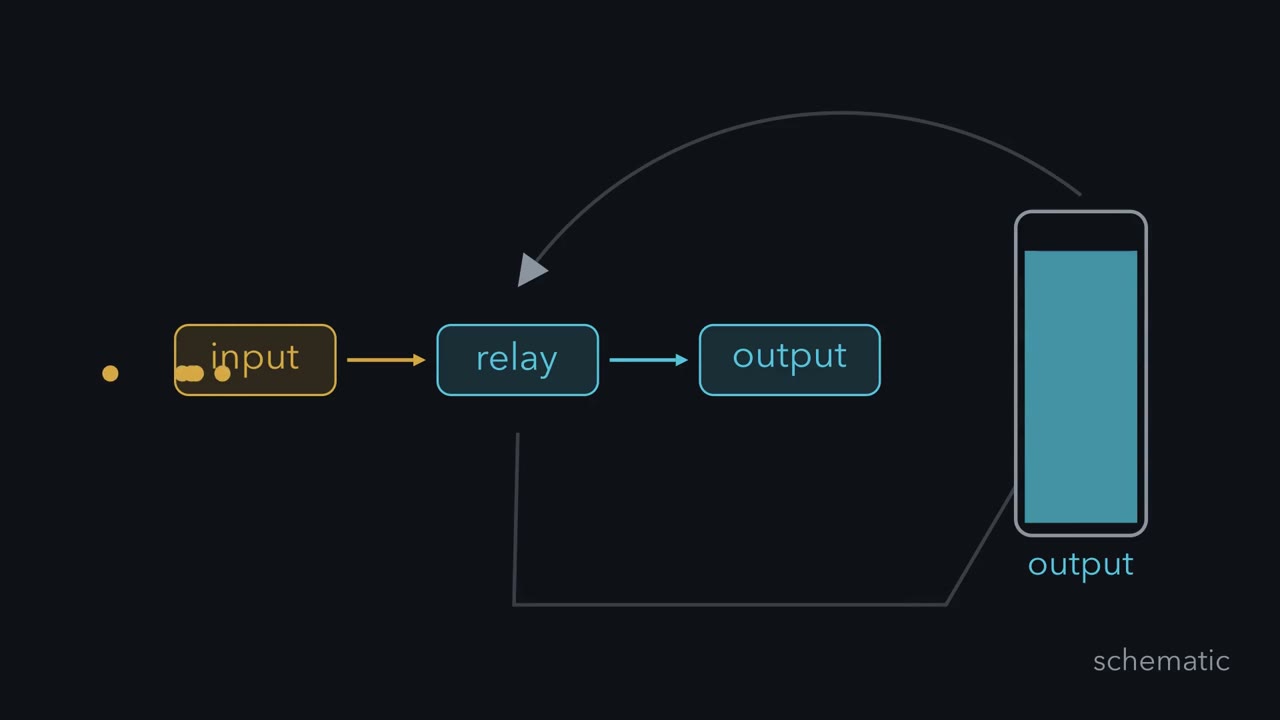
How can one activated molecule change a whole cell's current without letting its signal spread or run forever? Follow one photon into a rod cell. Its pathway reveals both the power and the cost of amplification. In darkness, cGMP holds channels open, and ions carry a steady dark current. The photon activates one rhodopsin. It does not add current. It starts a relay that closes some channels, so the existing current dips. Active rhodopsin switches on many transducins. Each active transducin activates phosphodiesterase, which destroys cGMP. As cGMP falls, some channels close. The current dip is only a small fraction of the dark current. One event has become many downstream events.
Gain is output molecules per input molecule. In a simple unsaturated cascade, total gain is the product of the step gains. A catalytic step multiplies. A one-to-one handoff contributes no multiplication. The transducin handoff is one-to-one, between two catalytic stages.
A catalytic molecule reaches more targets by working faster or remaining active longer. Rate times active lifetime helps set that step's gain. Longer activity can also prolong output. But downstream shutoff or feedback can shorten a high-gain output.
Size and duration are not locked together. Now compare two invented routes on screen. Both start from one input. Which route produces more final output? Follow every branch, then multiply each route's displayed step gains.
The upper route wins because its displayed factors give the larger product. This rule has limits. Saturation, shared substrates, deactivation, and feedback can make real pathways depart from simple multiplication. Use the product only when the simple counting assumptions fit. Amplification also magnifies some upstream fluctuations, so weak signals need evidence. Rod researchers separated blank trials from responses and tested their counts against a Poisson distribution. Every active component needs a stop. Rhodopsin is shut down, and transducin splits bound GTP to switch itself off. A diffusible messenger can also reach unintended targets. Local binding, anchoring, and destruction restrict its useful pool.
Anchoring proteins can hold a kinase, its target, and a messenger-destroying enzyme within one neighbourhood. Amplification is therefore not free. A strong signal must be stopped and kept near the right targets. Return to the photon. Its cascade made a detectable dip because catalytic stages multiplied its effect, and timed shutoff ended the response. In other pathways, local anchoring and destruction can also limit the spread of a diffusible messenger. Those safeguards make amplification useful.
How can one photon change a rod's current without letting the signal spread or run forever?
Continue in the lesson: Circuits: Amplification, Feedback, Adaptation and Switches →
3:50 · Free, with captions and a transcript. The lesson has the full text, the questions and the sources.
More films from this lesson
How this film was made. Narration: written from this lesson's text and read by an AI narrator voice (Kokoro, af_heart). Animation: AI-generated in code (Manim) by Claude, a schematic with no drawn molecular structures. Captions come from the narration script. See something wrong? Report it.