Genetics and Molecular Biology · Skim version
Transcription: From DNA to RNA
Read the full lesson → Skim the whole course →
The guiding idea
A gene has two DNA strands. What chooses which one the polymerase reads?
The start site and its orientation determine which strand is read.
From the film: The Strand Is Chosen at the Start
- The start site and its orientation determine which strand is read.
- RNA polymerase reads the template strand from 3′ to 5′ while RNA grows from 5′ to 3′.
- The RNA matches the coding strand, with U in place of T, and pairs with the template.
- A bare duplex does not identify its template strand without a promoter or an RNA product.
From the film: Two Ways to Start, Several Ways to Stop
- Different initiation teams place polymerase; termination releases RNA and enzyme.
- In E. coli, a sigma factor directs the core enzyme to promoters.
- In the nucleus, three main polymerases divide the work, and Pol II starts with general factors.
- Bacteria end transcription with RNA hairpins or Rho; Pol II termination is coupled to cutting the RNA at the poly(A) site.
-
The reaction fixes the direction
-
Use the rule on a sequence
-
Bacteria: sigma places one core enzyme
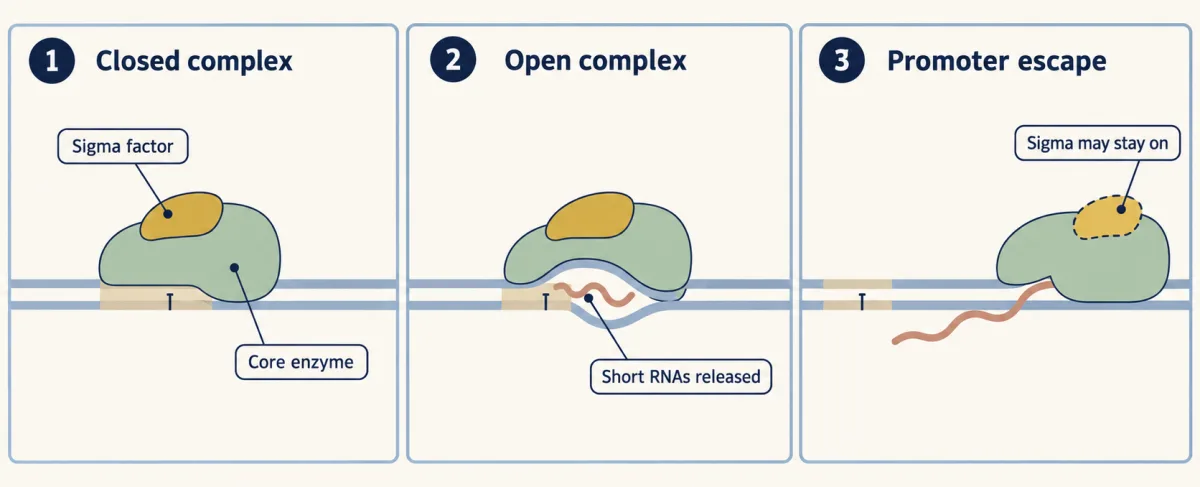
The E. coli holoenzyme binds closed DNA, opens a transcription bubble, makes short RNAs and escapes the promoter; sigma does not have to leave at escape. AI-generated illustration -
Eukaryotic nuclei divide the work
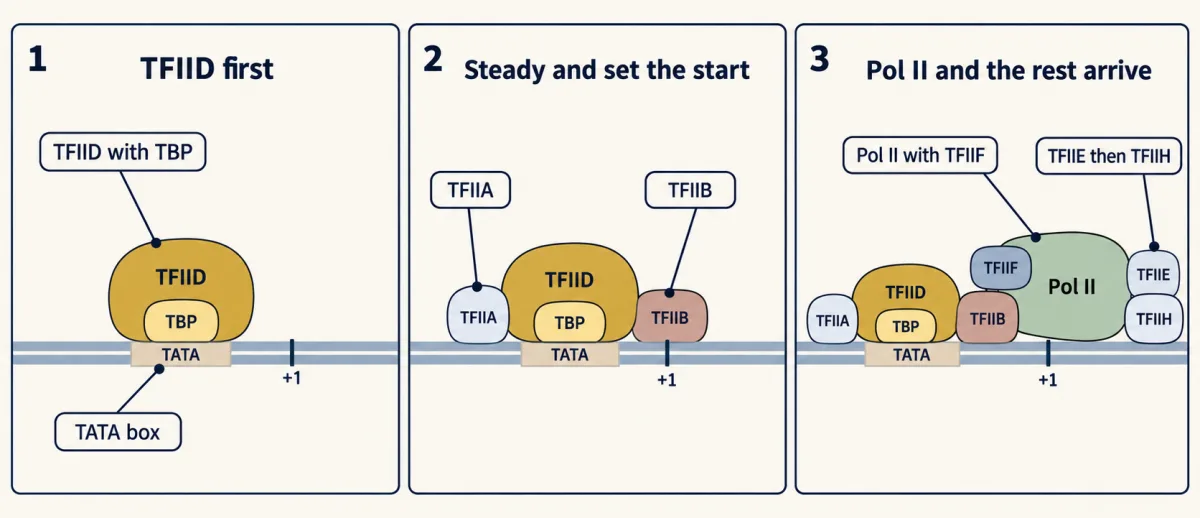
General transcription factors recognize a Pol II core promoter, position the polymerase and help open the template; a TATA box is one route, not a requirement at every human promoter. AI-generated illustration -
Stopping transcription
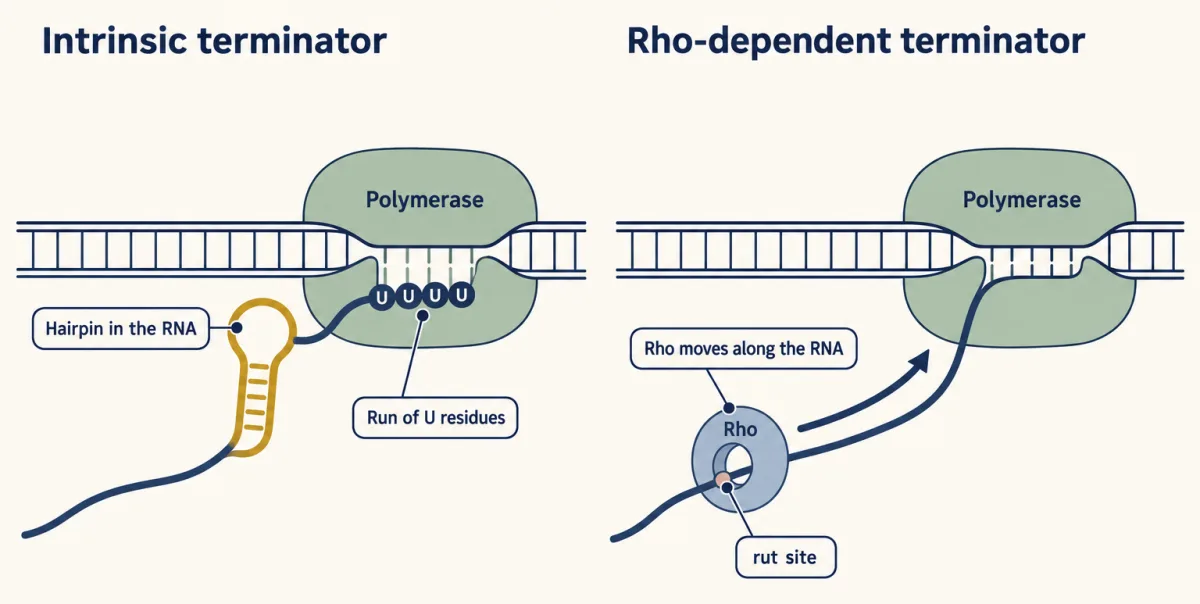
An intrinsic hairpin and U tract can destabilize a bacterial elongation complex, whereas Rho binds nascent RNA and advances toward polymerase to promote release. AI-generated illustration -
Design problem: identify the polymerase
-
Going deeper
Where this lesson fits
Before thisReview first
- DNA Replication: Semiconservative Copying and Its MachineryThis course · Lesson 13
You need 5′-to-3′ synthesis and antiparallel strands from there to see why RNA grows 5′ to 3′ here.
- DNA Is the Genetic MaterialThis course · Lesson 12
It establishes that DNA carries the information that transcription copies into RNA.
After thisStudy next
- RNA Processing: Caps, Tails and SplicingThis course · Lesson 17
The capped, spliced and tailed RNA is made from the Pol II transcript, using the CTD-recruited enzymes introduced here.
- The lac Operon: How Bacteria Regulate GenesThis course · Lesson 19
It applies bacterial promoters, sigma-directed initiation and operon transcription to regulate genes with repressors and activators.
- Eukaryotic Gene Regulation and EpigeneticsThis course · Lesson 20
It takes Pol II assembly at promoters further, showing how enhancers and chromatin control where initiation happens.
Elsewhere on the siteFilms, simulations and method films in other courses
- Transcribe, translate, mutateSimulation · Biology
It lets you transcribe a gene into mRNA and then see how codons are read.
- Reporter gene assaysMethod film
Testing what a promoter does by placing it before a measurable gene matches the promoter test in the design problem.
- From Gene Copy to Protein ChainFilm · Biology
It shows transcription making an mRNA copy of the gene before translation reads it.
Suggested by an AI model from the lessons themselves, then checked. How we use AI