Biology · Unit 2: Cells
Homeostasis in Action
Rewritten on : new text, flashcards and film. Your notes and highlights stay, but the text around them may have moved.
Why does your heart speed up when you run up the stairs, and then slow down again over the next few minutes?
Pause when the reading reaches a film, and offer to play it. Saved on this device.
Watch the film now, or keep listening
Builds on:Crossing the MembraneDiffusion and OsmosisWhy these?
Where this lesson sits
- Virginia SOL BIO.3b
- Practices BIO.1a, BIO.1b, BIO.1c, BIO.1d, BIO.1f
Essential question: How do cells and organisms keep conditions inside them steady when the outside keeps changing?
-
Life Science (grade 7) LS.2 e
Review it at grade 7 level
In Life Science you learned that all living things are made of cells. Each cell is wrapped in a cell membrane. The membrane lets some materials in and out and keeps others back. Water moves across it by osmosis, and other small particles spread from where there are more of them to where there are fewer by diffusion. A cell takes in what it uses and gets rid of wastes through this membrane. Biology adds the idea of feedback: cells and whole bodies sense a change and respond in a way that pulls conditions back into a steady range.
-
Biology BIO.3b You are here
This lesson
-
Biology II Biology II: Advanced Survey of Biology Topics, BIOII.2 f
Preview where it goes next
In Virginia's Biology II courses, homeostasis is followed into the systems that run it. The nervous system sends fast signals along nerves, and the endocrine system sends slower signals as hormones in the blood; some loops use one, and many use both. You meet set points that can shift, as during a fever, and positive feedback, which pushes a change further until an event ends it, as in the contractions of childbirth. You also meet control that acts before a change is sensed, such as the brain raising heart rate as exercise begins. In plants, the hormone abscisic acid (ABA) is one signal that closes stomata when a plant is short of water, though recent experiments on dry-air closing suggest it is not the only route.
-
College
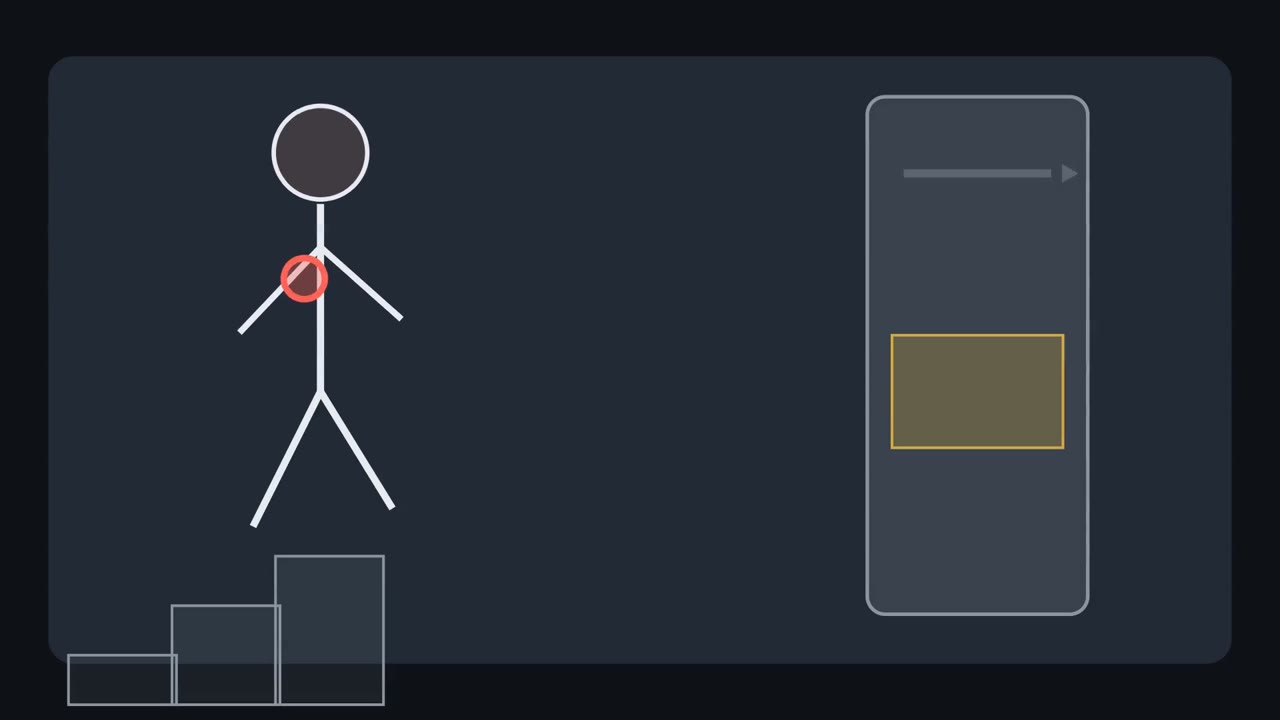 ▶ Watch When the Body Pushes Back · 3:09
Read the transcript of “When the Body Pushes Back”
Film transcript: When the Body Pushes Back
Why does your heart slow again after you stop climbing? At the top, your muscles relax, but your heartbeat stays fast. A marker sits above its usual band. Something must move it back without locking it to one value. That shaded band is a range, not a single target. Inside it, the marker can rise and fall. Homeostasis means keeping internal conditions within a stable range while the outside changes. The motion matters more than any one reading. Now warm the body. The red disturbance pushes the temperature marker above its band.
Sensors in the skin and brain detect that change. They send blue signals to a control center in the brain. The control center sends a yellow command toward sweat glands. Sweat appears on the skin. As it evaporates, heat leaves the skin, and the marker moves toward the band. The response acts against the warming that started it. That direction makes this negative feedback. When internal conditions drift, opposing responses move them toward their range. The condition can still vary inside that range.
Negative does not mean harmful here. It means the response pushes against the starting change. Predict what happens if sweat reaches the skin but cannot evaporate. Does the marker return as quickly, or does it stay higher? Keep the body, range, and sweat in view while you decide.
Without evaporation, sweating removes less heat from the skin. The cooling response is weaker, so the marker stays higher. The response exists, but its effect depends on what happens after the effector acts. We can map this loop as change, sensor, control center, effector, and opposing response. Sweat glands are the effectors here. Other body loops may combine parts or spread them across organs. The map is useful, but it is not anatomy for every case. A house thermostat follows a similar path: sense, compare, act. A body is richer. Many sensors and effectors work together, and most responses are graded. No one sets a dial inside you. A correction also takes time.
Heart rate does not snap to rest when climbing ends. Signals change, and the rate falls fastest at first. Then it approaches its resting range more gradually. Use the simulation to test this map one step at a time. Then a second film compares cases beyond this complete loop.
From the film
- When internal conditions drift, opposing responses move them toward their range.
- Homeostasis keeps internal conditions within a range, not at one fixed value.
- A negative feedback loop can be mapped as change, sensor, control center, effector and opposing response.
- Sweat cools the skin as it evaporates; without evaporation, it removes less heat.
Run up a flight of stairs and your heart pounds faster, then slows again over the next several minutes.
The first film followed one warming body back toward its range. The outside keeps changing, yet your blood stays within fairly narrow limits. On a hot, dry afternoon, tiny pores on the underside of many leaves narrow.
Homeostasis is keeping internal conditions within a stable range while the outside changes. Body temperature is usually near 37 °C, but it shifts a little through the day.
What do you think? Decide before you read.
-
Scientists disagree: When physiologists measure body temperature or blood sugar through a day, the numbers move. They stay inside a range, and when they drift too far, the body responds and pulls them back. Homeostasis is that holding within a range, not freezing every value at one number.
What scientists think
Scientists disagree: When physiologists measure body temperature or blood sugar through a day, the numbers move. They stay inside a range, and when they drift too far, the body responds and pulls them back. Homeostasis is that holding within a range, not freezing every value at one number.
-
Scientists disagree: The heart cannot judge what muscles want. Studies of exercising people show that nerve signals from the brain adjust the heart’s pace. The brain combines its own commands with information from sensors in the working muscles and blood vessels.
What scientists think
Scientists disagree: The heart cannot judge what muscles want. Studies of exercising people show that nerve signals from the brain adjust the heart’s pace. The brain combines its own commands with information from sensors in the working muscles and blood vessels.
-
Scientists disagree: Measurements of leaves show their pores begin narrowing within minutes when the air is made drier. Experiments with young roots show them bending toward wetter areas. Plants have no brain, but their cells detect changes and respond to them.
What scientists think
Scientists disagree: Measurements of leaves show their pores begin narrowing within minutes when the air is made drier. Experiments with young roots show them bending toward wetter areas. Plants have no brain, but their cells detect changes and respond to them.
Test the model in a simulation
Pick a disturbance (exercise, a hot room or dry air around a leaf) and step from sensor to control center to response while the graph tracks the variable. A switch breaks the sensor.
Predict. If the sensor is broken in the hot-room case, what shape will the temperature graph take? Run it to test your answer.
- 1Change?
- 2Sensor?
- 3Control center?
- 4Effector?
- 5Response?
- 6After you stop?
Pick a disturbance to begin. Before each step, predict what the graph will do.
In this sketch: the change happens once. With a working sensor, the response pulls the variable back gradually. With a broken sensor there is no signal and no response. The graph is in relative units, not a measurement. A real body has many sensors and effectors, so a loop with one sensor is a simplification.
Rule to keep: in negative feedback, a sensor detects a change, a control center compares it with the usual range, and an effector makes a response that pushes the variable the other way.
Check your prediction
The graph stays away from the usual range. With the sensor broken, the change is never detected, so the control center never signals the sweat glands.
Then pick dry air. Before you step through, predict what the guard cells do and what that costs the leaf.
Name the parts of negative feedback
- homeostasis
- negative feedback
- sensor
- control center
- effector
- positive feedback
- selectively permeable
- passive transport
- active transport
- stomata
- guard cells
- hydrotropism
Most homeostasis works by negative feedback, a loop in which the response opposes the change that started it, as sweating did in the first film. Map it in five parts:
- A change. Something pushes a variable away from its usual range.
- A sensor, a cell or organ that detects the change.
- A control center, which compares the sensed value with the usual range and sends a signal. In your body this is often the brain, but for some loops it is a gland, such as the pancreas for blood sugar.
- An effector, a muscle, gland or cell that carries out the response.
- The response, which pushes the variable back.
The map is a tool: real loops may combine parts within cells or spread them across organs. Use it to name the stations of the hot-day loop:
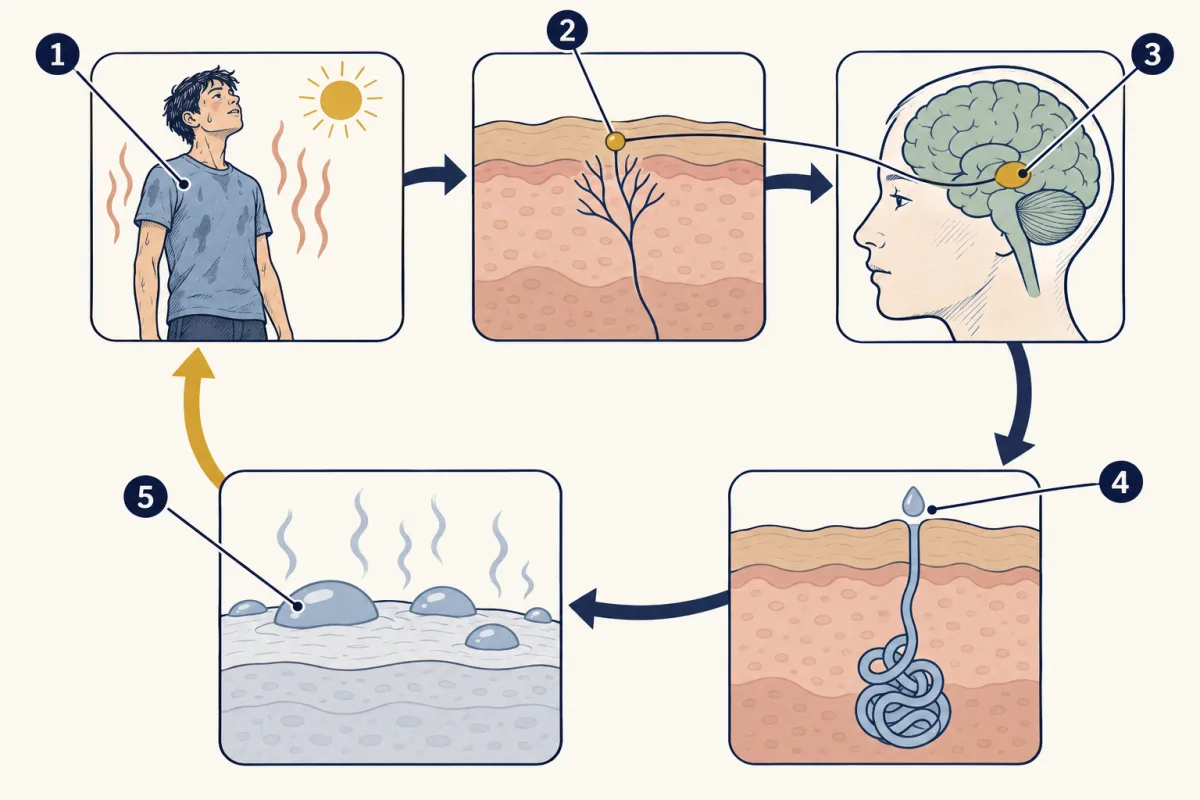
- body warms
- temperature sensors in skin and brain
- control center in the brain
- sweat glands
- skin cools
- body warms
- blank
- blank
- blank
- skin cools
Word bank: control center in the brain, sweat glands, temperature sensors in skin and brain
- blank
- blank
- blank
- blank
- blank
Check your labels
- body warms
- temperature sensors in skin and brain
- control center in the brain
- sweat glands
- skin cools
Predict. On a cold day, which effectors could push temperature the other way?
Check your prediction
The same control center sends different signals. Muscles shiver, which releases heat, and skin blood vessels narrow, so less heat is lost.
A few loops run the other way. In positive feedback, the response makes the change bigger until an event ends it, as in the contractions of childbirth.
Not every living system uses the same five parts. The second film compares four of them.
Read the transcript of “Four Ways to Hold Steady”
Film transcript: Four Ways to Hold Steady
The first film followed a body as it pushed back against warming. Do hearts, leaves, roots, and cells all use that same loop? Keep the same colors while the parts change. A gold badge marks the condition each case helps protect.
Start with the heart during exercise. Commands from the brain speed it as movement begins. Sensors in working muscles and blood vessels add information. The faster heart moves more blood past those muscles. Exercise control combines advance commands from the brain with feedback from sensors. Now move the gold range badge to a leaf.
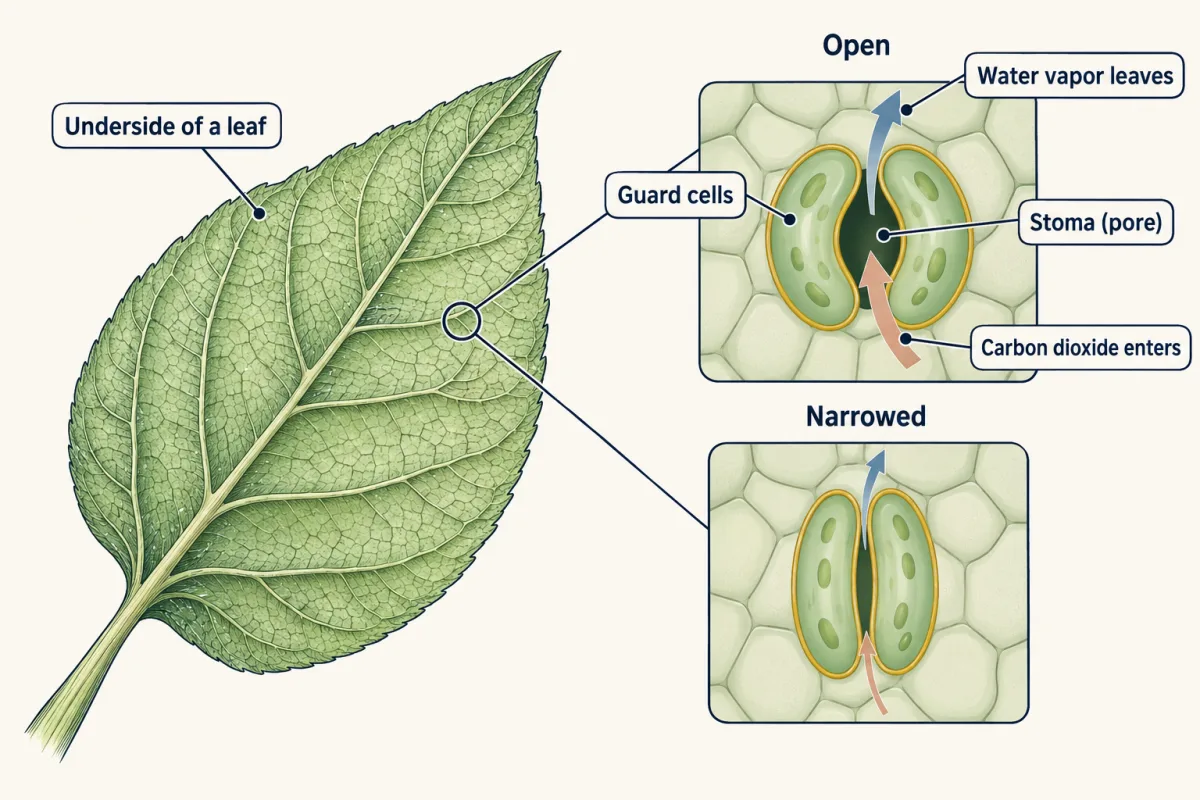
Dry air makes water vapor leave faster through stomata, the leaf's small pores. Guard cells can narrow each pore and slow that loss. But the pore also admits carbon dioxide. Predict what happens to carbon dioxide entry when the guard cells narrow the pore. Does only water movement change, or do both movements slow? Watch the two arrows while you decide.
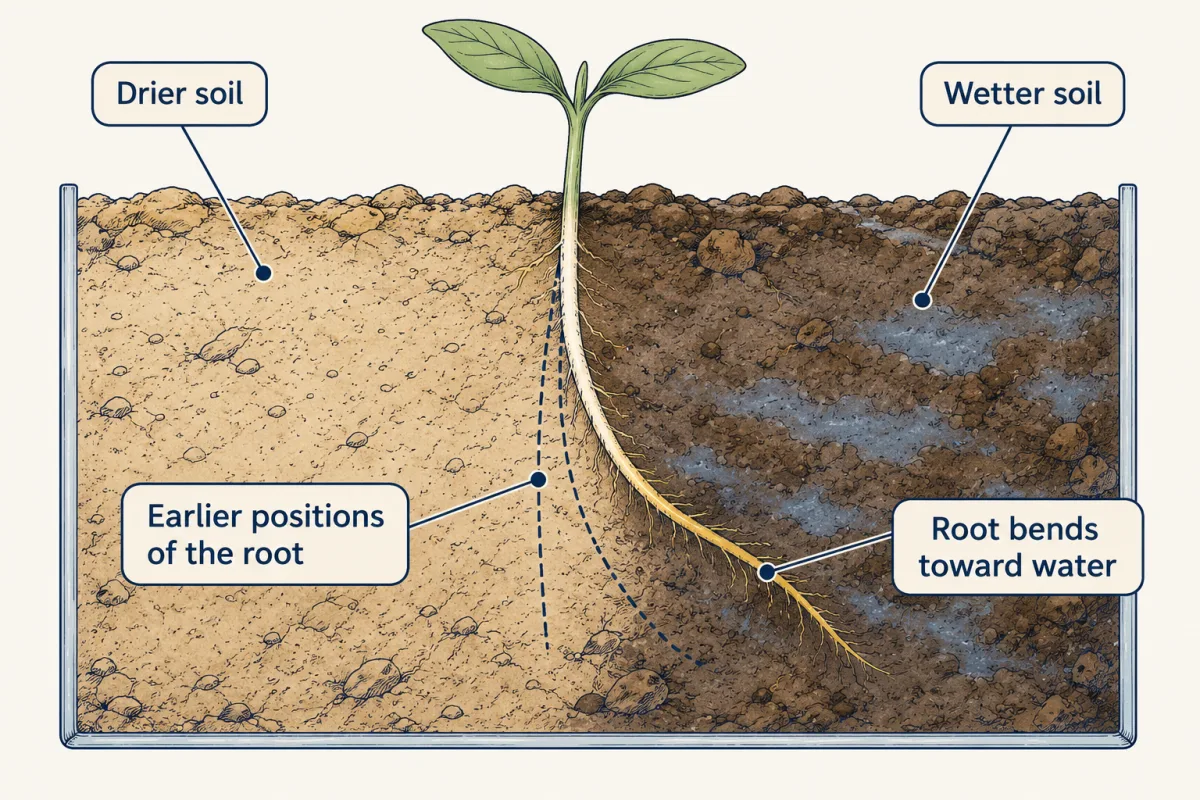
Both movements slow. Fewer water-vapor particles escape, helping the leaf keep water. Fewer carbon-dioxide particles enter, which is the tradeoff. One response can protect one condition while limiting another process. A root takes a slower path. When water is uneven in soil, the root can curve as it grows toward wetter ground. This is hydrotropism. It supports water supply, but biologists usually call it a response, not a complete feedback loop. A single cell uses its boundary. The selectively permeable membrane lets some substances cross and holds others back.
Passive transport follows a concentration gradient without cellular energy. Active transport spends cellular energy to move against that gradient. Together, these routes keep the inside different. Each case helps keep something steady, but by a different route. The heart changes flow, guard cells change a pore, and membranes control what crosses. Roots support water supply by changing growth direction. The goal is shared, but the diagrams are not identical. Body temperature fits the full sensor, control center, and effector map.
Exercise adds advance commands. Hydrotropism is not usually called a complete loop. A membrane needs no brain-like controller. The text now adds what the pictures skipped: the heart's two nerves and what complicates leaf pores. Then real heart-rate data show how one return unfolds over time.
From the film
- Same goal, different routes: only some are complete feedback loops.
- Exercise control combines advance commands from the brain with feedback from sensors.
- Narrower stomata slow both water loss and carbon dioxide entry.
- Hydrotropism supports water supply but is not usually called a complete feedback loop.
- Selective membranes use passive and active transport to keep a cell's inside different from the outside.
What the four pictures leave out
The second film compared the four routes, the leaf’s tradeoff and which cases are complete loops. Here is what it skipped.
Heart rate during exercise. The second film’s advance commands and sensor feedback reach the heart through nerves. The extra blood brings oxygen to working muscles and carries carbon dioxide away. During moderate exercise, faster breathing keeps blood carbon dioxide fairly steady, so carbon dioxide sensors are not the main reason heart rate rises. Two sets of nerves reach the heart: one speeds it and one slows it. Exercise turns up the first and turns down the second. When you stop, the slowing nerve becomes active again, mostly in the first minutes. Exercise control is more than one feedback loop: the brain raises heart rate as exercise begins, partly through commands sent before any large change in the blood.
Stomata in a leaf. Stomata (one is a stoma) are the leaf’s pores, and each sits between two guard cells that change shape to open or narrow it. Experiments show that drier air can make guard cells close the pores, with the tradeoff the second film showed. Temperature matters too, but not simply: in one 2020 study of Arabidopsis leaf tissue, warming opened the pores.
Predict. If warming tends to open pores in one preparation while dry air tends to narrow them, can temperature alone predict a whole plant’s response?
Check your prediction
No. In a whole plant on a hot afternoon, what the guard cells do depends on several signals together, including temperature, dry air and the water supply. “Hot means closed” is too simple.
Roots and water. Why is hydrotropism, a root growing toward wetter soil, not counted as a complete loop? It is slow compared with a heartbeat, and it changes the direction of growth rather than holding a number inside the plant within a range. Scientists usually describe it as a response to the environment, not a complete feedback loop with a control center.
The cell membrane. Every cell has its own homeostasis, and the membrane does much of the work. Selectively permeable means it lets some substances cross and holds others back. In passive transport, substances move from where they are more concentrated to where they are less, and the cell spends no energy. In active transport, the cell spends energy to move substances from less to more. Crossing the Membrane covers them in detail.
Read the evidence: how fast does heart rate come back?
Predict. The first film showed the fall is steepest at first. How much of the gap between peak and resting heart rate will close in the first minute: a little, about a third, or nearly all of it?
| Time | Mean heart rate (beats/min) | Lowest to highest in the group (beats/min) |
|---|---|---|
| At rest, before exercise | 75 | not reported |
| Peak exercise | 179 | 147 to 199 |
| 1 minute after | 145 | 111 to 170 |
| 2 minutes after | 119 | 78 to 142 |
| 3 minutes after | 110 | 78 to 130 |
| 4 minutes after | 106 | 79 to 125 |
| 5 minutes after | 102 | 77 to 123 |
These are means for 52 healthy adult volunteers on the first day of a treadmill study. Tulumen and colleagues at Hacettepe University in Ankara, Turkey, published it in 2011. Exercise ended with an active cool-down, and heart rates came from electrocardiogram (ECG) reports. The “peak” row is the highest heart rate during exercise, not a reading taken at the exact moment exercise stopped. For comparison, the American Heart Association gives 60 to 100 beats/min as a usual resting range for adults.
Check your prediction
About a third. The gap between peak (179) and the resting mean (75) is 104 beats/min, and the mean closed 34 of them in the first minute.
Work through the table:
- Mean heart rate fell by 179 − 145 = 34 beats/min in the first minute. Calculate the fall between 4 and 5 minutes. What does that tell you about the graph?
- At 5 minutes, was the group back to its resting mean? By how many beats per minute did it differ?
- The same volunteers repeated the test on days 7 and 30. Their mean heart rates at 1 minute were 145, 144 and 145 beats/min on days 1, 7 and 30. What is the mean of these three values?
Claim, evidence, reasoning
Make a claim that answers the essential question for heart rate, using this data.
Start with: After exercise, heart rate blank.
Start with: Mean heart rate fell from blank at peak to blank at 1 minute, and was still blank at 5 minutes, compared with blank at rest.
Start with: This fits the idea of returning to a range because blank. The return is gradual because blank.
Compare with a model answer
After exercise, heart rate returns toward its resting range, but gradually. In this study the mean fell from 179 beats/min at peak to 145 at 1 minute, a drop of about 34, then only 4 more between minutes 4 and 5. At 5 minutes it was 102, still above the resting mean of 75. Once exercise stops, the brain stops sending its speed-up commands and the nerve that slows the heart becomes active again, so the heart slows, which pulls the body back toward its usual state. One limit: these were adults on a treadmill in one study, so the numbers may not match a teenager marching in a classroom.
Saved in this browser only.
Design problem
Plan a safe class investigation: how does heart rate change after the same short activity, and how long does it take to come back toward rest? Name your variables, what you keep the same, how many trials you run, and how you keep it safe and fair.
Predict. Would a full-minute count or a shorter count show the earliest change more clearly? What is the tradeoff?
Saved in this browser only.
One way to do it
- Safety and fairness first. Anyone with a health condition, an injury, or a reason to sit out records data instead. Anyone can stop at any time. Stop and tell the teacher if you feel chest pain, dizziness, unusual trouble breathing, or unwell. This is a measurement, not a fitness test, so nobody’s results are ranked or shared by name.
- Independent variable: time after the activity (0, 1, 2, 3 and 5 minutes).
- Dependent variable: heart rate in beats per minute.
- Constants: the same comfortable activity for the same time (for example, marching in place for one minute), the same recovery position (sitting), the same way of counting, the same room.
- Control: a resting heart rate taken after sitting quietly, before each trial.
- Trials: practise counting your pulse first. Run three trials on separate occasions, each with a fresh resting reading. At each time, mean = sum of the three values ÷ 3. Keep every value; mark a count you know was a mistake instead of deleting a result you did not expect.
- Graph and meaning: plot time on the x-axis and mean heart rate on the y-axis, with a line for your resting value. A steep early drop that flattens out fits the published data. A full-minute count averages that minute, so record when each count started. Shorter counts, such as 15 seconds multiplied by 4, show changes closer together but are only estimates of the rate.
Evaluate: check your thinking
When you run up the stairs, nerve signals speed your heart. When you stop, they change, and it slows over several minutes toward its resting range. On a dry afternoon, guard cells narrow a leaf’s stomata, so water leaves more slowly. Both responses push a condition back toward its range.
Science practices you used: making predictions and testing them in a model, planning a safe and fair investigation with repeated trials, reading a data table and calculating a mean, and naming the limits of a model and of one study’s data.
Your notes
Select any text in the lesson to highlight it or add a note to it. Your highlights and notes are saved in this browser and collected in your notebook.
This browser is not letting the site save anything (a private window or strict privacy settings), so highlights and notes will be lost when you leave the page.
How we measure it
Counting a pulse
You press two fingers lightly on the inside of the wrist and count the beats you feel in a timed interval; an interval count is an average over that interval. The count gives heart rate in beats per minute without any equipment.
Electrocardiogram (ECG)
Sticky pads on the skin record the electrical signal of each heartbeat. The time between beats gives heart rate, and in the treadmill study in this lesson the heart rates were read from ECG reports at set times after exercise.
Leaf gas-exchange measurement
A plant's shoot sits in a clear chamber while instruments measure how much water vapor leaves it. This gives stomatal conductance, a number for how easily water vapor passes out through the pores, so researchers can see stomata narrow when the air is made drier.
Where this lesson fits
Before thisReview first
- Crossing the MembraneThis course · Lesson 8
You use passive and active transport there to see how a membrane keeps a cell's inside steady.
- Diffusion and OsmosisLife Science · Grade 7
It shows how substances move across a membrane, which the cell-membrane part here builds on.
After thisStudy next
- Populations and Carrying CapacityThis course · Lesson 29
Limits that push a population back toward a level work as feedback, like the loops here.
- Tissues, Organs and HomeostasisOne level up · Organismal Biology
It takes the feedback loop further with tissues, organs and a control loop for body temperature.
Elsewhere on the siteFilms, simulations and method films in other courses
- Adding up a reflexSimulation · Organismal Biology
The reflex route of receptor, centre and effector matches the sensor, control center and effector parts of a loop.
- Pulled From the TopFilm · Organismal Biology
It shows how leaf pores trade water loss against carbon dioxide entry, as in the stomata example.
Suggested by an AI model from the lessons themselves, then checked. How we use AI
Finish line
Test yourself
8 questions
Practice and MCAT-style, with explained answers.
Next · Lesson 10
The Cell Cycle and Mitosis
When one cell becomes two, what keeps either new cell from receiving only half the chromosomes?
Continue →