Organismal Biology · Skim version
Heat Balance and Body Temperature
Read the full lesson → Skim the whole course →
The guiding idea
How can a lizard basking on a desert rock end up warmer than you are, without making much heat of its own?
At a steady body temperature, heat made plus heat gained equals heat lost, so in a simple model, with air, ground and sky lumped as one effective surrounding temperature, the body sits above its surroundings by (heat made + heat gained − heat evaporated) divided by conductance, and an animal steers its temperature by changing one of those terms.
From the film: Where the Balance Sits
- Body temperature holds steady when heat made plus heat gained equals heat lost.
- Radiation, conduction and convection form a dry leak that grows with conductance and with the gap between body and air.
- An iguana warms mainly from sun and rock; a mouse warms mainly from its own metabolism.
- Animals hold their temperature by changing heat made, heat gained, conductance or evaporation.
- A controller in the brain chooses the temperature to defend, and skin sensors can warn it before the core cools.
From the film: The Price of Cold
- In the textbook thermoneutral zone, a resting endotherm stays at its basal rate and holds its temperature by changing conductance.
- In the chamber model, with conductance at its minimum and body temperature steady, each degree below the lower critical temperature costs the same extra heat.
- Thicker insulation moves the bend to colder air and makes the climb below it shallower.
- In Scholander and Irving's comparison, arctic and tropical mammals differed mainly in insulation, not in basal rate.
-
Routes and dials the first film left out
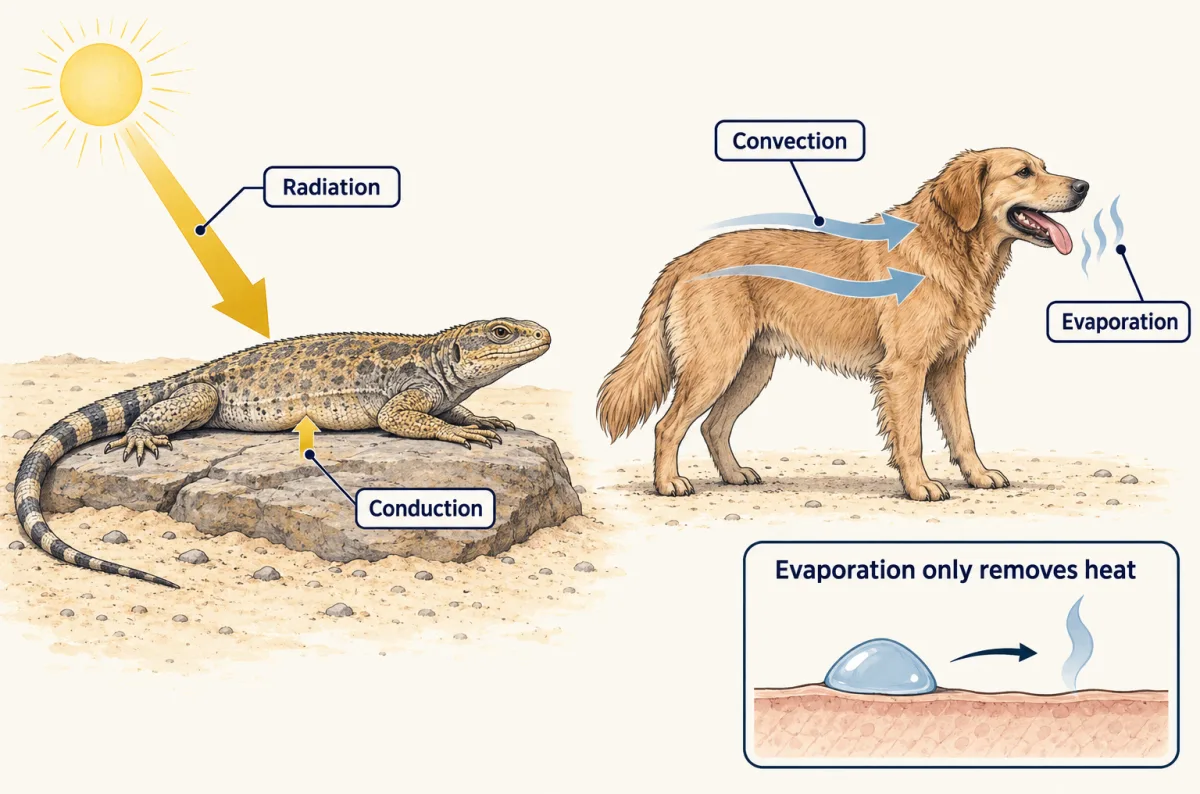
Radiation, conduction and convection can run either way. In this lesson's bookkeeping, sunlight on the lizard's back and heat from its warm rock are heat gained, G; the net dry exchange with the rest of the surroundings is the dry leak. In practice evaporation (panting) only removes heat. AI-generated illustration 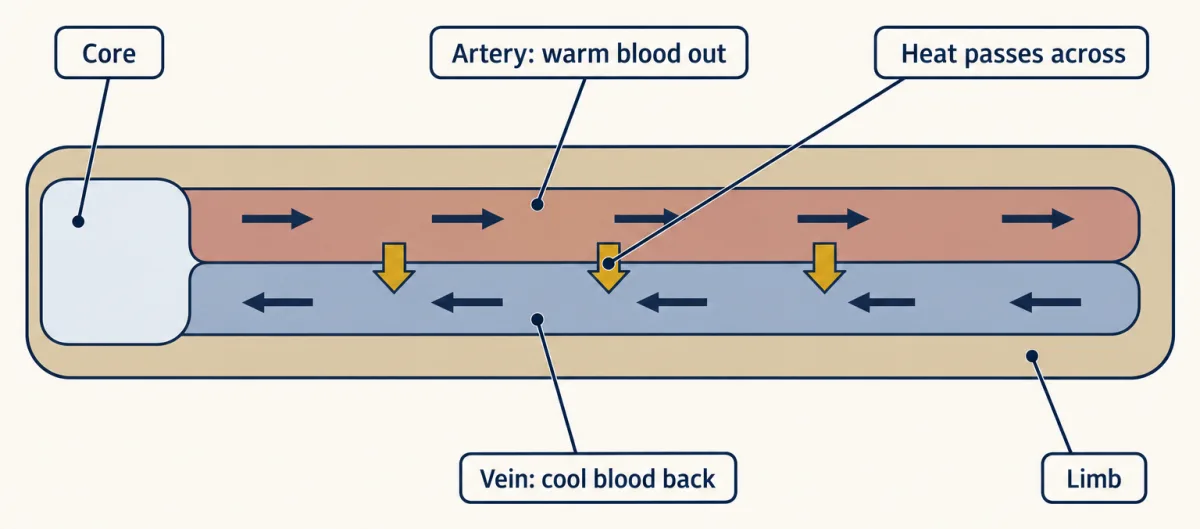
In countercurrent exchange, an artery carrying warm blood out to a limb runs alongside the vein bringing cool blood back, so heat passes across and much of it returns to the core. AI-generated illustration -
Endotherms, ectotherms and a second axis
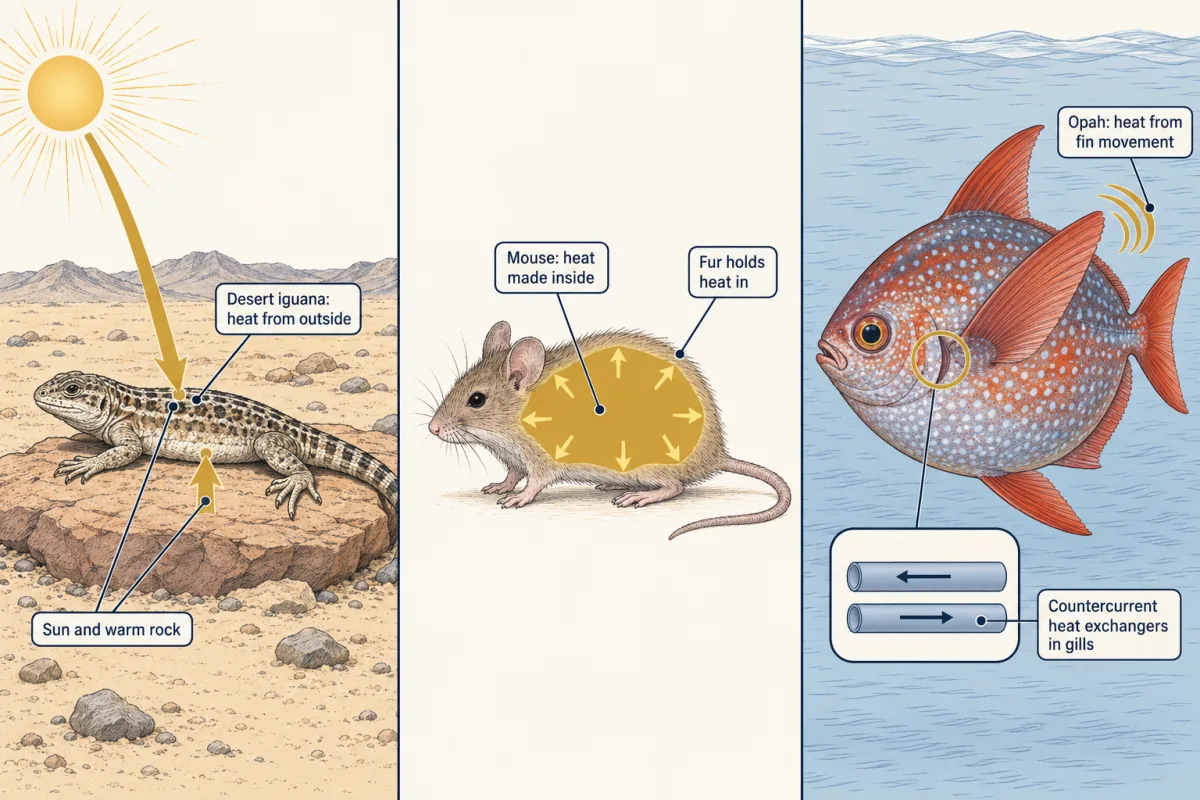
An iguana takes its heat from sun and rock, a mouse makes its own and holds it in with fur, and the opah, unusually for a fish, warms its body with heat from its beating pectoral fins and keeps it with countercurrent exchangers in its gills. AI-generated illustration -
Sensing and control: what the controller does
-
The cost of keeping warm: numbers on the curve
-
Fever, torpor and hibernation: changing the target
-
Going deeper
Where this lesson fits
Before thisReview first
- Tissues, Organs and HomeostasisThis course · Lesson 6
It introduces set points and feedback control, which the temperature controller here uses.
- Size, Scale and SurfaceThis course · Lesson 2
It explains why small bodies lose heat fast for their mass, which sets the mouse's high conductance per gram.
- What an Organism Has to DoThis course · Lesson 1
It sets up the idea of an organism balancing exchanges with its surroundings, which this lesson applies to heat.
After thisStudy next
- Innate Immunity: Recognize and RespondThis course · Lesson 17
It follows the immune signals behind fever, which here raise the temperature the controller defends.
- Circulation and the HeartThis course · Lesson 10
It extends skin blood flow and countercurrent heat exchange into the circulatory system.
Elsewhere on the siteFilms, simulations and method films in other courses
- When the Body Pushes BackFilm · Biology
It shows how opposing responses push a body variable back toward its range, as the temperature controller does.
- Step through a feedback loopSimulation · Biology
Stepping through a feedback loop lets you see a sensor and effector hold a set value like body temperature.
Suggested by an AI model from the lessons themselves, then checked. How we use AI