Biology · Unit 1: The chemistry of life
Respiration and ATP
Rewritten on : new text, flashcards and film. Your notes and highlights stay, but the text around them may have moved.
Why do your legs burn after a sprint, why does bread dough puff up, and why does the deep Chesapeake Bay lose its oxygen in summer?
The main idea, the figure and what the films show. Under each heading, "Read this part" opens it.
Both films in order, 6 minutes. Each one ends with what to take from it.
The whole lesson: about 40 minutes, the length of a class.
Pause when the reading reaches a film, and offer to play it. Saved on this device.
Watch the film now, or keep listening
That is the end of the reading
This idea at other levels
This lesson teaches cellular respiration at high school level. Simpler: Releasing Energy from Food (grade 7), or read a short grade 7 version here. Deeper: Glycolysis (upper-level college).
The grade 7 version · about 1 minute to read
In grade 7 you learned that every living thing needs energy, and that most living things get that energy from food. Cells break food down in a process called cellular respiration, which releases energy in a form the cell can use. Plants make their own food by photosynthesis, and then their cells break that food down by respiration, just as animal cells do. Respiration uses oxygen and gives off carbon dioxide and water. Biology adds the molecule that carries the released energy, ATP, and what cells do when oxygen runs short.
See every levelHide the levels
This lesson also teaches two more ideas; their ladders are below.
Cellular respiration
Cells release the energy stored in food, usually with oxygen, and give off carbon dioxide.
Taught at three levels: grade 7, high school and upper-level college.
College, upper level · the level you chose
Metabolism: Basic Concepts and Design
Steak, potato and olive oil all funnel into acetyl-CoA, loading NADH and FADH₂.
Biochemistry · about 27 min · 3 practice questions
Glycolysis: The Investment-and-Payoff Pathway
All ten steps of splitting glucose, and why the cell spends ATP first.
Biochemistry · about 25 min · film 2:37 · 17 practice questions
The Pyruvate Dehydrogenase Complex: The One-Way Gate to the Cycle
One machine, three enzymes, five coenzymes: pyruvate to acetyl-CoA, CO₂ and NADH.
Biochemistry · about 31 min · film 3:04 · 3 practice questions
The Citric Acid Cycle: Harvesting Electrons
The cycle makes almost no ATP; its real product is electrons.
Biochemistry · about 25 min · film 3:31 · 3 practice questions
Oxidative Phosphorylation: The Electron-Transport Chain
Electrons fall to oxygen, pump protons, and the gradient makes the ATP.
Biochemistry · about 24 min · film 3:54 · 5 practice questions
High school · the level you chose
Respiration and ATP · this lesson
Glucose and oxygen become carbon dioxide and water, rebuilding about 30 ATP per glucose.
Biology · about 40 min · film 3:15 · Virginia BIO.2e
Play the ladder · 9 films, about 30 min, from grade 7 to upper-level college. Each film waits for you to press play.
Next door to cellular respiration
- PhotosynthesisPhotosynthesis stores the energy that respiration later releases.Nearest lesson: Capturing Sunlight (high school)
- EnzymesEvery step of respiration is run by its own enzyme.Nearest lesson: Enzymes at Work (high school)
ATP, the cell's energy carrier
ATP is a small molecule that cells spend to power their work, then rebuild from ADP and phosphate.
Taught at two levels: high school and upper-level college.
College, upper level · the level you chose
Metabolism: Basic Concepts and Design
ATP's real ΔG in a red cell is about −52.7 kJ/mol, not −30.5.
Biochemistry · about 27 min · film 3:18 · 3 practice questions
High school · the level you chose
Respiration and ATP · this lesson
Spend ATP, rebuild ATP from ADP: why 'ATP is energy' is wrong.
Biology · about 40 min · film 3:15 · Virginia BIO.2e
Play the ladder · 2 films, about 7 min, from high school to upper-level college. Each film waits for you to press play.
Next door to ATP
- Muscle contraction (sliding filaments)Every pull of a muscle uses ATP, which is why a muscle with none stays stiff.Nearest lesson: Muscle, Bone and Movement (a first college course)
- Active transport and transport proteinsPumps in the cell membrane spend ATP to push ions where they would not go alone.Nearest lesson: Crossing the Membrane (high school)
Fermentation
Without enough oxygen, a cell breaks glucose down only partway, making a little ATP plus lactate or ethanol.
Taught at two levels: high school and upper-level college.
College, upper level · the level you chose
Glycolysis: The Investment-and-Payoff Pathway
Why it exists: lactate dehydrogenase returns NAD+ so step 6 keeps running.
Biochemistry · about 25 min · 17 practice questions
High school · the level you chose
Respiration and ATP · this lesson
Stop partway: 2 ATP per glucose, lactate in muscle, ethanol in yeast.
Biology · about 40 min · film 3:11 · Virginia BIO.2e
Next door to fermentation
- Muscle fatigueA hard-working muscle that runs short of oxygen makes lactate, one reason it tires.Nearest lesson: Skeletal Muscle: Length, Load and Speed (upper-level college)
- Cellular respirationWith oxygen, the same glucose yields far more ATP than the partway route gives.Nearest lesson: Releasing Energy from Food (grade 7)
Short versions inside this lesson
Where Biology II takes it · about 1 minute to read
Biology II opens the summary equation into its three stages. Glycolysis, in the cytoplasm, splits glucose into two molecules of pyruvate for a net gain of 2 ATP and loads electrons onto the carrier NAD+, making NADH. In the mitochondria, the Krebs cycle finishes breaking the carbon down to carbon dioxide and loads more electron carriers. The electron transport chain, in the inner mitochondrial membrane, passes those electrons to oxygen and pumps protons across the membrane; the protons flowing back through the enzyme ATP synthase drive most ATP formation. Fermentation exists because it turns NADH back into NAD+, so glycolysis can keep running without oxygen.
Find an idea: every idea, searchable
Which lessons teach an idea, and the notes on each level, were written by AI models from the lessons and checked by a second model. A person has not yet read every one. How we use AI
About this lesson goals, help with the tasks, standards, parts
What you'll learn
- You will describe cellular respiration as the breakdown of glucose with oxygen into carbon dioxide and water, mostly in the mitochondria, with much of the released energy stored in ATP, and write the equation (C6H12O6 + 6O2 → 6CO2 + 6H2O + energy, much of it captured as ATP).
- You will explain how ATP stores and releases energy when a phosphate group is added or removed, and why the idea that ATP is itself energy is wrong.
- You will compare aerobic respiration with fermentation (called anaerobic respiration in the SOL) for oxygen use, speed, ATP per glucose (about 30 versus 2) and products, and connect respiration and photosynthesis as a cycle of matter.
Help with the tasks
Builds on:Capturing Sunlight (read)Enzymes at Work (read)Why these?
Essential question: How does the energy in food become energy a cell can use, with or without oxygen?
Standards: Virginia SOL BIO.2e · Practices BIO.1c, BIO.1d, BIO.1e, BIO.1f
Grade 7 Life Science: LS.4 b · Biology II: Advanced Survey of Biology Topics, BIOII.3 c
Rewritten on : new text, flashcards and film. Notes and highlights stay, but the text around them may have moved.
The main idea. Cells spend ATP and rebuild it by taking glucose apart; a glucose taken all the way to carbon dioxide and water with oxygen rebuilds about 30 ATP, while a glucose that stops partway in fermentation rebuilds 2, leaving most of the energy in lactate or ethanol.
The films
 ▶ Watch Spending ATP, Rebuilding ATP · 3:15
Read the transcript of “Spending ATP, Rebuilding ATP”
Film transcript: Spending ATP, Rebuilding ATP
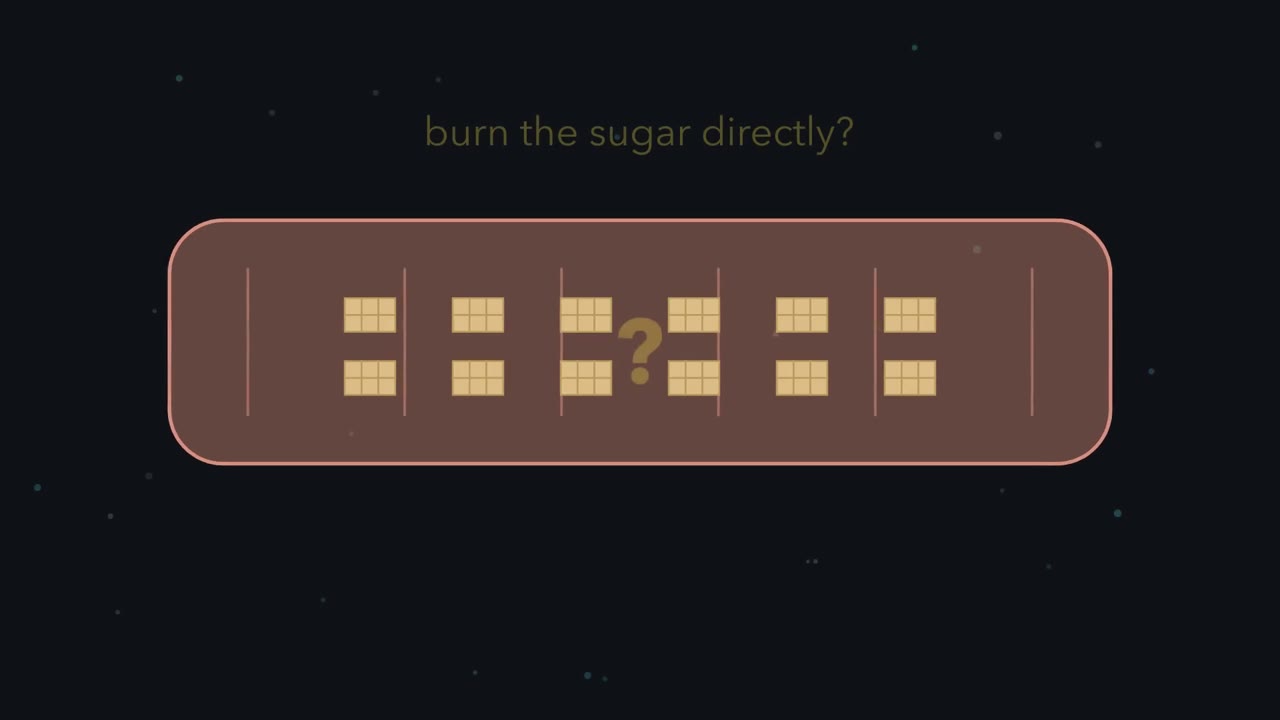
You just ate a sandwich, and your leg muscles are well stocked with sugar. So why can't a muscle simply burn that sugar to pull? The answer is a small molecule called ATP. Every working cell spends energy. A muscle cell pulls. A nerve cell pumps charged particles across its membrane. Almost every cell builds proteins.
None of these jobs runs on glucose directly. They run on ATP, a molecule that carries energy to the jobs that use it. ATP has three phosphate groups in a row. When it reacts with water, the end phosphate comes off. What is left is ADP, with only two. That reaction releases the energy the muscle uses to pull. Here's the catch. A cell keeps only a small supply of ATP. Watch that supply while the muscle keeps pulling, again and again. Suppose nothing rebuilt ATP from ADP. What would happen to this supply, and to the pulling?
The supply would soon run low, and the pulling would stop. So a working cell rebuilds ATP from ADP all the time. Putting the phosphate back takes energy. That energy comes from taking glucose apart. Glucose holds energy in the way its atoms are bonded. Taking it apart starts in the cytoplasm, the jelly-like inside of the cell. These first steps split glucose in two and rebuild a little ATP. With oxygen, the two halves move into a mitochondrion. This organelle finishes the job, down to carbon dioxide and water. Most of the ATP is rebuilt here. Count what one glucose gave back. With oxygen, it rebuilds about thirty ATP. Some energy also leaves as heat.
That is one reason you warm up when you exercise. Now the loop closes. Work turns ATP into ADP. Respiration turns ADP back into ATP. Round and round, for as long as the cell is alive. This whole process is cellular respiration. Glucose and oxygen go in. Carbon dioxide and water come out, with energy, much of it captured in ATP. ATP is not energy itself. It is a molecule that carries it. But a sprinting leg can need ATP faster than oxygen-using respiration can rebuild it. Yeast sealed in bread dough gets almost no oxygen at all. What happens then? Switch the oxygen off in the simulation and find out.
From the film: five take-homes
- Cells do work by spending ATP, which becomes ADP and a phosphate when it reacts with water.
- A cell keeps only a small supply of ATP, so it rebuilds ATP from ADP all the time.
- The energy to rebuild ATP comes from taking glucose apart; the first steps run in the cytoplasm.
- With oxygen, mitochondria finish the job, down to carbon dioxide and water; the whole route rebuilds about 30 ATP per glucose.
- ATP is a molecule that carries energy; it is not energy itself.
After a hard sprint up a few flights of stairs, your legs may burn and you may keep breathing hard for a few minutes. Meanwhile, bread dough in a warm kitchen puffs up with bubbles, and in summer, parts of the deep Chesapeake Bay hold very little oxygen.
Your legs were stocked with sugar the whole time, yet a muscle can’t pull with glucose directly. All three puzzles turn on one question: how far a cell takes glucose apart, and whether oxygen is used to do it.
What do you think? Decide before you read.
-
Scientists disagree: ATP is a molecule made of atoms you can count: an adenine-and-sugar part with three phosphate groups attached. Energy is released when ATP reacts with water and loses a phosphate. ATP carries energy; it is not energy.
What scientists think
Scientists disagree: ATP is a molecule made of atoms you can count: an adenine-and-sugar part with three phosphate groups attached. Energy is released when ATP reacts with water and loses a phosphate. ATP carries energy; it is not energy.
-
Scientists disagree: Plant cells have mitochondria, just as animal cells do, and they break down sugar for ATP day and night. A plant sealed in a dark jar gives off carbon dioxide. In bright light, photosynthesis takes in more carbon dioxide than respiration releases, which hides the respiration from view.
What scientists think
Scientists disagree: Plant cells have mitochondria, just as animal cells do, and they break down sugar for ATP day and night. A plant sealed in a dark jar gives off carbon dioxide. In bright light, photosynthesis takes in more carbon dioxide than respiration releases, which hides the respiration from view.
-
Scientists disagree: Breathing moves air in and out of your lungs. Cellular respiration is a chemical process inside cells that releases energy from food to build ATP. The two are linked: breathing brings in the oxygen your cells use and removes the carbon dioxide they make. Yeast and bacteria have no lungs, yet many of them respire.
What scientists think
Scientists disagree: Breathing moves air in and out of your lungs. Cellular respiration is a chemical process inside cells that releases energy from food to build ATP. The two are linked: breathing brings in the oxygen your cells use and removes the carbon dioxide they make. Yeast and bacteria have no lungs, yet many of them respire.
Explore: run a cell’s energy budget
In the simulation you choose whether oxygen is present and how much glucose arrives each second. Bars show the ATP made per glucose, the ATP made per second (how fast ATP is resupplied) and which products pile up.
- Glucose needed to make 60 ATP
- 2
- Oxygen used
- 6 per glucose
In this sketch every glucose supplied is broken down, and the cell makes 30 ATP per glucose with oxygen (the lesson says about 30 to 32) or 2 without. Glucose per second is in sketch units, not a measurement. The sketch does not show speed per enzyme.
Rule to keep: ATP per glucose depends on oxygen (about 30 with it, 2 without); ATP per second also depends on how much glucose arrives.
Try this.
- Predict how the ATP made per glucose will change when you switch oxygen off. Write your guess, then switch it off.
- With oxygen off, choose a muscle cell and then a yeast cell. Predict which products each one shows before you look.
- Keep oxygen off and double the glucose supply. Predict whether ATP per second changes, and whether ATP per glucose changes.
- Turn oxygen back on. Predict how many glucose molecules the cell needs to make 60 ATP, then check.
Explain: ATP carries energy to where it is used
The one idea. A cell’s jobs, from a muscle pulling to a nerve cell pumping charged particles to building proteins, run on ATP, not on glucose directly. The cell rebuilds ATP from ADP with energy from taking glucose apart. A glucose taken all the way down to carbon dioxide and water, with oxygen, rebuilds about 30 ATP. When oxygen-using respiration can’t keep up, glucose that stops partway, at lactate or ethanol, rebuilds only 2. Most of its energy stays locked in those leftovers.
Scope: glucose in plant, animal and fungal cells such as muscle and yeast, with classroom yields of about 30 and 2 ATP per glucose. ATP is the main carrier; a few jobs use others. Bacteria come up only briefly; how they make ATP without mitochondria is in Going deeper.
- cellular respiration
- mitochondria
- ATP
- ADP
- aerobic
- anaerobic
- fermentation
- lactate
The first film showed ATP (adenosine triphosphate, three phosphate groups) losing its end phosphate to water to become ADP (adenosine diphosphate, two). It left out why that releases energy at all.
Predict. Breaking any chemical bond takes energy. So how can ATP release energy when its end phosphate comes off?
Check your prediction
The energy comes from the whole reaction, not from snapping one bond. The products, ADP and phosphate, end up more stable than ATP and water were, meaning lower in energy. That difference is the energy the cell can use. Think of a ball on a shelf. Pushing it over the edge takes a nudge, but it ends lower than it started, and the drop is what you get.
ATP is like a rechargeable battery, drained by work and charged by respiration. Unlike a battery, though, ATP really changes into ADP and a loose phosphate, and is then rebuilt.
Explain: where ATP is rebuilt
The first film built the respiration equation but skipped where the energy sits and whether the atoms add up. Glucose, the sugar from Capturing Sunlight, holds energy in how its atoms are bonded. Rearranged with oxygen into carbon dioxide and water, the same atoms sit lower in energy, like the ball on the floor. Cellular respiration is cells breaking down glucose and other food molecules and using the released energy to build ATP, in plants, animals, fungi and many microbes.
C6H12O6 + 6O2 → 6CO2 + 6H2O + energy (much of it captured in ATP)
Check the atoms: 6 carbons, 12 hydrogens and 18 oxygens on each side. Matter is rearranged, not created or lost.
The real process runs as many small steps, each sped up by an enzyme, usually a protein (see Enzymes at Work). The first film placed the first steps in the cytoplasm and the rest in the mitochondria (one is a mitochondrion), organelles found in plant, animal and fungal cells.
For an animal cell, modern estimates say about 30 to 32 ATP per glucose; real cells vary (see Going deeper). No energy is made or destroyed: it moves from glucose into ATP and heat.
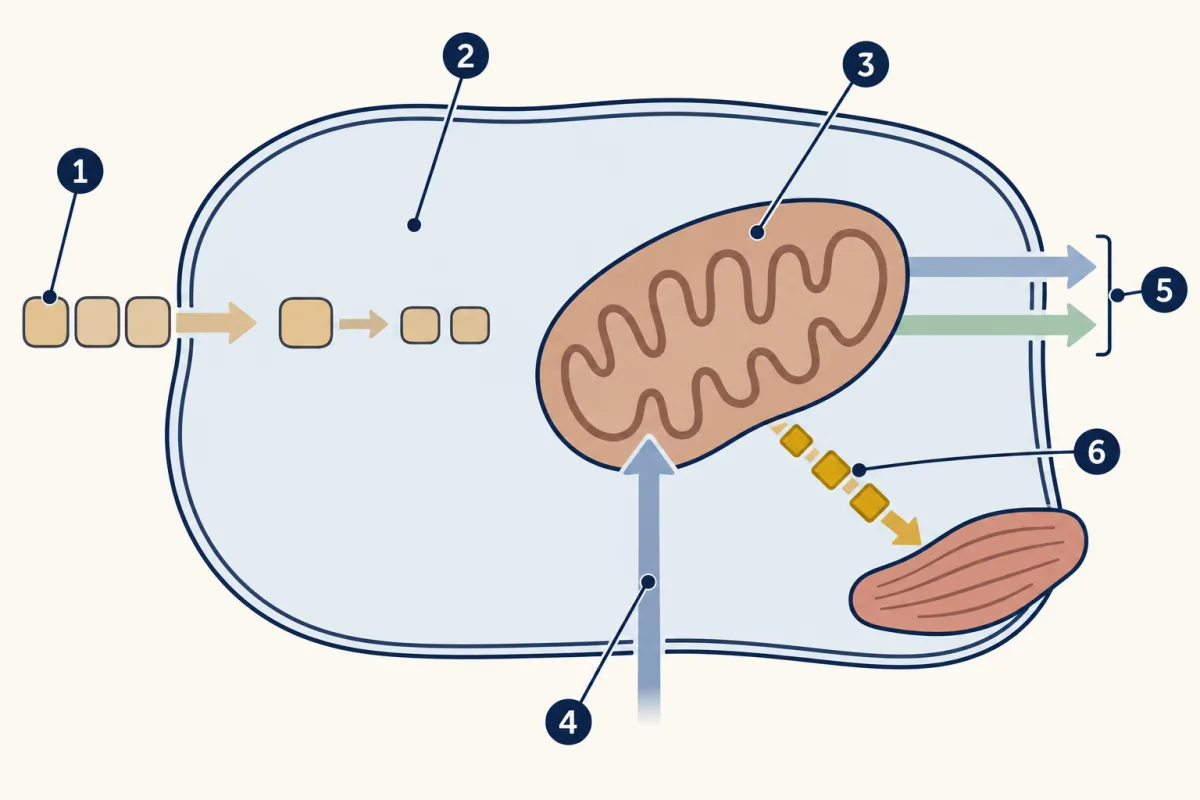
- glucose
- cytoplasm
- mitochondrion
- oxygen
- carbon dioxide and water
- ATP
- glucose
- blank
- mitochondrion
- blank
- blank
- blank
Word bank: ATP, carbon dioxide and water, cytoplasm, oxygen
- blank
- blank
- blank
- blank
- blank
- blank
Check your labels
- glucose
- cytoplasm
- mitochondrion
- oxygen
- carbon dioxide and water
- ATP
All of that depended on oxygen-using respiration. A sprinting leg can need ATP faster than that route supplies it, even with its mitochondria working, and yeast sealed in dough gets almost no oxygen. The second film turns the oxygen down.
Read the transcript of “Stopping Partway”
Film transcript: Stopping Partway
Can a cell still rebuild ATP when oxygen-using respiration can't keep up? A sprinting leg and yeast sealed in dough both face this problem. In the first film, glucose began breaking down in the cytoplasm. With oxygen, the mitochondrion finished the job. That gave about thirty ATP per glucose. Now we turn the oxygen down and watch the same cell. The first steps still run in the cytoplasm. They need no oxygen, and they are the same steps as before. Glucose splits in two, and the counter reaches two ATP. With too little oxygen, or too much demand, the mitochondrion can't keep up. Some halves can't go on into it. For those, the cell has to stop partway.
Their energy stays locked inside. In a working muscle cell, the halves become lactate. Lactate builds up when the muscle makes it faster than it can be used. Your leg muscles do this during a hard sprint. In yeast, the halves become ethanol and carbon dioxide. The carbon dioxide forms the bubbles that make bread dough rise. This partway route has a name. Biologists call it fermentation. It runs in the cytoplasm and never uses the mitochondrion. Watch the counter. Turning the halves into lactate or ethanol adds nothing. Both ATP came from the first steps. Why only two ATP? Look at the leftovers. Lactate and ethanol still hold over nine-tenths of the energy that was in the glucose. Fermentation frees only a small part of it.
So suppose a cell needs thirty ATP, and it has no oxygen. How many glucose must it break down? Fifteen glucose. With oxygen, about one would do. Without it, the fermenting cell has to pull in glucose after glucose just to keep up. That is about fifteen times as much glucose for the same ATP. Fermentation does have strengths. It needs no oxygen, and it can make ATP quickly. So a hard-working muscle adds it when oxygen-using respiration can't keep up. The mitochondria keep working too. Yeast in sealed dough has no other choice. Take a glucose all the way apart, and the cell rebuilds about thirty ATP. Stop it partway, and it rebuilds two. Most of the energy stays behind in the leftovers.
Same glucose, same first steps, very different payoff.
From the film
- When oxygen-using respiration can't keep up, some glucose stops partway; each glucose that stops partway rebuilds just 2 ATP, while the mitochondria keep working on the rest.
- In muscle the halves become lactate; in yeast they become ethanol and carbon dioxide, which makes dough rise.
- Lactate and ethanol still hold over nine-tenths of glucose's energy, which is why fermentation yields so little ATP.
- To rebuild the same ATP, a fermenting cell must break down about 15 times as much glucose.
Explain: with oxygen and without it
The second film showed glucose stopping partway for 2 ATP. It left out why a cell bothers with a last step that adds no ATP. Aerobic means using oxygen; anaerobic means without it. The first steps, which rebuild the 2 ATP, use up a small helper molecule (Biology II calls it NAD+). Turning the halves into lactate or ethanol hands that helper back, so the first steps can keep running. It is not all or nothing, as the second film showed.
What to call it. Biologists call this route fermentation: making a small amount of ATP from glucose without oxygen. The SOL calls it anaerobic respiration, a name biologists also use for something different that some microbes do (see Going deeper).
Predict. If lactate still holds most of glucose’s energy, does your body throw it away?
Check your prediction
No. Lactate, the muscle’s leftover, is not just waste: the heart, other muscles and the liver use it as fuel or to rebuild glucose.
| Aerobic respiration | Fermentation | |
|---|---|---|
| Uses oxygen? | Yes | No |
| Where in the cell | Starts in the cytoplasm; most ATP made in mitochondria | Cytoplasm |
| ATP per glucose | About 30 to 32 | 2 |
| Products | Carbon dioxide and water | Muscle: lactate. Yeast: ethanol and carbon dioxide |
| Speed | Often slower | Often faster |
Whether fermentation is really faster for the same amount of enzyme is still debated (see Going deeper). About the burn and the breathing:
- The burn is not caused by lactate alone; experiments point to a mix of acid, lactate and other chemicals.
- Soreness the next day is a different effect, and lactate is not its cause.
- You keep breathing hard after a sprint partly because your cells use extra oxygen while they recover.
Respiration and photosynthesis mirror each other. Photosynthesis uses light energy to build glucose from carbon dioxide and water, releasing oxygen; respiration breaks glucose back down with oxygen into carbon dioxide and water. Plants do both. The atoms go round and round between them, while energy arrives as light and leaves as heat (see Matter Cycles).
Elaborate: the Bay’s summer oxygen gap
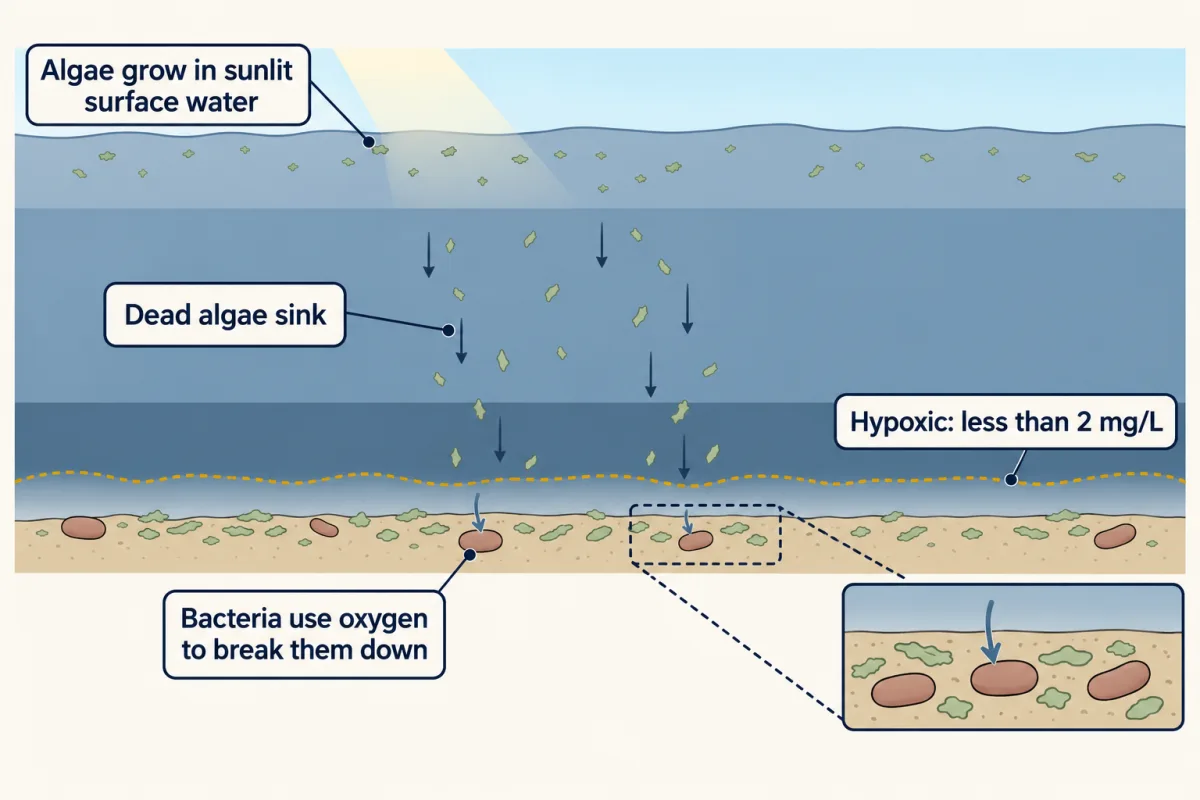
Here the all-the-way-down route is the problem. In spring and summer, algae grow in the sunlit surface water, fed by nutrients that rivers carry in from the land, much of them from human activity. Many die and sink, and near the bottom bacteria break them down by aerobic respiration, using up the dissolved oxygen. In summer the warm surface layer does not mix well with the deep water, so little new oxygen reaches the bottom. Water with less than 2 milligrams of oxygen per liter (2 mg/L) is hypoxic; a large patch of it is often called a dead zone.
| Year | Largest hypoxic volume on any one day (km³) |
|---|---|
| 2020 | 9.8 |
| 2021 | 8.2 |
| 2022 | 10.7 |
| 2023 | 3.3 |
| 2024 | 9.8 |
| 2025 | 10.1 |
Source: Virginia Institute of Marine Science (William & Mary), December 2025 dead-zone report, Table 1. Each value is a computer-model estimate for the whole Bay on that year’s worst day, not a reading at one station. One cubic kilometer (km³) is a trillion liters.
- Which year had the smallest peak volume? About what fraction of the 2022 peak was it?
- Find the mean of the six values, rounded to the nearest whole number.
- Use the respiration equation: why would more sinking algae make the bottom water lose oxygen faster?
Claim, evidence, reasoning
Using the Bay data, make a claim about how bacteria get energy from sinking algae and what that does to the oxygen in deep water.
Start with: Bacteria in the deep Bay get energy from dead algae by blank, which uses up blank.
Start with: In most years from 2020 to 2025 the peak hypoxic volume was about blank km³, but in blank it was only blank km³.
Start with: Aerobic respiration uses blank to break food down into blank and blank, so when more blank sink, the oxygen in the bottom water blank.
Compare with a model answer
Bacteria in the deep Bay break down dead algae by aerobic respiration, which uses oxygen to release the energy in the algae’s food molecules and captures part of it in ATP. In five of the six years from 2020 to 2025, the peak volume of water below 2 mg/L of oxygen was between 8.2 and 10.7 km³; in 2023 it was only 3.3 km³. Because respiration keeps using oxygen and deep water is slow to gain more, a sizable volume of the deep Bay becomes hypoxic every summer. One limit: these are model estimates for one peak day a year, so they do not show how long the low oxygen lasted or why 2023 was lower.
Saved in this browser only.
Design problem
Plan an investigation to test whether bread yeast needs to be alive to make gas from sugar. You have dry yeast, sugar, warm water, small plastic bottles, balloons and a string with a ruler.
Saved in this browser only.
One way to do it
- Question: Does gas come from living yeast cells breaking down sugar?
- Independent variable: the yeast in each bottle: live yeast, no yeast (the control), or yeast that your teacher has boiled first so the cells are dead.
- Dependent variable: the distance around each balloon after 30 minutes, measured with the string.
- Constants: the same amount of sugar, water and yeast, the same water temperature, the same bottle and balloon size, and the same time.
- Repeated trials: three bottles of each kind, nine in all. Find the mean for each kind.
- What results would mean: if only the live-yeast balloons inflate, the gas comes from the live yeast breaking down sugar. Boiling kills the cells and also destroys their enzymes, so this test cannot say which of the two stopped the gas.
- Safety: use warm tap water, not hot water. Let the teacher do any boiling. Do not taste anything, and wipe up spills.
Evaluate: check your thinking
In the sprint and the dough, how far glucose was taken apart set how much ATP came back; in the Bay, the oxygen it takes to go all the way down is the problem.
- Sprint: when aerobic respiration alone can’t rebuild ATP fast enough, fermentation adds quick ATP and lactate builds up.
- Dough: yeast ferments sugar, and the carbon dioxide makes the bubbles.
- Bay: bacteria break down sinking algae by aerobic respiration and use up oxygen faster than it returns.
Science practices you used: making predictions and testing them with a model, reading a data table and finding a mean, planning a fair test with a control and repeated trials, and backing a claim with evidence while naming the limits of the data.
Going deeper
Is fermentation faster for the same amount of enzyme?
A 2024 analysis estimated that, for the same mass of enzyme, the fermentation route made ATP about 2.1 times as fast as respiration in yeast and 3.1 times as fast in mammal cells. In the bacterium E. coli, though, respiration was faster. Scientists still debate this result, because another 2024 study found respiration more efficient for the same amount of protein, in yeast, immune cells and cancer cells. The debate bears on a puzzle: baker’s yeast given plenty of sugar ferments even when oxygen is present.
How big is the ATP yield from one glucose?
Older textbooks say 36 to 38 ATP per glucose. The modern estimate of about 30 to 32 is lower mainly because each ATP turned out to cost more of the energy the mitochondrion stores across its inner membrane than older counts assumed; the total also depends on which shuttle passes electrons from the helper molecule in the cytoplasm to the electron transport steps in the mitochondrion. Real cells can get less, because some stored energy leaks away, and some, such as baker’s yeast, get fewer.
The first seconds of a sprint
For the first few seconds of a sprint, a store called creatine phosphate refills ATP; then fermentation adds ATP and lactate builds up.
Bacteria
Bacteria have no mitochondria. In those that use oxygen, the electron transport steps, which make most of the ATP, run on the cell membrane.
Anaerobic respiration in a stricter sense
Some microbes carry out anaerobic respiration in a stricter sense, using another substance such as nitrate or sulfate in place of oxygen.
Your notes
Select any text in the lesson to highlight it or add a note to it. Your highlights and notes are saved in this browser and collected in your notebook.
This browser is not letting the site save anything (a private window or strict privacy settings), so highlights and notes will be lost when you leave the page.
Try the Predict questions again
Two Predict questions from this lesson, on their own. Answer each one first, then open its check.
Breaking any chemical bond takes energy. So how can ATP release energy when its end phosphate comes off?
From: Explain: ATP carries energy to where it is used
Check your prediction
The energy comes from the whole reaction, not from snapping one bond. The products, ADP and phosphate, end up more stable than ATP and water were, meaning lower in energy. That difference is the energy the cell can use. Think of a ball on a shelf. Pushing it over the edge takes a nudge, but it ends lower than it started, and the drop is what you get.
If lactate still holds most of glucose’s energy, does your body throw it away?
From: Explain: with oxygen and without it
Check your prediction
No. Lactate, the muscle’s leftover, is not just waste: the heart, other muscles and the liver use it as fuel or to rebuild glucose.
How we measure it
Computer modelling of dissolved oxygen in the Bay
The Chesapeake Bay Environmental Forecast System, run by scientists at the Virginia Institute of Marine Science, estimates every day how much of the Bay's water holds less than 2 mg of oxygen per liter. Yearly summaries of those estimates show how big the low-oxygen zone gets.
Measuring gas from fermenting dough
An instrument called a Risograph records the volume of gas that yeast releases from a sample of dough over time. More gas means more fermentation, although the reading does not measure ATP directly.
Breath-by-breath gas analysis
A person breathes through a mouthpiece connected to sensors that measure the oxygen and carbon dioxide in every breath. Scientists use it to follow how gas exchange changes during and after exercise.
Where this lesson fits
Before thisReview first
- Capturing SunlightThis course · Lesson 4
You need to know how glucose is built from carbon dioxide and water, with its energy, before taking it apart here.
- Enzymes at WorkThis course · Lesson 3
Respiration runs as many small steps, each sped up by an enzyme, so you need how enzymes work.
After thisStudy next
- Matter CyclesThis course · Lesson 31
It follows carbon and oxygen atoms round between respiration and photosynthesis, which this lesson only introduces.
- Energy in EcosystemsThis course · Lesson 30
It uses respiration to explain why energy leaves a food chain as heat at each step.
- The Chesapeake Under PressureThis course · Lesson 33
It takes the bottom-water oxygen loss from bacterial respiration further, tracing how fertilizer causes it.
Suggested by an AI model from the lessons themselves, then checked. How we use AI
That is the skim: you have the shape of it.
That is both films: the lesson in pictures.
The rest of the lesson is here when you want it.
Finish line
Test yourself
8 questions
Practice and MCAT-style, with explained answers.
Next · Lesson 6
The Cell Theory and Its Evidence
Robert Hooke saw tiny boxes in a slice of cork in 1665, so why did it take about 175 more years to claim that plants and animals alike are made of cells?
Continue →Rewritten on : new text, flashcards and film. Notes and highlights stay, but the text around them may have moved.