Spending ATP, Rebuilding ATP
Read the transcript of “Spending ATP, Rebuilding ATP”
Film transcript: Spending ATP, Rebuilding ATP
You just ate a sandwich, and your leg muscles are well stocked with sugar. So why can't a muscle simply burn that sugar to pull? The answer is a small molecule called ATP. Every working cell spends energy. A muscle cell pulls. A nerve cell pumps charged particles across its membrane. Almost every cell builds proteins.
None of these jobs runs on glucose directly. They run on ATP, a molecule that carries energy to the jobs that use it. ATP has three phosphate groups in a row. When it reacts with water, the end phosphate comes off. What is left is ADP, with only two. That reaction releases the energy the muscle uses to pull. Here's the catch. A cell keeps only a small supply of ATP. Watch that supply while the muscle keeps pulling, again and again. Suppose nothing rebuilt ATP from ADP. What would happen to this supply, and to the pulling?
The supply would soon run low, and the pulling would stop. So a working cell rebuilds ATP from ADP all the time. Putting the phosphate back takes energy. That energy comes from taking glucose apart. Glucose holds energy in the way its atoms are bonded. Taking it apart starts in the cytoplasm, the jelly-like inside of the cell. These first steps split glucose in two and rebuild a little ATP. With oxygen, the two halves move into a mitochondrion. This organelle finishes the job, down to carbon dioxide and water. Most of the ATP is rebuilt here. Count what one glucose gave back. With oxygen, it rebuilds about thirty ATP. Some energy also leaves as heat.
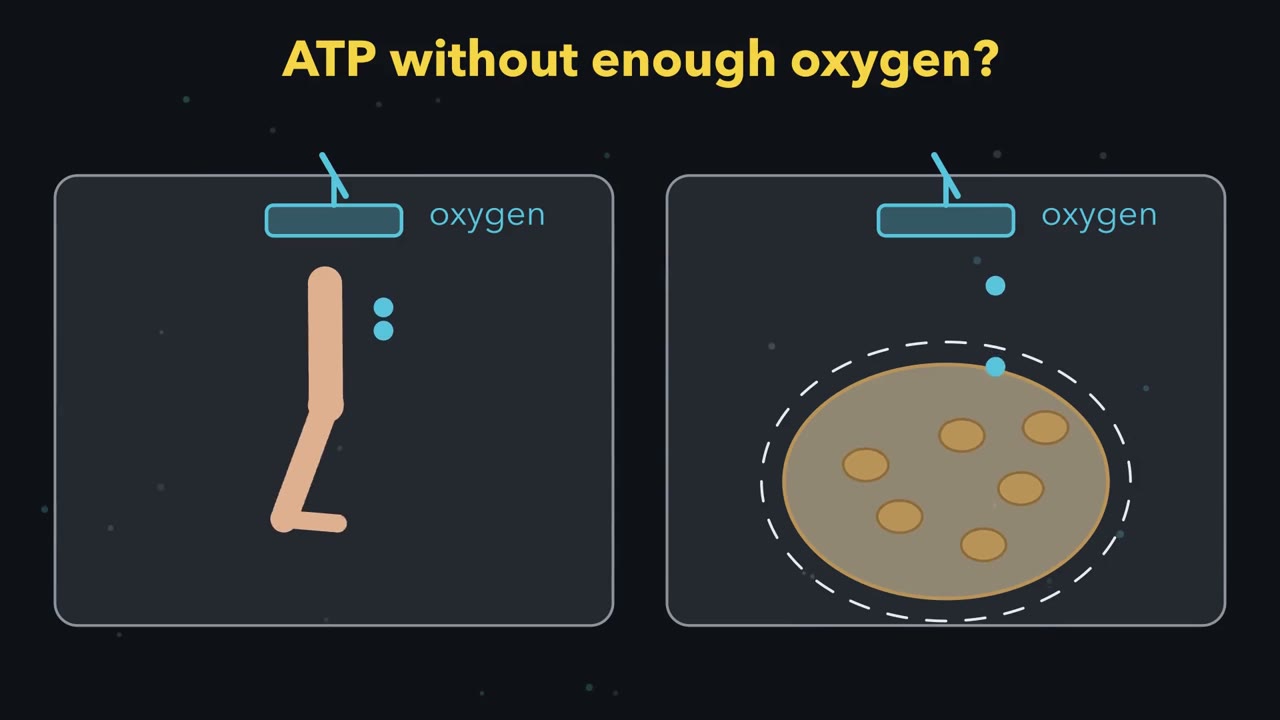
That is one reason you warm up when you exercise. Now the loop closes. Work turns ATP into ADP. Respiration turns ADP back into ATP. Round and round, for as long as the cell is alive. This whole process is cellular respiration. Glucose and oxygen go in. Carbon dioxide and water come out, with energy, much of it captured in ATP. ATP is not energy itself. It is a molecule that carries it. But a sprinting leg can need ATP faster than oxygen-using respiration can rebuild it. Yeast sealed in bread dough gets almost no oxygen at all. What happens then? Switch the oxygen off in the simulation and find out.
Why do your legs burn after a sprint, why does bread dough puff up, and why does the deep Chesapeake Bay lose its oxygen in summer?
Continue in the lesson: Respiration and ATP →
3:15 · Free, with captions and a transcript. The lesson has the full text, the questions and the sources.
More films from this lesson
How this film was made. Narration: written from this lesson's text and read by an AI narrator voice (Kokoro, af_heart). Animation: AI-generated in code (Manim) by Claude, a schematic with no drawn molecular structures. Captions come from the narration script. See something wrong? Report it.