Stopping Partway
Read the transcript of “Stopping Partway”
Film transcript: Stopping Partway
Can a cell still rebuild ATP when oxygen-using respiration can't keep up? A sprinting leg and yeast sealed in dough both face this problem. In the first film, glucose began breaking down in the cytoplasm. With oxygen, the mitochondrion finished the job. That gave about thirty ATP per glucose. Now we turn the oxygen down and watch the same cell. The first steps still run in the cytoplasm. They need no oxygen, and they are the same steps as before. Glucose splits in two, and the counter reaches two ATP. With too little oxygen, or too much demand, the mitochondrion can't keep up. Some halves can't go on into it. For those, the cell has to stop partway.
Their energy stays locked inside. In a working muscle cell, the halves become lactate. Lactate builds up when the muscle makes it faster than it can be used. Your leg muscles do this during a hard sprint. In yeast, the halves become ethanol and carbon dioxide. The carbon dioxide forms the bubbles that make bread dough rise. This partway route has a name. Biologists call it fermentation. It runs in the cytoplasm and never uses the mitochondrion. Watch the counter. Turning the halves into lactate or ethanol adds nothing. Both ATP came from the first steps. Why only two ATP? Look at the leftovers. Lactate and ethanol still hold over nine-tenths of the energy that was in the glucose. Fermentation frees only a small part of it.
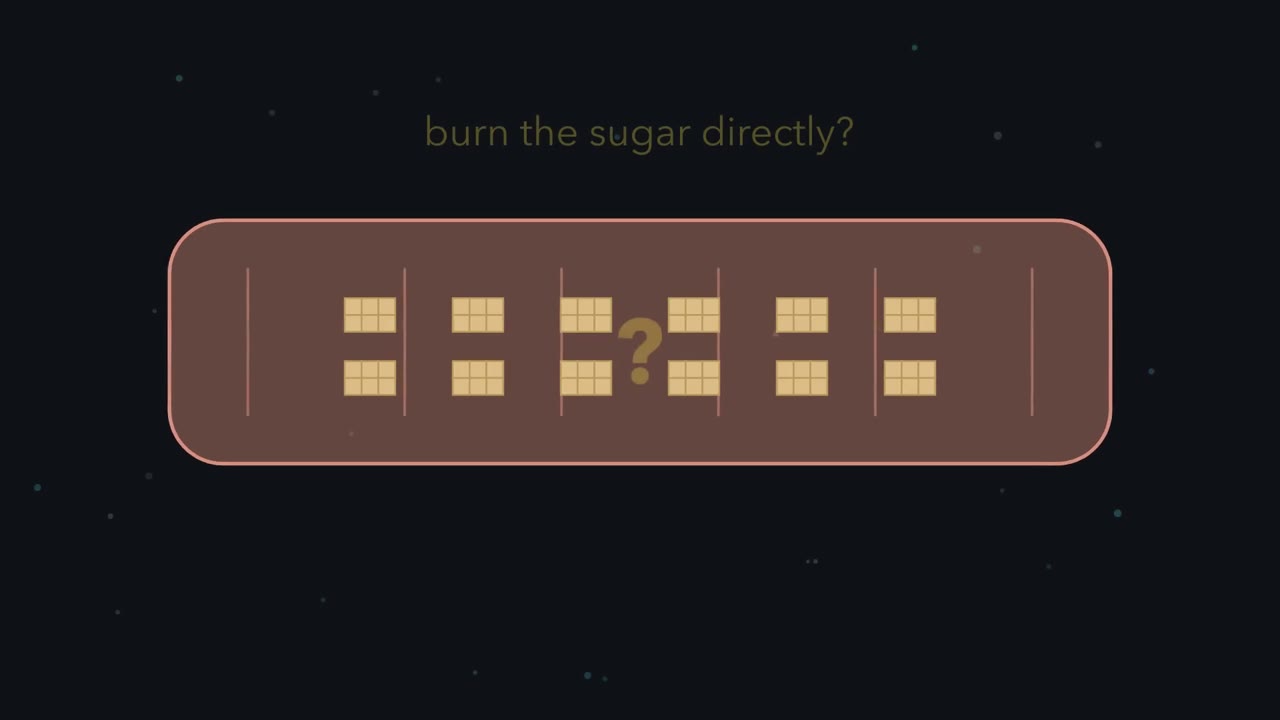
So suppose a cell needs thirty ATP, and it has no oxygen. How many glucose must it break down? Fifteen glucose. With oxygen, about one would do. Without it, the fermenting cell has to pull in glucose after glucose just to keep up. That is about fifteen times as much glucose for the same ATP. Fermentation does have strengths. It needs no oxygen, and it can make ATP quickly. So a hard-working muscle adds it when oxygen-using respiration can't keep up. The mitochondria keep working too. Yeast in sealed dough has no other choice. Take a glucose all the way apart, and the cell rebuilds about thirty ATP. Stop it partway, and it rebuilds two. Most of the energy stays behind in the leftovers.
Same glucose, same first steps, very different payoff.
Why do your legs burn after a sprint, why does bread dough puff up, and why does the deep Chesapeake Bay lose its oxygen in summer?
Continue in the lesson: Respiration and ATP →
3:11 · Free, with captions and a transcript. The lesson has the full text, the questions and the sources.
More films from this lesson
How this film was made. Narration: an AI narrator voice (Kokoro, af_heart) reading narration written from this lesson's text. Animation: AI-generated in code (Manim) by Claude, a schematic with no drawn molecular structures. Captions come from the narration script. See something wrong? Report it.