Biology · Unit 1: The chemistry of life
Enzymes at Work
Rewritten on : new text, flashcards and film. Your notes and highlights stay, but the text around them may have moved.
Why does fresh pineapple keep gelatin from setting, while canned pineapple lets it set?
Pause when the reading reaches a film, and offer to play it. Saved on this device.
Watch the film now, or keep listening
Builds on:What Am I Made Of?Why these?
Where this lesson sits
- Virginia SOL BIO.2c
- Practices BIO.1a, BIO.1b, BIO.1c, BIO.1d, BIO.1f
Essential question: How do enzymes speed up the chemistry of life, and why do temperature and pH matter so much?
-
Life Science (grade 7)
Review it at grade 7 level
In Life Science you learned that metabolism is all the chemical reactions and interactions among the molecules in a living thing. You also saw that temperature changes how fast living things carry out respiration, so an animal that takes the temperature of its surroundings is slower on a cold morning. Grade 7 did not name the molecules that make these reactions fast enough to keep a cell alive. Biology adds them: enzymes, proteins that speed up particular reactions, and the reasons temperature and pH change how well they work.
-
Biology BIO.2c You are here
This lesson
-
Biology II Biology II: Advanced Survey of Biology Topics, BIOII.3 d and e
Preview where it goes next
Biology II: Advanced Survey of Biology Topics returns to the active site and activation energy with energy diagrams drawn to scale, and adds what this lesson left out: inhibitors. A competitive inhibitor, often a molecule that looks like the substrate, sits in the active site and blocks it. Other inhibitors bind somewhere else on the enzyme and change its shape, so the active site works less well. Cells use inhibition to switch pathways on and off, and many medicines work by inhibiting one enzyme. You also design enzyme investigations of your own and learn that some catalysts in cells, called ribozymes, are made of RNA rather than protein.
-
College
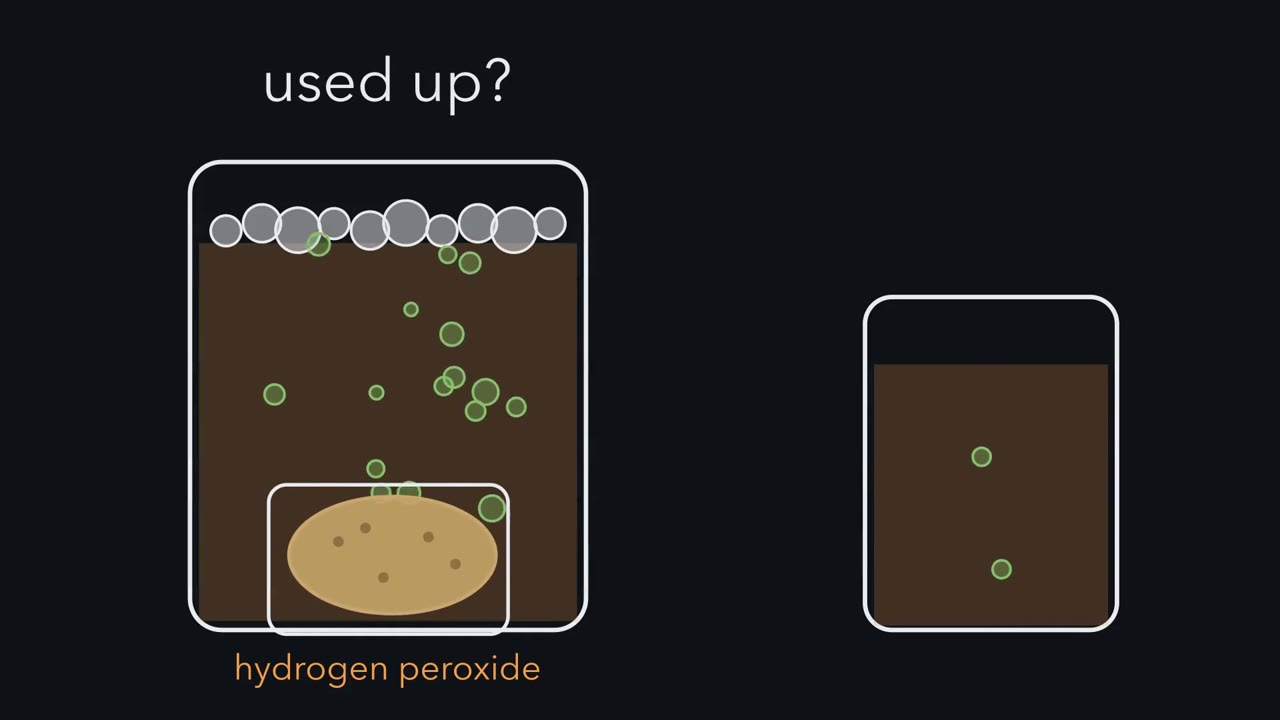 ▶ Watch Count the Working Sites · 3:13
Read the transcript of “Count the Working Sites”
Film transcript: Count the Working Sites
Drop a slice of raw potato into hydrogen peroxide, and it fizzes. Something in the potato does the work, so why is it never used up? Hydrogen peroxide breaks down alone, but slowly. The bubbles are oxygen gas. The worker is catalase, an enzyme found in potato cells, liver cells and many others. An enzyme is a molecule, almost always a protein, that speeds up a specific reaction. Follow one catalase. Its substrate, the molecule it acts on, is hydrogen peroxide. The substrate drifts into the active site, a small pocket on the enzyme. There it is turned into products, water and oxygen. The products leave, and the enzyme is unchanged. Then it takes in the next one, and the next.
The same enzyme works again and again. That makes it a catalyst, a substance that speeds up a reaction without being used up. Why does this pocket take only hydrogen peroxide? The active site's shape and electric charges fit only certain molecules.
So each enzyme usually speeds up one reaction, or a few similar ones. And why does fitting make the reaction faster? Picture a ball that must be pushed over a hill before it rolls down the other side. Activation energy is the energy needed to get a reaction started, like that hill. An enzyme does not add energy. It lowers the hill.
With a lower hill, many more molecules cross each second. The hill is a graph of energy, not a real place. Now pull back to eight active sites, one per block. Two things set how fast the tube makes products. First, how many active sites are working, still in the shape that fits. Second, the speed of each site: how much product it makes per second. The rate is the two multiplied together: working sites times the speed of each site. A site makes product only while a substrate sits in it. So temperature, pH and the amount of substrate each turn one dial, or both. Suppose one active site is bent out of shape, so the substrate no longer fits. What happens to the counter, and to the rate?
The counter drops to seven of eight. That site is not working, so the rate bar shrinks by an eighth. The other seven sites run just as fast as before. A site bent so far that the substrate no longer fits does not work slowly. It does not work at all. Anything that bends active sites out of shape lowers the count.
From the film
- An enzyme is a catalyst: it speeds up a reaction and comes out unchanged, ready to work again.
- The substrate fits into the enzyme's active site, a pocket whose shape and charges match it.
- An enzyme lowers the activation energy, the hill a reaction must get over; it does not add energy.
- Rate = working active sites × speed of each site: how many sites still fit the substrate, times the product each makes per second.
Stir pieces of fresh pineapple into gelatin and chill it, and the gelatin can stay runny. Use canned pineapple instead, and it sets. Gelatin is a protein. As it cools, its long chains link up into a net that traps water, and the dessert turns firm. So what is in fresh pineapple, and what did canning change?
The first film met the molecule behind this puzzle: an enzyme, which speeds up one reaction by gripping its substrate, the molecule it acts on, in a pocket called the active site.
The one idea. The rate of an enzyme reaction = working active sites × speed of each site. A working site still has the shape that fits its substrate. The speed of each site is how much product it makes per second. A site makes product only while a substrate molecule sits in it. Adding more substrate raises that speed until nearly every site is busy. Warming raises it too, up to a point. Too much heat, or a pH far from the enzyme’s best (too acidic or too basic), can bend sites out of shape so they stop working.
Scope: a simple model of one enzyme, a fixed amount of it, in a test tube, with the rate measured early in the reaction and every test the same length. Going deeper says where real enzymes are messier.
What do you think? Decide before you read.
-
Scientists disagree: More substrate helps only while working sites sit empty part of the time. Once nearly every site is busy, extra substrate barely raises the rate.
What scientists think
Scientists disagree: More substrate helps only while working sites sit empty part of the time. Once nearly every site is busy, extra substrate barely raises the rate.
-
Scientists disagree: An enzyme is a molecule, not a living thing, so it cannot die. Heat can make it unfold, losing the folded shape its working pocket depends on; biologists call this denaturing. Tests show that an unfolded enzyme stops working even though its chain of building blocks is still there.
What scientists think
Scientists disagree: An enzyme is a molecule, not a living thing, so it cannot die. Heat can make it unfold, losing the folded shape its working pocket depends on; biologists call this denaturing. Tests show that an unfolded enzyme stops working even though its chain of building blocks is still there.
-
Scientists disagree: Warming makes molecules move faster, so the rate usually rises at first, but in lab tests it then peaks and falls, often because the enzyme starts to lose its shape. In one 2019 study, an insect enzyme was less active at 46 °C than at 42 °C.
What scientists think
Scientists disagree: Warming makes molecules move faster, so the rate usually rises at first, but in lab tests it then peaks and falls, often because the enzyme starts to lose its shape. In one 2019 study, an insect enzyme was less active at 46 °C than at 42 °C.
Explain: what the first film left out
- metabolism
- enzyme
- catalyst
- substrate
- active site
- product
- activation energy
- denature
- optimum
- pH
- saturation
In formulas, the film’s fizz takes two hydrogen peroxide molecules for each oxygen molecule:
hydrogen peroxide → water + oxygen
2 H₂O₂ → 2 H₂O + O₂ (sped up by catalase)
Metabolism is all the chemical reactions in a living thing, and many would be far too slow at body temperature without enzymes, catalysts like the film’s catalase. Almost all enzymes are proteins.
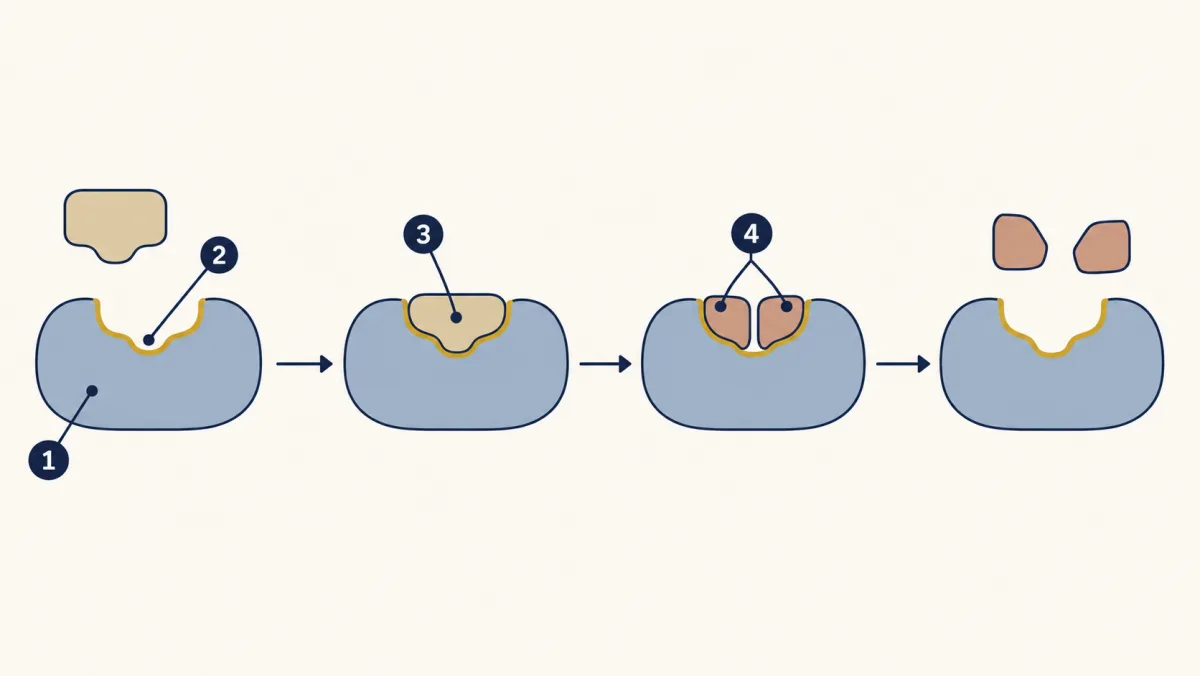
- enzyme
- active site
- substrate
- products
- enzyme
- blank
- substrate
- blank
Word bank: active site, products
- blank
- blank
- blank
- blank
Check your labels
- enzyme
- active site
- substrate
- products
Where lock and key breaks. An active site’s shape and charges fit only certain molecules, so bromelain in pineapple cuts protein chains while catalase does not touch protein. The usual picture of this fit, a key in a lock, breaks in two places. A real enzyme is not rigid: when the substrate binds, it often shifts its shape a little to grip it more tightly, which biologists call induced fit. And charge matters as well as shape.
How the hill gets lower. The film lowered the activation energy, the energy needed to get a reaction started, without saying how. The active site holds the substrate in place. Its shape and charges also steady the half-changed form the substrate must pass through while its bonds break or form. That is what lowers the hill.
A few catalysts in cells are made of RNA instead of protein; Biology II covers them.
Explore: speed up and slow down an enzyme
The explorer’s sliders set the temperature, pH and amount of substrate for one enzyme in a test tube, and a graph shows the rate. pH is a scale from 0 to 14 that measures how acidic or basic a solution is; 7 is neutral. The curves are a sketch of the usual pattern, not measured data for any one real enzyme.
- fresh enzyme at this pH and substrate
- this enzyme after the heating so far
- rate now
- Rate now (relative units)
- 0
- Enzyme still folded
- 100%
- Active sites busy
- 0%
- Doubling the substrate multiplies the rate by
- —
Slide the temperature and watch the rate.
In this sketch: one enzyme with its best temperature at about 37 °C and best pH at 7. The curves show the usual pattern, not measured data for any real enzyme. Rates are relative units. The steepness of the curves, the 0 to 70 °C range, half the active sites busy at substrate 8, and the “still folded” and “busy” percentages are invented for the sketch. Time spent heated is not modelled.
Rule to keep: heat speeds an enzyme up to its optimum and then denatures it; the wrong pH changes its charges; more substrate helps only until the active sites are full. Heat damage is often lasting, so this sketch makes it lasting; it does not model lasting damage from extreme pH, which the lesson says can also happen.
Try this.
- Set the pH in the middle and the substrate high. Predict what the rate does as you slide the temperature from cold to hot, then test it.
- At the temperature with the highest rate, predict whether the peak stays as tall when you move the pH far to one side. Test it.
- At the best temperature and pH, predict whether doubling the substrate doubles the rate every time. Double it several times.
- Push the temperature very high, then bring it back down. Predict whether the rate comes back, then see what the model shows.
In step 1 the rate climbed with warming, then fell. Warming raises the speed of each site, so why does the rate fall? The second film answers with bromelain, then returns to the pineapple.
Read the transcript of “Why Heat Gives a Peak”
Film transcript: Why Heat Gives a Peak
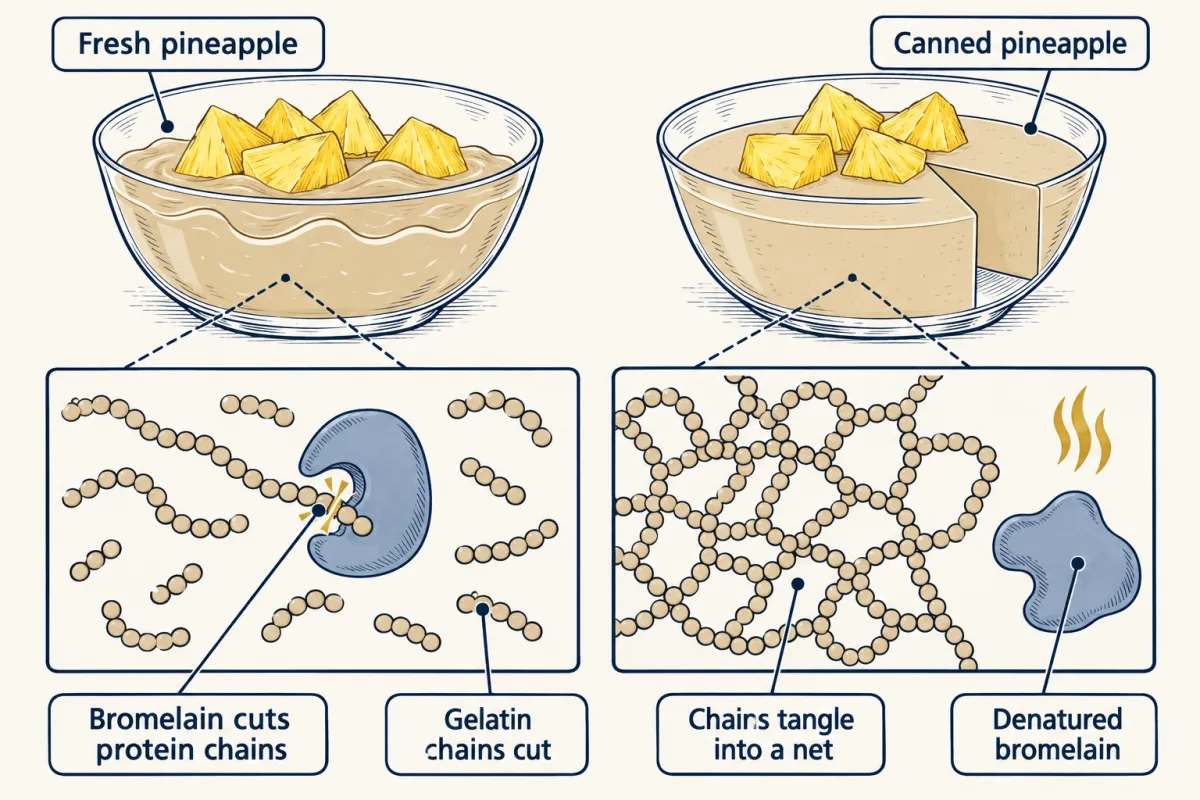
Why does fresh pineapple keep gelatin runny, while canned pineapple lets it set? The first film gave us two dials: how many active sites are working, and how fast each one works. Heat turns both of them. Gelatin is a protein. As it cools, its long chains link up into a net that traps water, and the dessert turns firm. Fresh pineapple contains bromelain, really a small family of protein-cutting enzymes.
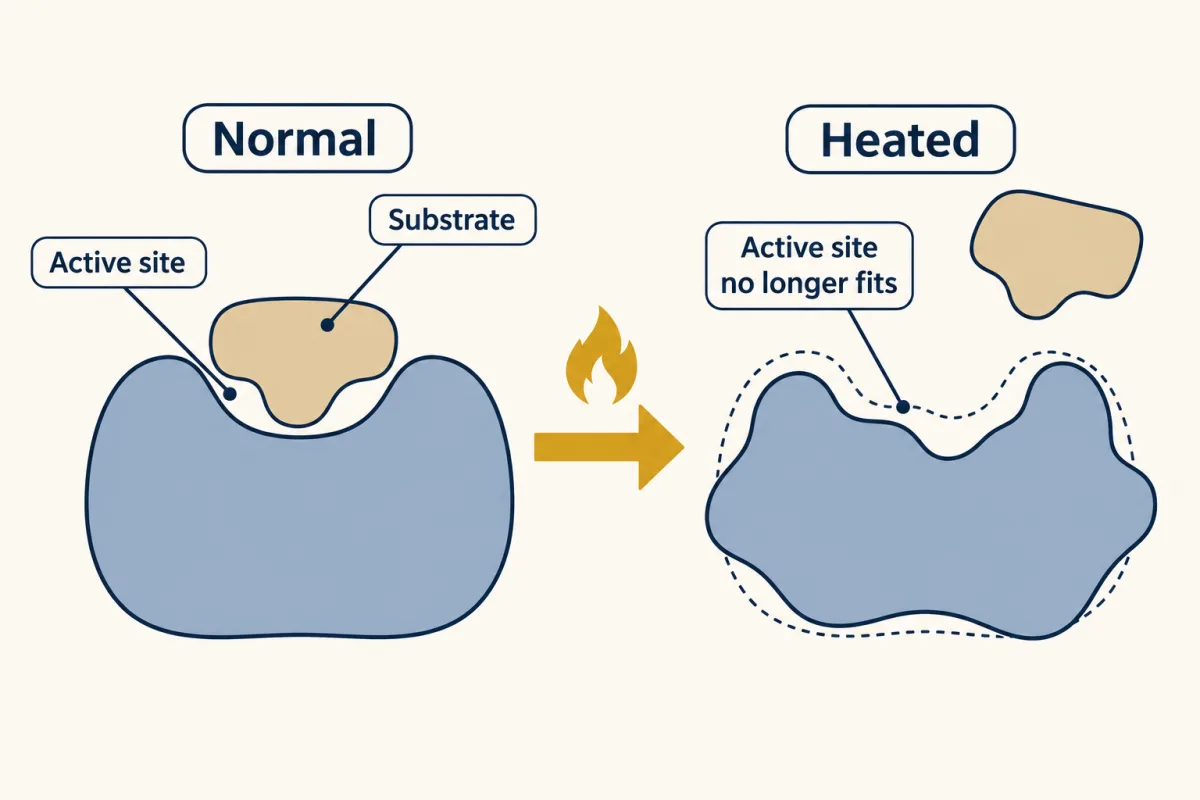
Bromelain cuts the chains, so the net cannot form. So the question is what heat does to bromelain. Hold equal tubes of it at different temperatures, each for the same time. Then compare both dials from tube to tube. Warmer molecules move faster, so more of them have enough energy to get over the activation-energy hill. The speed of each working site climbs. Up to a point, a warmer reaction runs faster. But a protein enzyme is a folded chain, held in shape by many weak attractions. Too much heat shakes those attractions apart. To denature is for a protein to lose the folded shape it needs to work. A denatured enzyme is not dead. It is a molecule whose active site no longer fits.
So, in the hotter tubes, the working-sites counter starts to fall. Now multiply the two dials at each temperature. At first the rising speed wins, and the rate climbs. Then the falling counter wins, and the rate drops. The top of the curve is the optimum, the temperature at which the enzyme works fastest. Above the optimum, the rate often falls because sites are being lost faster than the rest speed up. Back to the pineapple. Canning heats the fruit enough to denature bromelain. The counter falls toward zero. Too little is left to cut the gelatin chains, so they link up into a net, and the gelatin sets. Now a harder one. Hold fresh pineapple juice as hot as canning does, long enough to denature most of its bromelain.
Then cool it and add it to gelatin. Will the gelatin set? It is likely to set. Cooling does not usually fold the enzyme back up. A few proteins can refold, but heat damage like this is often permanent, like a cooked egg white. Heat speeds up each working site, and it can take sites out of work. In this model, the rate peaks at the optimum, where faster sites are offset by lost working sites. Real optima can have other causes, and depend on the test.
From the film
- Fresh pineapple contains bromelain, protein-cutting enzymes that cut gelatin's chains so they cannot link into a net.
- Warming makes each working active site faster, up to a point.
- Too much heat can denature an enzyme: it unfolds, its active site stops fitting, and that site stops working.
- In this model, the rate peaks at the optimum, where faster sites are offset by lost working sites.
- Canning heat denatures most of the bromelain, so canned pineapple lets gelatin set; heat damage is often permanent.
Explain: the wrong pH, and what an optimum means
pH can turn both dials too, through charge. A pH change alters the electric charges on the active site and the substrate, so they may grip each other less well, and each site slows. Very acidic or very basic conditions can also unfold the enzyme for good, taking sites out of work. Each enzyme has a best pH:
| Enzyme | Where it works | Temperature it works at | Best pH |
|---|---|---|---|
| Pepsin | Human stomach | Body temperature, about 37 °C | About 2 (strong acid) |
| Many enzymes inside human cells | Inside cells | Body temperature, about 37 °C | Near 7 |
| Catalase from Geobacillus strain CHB1 | A heat-loving bacterium, tested in a lab | Fastest at 60 to 70 °C | 6 to 7 |
Predict. Pepsin works best near pH 2. Put it in a solution near pH 7. Which dial could change: the number of working sites, or the speed of each site?
Check your prediction
Either, or both; the table cannot tell you which. Changed charges can weaken a site’s grip or its chemistry, lowering the speed of each site. A pH far enough from the best can also unfold pepsin, taking sites out of work. Telling them apart would mean measuring activity and shape separately.
The film’s optimum, the top of the curve, belongs to a test as well as to an enzyme. Most human enzymes work best near 37 °C in the body, but the insect enzyme below had a different best temperature after 20 minutes than after 60. Enzymes from heat-loving microbes, like the catalase in the table, can have much higher optima.
Explain: more substrate, until the sites are full
In step 3 the rate rose with each doubling of substrate, but by less and less. In this simple model each working site holds one substrate molecule at a time, so with a fixed amount of enzyme and little substrate, most sites sit empty most of the time. Saturation is the point at which nearly every working site is busy, so more substrate barely raises the rate.
| Substrate added | Share of working sites busy | Rate, compared with the start |
|---|---|---|
| 1 unit | 50% | 1 |
| 2 units | 67% | 1.33 |
| 4 units | 80% | 1.6 |
| 10 units | 91% | 1.82 |
| 20 units | 95% | 1.9 |
A model for one enzyme, with the substrate unit chosen so that 1 unit keeps half the sites busy. The busy share is substrate ÷ (substrate + 1): 1 ÷ 2, then 2 ÷ 3, then 4 ÷ 5. Real enzymes differ in how much substrate keeps half their sites busy.
Doubling from 1 to 2 units raised the rate by a third. Doubling from 10 to 20 raised it by only a twentieth.
A store with four checkout lanes works the same way: sales per minute rise with shoppers until every cashier is busy, then only more lanes help, as only more enzyme raises the top rate under the same conditions. Where it breaks: shoppers wait in an orderly line, while substrate molecules bump into active sites at random, free or busy.
Predict. You double the amount of enzyme in a tube that is already saturated. What happens to the rate?
Check your prediction
It roughly doubles, as long as there is still plenty of substrate for the extra sites. There are twice as many working sites, and each one is still busy nearly all the time.
Elaborate: an enzyme tested at five temperatures
Scientists made an insect enzyme, Sfβgly from the fall armyworm caterpillar, in bacteria, purified it and measured its activity at five temperatures, at the 20 minute and 60 minute marks of long tests, with every other condition the same.
Predict. Will the best temperature be the same at 20 minutes and at 60? Which dial has more time to change in a longer test? Then read the table.
Relative activity is the rate at each temperature as a percent of the fastest rate in that time block, so compare temperatures within a block, not numbers across blocks.
| Minutes into the test | Temperature (°C) | Relative activity (%, mean of 3 tests ± spread) |
|---|---|---|
| 20 | 29 | 64 ± 7 |
| 20 | 33 | 79 ± 4 |
| 20 | 37 | 87 ± 6 |
| 20 | 42 | 100 ± 10 |
| 20 | 46 | 74 ± 5 |
| 60 | 29 | 74 ± 7 |
| 60 | 33 | 91 ± 3 |
| 60 | 37 | 100 ± 5 |
| 60 | 42 | 86 ± 5 |
| 60 | 46 | 51 ± 2 |
Source: Almeida and Marana, PLOS ONE, 2019 (see Going deeper): one purified insect enzyme, not catalase, in a test tube, not a living animal.
- In the 20-minute tests, which temperature gave the highest activity? What happened between 42 and 46 °C?
- (a) Which was higher at 20 minutes, 42 or 37 °C? Which was higher at 60 minutes? (b) The longer test gave heat more time. What could heat have done to the enzyme at 42 °C during that extra time?
- Each value is the mean of three tests. What does ”± 10” at 42 °C tell you, and why is a mean of three more trustworthy than one test?
Claim, evidence, reasoning
Make a claim that answers this: does a warmer temperature always make an enzyme work faster? Use the table.
Start with: The data show that as temperature rises, enzyme activity blank.
Start with: In the 20-minute tests, activity was blank at 42 °C and blank at 46 °C. In the 60-minute tests the peak was at blank.
Start with: This happens because warming blank, but above the optimum the enzyme blank, so its active site blank.
Compare with a model answer
Warmer is not always faster. In the 20-minute tests, activity rose from 64% at 29 °C to 100% at 42 °C, then fell to 74% at 46 °C. In the 60-minute tests it peaked at 37 °C and fell to 51% at 46 °C. Warming gives more molecules enough energy to get over the activation-energy hill, which raises the rate at first. Above the optimum, heat starts to denature the enzyme, so fewer active sites fit the substrate. The longer test probably gave heat more time to do damage. These data come from one purified enzyme in one lab, at one pH, so other enzymes will have different optimums.
Saved in this browser only.
Design problem
Plan a fair test of how temperature changes the rate of catalase from potato. Name your independent and dependent variables, what you keep constant, your control and how many trials you run. Say how you will stay safe.
Saved in this browser only.
One way to do it
- Question: How does the temperature of the reacting mixture change the rate at which potato catalase makes oxygen?
- Independent variable: temperature, set with several water baths your teacher approves, from cold to hot, measured with a thermometer in the tube.
- Dependent variable: the rate, as millilitres of oxygen collected per minute over the first few minutes.
- Constants: one batch of potato extract, the same volume of extract, the same strength and volume of hydrogen peroxide, the same pH, the same equipment, and the same warm-up time in the bath for both liquids before mixing.
- Control: at every temperature, a tube of hydrogen peroxide with water instead of extract. It shows how fast peroxide breaks down with no enzyme.
- Trials: at least three fresh tubes at each temperature, in a mixed-up order. Work out each rate, then the mean, and report the spread.
- Safety: goggles, a peroxide strength your teacher approves, and care with hot water.
A rise then a fall shows lower activity, but it does not prove the enzyme denatured. To test lasting damage, heat extract samples first, cool them all to one temperature, and measure them there.
Evaluate: check your thinking
Canning heat takes most of bromelain’s sites out of work. Test gentler heat on fresh pineapple juice the way the design problem tests lasting damage: heat equal samples for the same time at several temperatures, from gentle to hot, cool them all to one temperature, and add equal volumes to identical bowls of gelatin. Predict the result. More setting after hotter heating would show less working bromelain was left, though not, by itself, why.
Science practices you used: predicting and testing with a model, planning a fair test with a control and repeated trials, reading means with their spread, and naming the limits of data and a model.
Going deeper
Where the two-dial model is simplified
The model counts a site as working or not. A real site can be bent a little and work more slowly; a pH change can weaken its grip, change its chemistry or unfold it, often some of each. Warming speeds each site only over a limited range, and many enzymes take two or more substrates. Above the optimum, lost sites are a common reason the rate falls, but not the only one. After strong heat, cooling lets a few proteins refold and work again, but often it does not. Inhibitors, which cells use to switch enzymes off, come in Biology II.
Where the pineapple puzzle comes from
A University of Georgia Extension food lab uses this fresh-versus-canned contrast as its teaching question.
More on the five-temperature data
The table comes from Almeida and Marana, PLOS ONE, 2019, supplementary S1 Table: one lab sample of purified enzyme, with the same substrate concentration (6 mM, millimolar) at pH 6. The 100% marks differ: in the 20-minute block, 42 °C counts as 100%, and in the 60-minute block, 37 °C does. So the rises at 29 to 37 °C between the two blocks come only from this change of scale. At those temperatures the enzyme’s activity really stayed steady.
Your notes
Select any text in the lesson to highlight it or add a note to it. Your highlights and notes are saved in this browser and collected in your notebook.
This browser is not letting the site save anything (a private window or strict privacy settings), so highlights and notes will be lost when you leave the page.
How we measure it
Collecting gas to measure a reaction rate
Oxygen from a catalase reaction is collected in an upside-down measuring tube, and its volume is read at set times. The volume made per minute early in the reaction is the rate.
Measuring a product by its color
A spectrophotometer shines light through a sample and measures how much is absorbed, which tracks how much colored product an enzyme has made. Readings taken over time give the rate.
Temperature-controlled water baths
Tubes sit in water held at a set temperature so the reaction itself is at that temperature. Running the same reaction in several baths, with everything else the same, is a fair test of temperature.
Where this lesson fits
Before thisReview first
- What Am I Made Of?This course · Lesson 2
You need to know enzymes are proteins folded from amino acids, so heat and pH can change their shape.
After thisStudy next
- Respiration and ATPThis course · Lesson 5
Respiration is a chain of enzyme-catalysed steps, so rate, temperature and working sites apply directly.
- Homeostasis in ActionThis course · Lesson 9
Keeping body temperature and pH steady matters because enzymes stop working well when either drifts too far.
- From DNA to ProteinThis course · Lesson 18
This lesson shows how one changed amino acid can alter a protein's shape and stop it working.
Elsewhere on the siteFilms, simulations and method films in other courses
- Spectrophotometry and enzyme kineticsMethod film
Measuring how fast product forms is how enzyme rates are read from data like the temperature set here.
Suggested by an AI model from the lessons themselves, then checked. How we use AI
Finish line
Test yourself
8 questions
Practice and MCAT-style, with explained answers.
Next · Lesson 4
Capturing Sunlight
How can a willow gain more than 160 pounds in five years while the soil in its pot loses only about 2 ounces, and how does sunlight end up stored in the sugar that built it?
Continue →