Two Jobs in One Green Cell
Read the transcript of “Two Jobs in One Green Cell”
Film transcript: Two Jobs in One Green Cell
How can one green leaf cell build sugar and release energy from it? Watch one large cell stay on screen as its parts begin working. Its two jobs use different cell parts, but their materials connect. Sunlight reaches the cell, and a green chloroplast swells into view. A chloroplast is a cell part that takes in light for photosynthesis. Carbon dioxide and water move inside.
Sugar, called glucose, and oxygen move out. The sugar does not sit still. It moves toward a red mitochondrion, another cell part. Most cellular respiration happens in mitochondria. Respiration breaks down the sugar with oxygen, and usable energy comes out.
Carbon dioxide and water also leave. What went in? A reactant is a substance entering a process. What came out? A product is a substance leaving a process. Watch each product badge move to the other cell part, where it becomes a reactant. The products of either process can supply reactants for the other. Now the sun moves toward the horizon, but the cell still needs usable energy. Which moving arrows will stop after darkness arrives? Keep the chloroplast, mitochondrion, and every material in mind.
Darkness removes the light arrow. The chloroplast stops making new sugar and oxygen. Respiration keeps using stored sugar and oxygen. It keeps releasing usable energy, carbon dioxide, and water. The plant cell is still respiring. Light returns, and photosynthesis starts making new sugar and oxygen again. Respiration continues at the same time. A green leaf cell does not switch between jobs. It can photosynthesize and respire while light is available.
Photosynthesis adds oxygen in light; respiration uses oxygen day and night. Follow the material badges around the cell. Carbon dioxide and water can help build sugar and oxygen. Sugar and oxygen can then feed respiration.
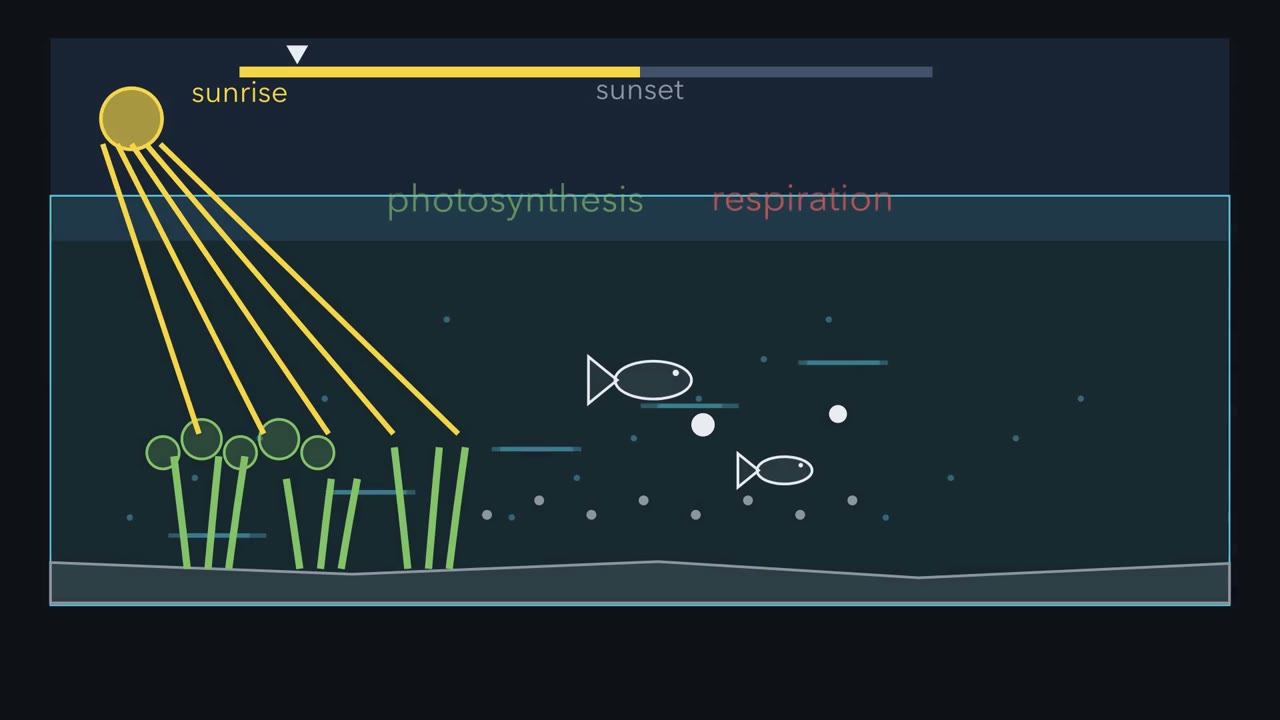
Matter can be used again. Energy takes a different path through the picture. Yellow light enters once. Chemical energy travels with the sugar, then becomes energy the cell can use. Some energy leaves as heat. The matter arrows loop, but energy flows one way. Move back outside the leaf. The same two jobs help explain oxygen in a pond or creek. Photosynthetic organisms add oxygen only while light is available.
Plants, animals, fungi, and many microbes use oxygen through respiration. That use continues in darkness. In light, oxygen can be added. Through day and night, respiration keeps using it. Carry that pattern into ponds and creeks.
Why does the oxygen in a quiet Virginia creek go up and down over a single summer day?
Continue in the lesson: Partners in Energy →
3:34 · Free, with captions and a transcript. The lesson has the full text, the questions and the sources.
More films from this lesson
How this film was made. Narration: written from this lesson's text and read by an AI narrator voice (Kokoro, af_heart). Animation: AI-generated in code (Manim) by Claude, a schematic with no drawn molecular structures. Captions come from the narration script. See something wrong? Report it.