Life Science · Unit 7: Heredity
Predicting Traits with Punnett Squares
Rewritten on : new text, flashcards and film. Your notes and highlights stay, but the text around them may have moved.
How can two purple-flowered pea plants have a white-flowered offspring?
Pause when the reading reaches a film, and offer to play it. Saved on this device.
Watch the film now, or keep listening
Builds on:Reproduction and MeiosisDNA: The Code of LifeWhy these?
Where this lesson sits
- Virginia SOL LS.10 c
- Practices LS.1 c, LS.1 d, LS.1 e
Essential question: Can we predict what traits a baby plant or animal will have?
-
Life Science (grade 7) LS.10 c You are here
This lesson
-
Biology
Preview it at high school level
In Biology you will use the words homozygous (two same alleles, like PP or pp) and heterozygous (two different alleles, like Pp). You will run a test cross. You cross a purple plant with a white pp plant to find out whether the purple plant is PP or Pp, a genotype you cannot see. You will also track two traits at once, such as seed shape and seed color. The two genes can sort into sex cells independently, so a 16-box Punnett square for two parents that are heterozygous for both genes predicts a 9 : 3 : 3 : 1 ratio. Then you will test these predictions against more of Mendel’s real counts.
-
Biology II Biology II: Advanced Survey of Biology Topics, BIOII.4 c-f; Genetics, GEN.5 a
Preview where it goes next
Biology II builds on the simple rules of this lesson. In the Advanced Survey of Biology Topics course, you meet heterozygotes that look in between their parents (incomplete dominance) or show both traits (codominance). You meet genes with more than two alleles, such as the ABO blood groups, genes linked on one chromosome, and sex-linked traits. You also meet traits shaped by many genes, and genes that mask other genes. The Genetics course adds the chi-square test, which asks whether the gap between real and predicted counts is bigger than chance usually gives.
-
College
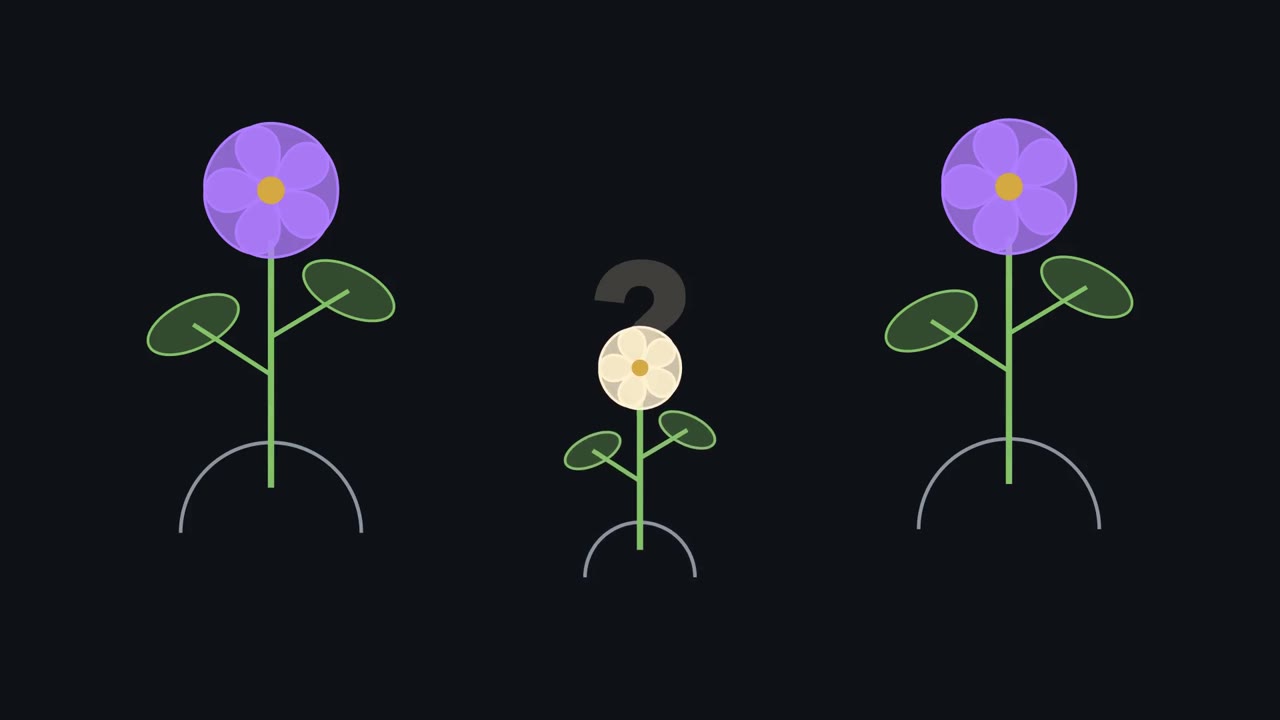 ▶ Watch Where Can White Flowers Hide? · 3:21
Read the transcript of “Where Can White Flowers Hide?”
Film transcript: Where Can White Flowers Hide?
How can two purple-flowered pea plants have a white-flowered offspring? Picture two purple-flowered parents, and between them, one offspring with white flowers. Nothing about the parents’ visible color seems to explain it. The answer is hidden inside what each parent carries.
Look inside one parent. Its flower-color gene comes in versions called alleles. This plant carries a purple allele and a white allele. P is dominant, so purple shows. p is recessive. It is hidden from view, not damaged or erased. The allele pair a plant carries is its genotype. The flower color that shows is its phenotype. This parent’s genotype is Pp. Its phenotype is purple. A purple plant can carry a hidden p allele, so appearance alone cannot reveal its pair. Carried information and the visible trait can differ. Carried information and the visible trait can differ. Before offspring form, the pair separates. Each sex cell carries one allele from the parent.
Watch P enter one teal path and p enter another. The other parent does the same. Either parent can pass the hidden p onward. A Punnett square organizes those possible meetings. One parent’s sex cells settle across the top. The other’s settle down the side. Follow a teal path from each edge into a box. The two arriving alleles become one possible genotype for an offspring. Both parents’ contributions stay separate and easy to trace. Three boxes now hold possible allele pairs. The last box receives p from each parent. What genotype and flower color should appear there? Keep your answer in mind while the paths move.
Both p alleles meet. The genotype is pp, so the white phenotype appears. The white color never showed in the parents’ flowers. It was carried as a hidden allele in each parent, then joined in this offspring. Now read the whole grid. The allele pairs predict genotypes. The flowers translate them into phenotypes. Most boxes show purple, while one shows white. Each box describes a possible outcome for a new offspring. The grid does not schedule what must happen next. This model has a boundary. It follows one gene, two alleles, one of them dominant, and known parent genotypes. Within that scope, it links what parents carry to what offspring may inherit.
Real groups can still vary. For one-gene crosses, Punnett squares predict chances, not exact offspring counts.
From the film
- For one-gene crosses, Punnett squares predict chances, not exact offspring counts.
- A recessive allele can be hidden in a parent and still pass to offspring.
- Genotype is an allele pair; phenotype is the trait that shows.
- A Punnett square joins the possible sex cells from both parents.
The first film showed how two purple-flowered Pp pea plants can have a white-flowered offspring. Could a gardener predict, before planting a single seed, what share will bloom white?
What do you think? Decide before you read.
-
Scientists disagree: Mendel crossed pea plants and counted thousands of offspring. For the seven traits he tracked, he found no in-between forms. A trait that vanished in one generation came back unchanged in the next. A blend could not come apart again like that, so traits must pass on as separate units.
What scientists think
Scientists disagree: Mendel crossed pea plants and counted thousands of offspring. For the seven traits he tracked, he found no in-between forms. A trait that vanished in one generation came back unchanged in the next. A blend could not come apart again like that, so traits must pass on as separate units.
-
Scientists disagree: Mendel recorded one pea plant with 43 round seeds and only 2 wrinkled ones, far from 1 in 4. When he added up thousands of seeds from many plants, the count came much closer to the prediction.
What scientists think
Scientists disagree: Mendel recorded one pea plant with 43 round seeds and only 2 wrinkled ones, far from 1 in 4. When he added up thousands of seeds from many plants, the count came much closer to the prediction.
-
Scientists disagree: In Mendel’s crosses, hidden traits came back unchanged in later generations, so the allele was still there. The word recessive only tells you whether a trait shows when a dominant allele is also present.
What scientists think
Scientists disagree: In Mendel’s crosses, hidden traits came back unchanged in later generations, so the allele was still there. The word recessive only tells you whether a trait shows when a dominant allele is also present.
Explain: alleles can hide but do not disappear
- allele
- dominant
- recessive
- genotype
- phenotype
- Punnett square
- probability
- ratio
A pea plant gets one copy of each gene from each parent, so each body cell carries two copies of the flower-color gene. An allele is one version of a gene. In this one-gene model, the flower-color gene has a purple allele, P, and a white allele, p.
- A dominant allele shows its trait even when there is only one copy. It gets a capital letter.
- A recessive allele shows its trait only when both copies are recessive. It gets a small letter.
A dominant allele masks a recessive one: it hides it from view without destroying it.
Your genotype is the pair of alleles you carry, such as Pp. Your phenotype is the trait that shows, such as purple flowers.
| Genotype | Alleles | Phenotype |
|---|---|---|
| PP | two same alleles (homozygous) | purple |
| Pp | two different alleles (heterozygous) | purple |
| pp | two same alleles (homozygous) | white |
Sex cells carry only one allele of each pair, as you saw in that lesson. A PP plant can only pass on P. A pp plant can only pass on p. A Pp plant passes on P or p, with a 50 percent chance for each.
Predict. A PP plant is crossed with a pp plant. Which allele can each parent pass, and what color will the offspring be?
Check your prediction
The parents pass P and p, so every offspring is Pp and purple but carries p.
Explain: a Punnett square shows the chances
A Punnett square, the grid the first film built, shows how the sex cells of two parents can join. Here it is for two Pp parents.
| P | p | |
|---|---|---|
| P | PP | Pp |
| p | Pp | pp |
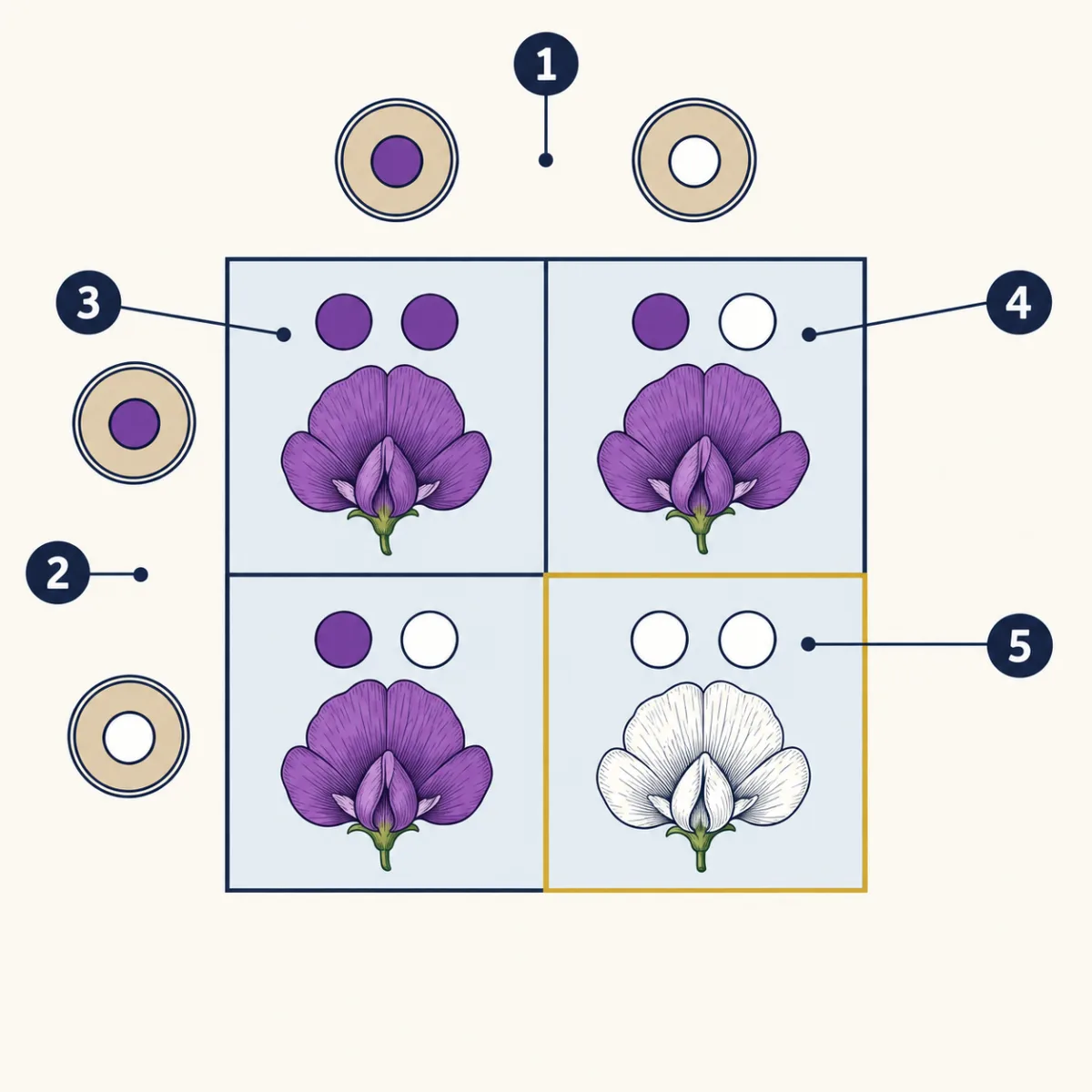
- one parent's sex cells (P and p)
- the other parent's sex cells (P and p)
- PP
- Pp
- pp
- one parent's sex cells (P and p)
- the other parent's sex cells (P and p)
- blank
- blank
- blank
Word bank: pp, Pp, PP
- blank
- blank
- blank
- blank
- blank
Check your labels
- one parent's sex cells (P and p)
- the other parent's sex cells (P and p)
- PP
- Pp
- pp
Probability is the chance that something will happen. Every box needs one particular allele from each Pp parent. Each allele has a 1 in 2 chance. So every box has the same chance: 1/2 × 1/2 = 1/4.
One box is PP, two are Pp and one is pp, so the genotype chances are 1/4 PP, 2/4 Pp and 1/4 pp. PP and Pp are purple, while pp is white. A ratio compares two numbers, such as 3 purple to 1 white.
| What you predict | As fractions | As percents | As a ratio |
|---|---|---|---|
| Genotypes | 1/4 PP, 2/4 Pp, 1/4 pp | 25, 50, 25 | 1 PP : 2 Pp : 1 pp |
| Phenotypes | 3/4 purple, 1/4 white | 75, 25 | 3 purple : 1 white |
This 3 : 1 prediction needs two Pp parents.
Here a one-gene cross means one gene, two alleles (one dominant) and known parent genotypes.
Predict. Cross a Pp plant with a pp plant. What share of the boxes are pp and white?
Check your prediction
The pp parent passes p. The Pp parent passes P or p. Half the boxes are Pp and half are pp.
Four seeds from two Pp parents might all bloom purple; the chance is about 32 percent. Mendel’s rules explain how many inherited traits are passed on; later courses add other patterns.
- Two purple parents can have a white offspring when blank.
- The chance of a white offspring from two Pp parents is blank, or blank percent.
Explore: breed purple and white pea plants
Choose PP, Pp or pp for each parent. The simulation fills the square and grows 4, 40 or 1,000 offspring. Each one is made by a random draw of one sex cell from each parent. A bar graph puts your real counts next to the predicted ones.
- Purple flowers
- White flowers
- White offspring in the last runs (up to 8)
- none yet
Pick two parents and a number of offspring. Then press Grow offspring.
In this sketch: one gene with complete dominance (P purple, p white), no weather, soil or lost seeds, and every cross gives offspring. A Pp parent passes on P or p with a 50 percent chance, as the lesson says. A PP or pp parent makes only one kind of sex cell, so it is written twice to keep the 4-box square. The plants are labelled shapes, not to scale. Nothing here is measured; the computer makes the random draws.
A Punnett square gives the chance for each offspring, not an exact count. Real counts land near its ratio but rarely match it exactly.
Try this.
- Cross two Pp plants. Predict how many of 4 offspring will be white. Grow them, then repeat three times.
- Grow 40, then 1,000. Predict first: will the share of white plants move closer to one in four, or stay just as scattered?
- Cross a PP plant with a Pp plant. Make the prediction below, then test it.
Predict. In the PP × Pp cross, can any offspring be white?
Check your prediction
No. The PP parent always passes P, so every offspring gets at least one P and is purple. Some carry a hidden p. Two purple parents give white offspring only when both are Pp.
Your groups of 4 probably wandered from one in four. The second film shows why chance and count differ.
Read the transcript of “Why Real Counts Wander”
Film transcript: Why Real Counts Wander
The first film built a Punnett square for Pp parents. Why might their real offspring counts miss its predicted ratio? A square gives each new plant a chance. A real group records what happened after those separate chances played out.
Think of the square as a chance map, not a packing list. For every new offspring, one box is selected by the parents’ allele contributions. Then the process starts again. Earlier flowers do not remove boxes or force later results. The map resets without remembering the last selection. Watch a small computed example. Several selectors land, and flowers fill the short row. The colors form an uneven group. That does not make the square wrong. A small group leaves plenty of room for chance to swing the count. Another short run could lean differently. The short row has leaned toward one color. The next slot is still empty. Does the earlier run force the next flower to balance the group, or does the same chance map apply again?
Make your prediction. The same chance map applies again. The next result is not a correction chosen by the earlier results. Each offspring is a separate chance. The group may move nearer the prediction or farther away before later results add more evidence. Now extend the computed run. More flower slots stream in while the bars rescale. The observed share still wiggles, but its swings usually shrink. With more separate outcomes, an unusual short streak has less control over the whole group. The curve approaches its target unevenly, not in a straight march.
Mendel tested the pattern with real pea plants. He counted offspring for several traits, not just one small family. Place each dominant-to-recessive ratio beside the square’s target. The rows gather near the target, but they do not land exactly together. That spread is the evidence to examine. A prediction is useful when many real results gather near it, even without an exact match. No single row must sit exactly on the target. In the lesson, you will compare counts, ratios and group sizes yourself. The square remains a one-gene model. Weather, soil, lost seeds, and more complex inheritance are outside it. Within its scope, it gives a clear target for repeated outcomes.
Larger groups usually reveal that target more clearly than small groups do.
From the film
- Larger groups usually come closer to a Punnett square’s predicted ratio.
- Each offspring is a new chance, not a step in a fixed schedule.
- Small groups can land far from the predicted ratio.
- Mendel’s full pea counts came close to the predicted ratio.
Elaborate: Mendel’s pea counts
Now check Mendel’s counts yourself. He crossed plants differing in one trait. Their first offspring all showed the dominant trait. He let those hybrids fertilize themselves and counted the next generation.
| Trait (dominant vs recessive) | What was counted | Dominant (number) | Recessive (number) | Ratio (dominant ÷ recessive) |
|---|---|---|---|---|
| Seed shape: round vs wrinkled | seeds | 5,474 | 1,850 | 2.96 : 1 |
| Seed color: yellow vs green | seeds | 6,022 | 2,001 | ? |
| Flower color: purple vs white | plants | 705 | 224 | ? |
| Pod shape: full vs pinched | plants | 882 | 299 | 2.95 : 1 |
| Unripe pod color: green vs yellow | plants | 428 | 152 | 2.82 : 1 |
| Flower position: along the stem vs at the tip | plants | 651 | 207 | 3.14 : 1 |
| Stem length: tall vs short | plants | 787 | 277 | 2.84 : 1 |
Source: Gregor Mendel’s pea paper, read at two meetings in Brno in 1865 and printed in 1866 (English translation by Abbott and Fairbanks, 2016). The plants grew in his garden beds and in some pots. The paper does not give a year for each row. For flower color, Mendel sorted plants by seed-coat color, which goes with flower color. The ratios were calculated here.
Predict. If a group has 3 dominant offspring for every 1 recessive offspring, is the recessive share 1/3 or 1/4 of the total?
Check your prediction
It is 1/4. The total has four parts: three dominant plus one recessive. A fraction compares one group with that total.
- Find the two missing ratios. Divide the dominant count by the recessive count and round to two decimal places.
- Which row is farthest from 3 : 1? Which row has the fewest offspring counted? What do you notice?
- What percent of the flower-color plants were white? Divide 224 by the total, 929, and compare with 25 percent.
Claim, evidence, reasoning
Can a Punnett square predict the traits of pea offspring? Make a claim using Mendel’s counts.
Start with: Mendel’s counts show that a Punnett square blank.
Start with: For the seven traits, the ratios ranged from blank to blank. For flower color, blank of 929 plants were white, about blank percent.
Start with: The counts are close to 3 : 1 because blank. They are not exactly 3 : 1 because blank.
Compare with a model answer
A Punnett square predicts Mendel’s pea offspring well, but not exactly. For all seven traits, the ratio was between 2.82 : 1 and 3.15 : 1, close to the predicted 3 : 1. For flower color, 224 of 929 plants were white, about 24.1 percent, near the predicted 25 percent. The counts are close because each offspring had a 1 in 4 chance of getting two recessive alleles. They are not exact because each offspring is a separate chance. One limit is that all the data come from one scientist, one kind of plant and one garden.
Saved in this browser only.
Design problem
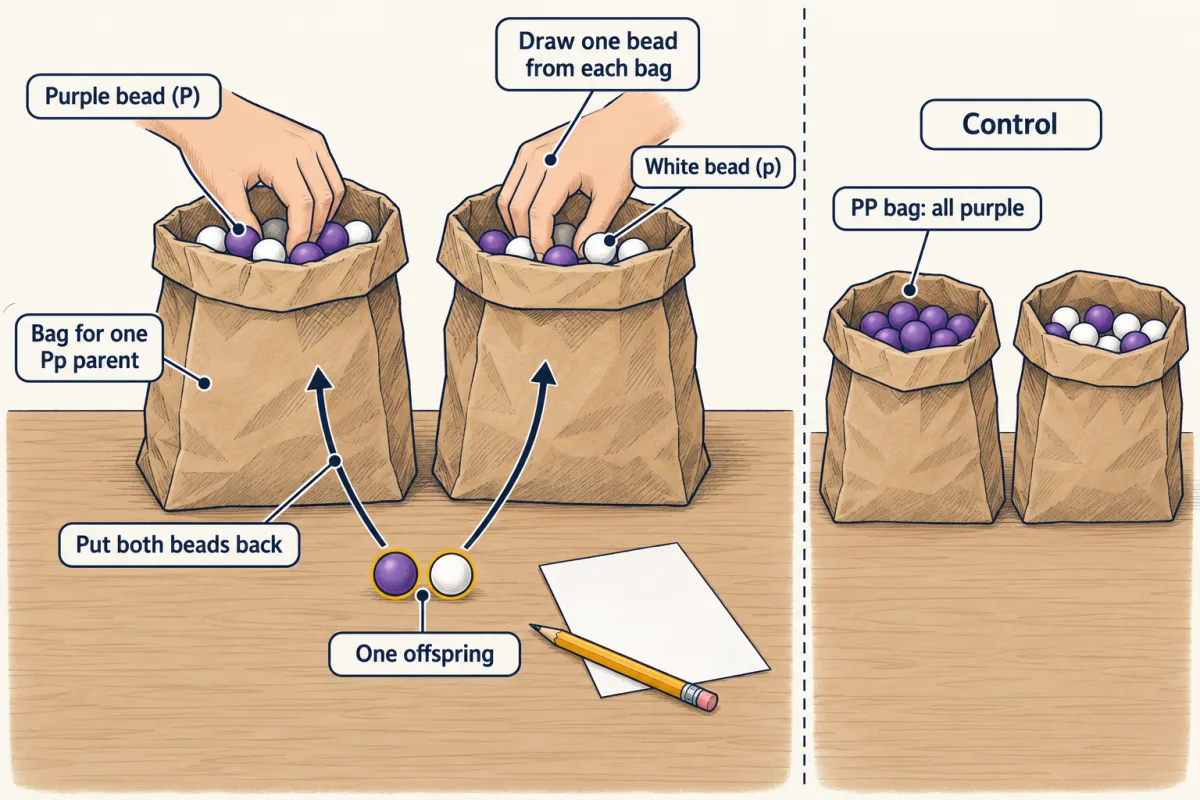
Plan a bead model to test whether the number of offspring changes how close a cross comes to 3 : 1.
Predict. What would go wrong if you kept each drawn bead out of its bag?
Saved in this browser only.
Check your prediction
The chances would change after each draw. Parents do not run out of an allele after passing it on, so replace both beads.
One way to do it
Make two paper bags, one for each Pp parent. Put 20 purple beads (P) and 20 white beads (p) in each bag. All beads are the same size, about 1 centimetre across, so you cannot tell them apart by feel.
- Make one offspring: without looking, draw one bead from each bag. Record the pair, then put both beads back and shake the bags.
- Independent variable: the number of offspring you make: 4, 20 or 100.
- Dependent variable: the percent of offspring that are pp (white).
- Constants: the same bags, the same 20 and 20 beads, and putting beads back after every draw.
- Control: a PP bag (40 purple beads) paired with a Pp bag. It should never give a pp offspring, which checks that your method works.
- Repeated trials: make each group size 5 times and find the mean percent of white.
- Safety: pick up dropped beads so no one slips, and keep beads away from your mouth.
If the 100-offspring groups usually land closer to 25 percent than the 4-offspring groups, sample size matters. The bead model is not a real plant: it has one gene and no weather, soil or lost seeds.
Evaluate: check your thinking
Back to the gardener: both purple parents were Pp, so each offspring had a 1 in 4 chance of getting p from both and blooming white. Remember: for one-gene crosses, Punnett squares predict chances, not exact offspring counts.
Science practices you used: making and testing predictions, using a Punnett square as a model and naming its limits, calculating ratios and percents from real counts, and making a claim with evidence and reasoning.
Your notes
Select any text in the lesson to highlight it or add a note to it. Your highlights and notes are saved in this browser and collected in your notebook.
This browser is not letting the site save anything (a private window or strict privacy settings), so highlights and notes will be lost when you leave the page.
How we measure it
Controlled hand-pollination
The pollen-making parts of a flower are removed before they ripen, and pollen from a chosen plant is brushed on. This way you know both parents of every seed.
Counting offspring by trait
Each seed or plant is sorted into a group, such as round or wrinkled, and each group is counted. Dividing one count by another gives a ratio to compare with a Punnett square.
Where this lesson fits
Before thisReview first
- Reproduction and MeiosisThis course · Lesson 28
You need to know each sex cell gets one allele of each pair, which is what fills a Punnett square.
- DNA: The Code of LifeThis course · Lesson 27
It explains that genes are stretches of DNA and that alleles are different versions of one gene.
After thisStudy next
- Inherited or Acquired?This course · Lesson 30
It uses genotype and phenotype to separate traits passed on in genes from traits gained during life.
- Mutations and VariationThis course · Lesson 31
It shows where new alleles, like a white-flower allele, first come from.
Suggested by an AI model from the lessons themselves, then checked. How we use AI
Finish line
Test yourself
8 questions
Practice and MCAT-style, with explained answers.
Next · Lesson 30
Inherited or Acquired?
If a parent gets a scar, why is a baby not born with it—and why can matching hydrangea cuttings bloom different colors?
Continue →