Biology · Unit 4: DNA and inheritance
Mendel and Punnett Squares
Rewritten on : new text, flashcards and film. Your notes and highlights stay, but the text around them may have moved.
How can white flowers disappear in one generation, then return in the next?
Pause when the reading reaches a film, and offer to play it. Saved on this device.
Watch the film now, or keep listening
Builds on:Meiosis and VariationWhy these?
Where this lesson sits
- Virginia SOL BIO.5c
- Practices BIO.1c, BIO.1d, BIO.1e, BIO.1f
Essential question: Why do you look like your parents but not exactly, and how can we predict the odds?
-
Life Science (grade 7) LS.10 b and c
Review it at grade 7 level
In Life Science you learned that genes come in different forms, and you get one from each parent. A dominant form shows even when only one copy is present. A recessive form shows only when both copies are recessive. Your genotype is the pair of forms you carry, and your phenotype is the trait that shows. A parent with two different forms makes sex cells that each carry one form or the other, with a 50 percent chance of each. You used Punnett squares for one trait. Biology adds crosses for two traits at once and tests the predictions against Mendel’s real counts.
-
Biology BIO.5c You are here
This lesson
-
Biology II Biology II: Advanced Survey of Biology Topics, BIOII.4 c-f; Genetics, GEN.5 a
Preview where it goes next
This lesson used genes with complete dominance, two alleles each, and two genes that sort independently. Biology II drops those limits. Some heterozygotes look in between their parents (incomplete dominance), and some show both traits at once (codominance). Some genes have more than two alleles, as in the ABO blood groups. Genes close together on one chromosome are linked. Their alleles tend to be inherited together, so a dihybrid cross can depart from 9:3:3:1. Genes on the X chromosome give sex-linked patterns. Many traits depend on several genes, and one gene can mask another. The Genetics course adds the chi-square test, which asks whether a gap between observed and expected counts is bigger than chance usually gives.
-
College
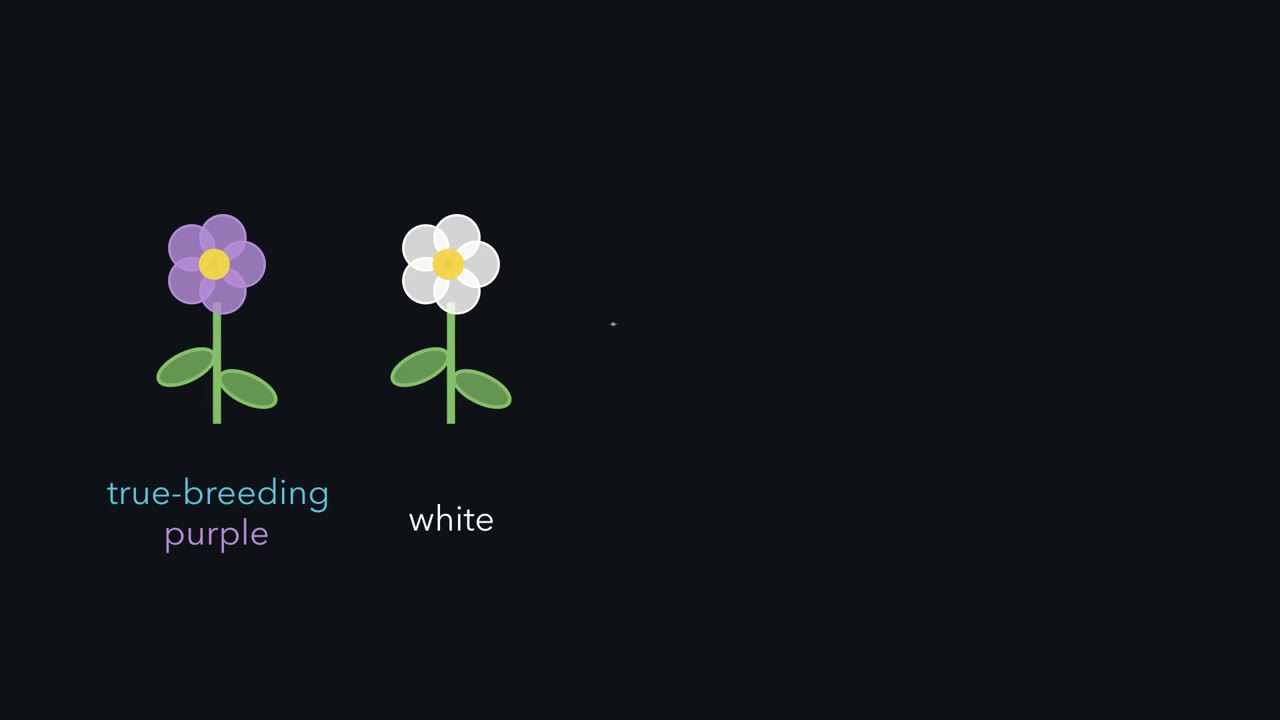 ▶ Watch Where the White Was Hiding · 3:18
Read the transcript of “Where the White Was Hiding”
Film transcript: Where the White Was Hiding
How can white flowers disappear, then return in the next generation? Crossing a true-breeding purple pea plant with a white one gives only purple offspring. Later, white flowers return among their descendants. The flower-color gene comes in different versions, called alleles. We will track a purple allele and a white allele. Each plant carries a pair. The original purple parent carried only purple alleles. The white parent carried only white alleles. Their offspring received one allele from each parent. That allele pair is the genotype. The visible flower color is the phenotype. This plant looks purple, yet it still carries white. Matching allele pairs are homozygous.
A mixed pair is heterozygous. The first-generation plants are heterozygous, which explains how the white allele stays present. Here, the purple allele is dominant, so one copy makes purple flowers. The white allele is recessive, so white appears only when no purple allele is present. Dominant does not mean common, stronger, or more likely to be passed on. It describes which phenotype appears when the two alleles differ. When a plant makes sex cells, its allele pair separates during meiosis. A heterozygous plant therefore makes both kinds in about equal numbers. Fertilization brings one sex cell from each parent together. Which sex cells meet is a matter of chance.
A grid can organize every possible pairing. Because each parent makes both sex-cell types equally often, every box has the same probability. The grid's area becomes a probability map. Both parents can send either allele. Predict which pairing can make a white plant. Watch the allele cards before the flowers appear.
White appears only when a small p arrives from both parents. The other pairings carry a dominant allele, so their flowers are purple. Read genotype before phenotype. The genotype pattern has three groups. Complete dominance combines the first two groups into the same purple phenotype. The grid predicts the genotype pattern shown below it. Grouping by visible color gives the phenotype pattern. Both describe chances across repeated offspring. These four boxes are equally likely outcomes, not four promised offspring. A small batch may miss white entirely. Another batch may contain several. Alleles separate, and sex cells meet by chance. The square organizes those chances.
It does not promise which offspring will arrive.
From the film
- Allele separation creates inheritance chances; Punnett squares organize, not guarantee, outcomes.
- A Pp parent makes P and p sex cells in about equal numbers.
- Two Pp parents can produce PP, Pp or pp offspring.
- With complete dominance, PP and Pp are purple while pp is white.
- The four boxes are equally likely outcomes, not four promised offspring.
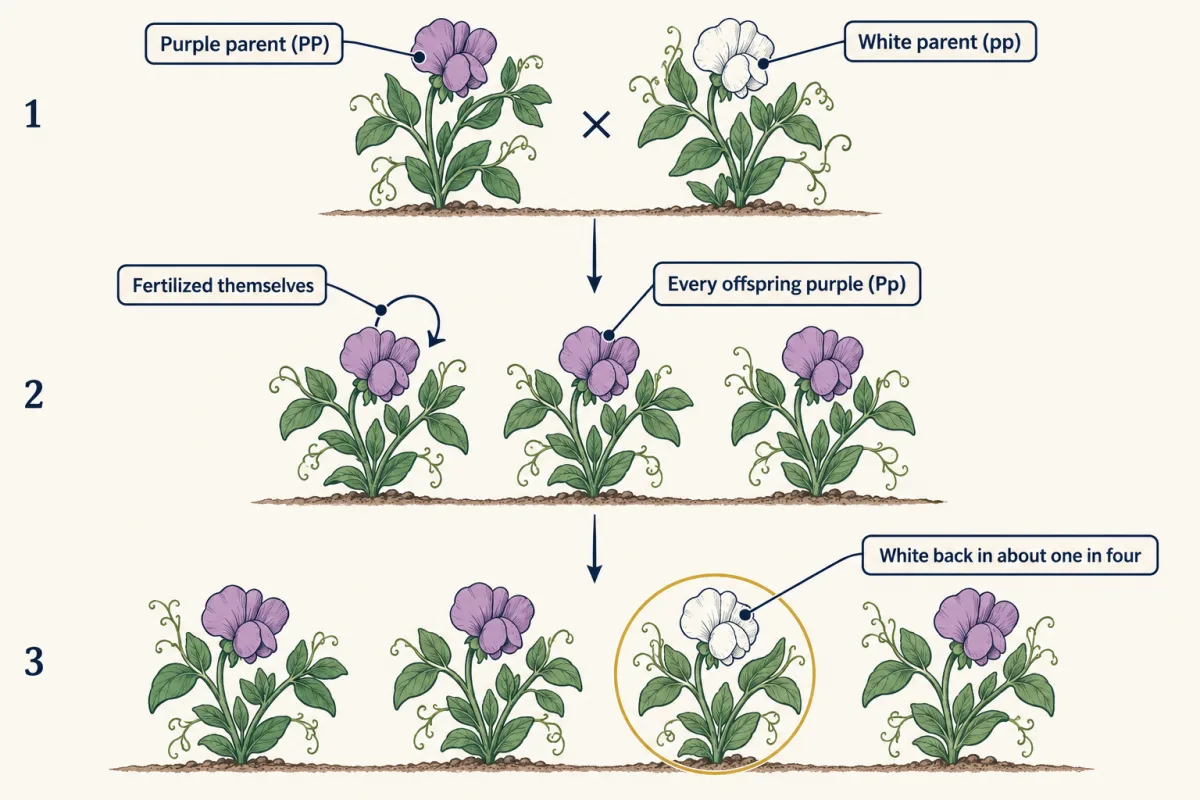
Mendel crossed true-breeding purple-flowered and white-flowered pea plants, and every offspring was purple. When those offspring fertilized themselves, he counted 224 white-flowered plants among 929, about one in four. The first film traced where the white was hiding; this page tests that answer against chance, a second gene and Mendel’s counts.
The one idea. Allele separation creates inheritance chances; Punnett squares organize, not guarantee, outcomes.
Scope: Here the one-gene crosses have two alleles with complete dominance. The two-gene cross also assumes that the genes assort independently.
What do you think? Decide before you read.
-
Scientists disagree: Dominant only means one copy of the allele is enough for the trait to show. It says nothing about how many individuals in a population have the trait. Geneticists who count traits in real populations find some dominant traits are rare and some recessive traits are common.
What scientists think
Scientists disagree: Dominant only means one copy of the allele is enough for the trait to show. It says nothing about how many individuals in a population have the trait. Geneticists who count traits in real populations find some dominant traits are rare and some recessive traits are common.
-
Scientists disagree: A Punnett square lists the possible combinations and how likely each one is. Breeders and geneticists who count real offspring find the numbers wander around the prediction, especially in small families or small batches of seeds.
What scientists think
Scientists disagree: A Punnett square lists the possible combinations and how likely each one is. Breeders and geneticists who count real offspring find the numbers wander around the prediction, especially in small families or small batches of seeds.
-
Scientists disagree: Each child comes from a new egg and a new sperm, so each birth is a fresh chance. Medical genetics guides state that when both parents carry the same recessive allele, the chance is the same for every pregnancy.
What scientists think
Scientists disagree: Each child comes from a new egg and a new sperm, so each birth is a fresh chance. Medical genetics guides state that when both parents carry the same recessive allele, the chance is the same for every pregnancy.
Explore: cross two plants and count the offspring
Pick parents for one gene or two, “plant” 10, 100 or 1,000 random computer offspring, and compare the counts with the square’s prediction.
In this sketch: complete dominance, two alleles per gene, genes sort independently, and every box of the square is equally likely. The offspring are random draws by the computer, not real plants.
A Punnett square gives probabilities, not certainties, so real counts scatter around its ratios. Expected counts are what the ratio predicts, not a promise.
Try this.
- Cross two Pp plants. Predict how many of 10 will be white, then plant 10. Repeat three times.
- Now plant 100, then 1,000. Predict first: will the share of white move closer to one in four, or stay as scattered?
- Cross PP with pp. Predict the offspring, then test.
- Switch to two genes and cross two RrYy plants. Predict which seed type will be rarest, then plant 1,000 and check.
The hidden allele
- gene
- allele
- dominant
- recessive
- homozygous
- heterozygous
- genotype
- phenotype
- Punnett square
- probability
- dihybrid cross
A gene is a section of DNA that is a basic unit of inheritance. Many genes code for a protein. An allele is one version of a gene. For most genes, the body cells of peas, like ours, carry two alleles, one from each parent. P is the purple allele and p the white one. The pair is the genotype. The phenotype is the trait you can observe or measure; it can be chemical, such as whether a body makes an enzyme.
- A dominant allele (capital letter) shows its trait when one copy is present.
- A recessive allele (lowercase letter) shows its trait here only when both copies are recessive.
- Homozygous means the two alleles match (PP or pp); heterozygous means they differ (Pp).
| Genotype | Homozygous or heterozygous? | Phenotype |
|---|---|---|
| PP | homozygous dominant | purple |
| Pp | heterozygous | purple |
| pp | homozygous recessive | white |
During meiosis, the two alleles separate into different sex cells. This is the law of segregation, and the meiosis and variation lesson follows the cell movements behind it.
Probability is the chance that something will happen, from 0, never, to 1, always. A Pp plant makes P and p sex cells in about equal numbers, so a sex cell picked at random has a 50 percent chance of carrying either allele. This resembles a coin toss, but nothing is tossed: meiosis physically separates the alleles.
Build a one-gene Punnett square
A Punnett square is a grid that shows every way one sex cell from each parent can combine. The first film filled one in for two Pp plants. Try a cross it did not show.
Predict. A Pp plant makes P and p sex cells. A pp plant makes only p sex cells. Which offspring genotypes can a Pp × pp cross produce?
Check your prediction
Pp or pp. Half the equally likely boxes are Pp and half are pp, so purple and white offspring are equally likely.
The first film’s Pp × Pp square is a monohybrid cross: both parents are heterozygous for one gene.
| P (1/2) | p (1/2) | |
|---|---|---|
| P (1/2) | PP | Pp |
| p (1/2) | Pp | pp |
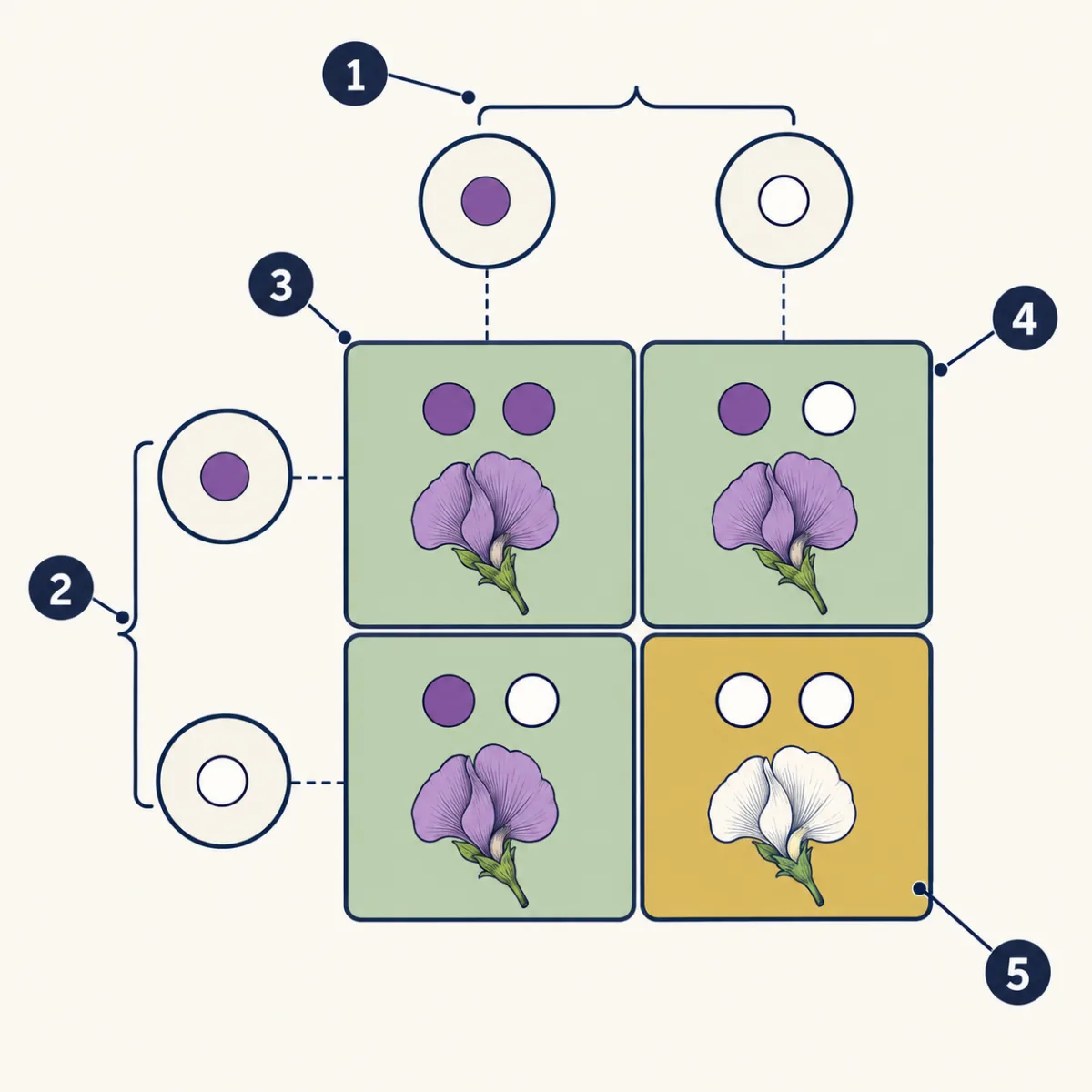
- one parent’s sex cells
- the other parent’s sex cells
- homozygous dominant
- heterozygous
- homozygous recessive
- one parent’s sex cells
- the other parent’s sex cells
- blank
- blank
- blank
Word bank: heterozygous, homozygous dominant, homozygous recessive
- blank
- blank
- blank
- blank
- blank
Check your labels
- one parent’s sex cells
- the other parent’s sex cells
- homozygous dominant
- heterozygous
- homozygous recessive
Each box has a 1 in 4 chance (1/2 × 1/2). The genotypes come out 1 PP : 2 Pp : 1 pp (1:2:1), and the phenotypes 3 purple : 1 white (3:1), because PP and Pp both look purple.
Predict. Two Pp parents have three purple offspring. Has the chance that their next offspring will be white changed?
Check your prediction
No. Each offspring begins with a new pair of sex cells, so the chance of pp is still 1 in 4. A recessive offspring is never “due.”
The four boxes are equally likely outcomes, not four promised offspring. All four offspring could be purple: 3/4 × 3/4 × 3/4 × 3/4, about 32 percent.
So far each sex cell carried one allele of one gene. Follow a second gene and each sex cell must carry one allele of each, so the grid has to grow.
Read the transcript of “Two Genes, Sixteen Chances”
Film transcript: Two Genes, Sixteen Chances
The first film followed one gene. What changes when two genes travel through the same cross? The grid must track both allele pairs together. Mendel followed seed shape and seed color. We will use capital R and small r for shape.
Capital Y and small y track color. Each parent is heterozygous for both genes. Every sex cell receives one shape allele and one color allele. In this model, the genes assort independently. Receiving either shape allele does not affect which color allele joins it. That creates every pairing. Predict how many different sex-cell types this parent can make. Follow every path from a shape allele to a color allele.
The paths make capital R capital Y, capital R small y, small r capital Y, and ry. Each type is equally likely here. Each sex cell carries one allele for each gene. No path carries both shape alleles or both color alleles from one parent. Place those sex-cell types along both sides. The square expands to show every possible meeting. Each box receives one type from each parent. Read each box gene by gene.
Combine the shape alleles first, then the color alleles. The finished genotype controls both visible traits. Now group boxes by phenotype. A dominant shape allele makes round seeds. A dominant color allele makes yellow seeds in this model. The largest group is round and yellow. Two smaller groups carry one recessive phenotype. The smallest group is wrinkled and green. The smallest group needs recessive alleles at both genes. That combination occupies only the bottom corner of the organized grid. The ratio describes probabilities, not a promised batch. Random offspring can land unevenly. Larger samples usually settle closer to the predicted shares.
Mendel's pea counts landed close, but not exactly on the predicted groups. That is what repeated chance events should look like. This pattern needs independent assortment and complete dominance. Linked genes, close together on one chromosome, can depart from it. Other allele relationships can change it too. One gene or two, the logic stays steady. Alleles separate, sex cells combine, and the square organizes the chances. Two independent genes simply give four sex-cell types and sixteen equal chances.
From the film
- Genes that sort independently turn four sex-cell types into 9:3:3:1 chances.
- An RrYy parent makes RY, Ry, rY and ry sex cells, each with a 1 in 4 chance.
- Only 1 box in 16, rryy, gives wrinkled green seeds.
- Real counts scatter around the prediction; larger samples usually come closer.
- Linked genes, close together on one chromosome, can depart from 9:3:3:1.
Two genes at once
A dihybrid cross follows two genes at once. Mendel’s plants were heterozygous for seed shape (R round, r wrinkled) and seed color (Y yellow, y green). The second film built their four sex-cell types: RY, Ry, rY and ry. Each type has a 1 in 4 chance only if getting R or r does not affect getting Y or y. That is the law of independent assortment, and it holds well for genes on different chromosomes.
| RY | Ry | rY | ry | |
|---|---|---|---|---|
| RY | RRYY | RRYy | RrYY | RrYy |
| Ry | RRYy | RRyy | RrYy | Rryy |
| rY | RrYY | RrYy | rrYY | rrYy |
| ry | RrYy | Rryy | rrYy | rryy |
Each box is one of 16 equally likely outcomes, because the four sex-cell types are equally likely. It is not a promise about the next 16 seeds. Grouped by phenotype:
round yellow : round green : wrinkled yellow : wrinkled green = 9 : 3 : 3 : 1
Predict. Ignore color. What share of the seeds are expected to be wrinkled?
Check your prediction
Wrinkled needs rr: four of the 16 boxes (rrYY, two rrYy, rryy), or 1 in 4. Because shape sorts independently of color, each gene still gives its own one-gene 3:1.
Genes close together on one chromosome are linked and can depart from 9:3:3:1. The Biology II ladder previews other patterns that change phenotype ratios.
Test the model against Mendel’s counts
For seven traits, Mendel let hybrid plants fertilize themselves and counted the second generation. In each row, the first trait listed is the one every first-generation plant showed.
| Trait | Dominant count | Recessive count | Total | Recessive share (%) |
|---|---|---|---|---|
| Seed shape: round vs wrinkled (seeds) | 5,474 | 1,850 | 7,324 | 25.3 |
| Seed color: yellow vs green (seeds) | 6,022 | 2,001 | 8,023 | 24.9 |
| Flower color: purple vs white (plants) | 705 | 224 | 929 | 24.1 |
| Pod form: inflated vs constricted (plants) | 882 | 299 | 1,181 | 25.3 |
| Unripe pod color: green vs yellow (plants) | 428 | 152 | 580 | 26.2 |
| Flower position: along stem vs at tip (plants) | 651 | 207 | 858 | 24.1 |
| Stem length: long vs short (plants) | 787 | 277 | 1,064 | 26.0 |
Counts are from Mendel’s paper, printed in Brno in 1866 (English translation, Experiments in Plant Hybridization). Each row is one experiment on one trait, counting seeds or plants as labelled; the paper gives no harvest year per row. Recessive share = recessive count ÷ total.
Predict. Before reading the last column, is 224 white plants out of 929 closer to 24 percent or 32 percent?
Check your prediction
224 ÷ 929 × 100 is about 24.1 percent, close to the predicted 25 percent.
In his dihybrid experiment, Mendel counted 556 seeds from 15 plants: 315 round yellow, 108 round green, 101 wrinkled yellow and 32 wrinkled green. A 9:3:3:1 ratio predicts about 313, 104, 104 and 35.
- Which two traits had the largest samples? How close were their recessive shares to 25 percent?
- Which trait had the smallest sample, and how far was its share from 25 percent?
- In the dihybrid count, which category was furthest from its prediction, and by how many seeds?
Claim, evidence, reasoning
Make a claim about how well the Punnett square model predicts real offspring, using Mendel’s counts.
Start with: Mendel’s counts show that the Punnett square model blank.
Start with: For the seven traits, the recessive share ranged from blank to blank percent, and the dihybrid counts were blank compared with a prediction of blank.
Start with: The counts are close but not exact because each offspring blank, and larger samples blank.
Compare with a model answer
Mendel’s counts fit the Punnett square model well, but not exactly. For all seven traits, the recessive share was between 24.1 and 26.2 percent, close to the predicted 25 percent. The dihybrid counts of 315, 108, 101 and 32 were each within 4 seeds of the 9:3:3:1 prediction. The counts are not exactly 3:1 because each offspring is a separate chance event. The two largest samples, over 7,000 seeds each, came closest to 25 percent. One limit is that the rows are different traits, not one trait tested at several sample sizes, and all come from one researcher’s garden peas.
Saved in this browser only.
Design problem
You have a purple-flowered pea plant. You do not know whether it is PP or Pp. Plan a cross that would tell you, and decide how many offspring you need.
Predict. Should you cross the unknown plant with PP, Pp or pp to make a hidden p allele easiest to detect?
Saved in this browser only.
One way to do it
Cross the purple plant with a white plant (pp). This is a test cross. A PP parent can only give P, so every offspring would be purple. A Pp parent gives p half the time, so about half the offspring would be white.
- What you want to find out: the purple parent’s genotype, which you work out from the offspring.
- What you measure: the number of purple and white offspring.
- Constants: the same white parent line, the same soil, water, light and growing time.
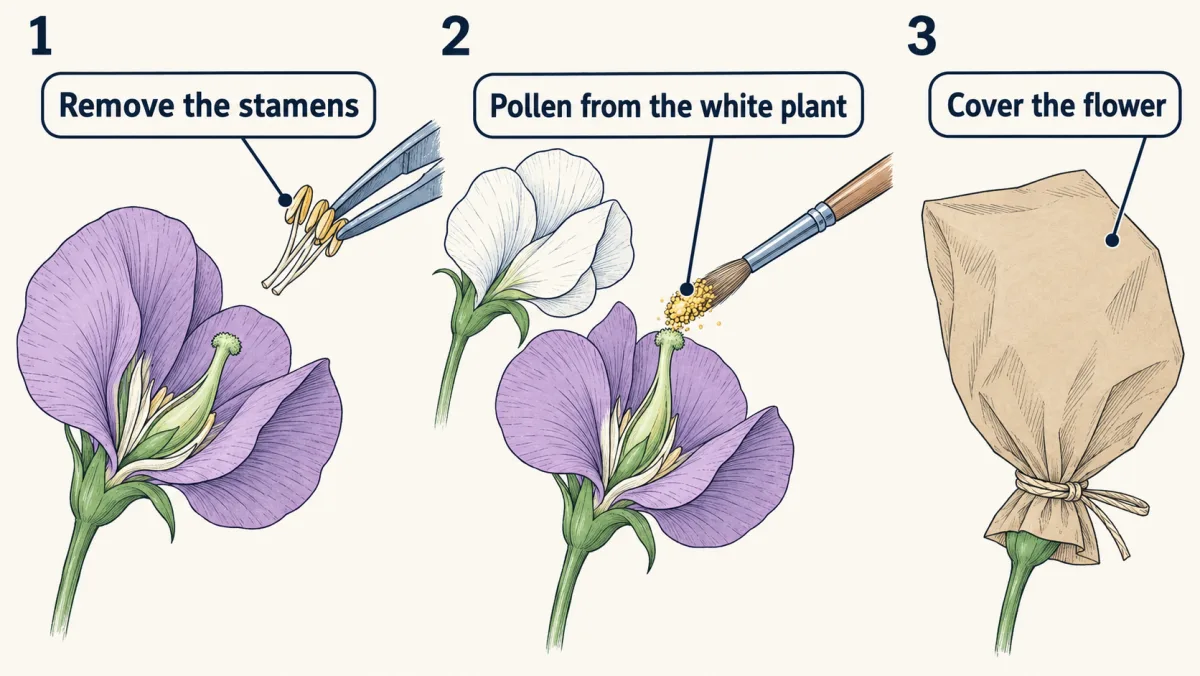
- Control of pollen: remove the purple flower’s stamens before they ripen, brush on pollen from the white plant, and cover the flower so insects cannot bring other pollen.
- Sample size: grow at least 20 offspring. Each offspring of Pp × pp has a one-half chance of being purple, so the chance of 20 purple in a row (no white plants) is one-half multiplied 20 times: under one in a million. With only 2 offspring, it is 1 in 4.
Even one white offspring means the purple parent is Pp. All purple in a large sample means it is very likely PP.
Evaluate: check your thinking
The white allele was never gone. Mendel’s purple first-generation plants were Pp, so each of their offspring had a 1 in 4 chance of receiving p from both parents, and about one plant in four did. The square organized those chances; it did not promise offspring.
Science practices you used: making predictions before testing, using a Punnett square as a model and naming its limits, calculating proportions from real counts, and judging how sample size affects a result.
Your notes
Select any text in the lesson to highlight it or add a note to it. Your highlights and notes are saved in this browser and collected in your notebook.
This browser is not letting the site save anything (a private window or strict privacy settings), so highlights and notes will be lost when you leave the page.
How we measure it
Controlled hand-pollination
The pollen-making parts of a flower are removed before they ripen, and pollen from a chosen plant is brushed onto it. If stray pollen is kept out, you know both parents of each seed.
Counting phenotypes in large samples
Each seed or plant is sorted into a category (round or wrinkled, purple or white) and the categories are counted. The proportion in each category is the count divided by the total scored. This proportion can then be compared with a predicted ratio.
Test cross
A plant with the dominant trait is crossed with a plant that is homozygous recessive. If any offspring show the recessive trait, the first plant must have carried a hidden recessive allele.
Where this lesson fits
Before thisReview first
- Meiosis and VariationThis course · Lesson 19
You need to know how meiosis separates alleles into sex cells to see why each one carries a 50 percent chance.
After thisStudy next
- Beyond Dominant and RecessiveThis course · Lesson 21
It uses the same square but with patterns where heterozygotes look different, so the 3:1 ratio no longer holds.
- Engineering GenesThis course · Lesson 22
Moving a gene between organisms builds on knowing how alleles pass on and combine.
- Variation and SurvivalThis course · Lesson 27
Inherited variation from allele shuffling is what selection acts on in a population.
Elsewhere on the siteFilms, simulations and method films in other courses
- Breed pea plantsSimulation · Life Science
Breeding pea plants in this simulation lets you practise one-gene crosses and see chances turn into real counts.
Suggested by an AI model from the lessons themselves, then checked. How we use AI
Finish line
Test yourself
8 questions
Practice and MCAT-style, with explained answers.
Next · Lesson 21
Beyond Dominant and Recessive
Why does a red snapdragon crossed with a white one give pink flowers, while a red Shorthorn bred with a white one gives a calf with red and white hairs side by side?
Continue →