Developmental Neuroscience · Skim version
Radial Migration: Climbing the Glial Ladder
Read the full lesson → Skim the whole course →
The guiding idea
How does a newborn neuron cross a thick, crowded wall to reach its layer, and what brings its nucleus along?
In a bipolar cortical neuron's stop-and-go climb, the front goes first, and the cell has moved only when its nucleus catches up, so migration is measured at the nucleus, not the tip.
From the film: The Front Goes First
- In the typical bipolar climb the front goes first, and the cell has moved only when its nucleus catches up.
- A tip can keep growing while the nucleus stays put, so migration is measured at the nucleus relative to the tissue, not at the tip.
- Each step has two strokes: the centrosome moves ahead into a swelling, then the nucleus is brought forward after it.
From the film: What Brings the Nucleus Up
- In the usual model, dynein moves the centrosome in stroke one and the nucleus in stroke two, toward the microtubule minus ends at the centrosome.
- LIS1 binds and regulates dynein; it is not the motor itself.
- In rat cortical slices, knocking down LIS1 or dynein stalls both the centrosome and the nucleus, while blocking myosin II stops only the nucleus.
- A cell can keep reaching without arriving, so measure migration at the nucleus.
From the film: When the Engine Breaks
- Disrupting the machinery that brings the nucleus up can stall neurons short of their layers, and one result can be lissencephaly.
- Losing one copy of LIS1 is enough to cause lissencephaly, a cortex with reduced or absent folding.
- Doublecortin stabilizes microtubules; girls with one mutant copy are mosaics, and neurons that stall can form a band called double cortex.
- The two-stroke climb is not the whole trip: in embryonic rat cortex, newborn neurons spend about a day or longer as multipolar cells with little net progress.
-
Across the wall
-
Two ways up
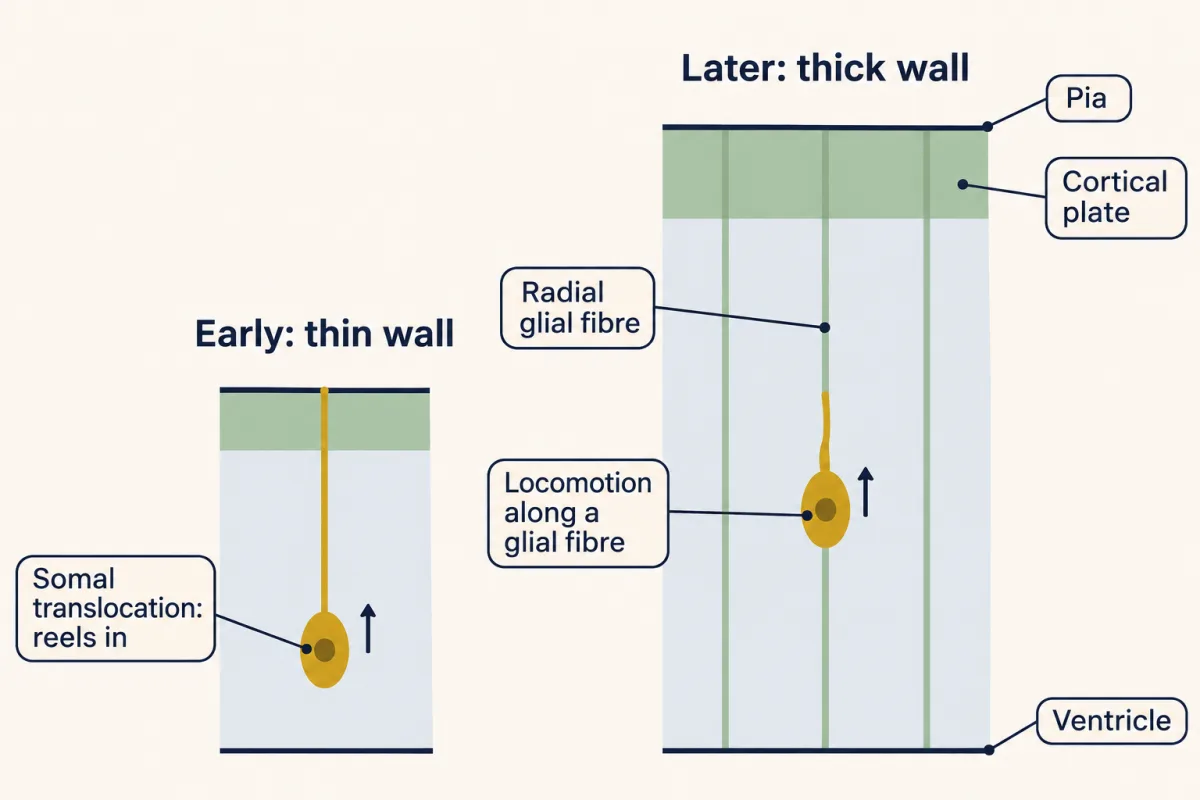
Early, when the wall is thin, many neurons already have a long leading process attached near the pia and reel the cell body up along it: somal translocation. Later, when the wall is thick, neurons with a shorter, free-ending process advance in jumps along radial glial fibres: locomotion. AI-generated illustration -
The glial ladder: from an inference to a movie
-
The front goes first
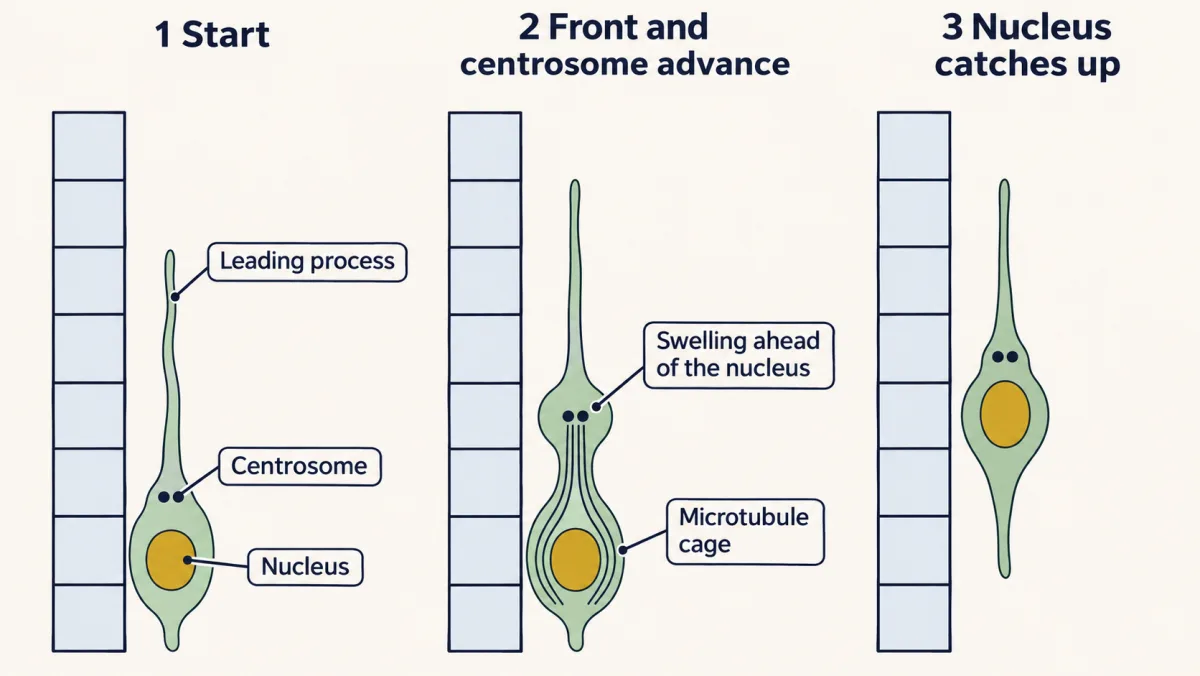
The proposed two-stroke cycle: first the leading process extends, a swelling forms ahead of the nucleus and the centrosome moves into it; then the nucleus is brought forward into the swelling. The cell has moved only when the nucleus catches up. AI-generated illustration -
The engine: what brings the nucleus up
-
When the engine breaks: lissencephaly
-
Not a straight climb
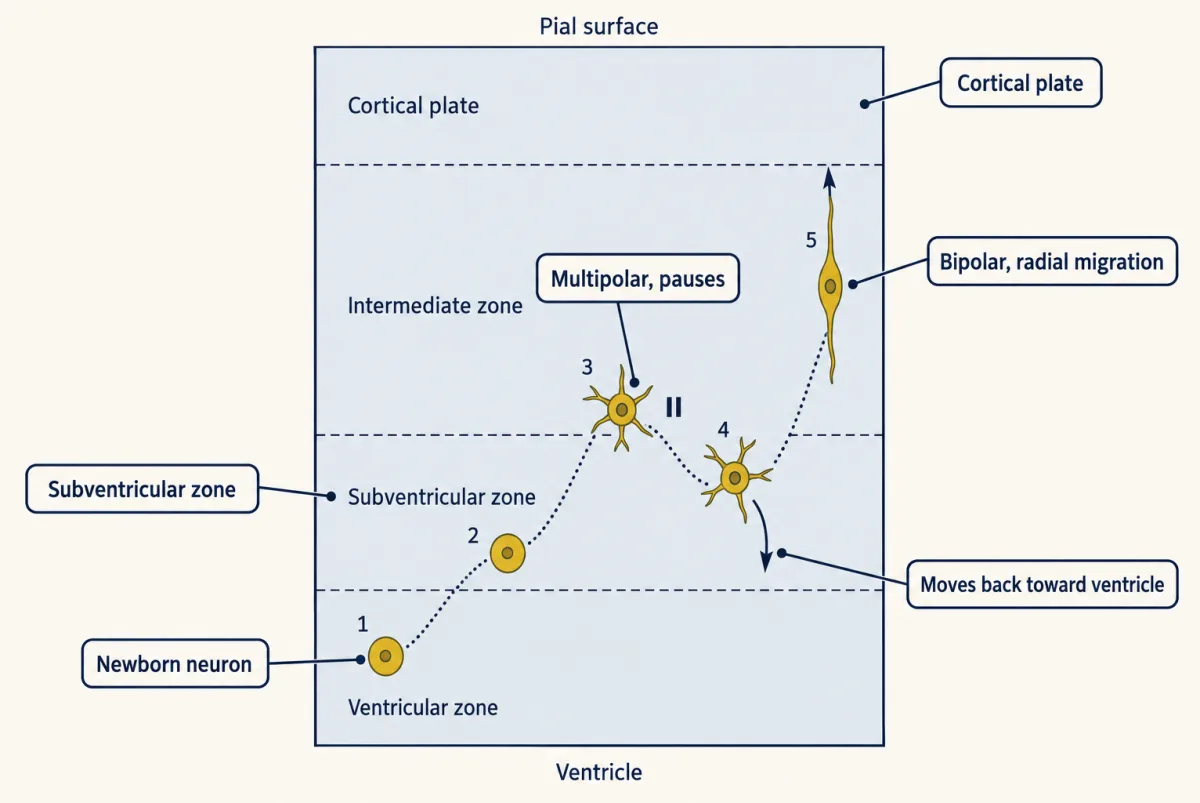
One route observed in embryonic rat cortical slices: (1) a newborn neuron in the ventricular zone moves outward to (2) the subventricular zone, then (3) becomes multipolar and lingers, with little net progress, in the subventricular zone or lower intermediate zone. Many cells (4) move back toward the ventricle before (5) becoming bipolar and migrating radially toward the cortical plate. This is an example trajectory, not a required route for every neuron. AI-generated illustration -
Putting it together
-
Going deeper
Where this lesson fits
Before thisReview first
- The Ventricular Zone: Radial Glia as Stem CellsThis course · Lesson 13
The fibres the neuron climbs belong to radial glia, whose role as progenitors and scaffold is taught there.
- Birth Order and Fate: Temporal Identity and the Inside-Out CortexThis course · Lesson 16
The rule that birth date predicts layer is the reason neurons must cross the wall, and this lesson builds on it.
- The Growth Cone: The Tip That Steers the AxonThis course · Lesson 3
You need the leading process and its actin and microtubule behavior from there to follow the front-first step.
After thisStudy next
- Reelin and the Reeler MouseThis course · Lesson 18
Reelin acts on migrating neurons in the cortical plate and decides where they stop and layer.
- Tangential Migration: Interneurons and the Long Way RoundThis course · Lesson 19
Interneurons use a similar leading-process and nucleus cycle but travel a different route into the cortex.
- When Building Goes Wrong: Microcephaly, Zika and LissencephalyThis course · Lesson 48
Lissencephaly from LIS1 and doublecortin, introduced here, is worked through there alongside other malformations.
Elsewhere on the siteFilms, simulations and method films in other courses
- Tight Ends, Loose EndsFilm · Cell Biology
Microtubule growth and shrinkage explains how doublecortin-stabilized microtubules form the cage around the nucleus.
- Grip, Swing, Let GoFilm · Cell Biology
It shows how dynein walks toward microtubule minus ends, the motor that pulls the centrosome and nucleus forward.
Suggested by an AI model from the lessons themselves, then checked. How we use AI