Tight Ends, Loose Ends
Read the transcript of “Tight Ends, Loose Ends”
Film transcript: Tight Ends, Loose Ends
Why would a polymer fall apart while its building blocks crowd around it? Watch one microtubule grow from a seed in purified tubulin. It lengthens slowly for minutes, then collapses many times faster. A crystal in its solution does not do this.
Start with one end, and treat it as a doorway. Subunits arrive at a rate set by how many are free. They leave at a rate that does not depend on that. At one free concentration, the two balance. That is the end's critical concentration, Above it, the end grows.
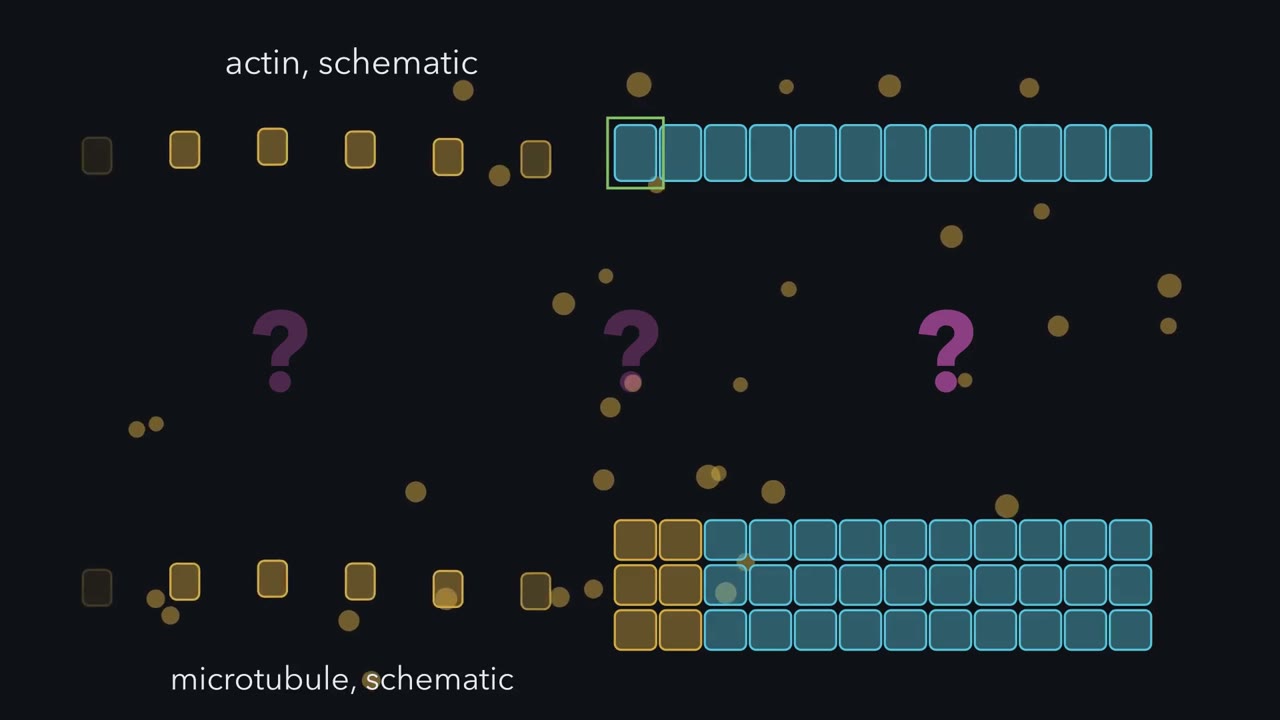
Below it, the end shrinks. If subunits never used their nucleotide, both ends would share one critical concentration. The polymer would grow until free subunits fell to that level, then simply settle. Real actin and tubulin differ. Each subunit arrives carrying fresh ATP or GTP. Some time after joining, it hydrolyses that nucleotide and releases the phosphate. Those old subunits then hold on less tightly. Here is the whole idea. Hydrolysis after joining gives one polymer two kinds of end. A tight end shows fresh subunits and has a low critical concentration. A loose end shows old subunits and has a high one. So set the free subunits between the two levels: above the tight end's, below the loose end's. What can the polymer do now?
It cannot come to rest. Actin answers in space. Its barbed end adds subunits fast and stays fresh: a tight end that grows. Its pointed end shows old subunits: a loose end that shrinks. When gain and loss match, the length holds while subunits flow through. That is treadmilling. A microtubule answers in time instead. While growing, it wears a cap of fresh GTP-tubulin, so its end stays tight. Behind the cap, GDP-tubulin is held straight only by its neighbours. The cap can be lost by chance, or when growth slows and hydrolysis catches up. Then the end turns loose. Its protofilaments peel outward, and it shortens many times faster than it grew. That switch is a catastrophe.
Growth starting again is a rescue. Exactly what commits an end to collapse is still argued, and in cells other proteins tune the rates. Hydrolysis gives tight and loose ends, so the polymer cannot simply settle. Cells use that restlessness to search their interior and rebuild.
A microtubule in a dish of pure tubulin grows for minutes, then collapses many times faster. Why would a polymer be built to fail? Because a polymer that switches by itself lets a cell explore space, rebuild its scaffolding and organize division.
Continue in the lesson: Cytoskeletal Polymers and Dynamics →
3:10 · Free, with captions and a transcript. The lesson has the full text, the questions and the sources.
More films from this lesson
How this film was made. Narration: written from this lesson's text and read by an AI narrator voice (Kokoro, af_heart). Animation: AI-generated in code (Manim) by Claude, a schematic with no drawn molecular structures. Captions come from the narration script. See something wrong? Report it.