Grip, Swing, Let Go
Read the transcript of “Grip, Swing, Let Go”
Film transcript: Grip, Swing, Let Go
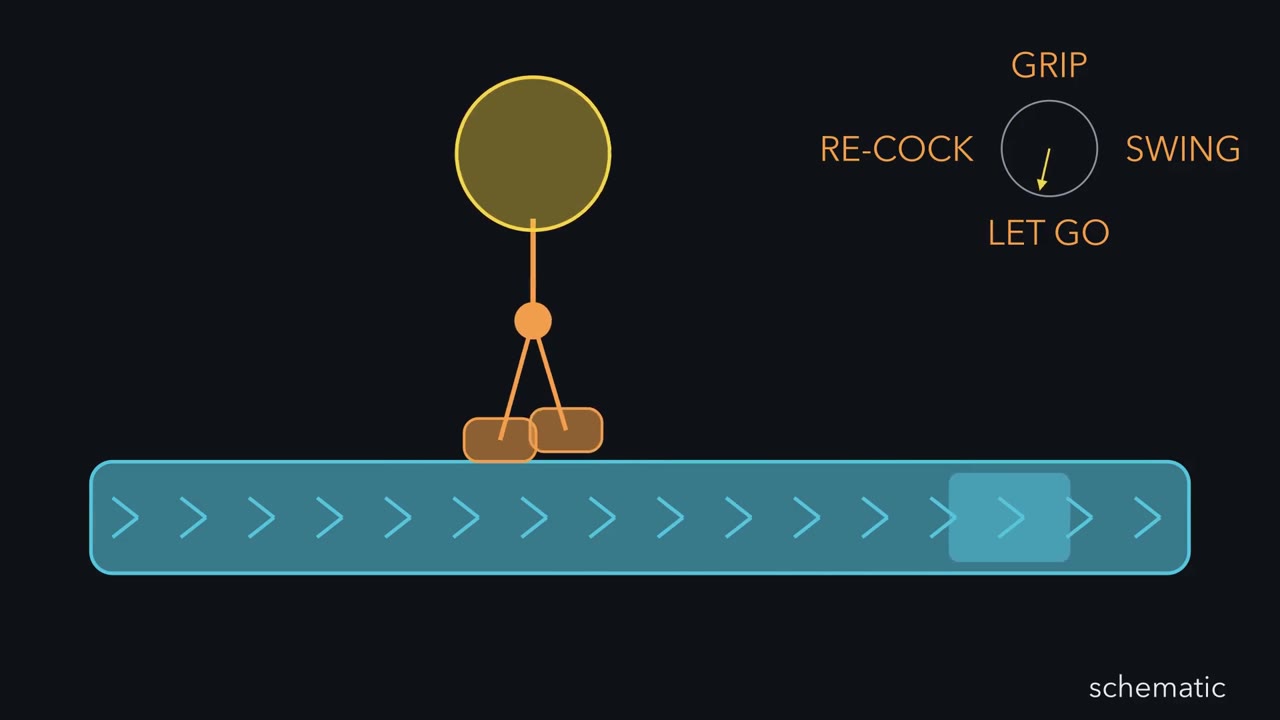
A protein made in a nerve cell's body may have to reach a synapse a metre away. Left to diffuse, it would take centuries, so how does it get there? The cell hands it to a motor, a protein that walks. Its road is a microtubule, and the road has a direction. In an axon, nearly every microtubule points its plus end out. Kinesin-1 walks toward the plus end. Dynein walks toward the minus end, back home. Watch one foot. It grips the track. It swings while gripping, which pulls the motor forward. Then it lets go and re-cocks. Each turn of this cycle is driven by one ATP. So a motor has feet on a polar track, each repeating grip, swing, let go, re-cock.
Which way the swing points helps set which way a motor goes, though dynein is less tidy. Kinesin-1 has two feet. The back foot lets go. The front foot, still gripping, swings and tips it past, onto the next site. Then the feet swap roles. Think of walking: your hips move one step, your back foot twice as far. The cargo rides at the hips, moving 8 nanometres per step. Each foot moves about 16. And at low load, each step costs one ATP. Here is the trick. The gripping foot nearly always stays on until the stepping foot lands. So one kinesin can take about 100 steps before it lets go. A motor that keeps walking like this is called processive. Now a test. Muscle myosin II also has two feet.
Could one molecule of it carry a vesicle all on its own? Pause and predict. No. Each myosin II foot spends most of its cycle off the track. The two feet do not take turns. One molecule soon falls away. So myosin II works in crowds, hundreds of heads per thick filament. That crowd shortens muscle. Heads grip the thin actin filaments, swing, and let go. The thin filaments slide inward between the thick ones. No filament gets shorter. They just overlap more. Back to the metre.
Cargo often carries several motors, so while one lets go, another still holds. How much this matters in cells is still being worked out. So a motor walks by repeating one small cycle. Keep a foot on the track, and one molecule can travel far. Let go too often, and only a crowd can pull.
A motor protein turns ATP into steps along a track, and every track has a direction. Which motors walk which way, and how do we know?
Continue in the lesson: Molecular Motors and Cargo →
3:09 · Free, with captions and a transcript. The lesson has the full text, the questions and the sources.
More films from this lesson
How this film was made. Narration: written from this lesson's text and read by an AI narrator voice (Kokoro, af_heart). Animation: AI-generated in code (Manim) by Claude, a schematic with no drawn molecular structures. Captions come from the narration script. See something wrong? Report it.