Organismal Biology · Skim version
Double Fertilization: How a Flower Makes a Seed
Read the full lesson → Skim the whole course →
The guiding idea
Dust a white-kernelled maize plant with pollen from a true-breeding yellow one, and its own ear fills with yellow kernels this season. How can the pollen parent change seeds on the mother's plant?
The father reaches only the embryo and the endosperm of a seed; the seed coat and the fruit wall are the mother's own tissue.
From the film: Whose Cells Are in a Seed?
- A pollen grain is not a sperm: it is a tiny male generation of the plant whose tube carries two sperm to the ovule.
- One sperm fuses with the egg and starts the embryo: one set of chromosomes from each parent.
- The other sperm fuses with the central cell and starts the endosperm, the embryo's food store: in most flowering plants two maternal sets and one paternal set.
- The father reaches only the embryo and the endosperm; the seed coat and the fruit wall are the mother's own tissue, with no chromosomes from the pollen parent.
- Pollination moves pollen to a stigma; fertilization happens later, inside the ovule, and only if a tube arrives.
From the film: Why Does a Strawberry Swell?
- After fertilization the ovule becomes the seed and, in most flowering plants, the ovary becomes the fruit, whose wall is the mother's own tissue.
- A strawberry is an accessory fruit: its red flesh is swollen receptacle, not ovary as in a tomato, and the true fruits are the small dry achenes on its surface, each holding one seed.
- Nitsch found that a pollinated receptacle stripped of its achenes did not enlarge, and that applied auxin made a stripped receptacle grow.
- So the developing achenes supply a growth signal that auxin can mimic: the receptacle is the mother's tissue, but the achenes tell it to grow. The experiment does not show that the signal is auxin alone, or how it moves.
-
The parts of a flower: four rings of organs
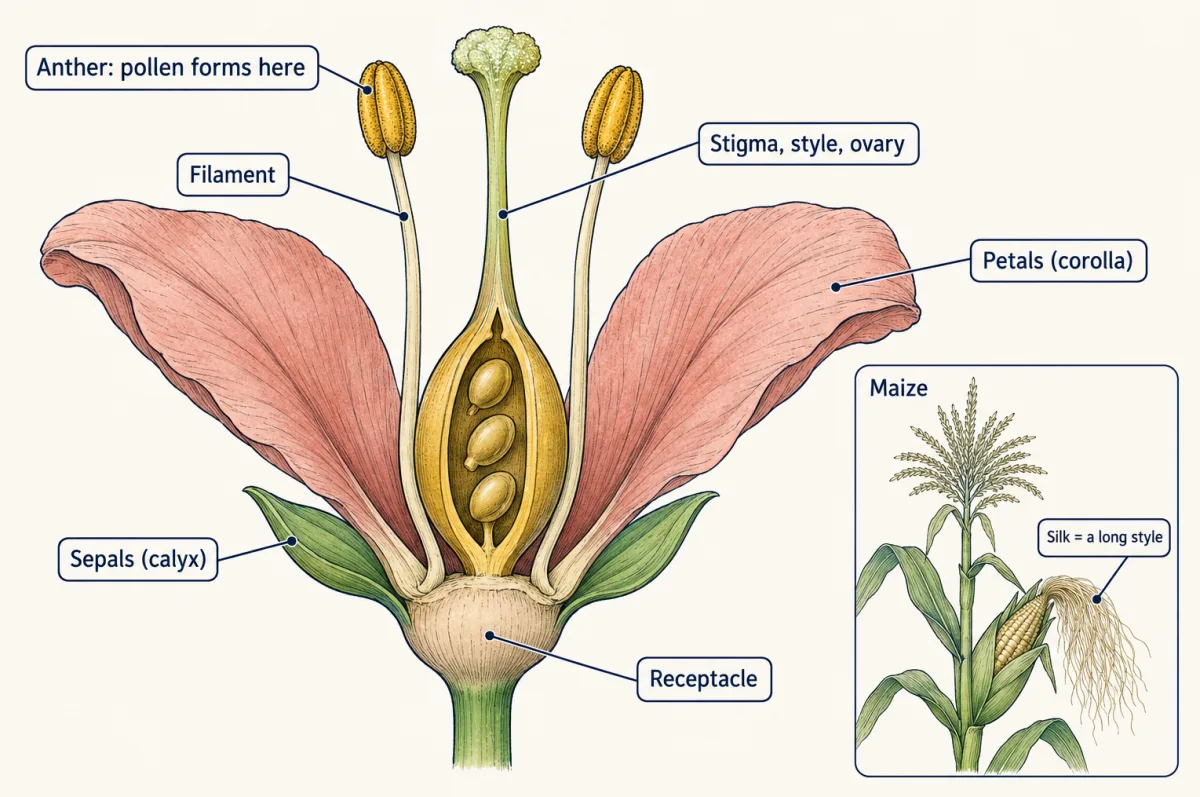
A flower's four whorls from the outside in: sepals, petals, stamens and carpels, on the receptacle. Pollen forms in the anther; the ovules sit in the ovary. In maize each silk is a long style and stigma. AI-generated illustration -
Before the sperm: two tiny generations
-
Pollen meets pistil: one tube, two fertilizations
-
Flowers and their animals: wind, insects and coevolution
-
From ovule to seed, ovary to fruit
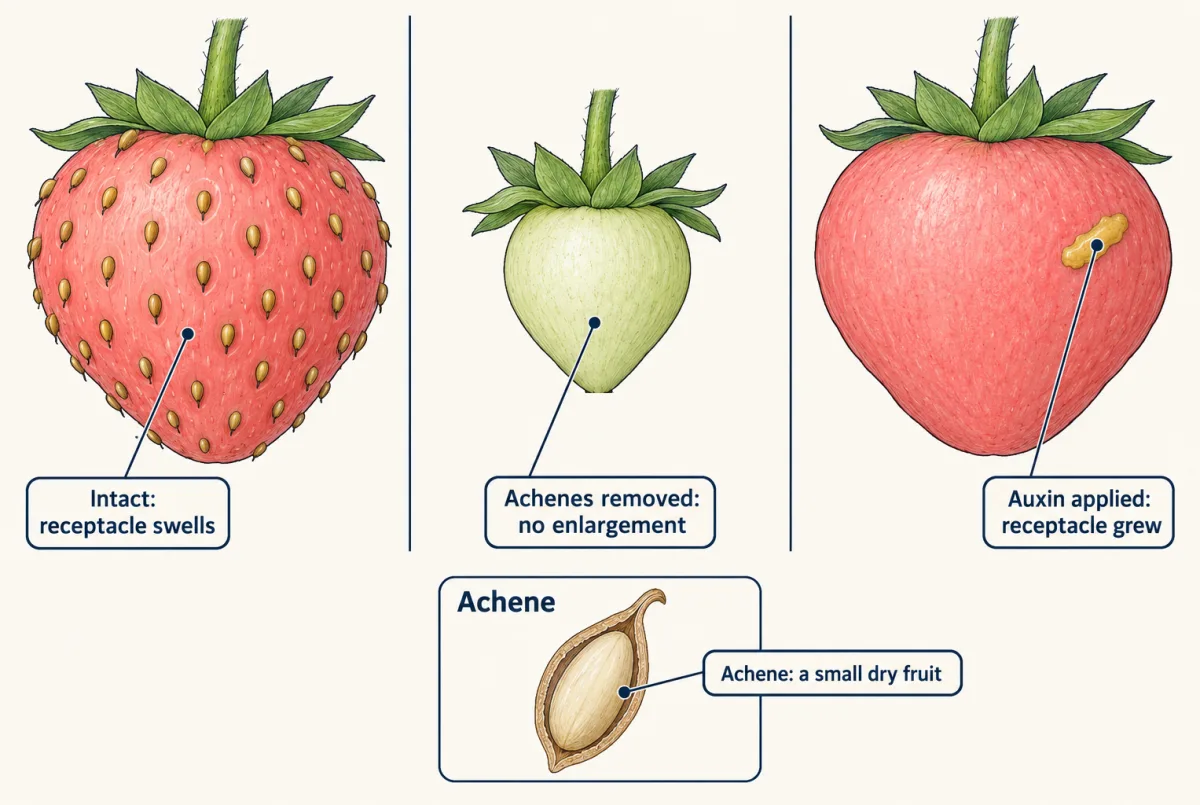
Stripped of its achenes, a pollinated receptacle stays small; auxin paste restores growth, so the achenes supply a signal auxin can mimic. AI-generated illustration 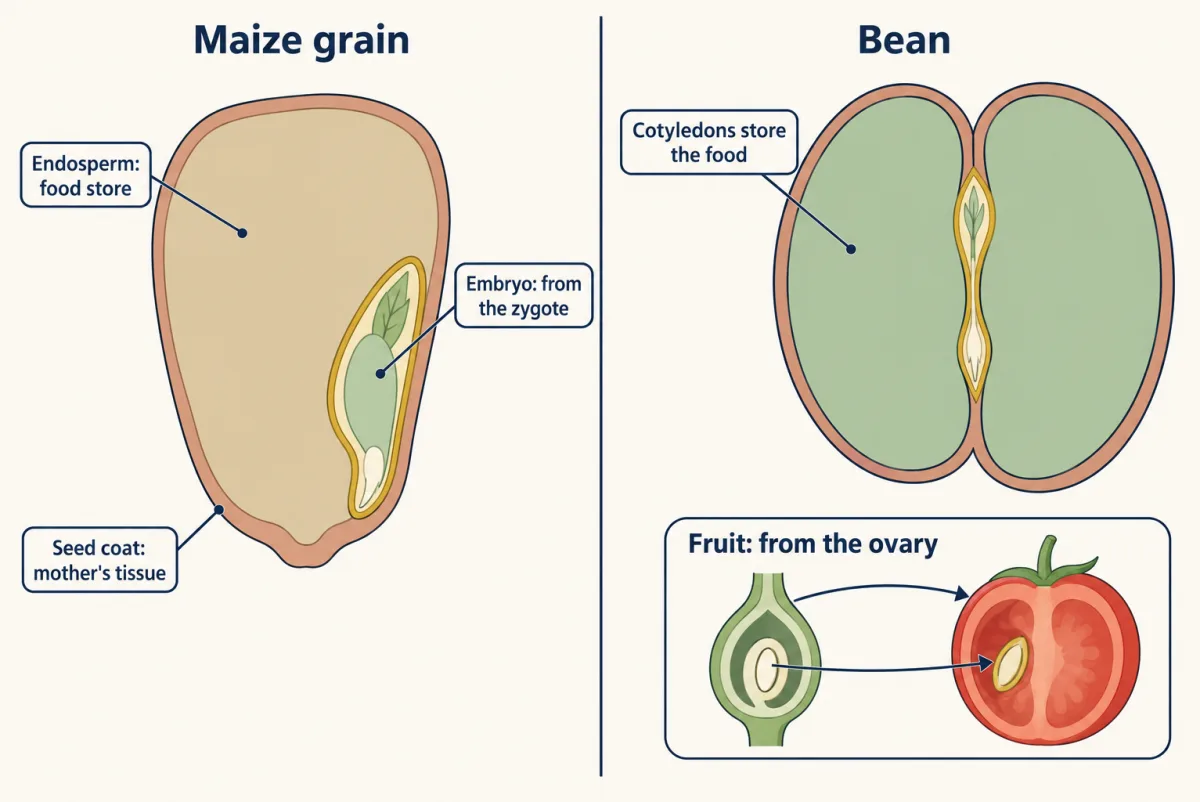
Three parts of three origins: the embryo from the zygote, the endosperm from the second fertilization, the seed coat from the mother's integuments. In maize the endosperm persists; in beans the cotyledons absorb it and store the food. AI-generated illustration -
Waiting and travelling: dormancy, dispersal and clones
-
Going deeper
Where this lesson fits
Before thisReview first
- Plants on LandThis course · Lesson 5
You need alternation of generations and the haploid gametophyte from there to follow pollen grains and embryo sacs.
- Plant Body and GrowthThis course · Lesson 22
Knowing the plant body and its growth helps you place the flower as a shoot and follow the seedling.
- Plant Cells and Animal CellsLife Science · Grade 7
Chromosome-set counting here builds on knowing that cells carry paired chromosomes, which gametes halve.
After thisStudy next
- Chromosomes and Meiosis: The Physical Basis of Mendel's LawsOne level up · Genetics and Molecular Biology
It takes meiosis further, showing which chromosomes a gamete gets, which sets the chromosome count of each seed part.
- Mendel's Peas: Segregation and Independent AssortmentOne level up · Genetics and Molecular Biology
Following alleles through gametes to seed colours takes this idea further, using ratios in pea seeds.
- Extending Mendel: Dominance, Multiple Alleles and Gene InteractionOne level up · Genetics and Molecular Biology
Gene dosage and dominance in kernels, such as yellow deepening with extra copies, extend into dominance and gene interaction.
Elsewhere on the siteFilms, simulations and method films in other courses
- Set Up: Take a Flower ApartFilm · Biology Together
It shows the parts of a real flower, including where seeds begin.
- Set Up: From Bean to BeanFilm · Biology Together
It follows a plant from seed through flower to new seed, the circle this lesson explains in detail.
- Set Up: Seeds on the MoveFilm · Biology Together
It shows how seeds get carried to new places, which this lesson treats as dispersal.
Suggested by an AI model from the lessons themselves, then checked. How we use AI