Organismal Biology · Skim version
Osmoregulation and Nitrogenous Waste
Read the full lesson → Skim the whole course →
The guiding idea
A goldfish in a bowl is soaking up water all day, and a cod in the sea is losing it. How does each one stay the same size?
Where water can cross and nothing pushes back, it moves on its own toward the higher osmolality, so a bony fish more dilute than seawater loses water, one in fresh water gains it, and at steady state each must match every leak.
From the film: Which Way Does the Water Go?
- Where water can cross and nothing pushes back, it moves on its own toward the side with more dissolved particles, the higher osmolality; in these fish each salt leaks toward the side where it is scarcer.
- A marine bony fish loses water and gains salt, so it drinks seawater and its gills spend ATP to send salt back out.
- A freshwater fish gains water and loses salt, so it makes a lot of dilute urine and its gills use ATP to take salt in.
- A shark makes urea and holds it in its blood with a little TMAO, which brings its total osmolality just above seawater, so water enters slowly and it need not drink.
- Gains must equal losses, for water and for each salt: the gap between body and water sets the leaks, and drinking, urine and ATP-driven salt transport close each gap.
From the film: Where Does a Seabird's Salt Go?
- Schmidt-Nielsen, Jørgensen and Osaki gave cormorants a salt load and collected two fluids: the drip from the beak and the fluid from the cloaca.
- The beak fluid, made by paired nasal salt glands, carried the salt at about the concentration of seawater or somewhat more; the cloacal fluid stayed much less salty.
- A more concentrated salt secretion costs less water per unit salt; whether the bird nets water depends on the volume and makeup of every input and output.
- The experiment showed a second route for salt that bypasses the kidney; it did not show how the gland concentrates salt or that every bird has one.
-
Three osmotic worlds
-
Fish in sea and river, and a shark full of urea
-
A bird with a second route for salt
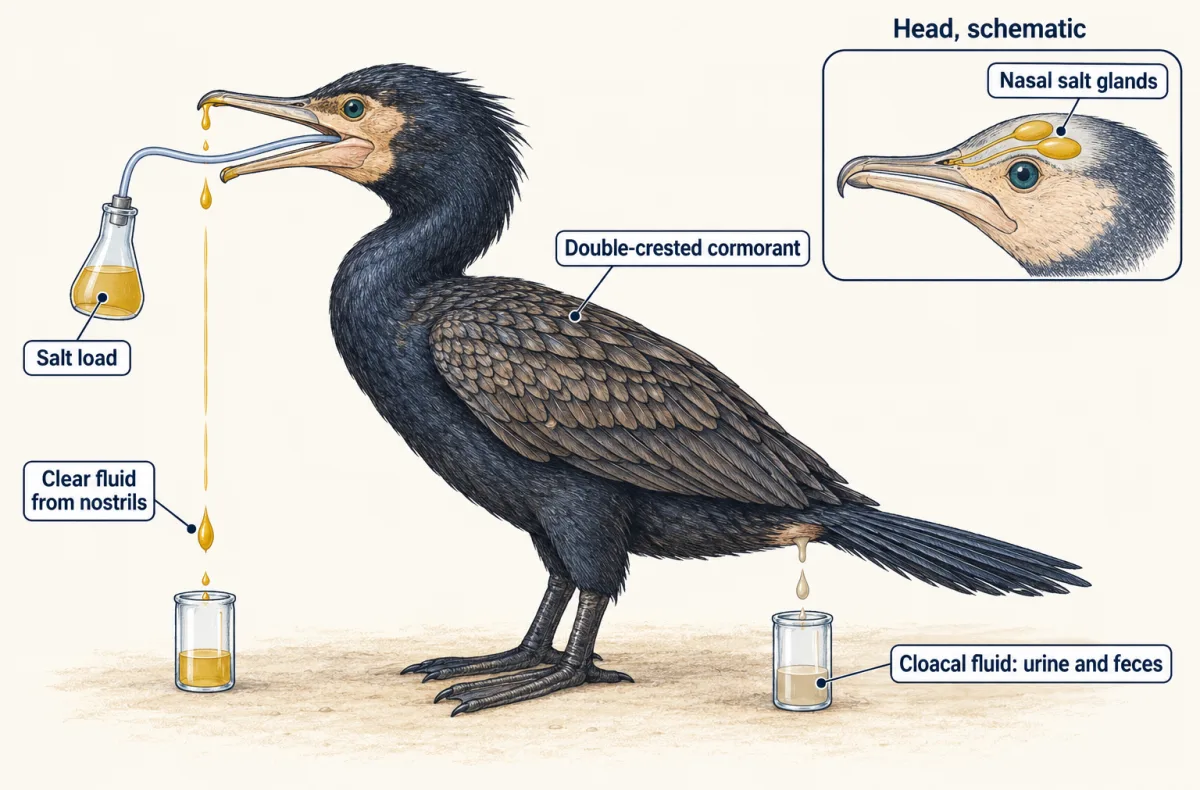
In salt-loaded double-crested cormorants, the beak drip from the nasal salt glands was about as salty as seawater or somewhat more, made fast enough to clear the body's salt in about 10 hours, while the cloacal fluid, urine mixed with feces, stayed much less salty (Schmidt-Nielsen, Jørgensen and Osaki). AI-generated illustration -
Ammonia, urea, uric acid
-
Four ways to make urine
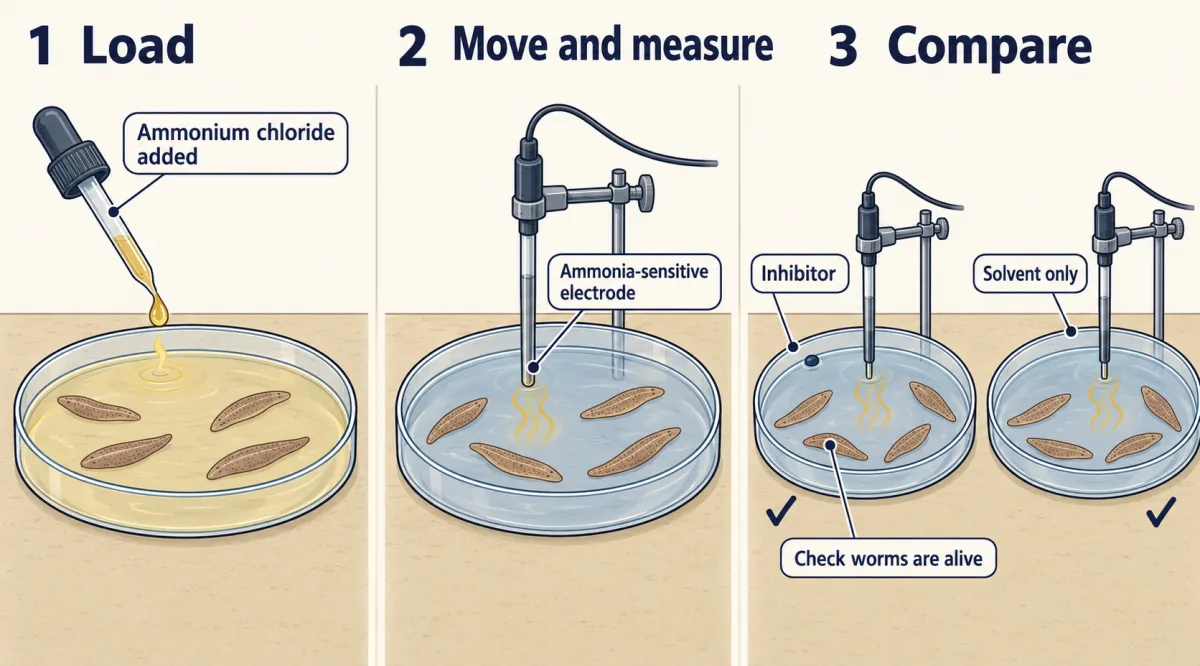
One design for the acoel question: load the worms with ammonium chloride, move them to clean seawater and measure ammonia appearing with an electrode, then compare worms given a pump or microtubule inhibitor with worms given solvent alone, checking that the treated worms are alive. AI-generated illustration -
Going deeper
Where this lesson fits
Before thisReview first
- Tissues, Organs and HomeostasisThis course · Lesson 6
It introduces steady state and organic osmolytes, and this lesson applies that balance to water and salt.
- What an Organism Has to DoThis course · Lesson 1
It sets up the exchange budget, where gains must equal losses, which this lesson applies to water and salts.
- Crossing the MembraneBiology · High school
It teaches how water follows dissolved particles across a membrane, the rule behind every fish budget here.
After thisStudy next
- The KidneyThis course · Lesson 16
It shows how the vertebrate nephron filters, reabsorbs and secretes to make concentrated urine.
Suggested by an AI model from the lessons themselves, then checked. How we use AI