Ecology and Evolution · Skim version
Distributions, Niches and Tolerances
Read the full lesson → Skim the whole course →
The guiding idea
A dune plant was planted 60 km past its own range edge, and the planted population more than tripled. So what was stopping it?
A species' niche is the set of conditions in which its population replaces itself over the long run without immigrants; its map records where it is found, sinks kept going by immigrants included, and cannot by itself tell the two apart.
From the film: Where It Can Live, Where It Is
- A niche is the set of conditions in which the long-run lambda, across good and bad years with no immigrants, is at least 1.
- Niche space is a space of conditions; the map shows the places where the species is found.
- A species can be missing from a place inside its niche because it has never reached it.
- A sink population lives outside the niche and is kept going by immigrants, so presence alone does not mark the niche.
From the film: Planting Past the Edge
- A range edge can be set by conditions, by other species, or by access: the species not arriving or not recolonising.
- Planting beyond the edge, with the same planting inside the range, tests which; if the inside plantings fail too, handling, the seed or a bad year may be to blame, and the test cannot single out the edge.
- Clearing neighbours on random plots separates the neighbours' net effect from a limit set by conditions.
- Lambda over the whole life cycle, not one measure such as first-year survival, decides whether a population can persist.
- The dune plant grew beyond its northern edge, so at that site the edge was not where the plant fails; its neighbours were not tested.
-
The bookkeeping behind a map
-
Fundamental and realized niches
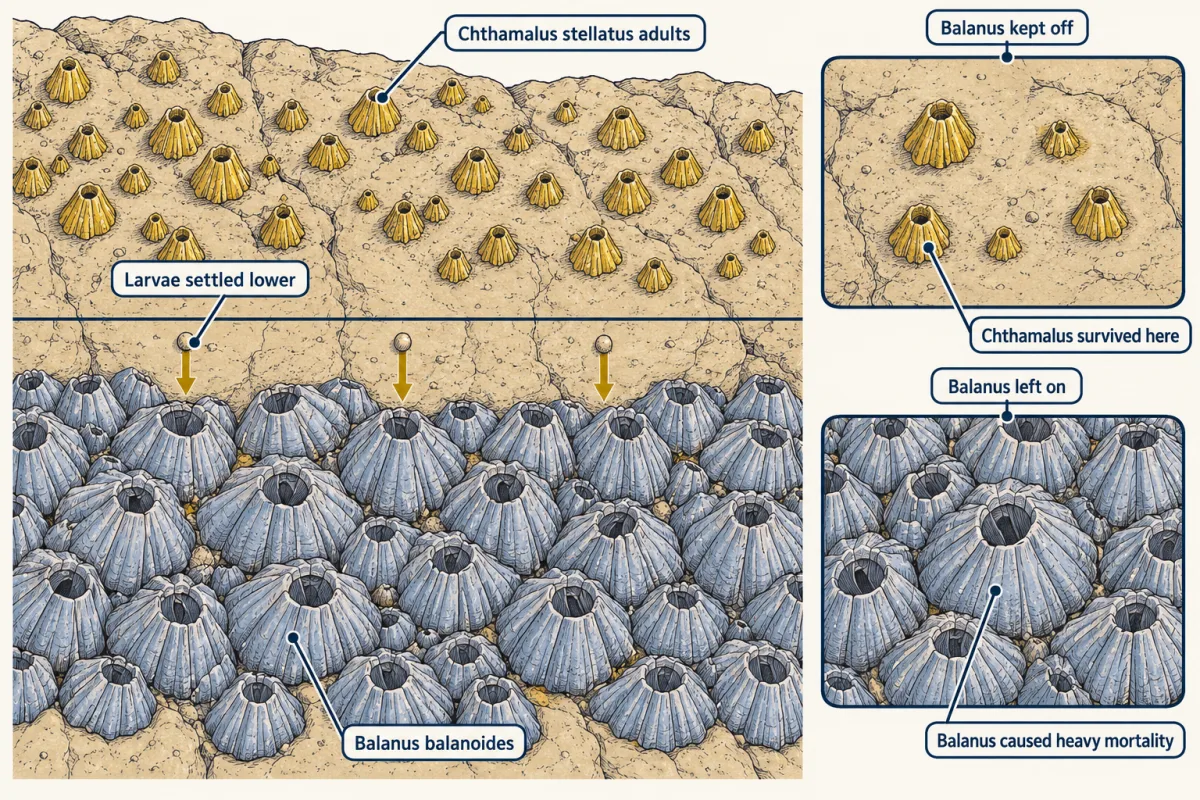
At Millport, Chthamalus larvae settled below the adult band; they survived where Connell kept the larger Balanus off and suffered heavy mortality where Balanus grew, so a competitor, not low-shore conditions, held Chthamalus off the lower rock. AI-generated illustration -
Tolerance: one piece of λ at a time
-
Testing a range edge
-
Going deeper
Where this lesson fits
Before thisReview first
- Climate, Biomes and Environmental VariationThis course · Lesson 11
You need how conditions vary with latitude, altitude and microclimate to see why one niche maps onto scattered places.
- Natural Selection in Ecological ContextThis course · Lesson 3
This lesson sets aside evolution at the edge, so you should already know selection in its ecological setting.
After thisStudy next
- Population Growth and RegulationThis course · Lesson 14
It uses N_next = λN and the sparse-population rate to ask what regulates a population.
- Movement and Spatial PopulationsThis course · Lesson 15
It takes up the colonisation and local extinction balance that may hold a range edge and the sinks fed by immigrants.
- CompetitionThis course · Lesson 16
It works out how a competitor shrinks the realized niche, which the Connell barnacles only introduce.
Elsewhere on the siteFilms, simulations and method films in other courses
- Grow a population, then add limitsSimulation · Biology
Adding limits to a growing population shows how conditions can stop the replacement rate from staying above one.
- Follow the Energy ArrowsFilm · Life Science
It is not a match, so ignore.
Suggested by an AI model from the lessons themselves, then checked. How we use AI