Follow the Energy Arrows
Read the transcript of “Follow the Energy Arrows”
Film transcript: Follow the Energy Arrows
An osprey lifts a menhaden from the Chesapeake Bay. Where did the energy inside that fish begin? Follow one glowing packet backward through the moving water. The Bay is an ecosystem, which includes living things and their nonliving surroundings. Light, water, and temperature are abiotic factors.
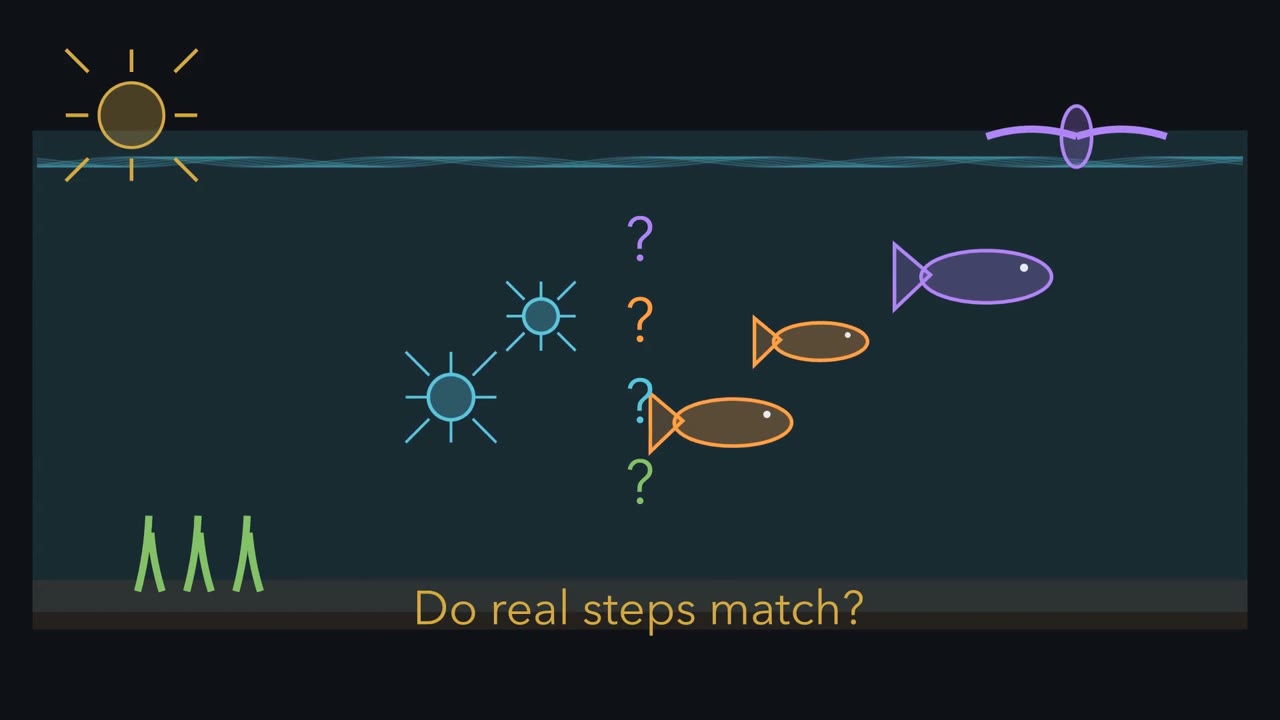
Organisms, their parts, and their wastes are biotic factors. A change in either kind can reshape the community. The trail ends at sunlight reaching phytoplankton, tiny drifting algae. They are producers because they make food using light energy. That stored energy can enter the living food web. Most ecosystems need new energy entering again and again. A zooplankton eats the producer. A menhaden eats that zooplankton. An osprey catches the menhaden. Each eater receives some stored energy from its food. The packet changes location, but it still follows the food. The arrows are missing. If each arrow shows energy movement, should it point toward the food or toward the eater? Choose before anything moves.
Arrows point from food to eater, the same direction the energy packet moves. This straight route is one food chain. It is one path, not the whole ecosystem. Read every arrow by asking where the stored energy goes. Menhaden can also eat phytoplankton directly.
Larger fish can eat menhaden too. New arrows join the first path. Linked food chains become a food web. That web reveals how a change can reach several organisms. On the longer path, the osprey is a third-order consumer. On a shorter path, it is second-order. The animal stays the same. Its order depends on the chosen path. Consumer order describes a position on one route. Dead matter and wastes carry stored energy from every level.
Dashed routes lead downward to decomposers, including many bacteria and fungi. Their work returns matter, but energy keeps moving onward. The decomposer branch connects to every feeding level, not just the top. Now watch each feeding step. Much energy follows other routes, so the packet continuing upward becomes smaller. Energy has not disappeared; different paths now hold it or release heat. At each feeding step, less energy is available to the next level. The osprey's energy began with sunlight captured by producers. A food web shows many connected routes. The shrinking packet explains why higher feeding levels have less energy to share. The web maps routes, while the packet maps what remains available.
If ospreys eat menhaden and menhaden eat plankton, how much of the sun’s energy ever reaches an osprey?
Continue in the lesson: Food Webs and Energy →
3:24 · Free, with captions and a transcript. The lesson has the full text, the questions and the sources.
More films from this lesson
How this film was made. Narration: written from this lesson's text and read by an AI narrator voice (Kokoro, af_heart). Animation: AI-generated in code (Manim) by Claude, a schematic with no drawn molecular structures. Captions come from the narration script. See something wrong? Report it.