Developmental Neuroscience · Skim version
Too Many Neurons: Naturally Occurring Cell Death
Read the full lesson → Skim the whole course →
The guiding idea
In Hamburger's raw counts, a chick embryo has just over 20,000 motor neurons in the column that serves its leg at the peak, and about 40% of them die over the next three days. Nothing is wrong with the embryo. How could anyone tell those neurons died, and what decides how many stay?
Make too many, then let the target keep what it can support: in the chick limb experiments, changing the target changed how many of the neurons already present survived.
From the film: Too Many, Then Fewer
- Many developing neurons are made in excess, and the target helps set how many survive.
- In the chick limb experiments, changing the target changed how many neurons survived but not detectably how many were made.
- Some neurons die on a schedule that the target does not set.
From the film: Count Across Time
- A low count at the end cannot tell neurons that were never made from neurons that were made and then lost, so you must count across time.
- In Hamburger's raw counts, about two in five leg motor neurons died after the peak near day six.
- An extra leg did not add motor neurons before the normal loss; more target meant fewer deaths, not more births.
From the film: A Dial With a Ceiling
- The target turns a dial: more target, fewer deaths, up to a ceiling set by the neurons present.
- In mice, about the same fraction of transplanted interneuron precursors died at every dose tested, and they died at their own age.
- An early wave of chick cervical motor neuron death is not controlled by the target and needs new RNA and protein.
-
Too small, or lost?
-
Counting the death itself
-
More target
-
A dial with a ceiling
-
How a developing neuron dies
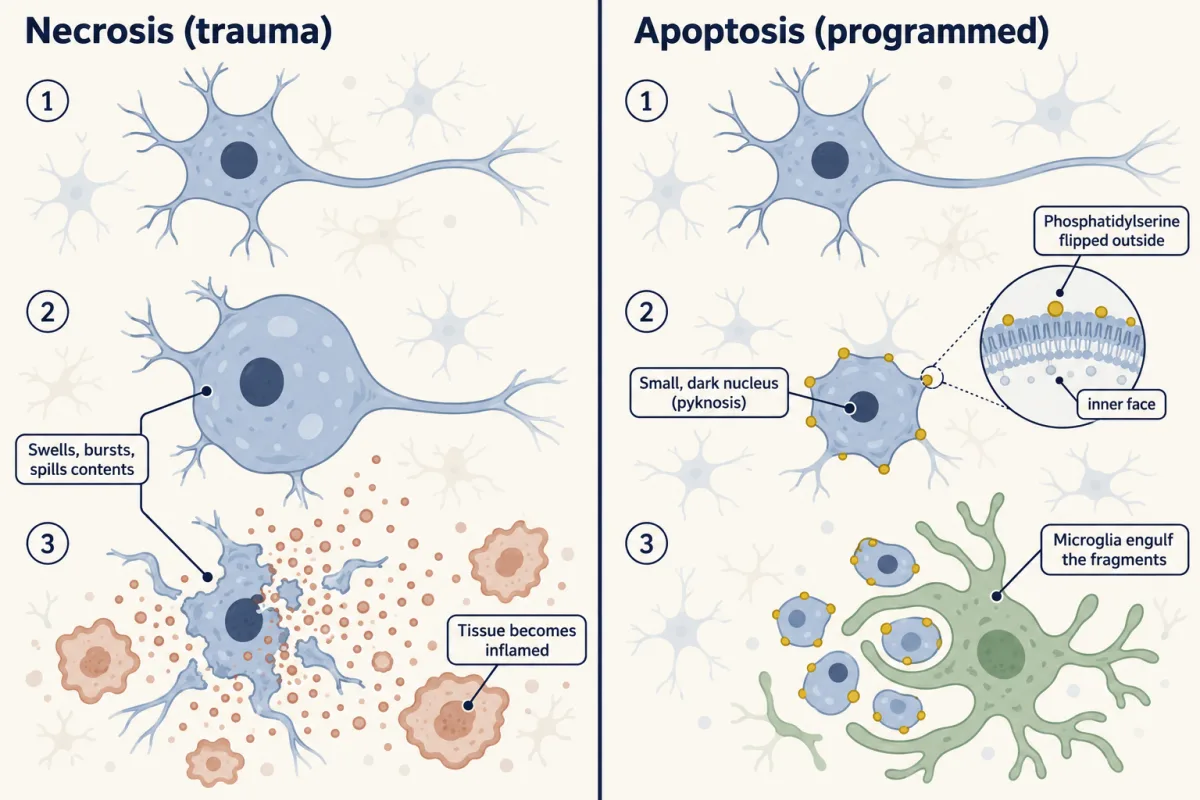
Necrosis typically follows injury, with swelling, membrane rupture and inflammation, though injury can also trigger apoptosis. Most developing neurons die by apoptosis instead: the nucleus condenses, the cell fragments, and microglia read phosphatidylserine flipped to the outer membrane leaflet as an eat-me signal, so few dying cells are visible at any moment. AI-generated illustration -
How much, and where
-
Why make neurons just to kill them?
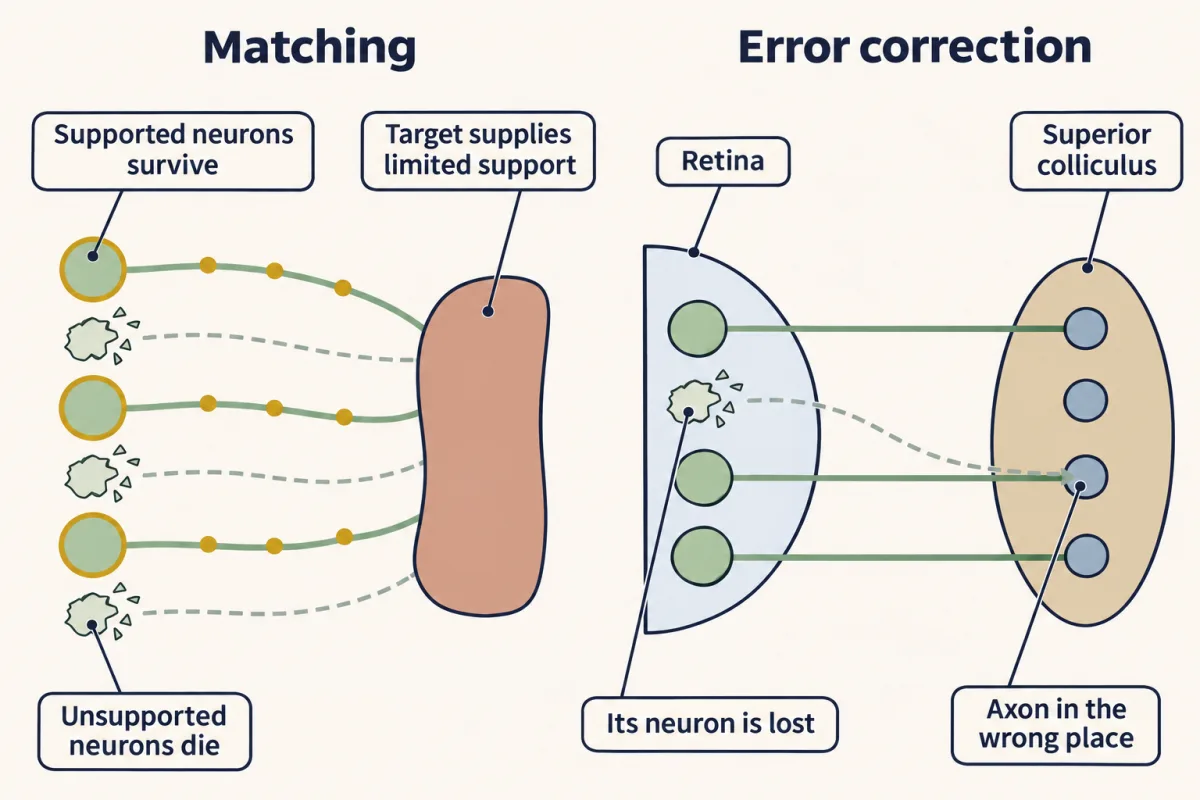
Two jobs for overproduction and death. Matching: a target supplies limited support, so the number of neurons that survive is set without a plan. Error correction: in the newborn rat, retinal ganglion cells whose axons reach the wrong part of the superior colliculus are removed preferentially, though pruning branches or synapses fixes many other wiring errors. AI-generated illustration -
Where the target account stops
-
Putting it together
-
Going deeper
Where this lesson fits
Before thisReview first
- The Growth Cone: The Tip That Steers the AxonThis course · Lesson 3
Axons reaching their targets, whose growth you follow there, is the starting point for the later loss of neurons.
- The Ventricular Zone: Radial Glia as Stem CellsThis course · Lesson 13
You need to know how neurons are first produced to see why a count at the peak is the supply that survivors cannot exceed.
- Tools for Following Cells and GenesThis course · Lesson 4
Birthdating and lineage labels from there are how you tell neurons never made from neurons made and lost.
After thisStudy next
- The Neurotrophic Hypothesis TestedThis course · Lesson 29
It tests whether a target-derived protein, NGF, is the limiting support that decides which neurons survive.
- The Death Machinery in NeuronsThis course · Lesson 31
It explains how the apoptotic program of Bcl-2 proteins and caspases is triggered in these neurons.
- Competition: How Neurons Win a TargetThis course · Lesson 32
It shows which neurons win when the target's limited support cannot keep all of them alive.
Elsewhere on the siteFilms, simulations and method films in other courses
- Sealed or TornFilm · Cell Biology
It shows apoptosis taking a cell apart with the plasma membrane intact, the death mode behind most of this loss.
- Cell death assaysMethod film
It shows how apoptotic cells are told from necrotic and live ones, which is how dying neurons are identified in counts.
- Reading annexin V and PISimulation · Cell Biology
It lets you practise reading annexin V and PI to separate dying from dead cells.
Suggested by an AI model from the lessons themselves, then checked. How we use AI