Sealed or Torn
Read the transcript of “Sealed or Torn”
Film transcript: Sealed or Torn
Every one of these worms kills the same 131 cells. How does a body lose that many cells without leaving a mess? In healthy tissue, dead cells are cleared so fast that you rarely see a corpse. Follow one doomed cell. Its own enzymes, called caspases, switch on. They cut other proteins. The cell shrinks, its chromatin packs down, its nucleus breaks into pieces, and its surface bubbles. But watch the membrane. It has not broken. The cell is taking itself apart, but for now every piece stays wrapped inside a closed membrane. This tidy, self-run death is called apoptosis. While still sealed, it can send two signals. First, a channel in its membrane opens, and small molecules puff out.
They are a find-me signal. They call a phagocyte, a cell that eats other cells. Second, a lipid called phosphatidylserine normally sits mostly on the membrane's inner face. The caspases cut the membrane proteins that control which face it sits on. Now it appears on the outer face. That is the eat-me flag. Here is the idea to carry. In apoptosis, the membrane holds while the cell takes itself apart. That buys time for a phagocyte to eat it before anything leaks. The phagocyte arrives and recognises the flag. In the simplest picture, it wraps around the whole cell and swallows it. A lysosome digests it. Nothing spills. That is why you rarely see a corpse.
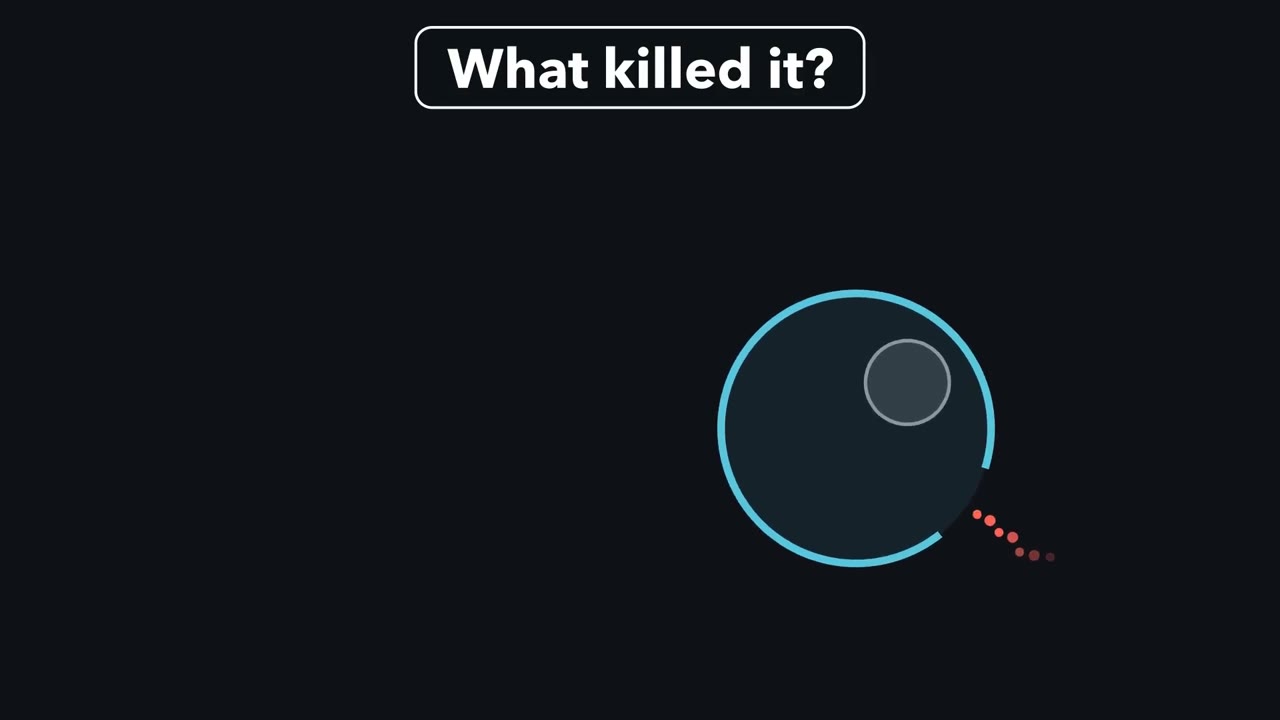
Now put the same kind of dying cell in a dish, where no phagocyte will come. Time passes. What happens to its membrane? Often, it fails. The membrane that held through the early stages now leaks, and the contents spill. This late leak is called secondary necrosis. In a tissue, a phagocyte usually gets there first. Some cells die the other way round. This one swells, and its membrane tears early. Its contents spill at once, including alarm signals. These can call in the immune system and cause inflammation.
This messy death is called necrosis. Tearing does not mean accident: some tearing deaths are genetic programs too. In its simplest form, the difference is timing. Apoptosis keeps the membrane intact early. Necrotic deaths generally open it early. So back to the worm. Its doomed cells are usually eaten by neighbouring cells before they spill. A membrane that holds until the meal often makes for a quieter death.
In a developing worm, the same 131 cells die on schedule, yet in healthy tissue you rarely see a corpse. How does a cell die without leaving a mess?
Continue in the lesson: Cell Death and Clearance →
3:17 · Free, with captions and a transcript. The lesson has the full text, the questions and the sources.
More films from this lesson
How this film was made. Narration: written from this lesson's text and read by an AI narrator voice (Kokoro, af_heart). Animation: AI-generated in code (Manim) by Claude, a schematic with no drawn molecular structures. Captions come from the narration script. See something wrong? Report it.