Cell Signaling · Unit 4: Receptors with enzymes attached
mTOR and AMPK: Reading Nutrients and Energy
Rewritten on : new text, flashcards and film. Your notes and highlights stay, but the text around them may have moved.
How does a cell decide it can afford to grow?
The main idea, the figures and what the films show. Under each heading, "Read this part" opens it.
Both films in order, 7 minutes. Each one ends with what to take from it.
The whole lesson: about 22 minutes of reading and 7 of film.
Pause when the reading reaches a film, and offer to play it. Saved on this device.
Watch the film now, or keep listening
That is the end of the reading
This idea at other levels
This lesson teaches sensing low energy in Cell Signaling, a graduate course. Simpler: read a short college version here.
The college version · about 1 minute to read
mTORC1 is a kinase complex that turns up protein synthesis by phosphorylating S6 kinase and 4E-BP1. It is active only when two GTPase switches agree. Growth factors act through Akt to silence the TSC complex, the GAP for Rheb, so Rheb stays bound to GTP. Amino acids act through the Rag GTPases, which bring mTORC1 to the lysosome surface, where Rheb can activate it. AMPK is a three-subunit kinase whose gamma subunit binds AMP in competition with ATP. Because adenylate kinase makes the AMP:ATP ratio vary as the square of the ADP:ATP ratio, AMP is a sensitive alarm. AMP binding favors the phosphorylated state of Thr172, the site that LKB1 phosphorylates. Active AMPK switches off acetyl-CoA carboxylase and HMG-CoA reductase, raises glucose uptake in muscle, and inhibits mTORC1 through TSC2 and Raptor. Rapamycin binds FKBP12, and the pair binds the FRB domain of mTOR.
See nearby ideasHide nearby ideas
This lesson also teaches one more idea; its ladder is below.
How cells sense low energy (AMPK)
When a cell runs low on energy, AMP rises, and the enzyme AMPK switches off costly jobs and turns on fuel use.
Taught at one level so far: graduate level.
Graduate · the level you chose
mTOR and AMPK: Reading Nutrients and Energy · this lesson
AMP rises from 0.025 to 0.096 mM while ATP barely moves: AMPK reads AMP.
Cell Signaling · about 22 min · 3 practice questions
Next door to sensing low energy
- mTOR: the cell's decision to growWhen energy is low, AMPK shuts down mTOR so the cell stops building and saves what it has.
- AutophagyLow energy also tells a cell to digest its own worn parts for fuel.Nearest lesson: Protein Quality Control and Organelle Turnover (college core)
mTOR: the cell's decision to grow
The kinase mTORC1 switches on growth only when growth factors and amino acids both say yes.
Taught at one level so far: graduate level.
Graduate · the level you chose
mTOR and AMPK: Reading Nutrients and Energy · this lesson
Two yeses to grow: Akt through Rheb, and Rag GTPases at the lysosome.
Cell Signaling · about 22 min · film 3:33 · 3 practice questions
Next door to mTOR
- How cells sense low energy (AMPK)When energy runs low, AMPK shuts mTORC1 off so the cell stops spending on growth.
- Amino acids and their side chainsmTORC1 checks that amino acids are present before it allows the cell to build protein.Nearest lesson: Amino Acids: How One Side Chain Decides Everything (upper-level college)
Short versions inside this lesson
The plainest version · about 1 minute to read
A cell is like a small builder. Before it builds, it checks three things: did the boss say to build, are there enough bricks, and is there enough power? One checker listens for the boss and counts the bricks, and another watches the power. If any answer is no, the building waits.
Find an idea: every idea, searchable
Which lessons teach an idea, and the notes on each level, were written by AI models from the lessons and checked by a second model. A person has not yet read every one. How we use AI
About this lesson goals, parts
What you'll learn
- Tell how rapamycin led to TOR, and explain why the drug needs the partner protein FKBP12 to inhibit the kinase.
- Explain mTORC1 as a decision that needs two yeses: a growth-factor signal through Akt, the TSC complex and Rheb, and an amino acid signal through the Rag GTPases at the lysosome.
- Explain why AMP is a more sensitive energy signal than ATP, what AMP does to AMPK, and what AMPK then switches on and off.
- Predict what a cell does when it is fed, when it lacks amino acids and when it lacks energy, using the wiring between AMPK and mTORC1.
Builds on:GTPase Switches: The Timer (read)PI 3-Kinase, Akt and Insulin (read)Phosphorylation: Kinases and Phosphatases (read)Why these?
Rewritten on : new text, flashcards and film. Notes and highlights stay, but the text around them may have moved.
The main idea. mTORC1 needs both growth factors and amino acids to switch on; AMPK reads rising AMP to conserve energy and veto mTORC1.
The films
 ▶ Watch mTORC1: Two Signals at the Lysosome · 3:33
Read the transcript of “mTORC1: Two Signals at the Lysosome”
Film transcript: mTORC1: Two Signals at the Lysosome
Building new protein burns amino acids and a large share of cellular energy. So how does a cell decide it can afford to grow? Starting without permission or raw materials wastes scarce supplies. One central kinase complex, mTORC1, makes that call. Before this kinase switches on, it checks two separate questions. First, has the body sent a growth factor saying it is time to grow? Second, are there enough amino acids on hand to build protein? Two independent tracks carry those two answers straight to the lysosome. Follow the growth-factor track first. A signal such as insulin activates the kinase Akt at the plasma membrane. On the lysosome sits a small switch protein called Rheb.
The TSC complex holds it off by making Rheb cut its GTP to GDP. Akt phosphorylates TSC, lifting that brake right off Rheb. With the TSC brake lifted, Rheb stays loaded with GTP. Active Rheb is the direct activator of mTORC1. Notice where Rheb sits, though. A lipid tail anchors Rheb to internal membranes, including the lysosome.
Meanwhile, the kinase complex still drifts out in the cytoplasm. Now follow the amino acid track. Another pair of small switches, the Rag proteins, sit anchored on that same lysosome surface. The Rags do not activate the kinase directly. Instead, when amino acids rise, the Rags grab mTORC1 and pull it onto the lysosome. Separating activation from delivery builds a strict cellular gate. Test it yourself. Suppose amino acids are plentiful, so the Rags hold the complex right on the lysosome. Now remove the growth factor from outside the cell. Does the kinase switch on, or stay off?
It stays off. Without the growth factor, Akt quiets down and the TSC brake returns to the lysosome. TSC drains Rheb of GTP, turning that activator off. Even sitting right beside Rheb, docked mTORC1 stays silent without an active partner. Now restore the growth factor while amino acids remain plentiful.
Akt clears the TSC brake, Rheb lights up with GTP, and docked mTORC1 fires. Once active, it speeds up protein building and lipid synthesis. At the same time, it holds off cellular self-digestion, called autophagy. So mTORC1 needs both growth factors and amino acids to switch on. Growth factors activate Rheb, and amino acids deliver the kinase to meet it. This is the standard model, though some nutrients like glutamine can bypass the Rags. In normal cells, growth waits until both signals agree.
From the film: four take-homes
- In the standard model, mTORC1 needs both growth factors and amino acids to switch on.
- Growth factors act through Akt to silence the TSC brake so lipid-anchored Rheb keeps GTP at the lysosome.
- Amino acids switch on the Rag GTPases, which deliver mTORC1 to the lysosome rather than activating the kinase directly.
- With both signals present, mTORC1 promotes protein and lipid synthesis and holds off autophagy, though some nutrients such as glutamine can bypass the Rags.
The drug that protects a transplanted kidney from rejection came out of soil collected on Easter Island in 1964–65. Working out what it hits inside a cell uncovered the enzyme that decides whether a cell grows.
The first film sketched mTORC1’s two-signal gate at the lysosome; here is the evidence behind it, and the energy gauge that can override it.
How a soil drug uncovered the growth controller
From December 1964 to February 1965 a Canadian medical expedition worked on Rapa Nui (Easter Island), where Montreal bacteriologist Georges Nogrady collected soil across the island. At Ayerst Research Laboratories in Montreal, a Streptomyces hygroscopicus strain grown from one sample killed fungi. In 1972 Ayerst microbiologist Suren Sehgal isolated the compound and named it rapamycin, after the island.
Why it stops cell growth was answered in yeast. In Michael Hall’s Basel laboratory, Joseph Heitman plated yeast on rapamycin and collected rare resistant mutants. Most carried mutations not in a kinase, but in a small protein called FPR1—the yeast version of human FKBP12.
Predict. If losing FPR1 makes yeast resistant to rapamycin at working doses, how must the drug block growth?
Check your prediction
Rapamycin does little alone at working doses. It must first bind FKBP12 (FPR1 in yeast), and the FKBP12–rapamycin pair is the active poison.
The remaining mutants altered TOR1 and TOR2, for “target of rapamycin” (published 1991). In 1994 and 1995 several labs identified the mammalian protein bound by FKBP12–rapamycin: mTOR.
mTOR is a large protein kinase with a small FRB domain beside its kinase domain. Rapamycin glues FKBP12 to FRB, so bound FKBP12 narrows substrate access to the active site. It does not compete with ATP; it is an allosteric inhibitor, acting from outside the active site.
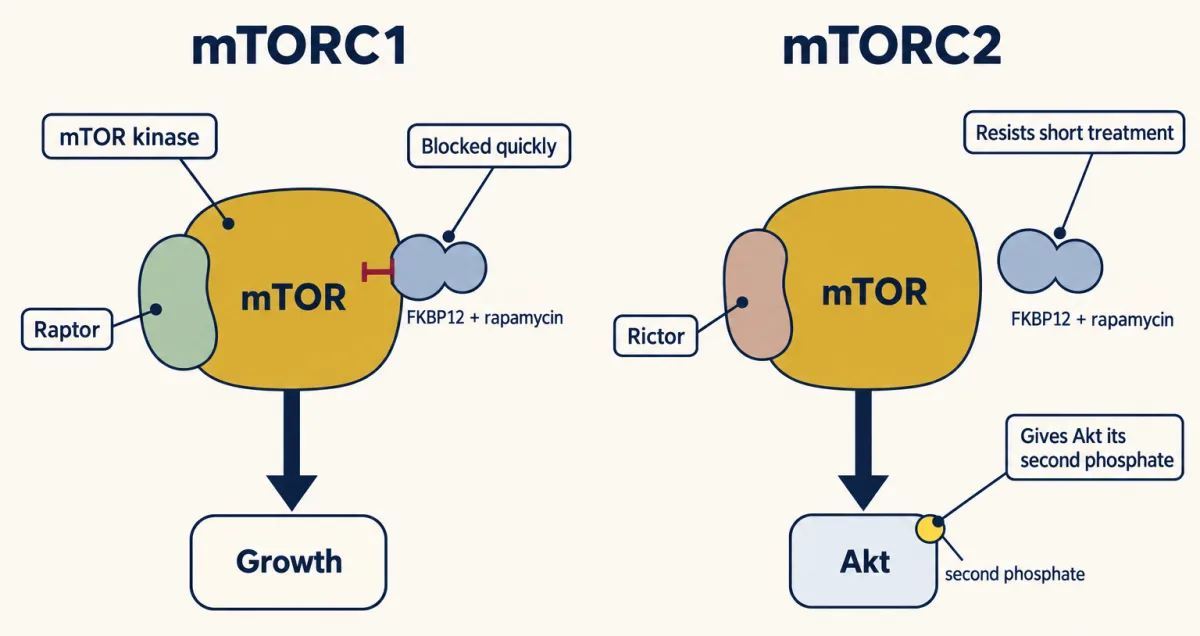
Yeast has two TOR genes and humans have one, yet in both the kinase works in two complexes. mTORC1, built around Raptor, controls growth and is blocked quickly by rapamycin. mTORC2, built around Rictor, gives Akt its second activating phosphate (the previous lesson) and resists short rapamycin treatment.
Two signals, one gate at the lysosome
Growth is expensive: making protein uses amino acids and a large share of cellular ATP. In 1996 Hall’s group reported that yeast without working TOR act starved even in rich medium—cutting back translation initiation and entering a resting state. Growth, they argued, is actively controlled, and TOR is the controller.
Track 1: Growth factors. A signal such as insulin activates Akt, releasing a brake through a double negative:
Growth factor → Akt ⊣ TSC complex (GAP) ⊣ Rheb-GTP → mTORC1
Akt phosphorylates TSC2 in the TSC complex, taking that complex out of action. The TSC complex is a GAP (the GTPase off-switch from the lesson on GTPase switches) for the small GTPase Rheb. Without its GAP, Rheb stays loaded with GTP, and Rheb-GTP directly activates mTORC1. In summer 2003 several labs, Kun-Liang Guan’s among them, reported within weeks of one another that TSC2 is Rheb’s GAP and Rheb acts upstream of mTOR.
Track 2: Amino acids. In 2008 Yasemin Sancak (David Sabatini’s lab) and independently Guan’s lab traced amino acid sensing to the Rag small GTPases. Sancak’s surprise was that the Rags bind Raptor and move mTORC1 without raising its kinase activity directly. In amino-acid-starved cells, mTORC1 spreads through the cytoplasm; restore amino acids and it gathers on one organelle, identified by the same lab in 2010 as the lysosome, the cell’s acidic digestive compartment. Because a lipid tail anchors Rheb to internal membranes, the lysosome surface is where Rheb-GTP and mTORC1 are thought to meet.
Rheb-GTP can activate only an mTORC1 that has been brought to it. Thus the lysosome acts as an AND gate: growth factors keep Rheb on, and amino acids deliver mTORC1 (amino acid loss also brings TSC to the lysosome to switch Rheb off).
Predict. Suppose Rheb loses the lipid tail that anchors it to membranes, while everything else is normal. In a cell given insulin and plenty of amino acids, is mTORC1 on?
Check your prediction
In the standard model, largely off. Akt still keeps Rheb loaded with GTP and the Rags still bring mTORC1 to the lysosome, but Rheb-GTP is no longer held where mTORC1 is delivered. The two signals have to meet in the same place.
Test each link below. This is the standard model, not the whole story: glutamine, for one, can switch on mTORC1 without the Rags. Amino acid sensors and Rheb’s working pool are in Going deeper.
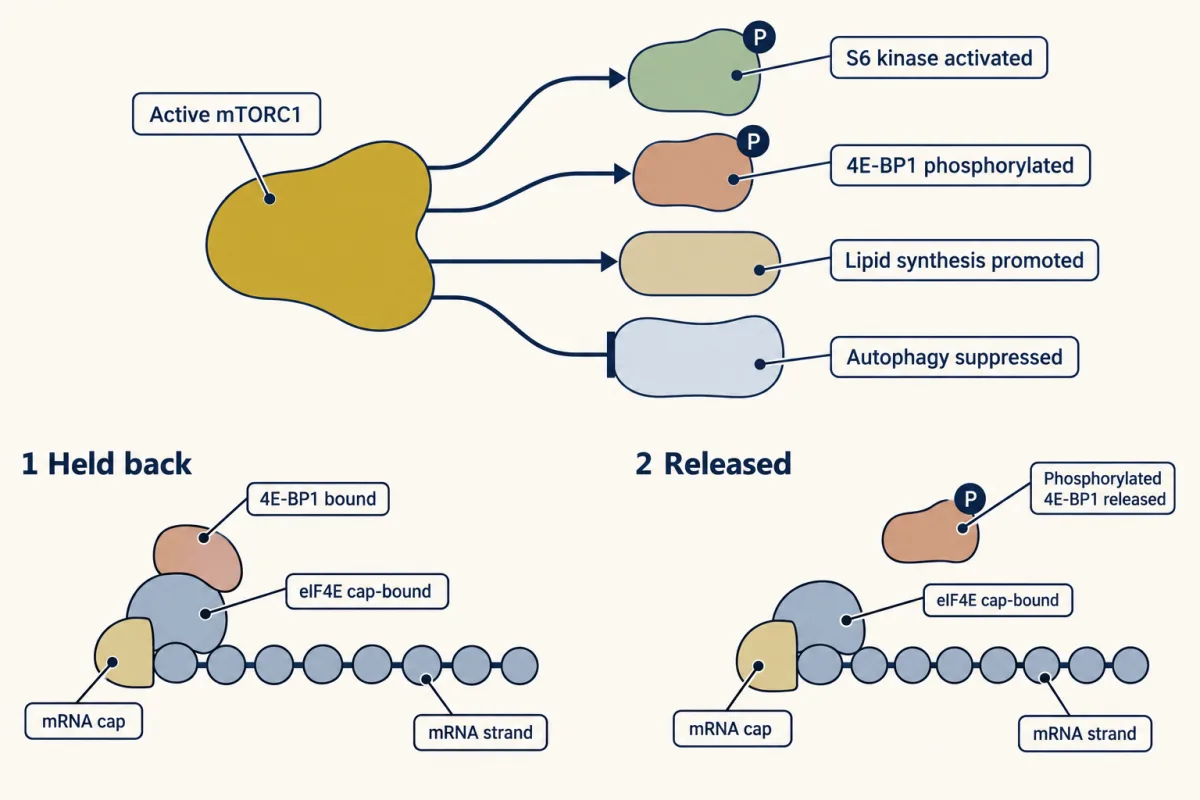
mTORC1 gives the order only when the growth-factor input and the amino acid input are both there, and low energy can veto it. The picture is a sketch of the logic: in this sketch, an arrowhead is an activation and a flat bar is an inhibition; teal means an input is present and being passed on, rust means a brake or the energy veto is acting, and grey means quiet. Where Akt and AMPK both act on the TSC complex, the sketch lets AMPK win.
When both inputs say yes, mTORC1 phosphorylates two translation-start regulators: S6 kinase switches on, and 4E-BP1 releases eIF4E, the factor gripping the mRNA cap. mTORC1 also promotes lipid synthesis and holds off autophagy, the process in which a cell digests its own contents in lysosomes to recover building blocks.
Even with growth factors and amino acids saying yes, building protein burns ATP—so the cell needs an energy gauge that can override mTORC1 before fuel runs dry.
Read the transcript of “AMPK: The Energy Veto”
Film transcript: AMPK: The Energy Veto
In the first film, growth factors and amino acids switched mTORC1 on at the lysosome. But what stops a cell from building when its ATP starts running low? Running out of cellular ATP threatens survival fast. So a second master kinase, AMPK, serves as the cell's energy gauge. You might expect a fuel gauge to watch ATP itself. The catch is that a working cell holds ATP nearly steady, so ATP barely budges at first. Instead, the enzyme adenylate kinase balances two ADP against one ATP plus one AMP. So AMP tracks ADP squared, divided by ATP. When ATP dips just ten percent, AMP rises almost fourfold. AMP works like a low-fuel warning light that trips while the needle has barely moved. AMPK has three subunits: alpha carries the kinase, and beta holds the complex together. The gamma subunit holds pockets where AMP and ATP compete, so it reads their ratio. Full activation needs a phosphate on alpha, added mainly by an always-active kinase called LKB1.
If LKB1 is always active, why does AMPK stay quiet in a rested cell? Because phosphatases keep stripping that phosphate back off. When AMP binds gamma, AMPK shifts shape so phosphatases cannot easily remove the phosphate. AMP also adds a direct allosteric boost, switching the kinase strongly on. Now put both gauges in one cell. Growth factors and amino acids are plentiful, but ATP dips and AMPK switches on, and it vetoes growth. One veto route runs through the TSC brake. So test it. Suppose a cell has lost TSC2, a key part of that brake. Can AMPK still shut the growth kinase down?
Partly, yes, because AMPK carries two separate brakes. Normally it phosphorylates TSC2 at activating sites, turning the TSC brake back on and draining Rheb of GTP. But AMPK also phosphorylates Raptor, a part of mTORC1 itself, braking the complex directly. So even without TSC2, energy stress can still dim protein building. At the same time, AMPK rebalances the cell's energy budget. It cuts spending by switching off enzymes that build fat and cholesterol. The first fat-building enzyme also makes a blocker of fatty acid entry into mitochondria. Switching it off opens that door, so fat is burned for fuel. In muscle, AMPK brings more glucose transporters to the surface to raise fuel income.
So AMPK reads rising AMP to conserve energy and veto mTORC1. Gamma senses AMP against ATP, while ADP and calcium signals can also tune this switch. That energy veto overrides both growth yeses whenever fuel runs short. Protecting cellular energy comes before building new protein.
From the film
- Under energy stress, AMPK reads rising AMP to conserve energy and veto mTORC1.
- Because adenylate kinase links ATP, ADP and AMP, a small drop in ATP drives a steep rise in AMP.
- AMP binding on AMPK's gamma subunit protects the activating phosphate on alpha from phosphatases and adds an allosteric boost.
- Active AMPK cuts fat and cholesterol synthesis, raises muscle glucose uptake, and shuts off mTORC1 through both TSC2 and Raptor.
Why AMP moves most: adenylate kinase and AMPK’s switch
Here is the equilibrium behind the fuel gauge you met in the biochemistry course and in the second film.
Because a healthy cell holds ATP nearly constant, ATP is a poor alarm. Adenylate kinase keeps the three adenine nucleotides near equilibrium:
2 ADP ⇌ ATP + AMP, so [AMP] = K × [ADP]² / [ATP]
Divide by [ATP] for the governing rule:
[AMP] / [ATP] = K × ( [ADP] / [ATP] )²
The AMP:ATP ratio varies as the square of the ADP:ATP ratio. Take round numbers with K = 0.5 (within reported values):
- At rest: ATP is 5.0 mM and ADP is 0.50 mM, so
[AMP] = 0.5 × 0.25 / 5.0 = 0.025 mM(total adenine poolATP + ADP + AMP = 5.525 mM). - After ATP drops 10%: ATP is 4.5 mM. Rather than ADP jumping the full 0.5 mM to 1.0 mM, adenylate kinase converts part of that ADP into AMP and ATP while holding the total pool at
5.525 mM. ADP settles near0.93 mM, and[AMP] = 0.5 × 0.93² / 4.5 ≈ 0.096 mM.
ATP fell 10 percent, yet AMP rose almost fourfold—like a low-fuel light tripping while the needle barely moved.
Predict. Suppose K were 1.0 instead of 0.5, and the ADP:ATP ratio changed in the same way as in the example. Would the fold rise in the AMP:ATP ratio be larger?
Check your prediction
No. K multiplies the AMP:ATP ratio in both states, so it cancels when you compare them. The fold rise depends only on how much the ADP:ATP ratio changed, squared.
AMP-activated protein kinase (AMPK) has three subunits: alpha carries the kinase, beta holds the complex together, and gamma holds binding sites where AMP, ADP and ATP compete, reading their ratio. Full activation requires phosphorylation of threonine 172 (Thr172) in alpha’s activation loop—boosting activity a hundredfold or more—added mainly by the upstream kinase LKB1.
LKB1 is active all the time, so AMP changes AMPK itself: AMP on gamma makes the Thr172 phosphate harder for phosphatases to remove and, by most accounts, easier for LKB1 to add, plus a direct allosteric push. (Going deeper covers ADP protection and calcium activation by CaMKK2.)
Predict. A cell lacking LKB1 cannot phosphorylate Thr172 via the energy route. If ATP drops and AMP spikes, does AMPK reach full activity?
Check your prediction
No. LKB1 adds most of the Thr172 phosphate, the source of the hundredfold or greater boost. Without it there is little phosphate for AMP to shield, and AMP’s allosteric push alone gives only weak activity. (CaMKK2 can still add the phosphate if calcium rises.)
Active AMPK cuts spending and raises income: it phosphorylates and inactivates acetyl-CoA carboxylase (slowing fat synthesis and lowering malonyl-CoA so fatty acids enter mitochondria to burn), inactivates 3-hydroxy-3-methylglutaryl coenzyme A (HMG-CoA) reductase (rate-setting enzyme of cholesterol synthesis), and in muscle brings more GLUT4 glucose transporters to the surface.
Two gauges, one decision: predicting cell states
Putting both halves of the rule together—mTORC1 needs growth factors and amino acids, while AMP-activated protein kinase (AMPK) reads rising AMP to conserve energy and veto it—shows how energy overrides growth.
AMPK blocks mTORC1 twice: it phosphorylates TSC2 at activating sites different from Akt’s (draining Rheb of GTP) and phosphorylates Raptor to inhibit mTORC1 directly. Both gauges also write on ULK1, the autophagy-initiating kinase (Going deeper).
| State | Growth factor / Akt | Amino acids / Rags | Energy / AMPK | Rheb & mTORC1 | Outcome |
|---|---|---|---|---|---|
| Fed | On (TSC silenced) | On (Rags bind Raptor) | High ATP (AMPK off) | Rheb-GTP; mTORC1 on lysosome | mTORC1 ON: protein & lipid synthesis run; autophagy low. |
| No amino acids | On | Off (Rags release mTORC1) | High ATP (AMPK off) | Rheb may hold GTP (loss can draw TSC); mTORC1 in cytoplasm | mTORC1 OFF: translation slows; autophagy starts, returning amino acids. |
| No energy | On | On | Low ATP, high AMP (AMPK ON) | AMPK activates TSC2 (Rheb-GDP) & brakes Raptor | mTORC1 OFF (vetoed): fat & cholesterol synthesis slow; fat burning & muscle glucose uptake rise. |
Predict. A cell lacks TSC2, keeping Rheb GTP-bound without growth factors. Will rapamycin still block mTORC1? Why?
Check your prediction
Largely, yes. FKBP12–rapamycin binds mTOR’s FRB domain, downstream of TSC2 and Rheb, and narrows substrate access whatever Rheb’s state. The block is not total: rapamycin stops S6 kinase phosphorylation more completely than 4E-BP1 phosphorylation.
Design problem
A cell should build new protein only when three things are true at once: a growth factor is present, amino acids are plentiful and ATP is plentiful. Design the logic using the parts in this lesson. Say where in the cell each condition is read, and name one mutation that would let the cell ignore each condition.
Saved in this browser only.
One way to do it
Make the output “mTORC1 is active” and require two things for it: Rheb holds GTP, and mTORC1 is on the lysosome.
- Growth factor. Read at the plasma membrane by a receptor and relayed by Akt, which takes the TSC complex out of action so that Rheb keeps its GTP. To ignore it: lose PTEN, so that PIP3 and Akt stay on with no growth factor.
- Amino acids. Read in the cytoplasm and inside the lysosome by sensors that report to the Rags, which bring mTORC1 to the lysosome. To ignore it: lock RagA or RagB in its GTP form, so that mTORC1 stays on the lysosome in a starved cell.
- ATP. Read in the cytoplasm by the gamma subunit of AMPK, as the AMP:ATP ratio. To ignore it: lose LKB1, so that AMPK barely switches on when AMP rises.
TSC2 is where two conditions meet. A cell without it largely ignores growth factors and has lost one of AMPK’s two routes to mTORC1, but it mostly keeps the amino acid check.
When a gauge is drugged or broken
Rapamycin. T cells need mTORC1 to grow and divide when interleukin-2, an immune signaling protein, stimulates them. Rapamycin (sirolimus) blocks that step and was approved in the United States in 1999 to prevent kidney transplant rejection. Because other tissues use mTORC1 too, mouth ulcers and raised blood sugar are among its side effects.
Tuberous sclerosis. People born with a faulty copy of TSC1 or TSC2 develop benign growths in the brain, kidneys, skin and other organs. Without a working TSC brake, Rheb stays on and mTORC1 largely stops waiting for a growth factor; rapamycin-family drugs shrink some of these growths.
Metformin. The most widely prescribed type 2 diabetes drug still has an unsettled mechanism. The liver (reducing glucose output) was long thought its main site, though the gut now looks important too. At high concentrations metformin partly inhibits mitochondrial complex I, raising AMP and activating AMP-activated protein kinase (AMPK). At lower, clinically relevant concentrations it has been reported to activate AMPK at the lysosome without changing AMP. Whether AMPK explains the blood-glucose drop is also argued: mice lacking liver AMPK still respond, and other liver and gut targets have been proposed.
Going deeper
Amino acid sensors upstream of the Rags
In 2011 Roberto Zoncu and colleagues reported that part of the amino acid reading occurs inside the lysosome and requires its membrane proton pump. Sensors found since include Sestrin2 (leucine) and CASTOR1 (arginine) in the cytoplasm, and the lysosomal membrane transporter SLC38A9—all reporting to the Rags. Which sensor matters most in which tissue, and where the working pool of Rheb sits, are not settled.
Beyond AMP: ADP and calcium inputs to AMPK
ADP on the gamma subunit also protects Thr172 from phosphatases, though at higher concentrations than AMP, and only AMP gives the allosteric push. Separately, CaMKK2 phosphorylates Thr172 when calcium rises, with no change in AMP.
AMPK and ULK1 in autophagy
mTORC1 phosphorylates ULK1 to keep autophagy off. In the 2011 model, AMP-activated protein kinase (AMPK) phosphorylates other sites on ULK1 to switch autophagy on, but later studies complicate AMPK’s side of this wiring, so hold it loosely.
Your notes
Select any text in the lesson to highlight it or add a note to it. Your highlights and notes are saved in this browser and collected in your notebook.
This browser is not letting the site save anything (a private window or strict privacy settings), so highlights and notes will be lost when you leave the page.
Try the Predict questions again
Five Predict questions from this lesson, on their own. Answer each one first, then open its check.
If losing FPR1 makes yeast resistant to rapamycin at working doses, how must the drug block growth?
From: How a soil drug uncovered the growth controller
Check your prediction
Rapamycin does little alone at working doses. It must first bind FKBP12 (FPR1 in yeast), and the FKBP12–rapamycin pair is the active poison.
Suppose Rheb loses the lipid tail that anchors it to membranes, while everything else is normal. In a cell given insulin and plenty of amino acids, is mTORC1 on?
From: Two signals, one gate at the lysosome
Check your prediction
In the standard model, largely off. Akt still keeps Rheb loaded with GTP and the Rags still bring mTORC1 to the lysosome, but Rheb-GTP is no longer held where mTORC1 is delivered. The two signals have to meet in the same place.
Suppose K were 1.0 instead of 0.5, and the ADP:ATP ratio changed in the same way as in the example. Would the fold rise in the AMP:ATP ratio be larger?
From: Why AMP moves most: adenylate kinase and AMPK's switch
Check your prediction
No. K multiplies the AMP:ATP ratio in both states, so it cancels when you compare them. The fold rise depends only on how much the ADP:ATP ratio changed, squared.
A cell lacking LKB1 cannot phosphorylate Thr172 via the energy route. If ATP drops and AMP spikes, does AMPK reach full activity?
From: Why AMP moves most: adenylate kinase and AMPK's switch
Check your prediction
No. LKB1 adds most of the Thr172 phosphate, the source of the hundredfold or greater boost. Without it there is little phosphate for AMP to shield, and AMP’s allosteric push alone gives only weak activity. (CaMKK2 can still add the phosphate if calcium rises.)
A cell lacks TSC2, keeping Rheb GTP-bound without growth factors. Will rapamycin still block mTORC1? Why?
From: Two gauges, one decision: predicting cell states
Check your prediction
Largely, yes. FKBP12–rapamycin binds mTOR’s FRB domain, downstream of TSC2 and Rheb, and narrows substrate access whatever Rheb’s state. The block is not total: rapamycin stops S6 kinase phosphorylation more completely than 4E-BP1 phosphorylation.
How we measure it
Drug-resistance screen in yeast
Spread millions of yeast cells on plates containing a drug that stops growth and keep the rare colonies that grow anyway. Then sort the survivors by which gene is changed. In the rapamycin screen the genes that turned up again and again encoded the drug's partner (FPR1) and its target (TOR1 and TOR2). In other screens such genes can also encode drug pumps or bypass routes.
Affinity purification with a drug–protein bait
Fix FKBP12 loaded with rapamycin to a solid support, pass a tissue extract over it, and look for proteins that stick only when the drug is present. This is how the mammalian target of rapamycin was pulled out of extracts.
Immunofluorescence co-localization
Fix cells, label mTOR with one fluorescent antibody and a lysosomal membrane protein with another, and ask whether the two signals overlap. Comparing starved and re-fed cells shows mTORC1 moving off and on the lysosome.
Phospho-specific immunoblotting
Separate cell proteins on a gel and probe them with antibodies that bind a protein only when one chosen residue carries a phosphate. Phosphorylated S6 kinase reports mTORC1 activity, and phosphorylated acetyl-CoA carboxylase reports AMPK activity, so one blot can read both gauges.
Practice questions on this lesson (3) → MCAT-style, original, each with an explanation
Where this lesson fits
Before thisReview first
- GTPase Switches: The TimerThis course · Lesson 7
TSC is a GAP that switches off Rheb, and the Rags are GTPases, so you need the GTPase timer idea.
- PI 3-Kinase, Akt and InsulinThis course · Lesson 20
Akt, switched on by insulin, phosphorylates TSC2 here, and mTORC2 gives Akt its second phosphate.
- Phosphorylation: Kinases and PhosphatasesThis course · Lesson 6
mTORC1, AMPK and LKB1 all work by adding or removing phosphates on target proteins.
After thisStudy next
- Stress Signals: p38 and JNK, p53, Unfolded Proteins and OxidantsThis course · Lesson 33
Stress pathways also cut growth and switch on autophagy, and they build on the energy and nutrient sensing here.
- Endocytosis and Signaling EndosomesThis course · Lesson 36
mTORC1 is activated on the lysosome surface, an example of signals running from a membrane compartment.
- Drugs Against a PartThis course · Lesson 42
Rapamycin acting through FKBP12 and allosteric kinase inhibition are drug-design examples that this lesson takes further.
Elsewhere on the siteFilms, simulations and method films in other courses
- Balloon on a flaskSimulation · Life Science
It shows how cells make ATP from food, the energy supply that AMPK monitors through AMP.
- How cells pull reactions uphillFilm · Biochemistry
It shows how ATP pays for uphill reactions, which explains why a cell's ATP and AMP levels matter to AMPK.
- How the body switches fuelsFilm · Biochemistry
It shows how the body switches between building and burning fuels, the decision that AMPK and mTORC1 make in a cell.
Suggested by an AI model from the lessons themselves, then checked. How we use AI
That is the skim: you have the shape of it.
That is both films: the lesson in pictures.
The rest of the lesson is here when you want it.
Finish line
Test yourself
8 questions
Practice and MCAT-style, with explained answers.
Next · Lesson 22
Cytokine Receptors and JAK–STAT
How does a cytokine receptor with no enzyme of its own switch on genes in the nucleus within minutes?
Continue →Rewritten on : new text, flashcards and film. Notes and highlights stay, but the text around them may have moved.