Cell Signaling · Skim version
mTOR and AMPK: Reading Nutrients and Energy
Read the full lesson → Skim the whole course →
The guiding idea
How does a cell decide it can afford to grow?
How does a cell know it has the supplies to grow?
-
The story: an antifungal from island soil works only with a partner protein
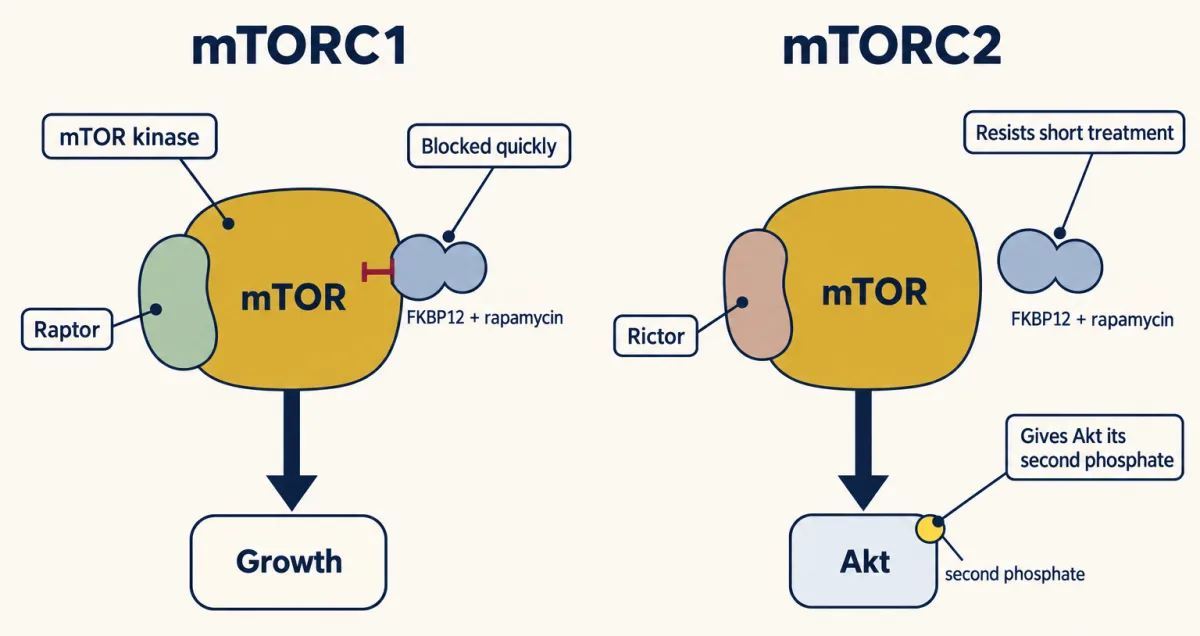
The mTOR kinase works inside two complexes. mTORC1, built around Raptor, controls growth and is the one rapamycin blocks quickly. mTORC2, built around Rictor, gives Akt its second activating phosphate and resists short rapamycin treatment. AI-generated illustration -
The idea: mTORC1 switches on only when two questions get a yes
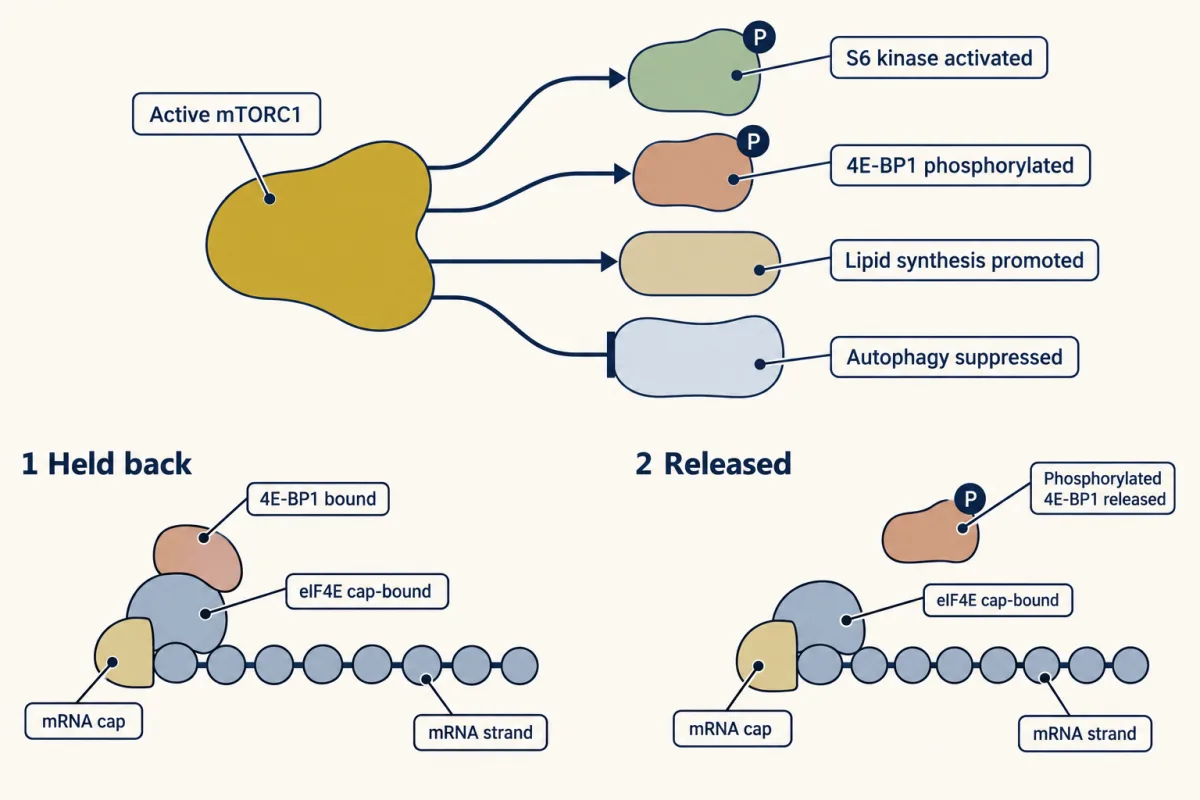
With both answers yes, mTORC1 phosphorylates two proteins that control the first step of translation: S6 kinase is switched on, and 4E-BP1 lets go of eIF4E, the factor that grips the cap at the start of an mRNA. mTORC1 also promotes lipid synthesis and holds off autophagy. AI-generated illustration -
The idea: AMPK reads AMP, because AMP moves most
-
Two gauges, one decision: energy can veto growth
-
When a gauge is drugged or broken
Where this lesson fits
Before thisReview first
- GTPase Switches: The TimerThis course · Lesson 7
TSC is a GAP that switches off Rheb, and the Rags are GTPases, so you need the GTPase timer idea.
- PI 3-Kinase, Akt and InsulinThis course · Lesson 20
Akt, switched on by insulin, phosphorylates TSC2 here, and mTORC2 gives Akt its second phosphate.
- Phosphorylation: Kinases and PhosphatasesThis course · Lesson 6
mTORC1, AMPK and LKB1 all work by adding or removing phosphates on target proteins.
After thisStudy next
- Stress Signals: p38 and JNK, p53, Unfolded Proteins and OxidantsThis course · Lesson 33
Stress pathways also cut growth and switch on autophagy, and they build on the energy and nutrient sensing here.
- Endocytosis and Signaling EndosomesThis course · Lesson 36
mTORC1 is activated on the lysosome surface, an example of signals running from a membrane compartment.
- Drugs Against a PartThis course · Lesson 42
Rapamycin acting through FKBP12 and allosteric kinase inhibition are drug-design examples that this lesson takes further.
Elsewhere on the siteFilms, simulations and method films in other courses
- Balloon on a flaskSimulation · Life Science
It shows how cells make ATP from food, the energy supply that AMPK monitors through AMP.
- How cells pull reactions uphillFilm · Biochemistry
It shows how ATP pays for uphill reactions, which explains why a cell's ATP and AMP levels matter to AMPK.
- How the body switches fuelsFilm · Biochemistry
It shows how the body switches between building and burning fuels, the decision that AMPK and mTORC1 make in a cell.
Suggested by an AI model from the lessons themselves, then checked. How we use AI