Neuroscience · Skim version
Feeding, Motivation and Reward
Read the full lesson → Skim the whole course →
The guiding idea
A well-fed mouse starts eating within minutes when one small group of hypothalamic neurons is switched on with light. What are those neurons for?
A midbrain dopamine neuron's quick burst or pause reports a reward prediction error, whether things turned out better or worse than predicted, and hunger changes how much the reward is worth.
From the film: Received Minus Predicted
- Dopamine bursts and pauses report better or worse than predicted, not the reward itself.
- When a reward is fully predicted there is no error and firing stays steady; with learning, the burst moves to the cue that announces it.
- This holds for many, not all, dopamine neurons, in trained monkeys and rodents, and it says nothing about pleasure.
From the film: The Tone and the Juice
- In monkeys, about three quarters of recorded dopamine neurons burst to unexpected juice, and once a tone predicted it the burst came at the tone.
- In the model, the error is the reward plus the change in prediction, so unexpected good news about the future counts as an error.
- When an expected juice is left out, firing pauses at about the time it was due.
- A recording shows only that firing matches the error; an imposed burst in rats is enough to drive learning, not shown to be needed.
From the film: Wanting Is Not Liking
- In rats, depleting forebrain dopamine stopped food seeking but left liking reactions to sugar intact.
- In mutant mice with extra extracellular dopamine, animals reached sweet food sooner without stronger liking reactions.
- So in these tests dopamine moved wanting, not liking; a lifelong mutation is not an acute drug, and a rat's face is not a human report.
-
Two questions, one idea
-
Hunger: a fuel gauge and two opposed groups of neurons
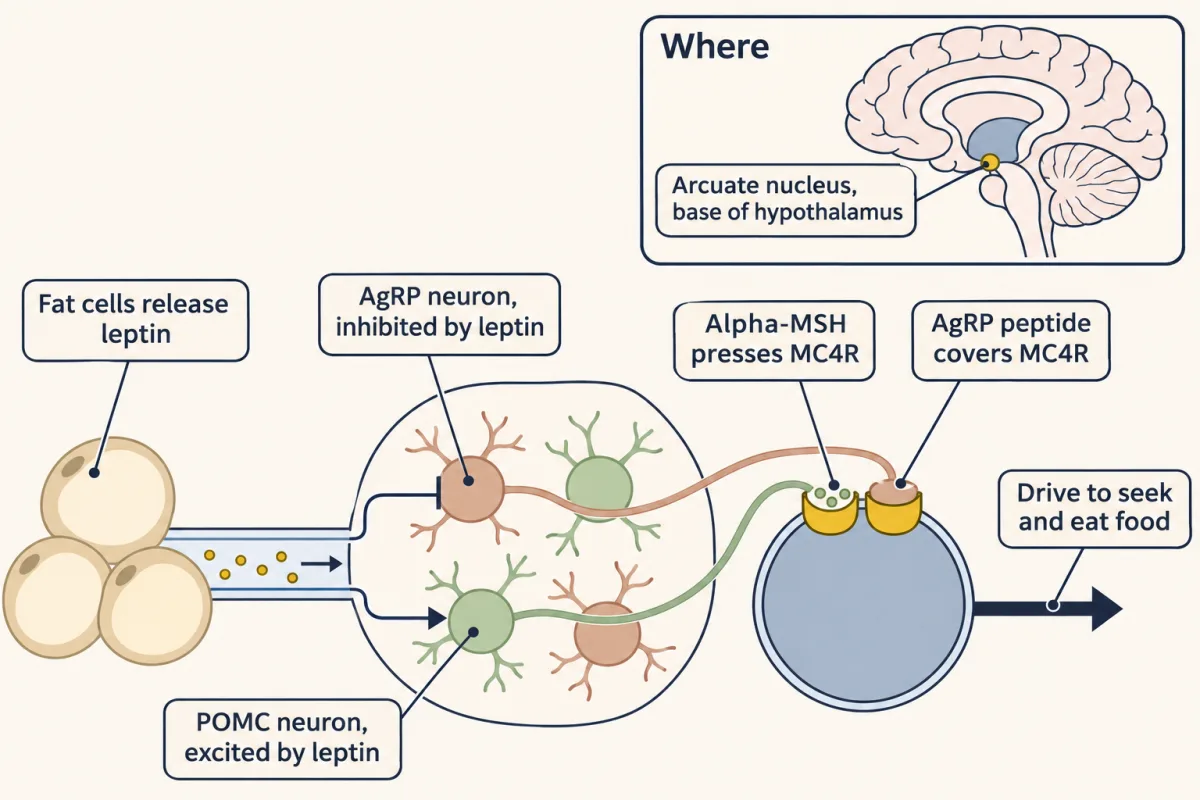
Leptin from fat inhibits AgRP neurons and excites POMC neurons in the arcuate nucleus; POMC's alpha-MSH presses MC4R while AgRP peptide covers it, and the balance between them sets the drive to seek and eat food. AI-generated illustration -
Dopamine neurons report prediction errors
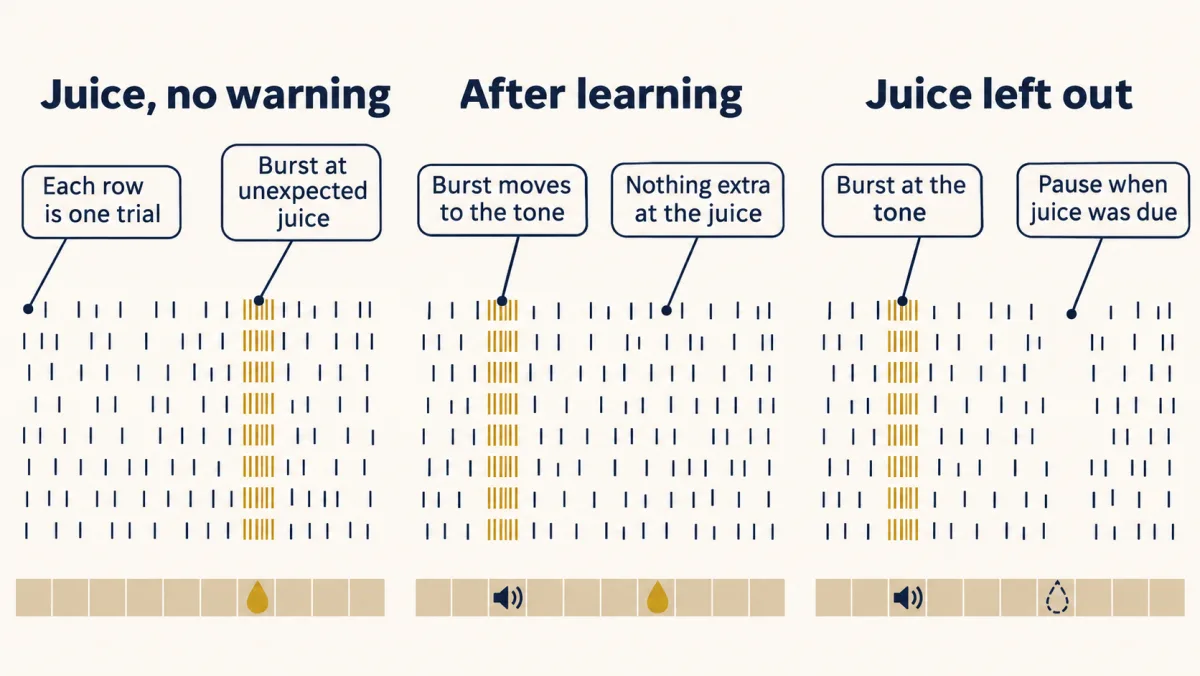
Drawn after the monkey recordings: the dopamine burst moves from unexpected juice to the tone that predicts it, and when the expected juice is left out, firing pauses at the time it was due. AI-generated illustration -
Wanting is not liking
-
In addiction, wanting can grow while liking does not
-
Going deeper
Where this lesson fits
Before thisReview first
- Autonomic Control and the HypothalamusThis course · Lesson 18
It maps the hypothalamus and arcuate region that this lesson's feeding circuit sits in.
- Transmitter Systems and DrugsThis course · Lesson 6
You need dopamine release and reuptake by the transporter from there to read the wanting and DAT evidence.
- Synaptic PlasticityThis course · Lesson 8
It explains how synapses strengthen with activity, which is what a prediction error is said to teach.
After thisStudy next
- Attention, Executive Control and DecisionsThis course · Lesson 25
Learned values from prediction errors guide choice, which this lesson uses to model decisions.
- Emotion and StressThis course · Lesson 20
It continues the affect unit, with the hypothalamus and learned cues driving emotional responses.
- Designing a Causal Circuit ExperimentThis course · Lesson 28
It takes further the recording, stimulation and silencing logic, with controls for light effects.
Elsewhere on the siteFilms, simulations and method films in other courses
- One sample, many answersSimulation · Physiology
Hormone signals such as leptin act through feedback loops that are tested by pairing the hormone with its controlling signals.
- Step through a feedback loopSimulation · Biology
The hunger drive works as a feedback loop that pushes internal state back toward its range.
- What the pump rate measuresSimulation · Physiology
Fuel state signalled by hormones such as insulin helps set hunger, the signal this lesson's feeding circuit reads.
Suggested by an AI model from the lessons themselves, then checked. How we use AI