Sensory Systems · Skim version
The Low-Threshold Mechanoreceptors: One Touch, Several Signals
Read the full lesson → Skim the whole course →
The guiding idea
A light stroke on your skin is not one signal. Different kinds of touch neuron are most sensitive to different parts of it: the motion, the steady press, the vibration, the slow stroke. On a mouse's back, three of these kinds can even share a single hair. Why build a sense that way?
Low-threshold mechanoreceptors (LTMRs) split gentle touch into separate signals.
From the film: One Press, Several Reports
- Each class of low-threshold mechanoreceptor is most sensitive to a different part of a touch.
- The ending and the neuron's own properties shape what a class responds to best, and axon size and myelin set how fast the report travels.
- No class reports the whole touch, so the nervous system reads the pattern across classes.
From the film: One Hair, Three Classes
- One movement of an awl/auchene hair can be reported in parallel by three classes, at three speeds.
- The combinations of endings repeat across the skin and differ between hair types.
- A single neuron branches to many hairs, so endings at a hair are not a count of neurons.
From the film: Your Own Skin: The Slow Stroke
- In people, C-tactile afferents fire most in the slow stroke range, in an inverted U across stroking speeds.
- These afferents support gentle, affective touch, but not every affective touch relies on them.
- The human C-tactile ending is still unknown, so the mouse hair map cannot be transplanted onto human hair.
-
One press, several reports
-
Hairy skin: two endings and the class table
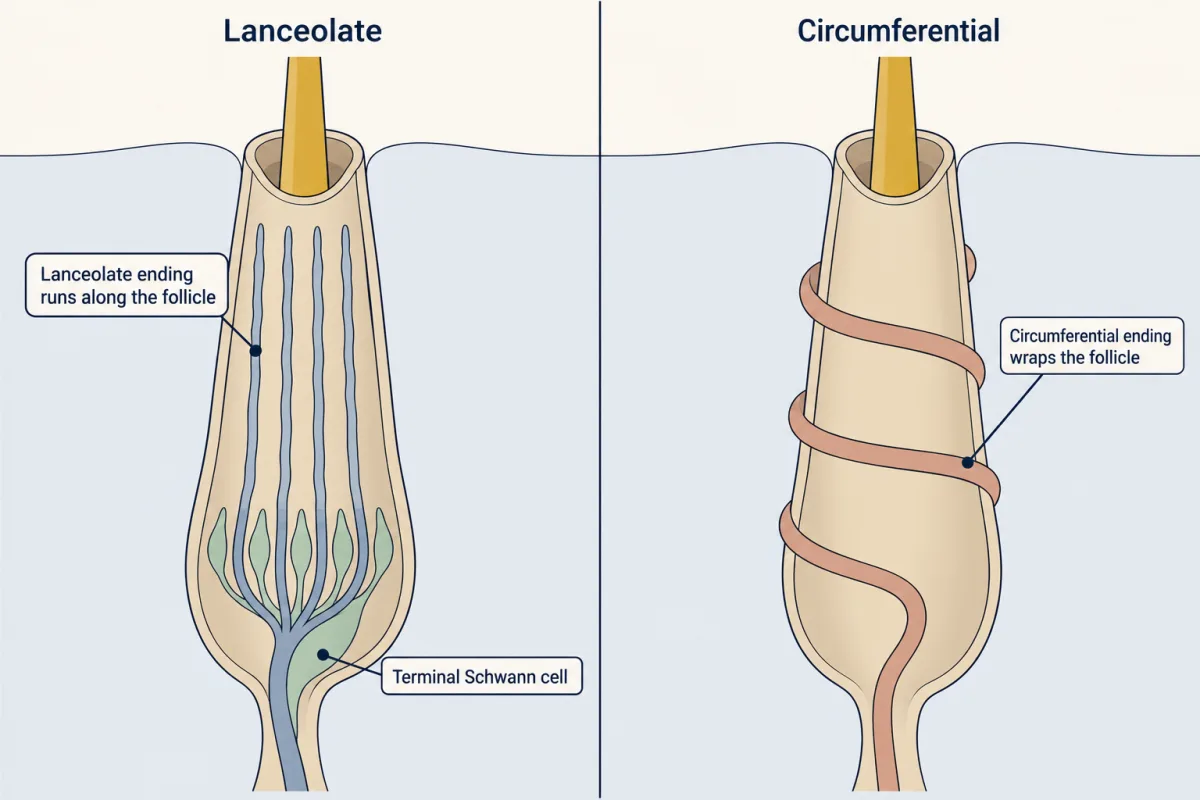
A lanceolate ending runs lengthwise along the upper part of a hair follicle like a picket in a fence, with terminal Schwann cell processes alongside; a circumferential ending wraps around the follicle instead. Schematic: the Schwann processes and the extent of the endings are simplified. AI-generated illustration -
The key experiment: label, record, map
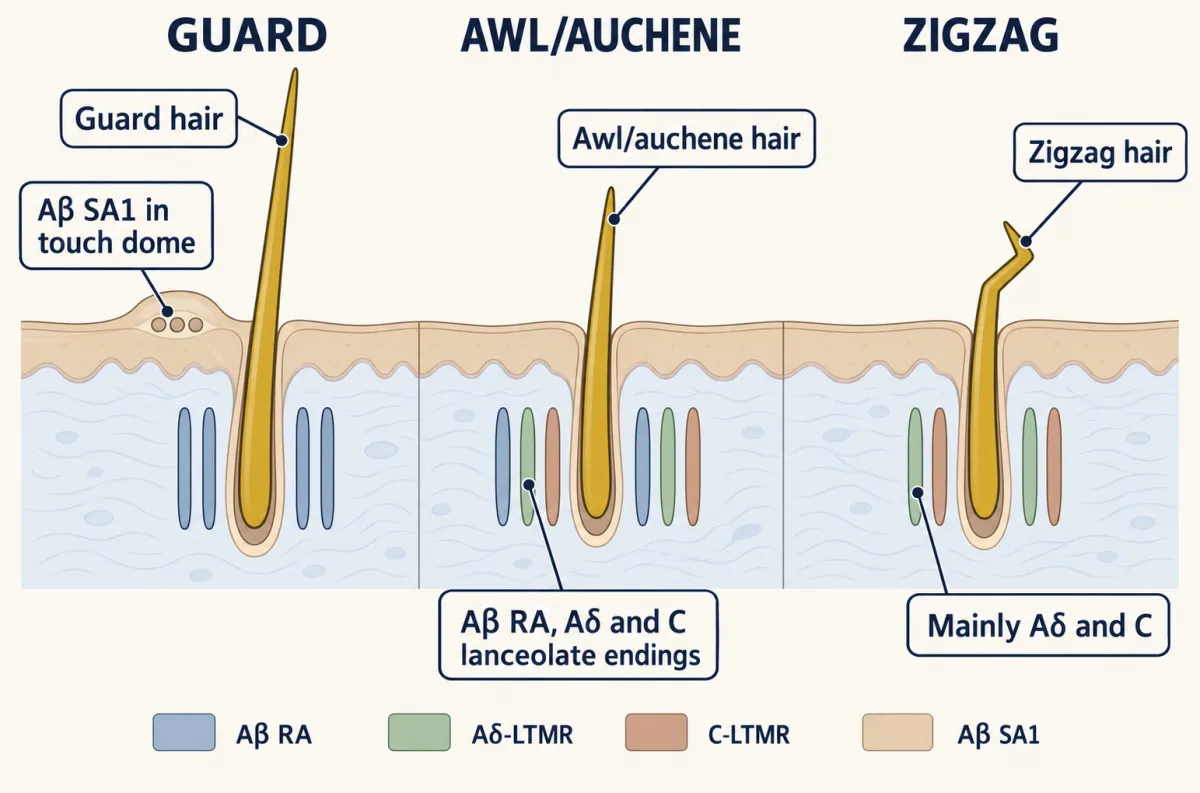
Dominant combinations in the mouse trunk-skin map of Li et al. (2011): guard follicles have Aβ RA lanceolate endings and an adjacent Merkel-associated Aβ SA1 touch dome; awl/auchene follicles have Aβ RA, Aδ and C lanceolate endings; zigzag follicles have mainly Aδ and C lanceolate endings, with very rare Aβ RA associations. Circumferential endings, which also wrap most follicles, are omitted, and the drawing is schematic. AI-generated illustration -
Your own skin: human touch classes and C-tactile afferents
-
How a tuning is built: direction
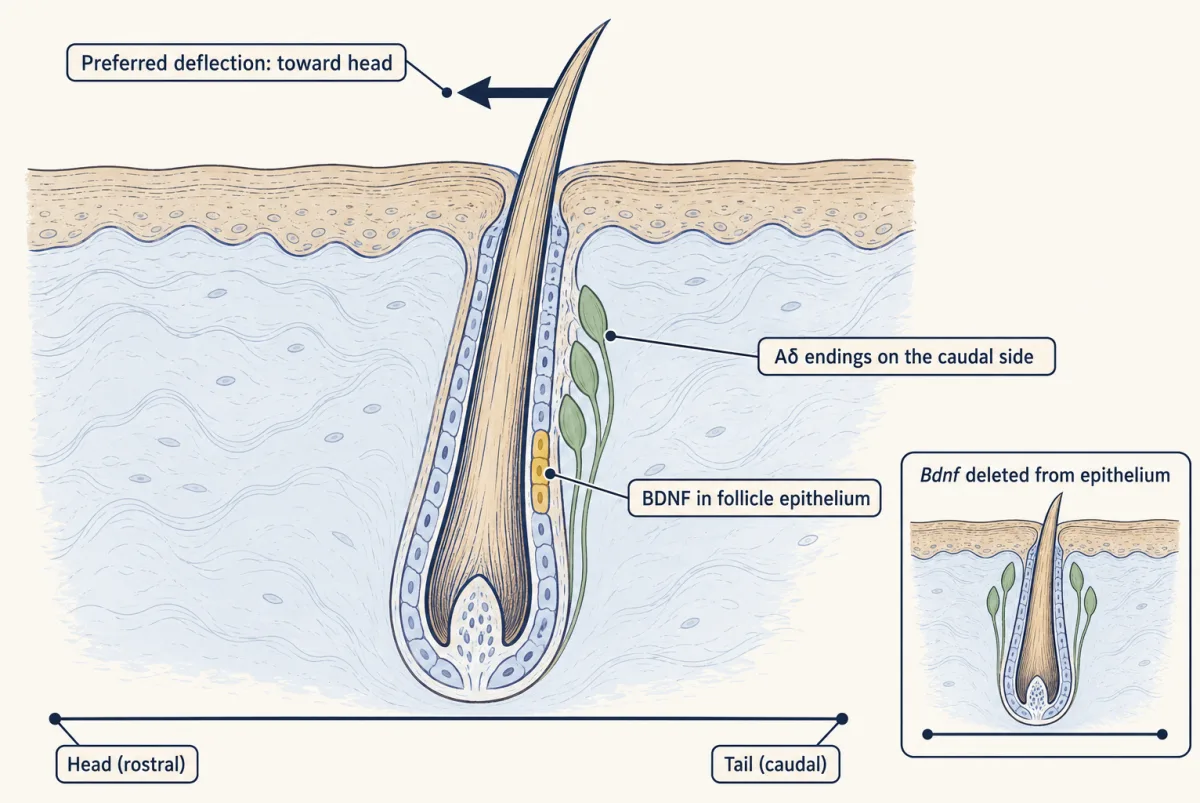
In mouse dorsal trunk skin, Aδ-LTMR endings and epithelial BDNF sit on the caudal side of the follicle, while the neurons prefer hair deflection toward the head. Deleting Bdnf from the epithelium disrupted the caudal polarity of the endings. AI-generated illustration -
Design problem
-
Where the idea stops
-
Going deeper
Where this lesson fits
Before thisReview first
- Five Ways to Turn a Stimulus into a CurrentThis course · Lesson 1
You need the ways a stimulus becomes a current to understand how each ending shapes its class's response.
- Piezo Channels and the Physics of ForceThis course · Lesson 2
The Piezo channel in the ending is what turns skin force into current in each class.
- Sensory Neurons by Their Genes: the Atlas EraThis course · Lesson 3
Genetic handles from the atlas are what this lesson checks by recording to turn them into classes.
After thisStudy next
- Merkel Cells: Touch Receptors That Are Not NeuronsThis course · Lesson 5
The Aβ SA1 class and its Merkel ending, only briefly met here, get a full lesson.
- Meissner and Pacinian Corpuscles: Flutter and VibrationThis course · Lesson 6
The RA1 and Pacinian classes, tuned to flutter and vibration, are worked through in detail.
- Hairy Skin, Stroking and Affective TouchThis course · Lesson 7
It takes the C-LTMR and human C-tactile slow-stroke tuning further, including the affective touch link.
Elsewhere on the siteFilms, simulations and method films in other courses
- Lateral inhibition at an edgeSimulation · Neuroscience
It shows how a sensory neuron's spikes carry meaning from its tuning, as each LTMR class is tuned to part of a touch.
- What a Spike MeansFilm · Neuroscience
It shows that a spike means what its neuron is tuned to, the principle behind reading touch across classes.
- Why Capsaicin Feels HotFilm · Neuroscience
It covers the skin touch receptors and the pathways that carry their signals to the spinal cord.
Suggested by an AI model from the lessons themselves, then checked. How we use AI