One Cell, Many Jobs
Read the transcript of “One Cell, Many Jobs”
Film transcript: One Cell, Many Jobs
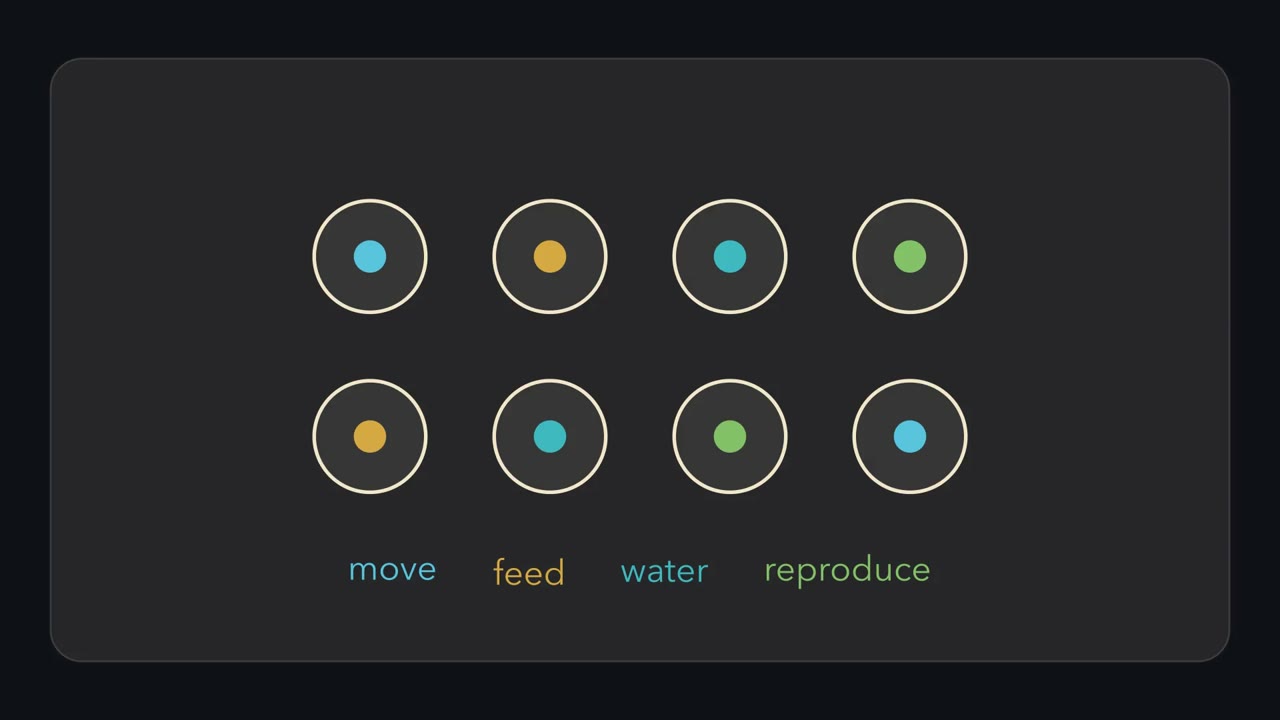
How can one cell swim, feed, control water, and reproduce without organs? In pond water, a Paramecium does all of them. Watch where each job happens. A unicellular organism is a living thing made of one cell. It has no tissues or organs. Its whole life must work inside one boundary. Bacteria, many algae, and many protists are unicellular. Each is a complete organism, not one cell broken away from a larger body. Short cilia cover its surface. They beat together like oars, pushing the cell through water.
Movement stays a job of this same cell. Food such as bacteria is swept into a groove. A food vacuole closes around it and travels through the cell. Digestion also happens inside. These jobs do not sit in separate organs. Moving, feeding, and digesting all occur within the membrane of one working cell. Pond water has fewer dissolved particles than the cell, so water keeps moving inward by osmosis. If that continued, what would the cell need to do?
It must remove the extra water. Two contractile vacuoles, one toward each end, fill and squeeze water out. The cell stays intact as the cycle repeats. For reproduction, the Paramecium copies what it needs and pinches into two cells. One cell has carried movement, feeding, water control, and reproduction. Binary fission is reproduction without a partner. One cell divides into two, and each new cell must carry every life process. A multicellular organism can place major jobs in different cells. Those cells become specialized for particular work. Each cell's structure fits the job it does. Similar specialized cells can work as a tissue. Several tissues can build an organ.
Related organs can form an organ system, all serving one organism. Muscle cells form muscle tissue. Several tissues form the heart. The heart works with blood vessels in the circulatory system. Sharing does not erase each cell's basic work. A muscle cell still takes in food molecules, makes ATP for energy, and maintains itself. Specialized means especially fitted for a job, not limited to only one job. The contrast is now clear. A Paramecium keeps every life process within one cell. A many-celled organism can share major jobs across cells shaped for their work.
How can one Paramecium do every job of life inside a single cell?
Continue in the lesson: One Cell or Many →
3:13 · Free, with captions and a transcript. The lesson has the full text, the questions and the sources.
More films from this lesson
How this film was made. Narration: written from this lesson's text and read by an AI narrator voice (Kokoro, af_heart). Animation: AI-generated in code (Manim) by Claude, a schematic with no drawn molecular structures. Captions come from the narration script. See something wrong? Report it.