Life Science · Skim version
From Cells to Organisms
Read the full lesson → Skim the whole course →
The guiding idea
A Paramecium is one cell and does every job of life. Why does your body need trillions of cells to do the same jobs?
One small cell can do every life job, but if a cell grows in every direction, its surface falls behind its inside, so most big bodies are many small cells that share the jobs.
From the film: One Cell, Every Job
- A Paramecium and you share one job list: moving, getting food, gas exchange, getting rid of wastes and extra water, responding and reproducing.
- A Paramecium does every job inside one cell, using different parts of that cell.
- Food and oxygen enter a cell through its surface. If a cell grows in every direction, its surface falls behind its inside, and its middle gets farther away.
- So most big bodies, like yours, are many small cells, and many cells can share the jobs.
From the film: One Job, Five Levels
- A specialized cell has a shape and parts that suit it to one kind of job.
- Similar cells doing one job form a tissue, such as heart muscle tissue. Each cell stays a cell inside every level above it.
- Different tissues form an organ, such as the heart, and organs working together form an organ system, such as the heart and blood vessels.
- A small, flexible red blood cell carries oxygen and bends through very narrow vessels.
- A long nerve cell carries signals far, and a long muscle cell shortens to pull.
-
Explain: why not one giant cell?
-
Explain: one cell does every job
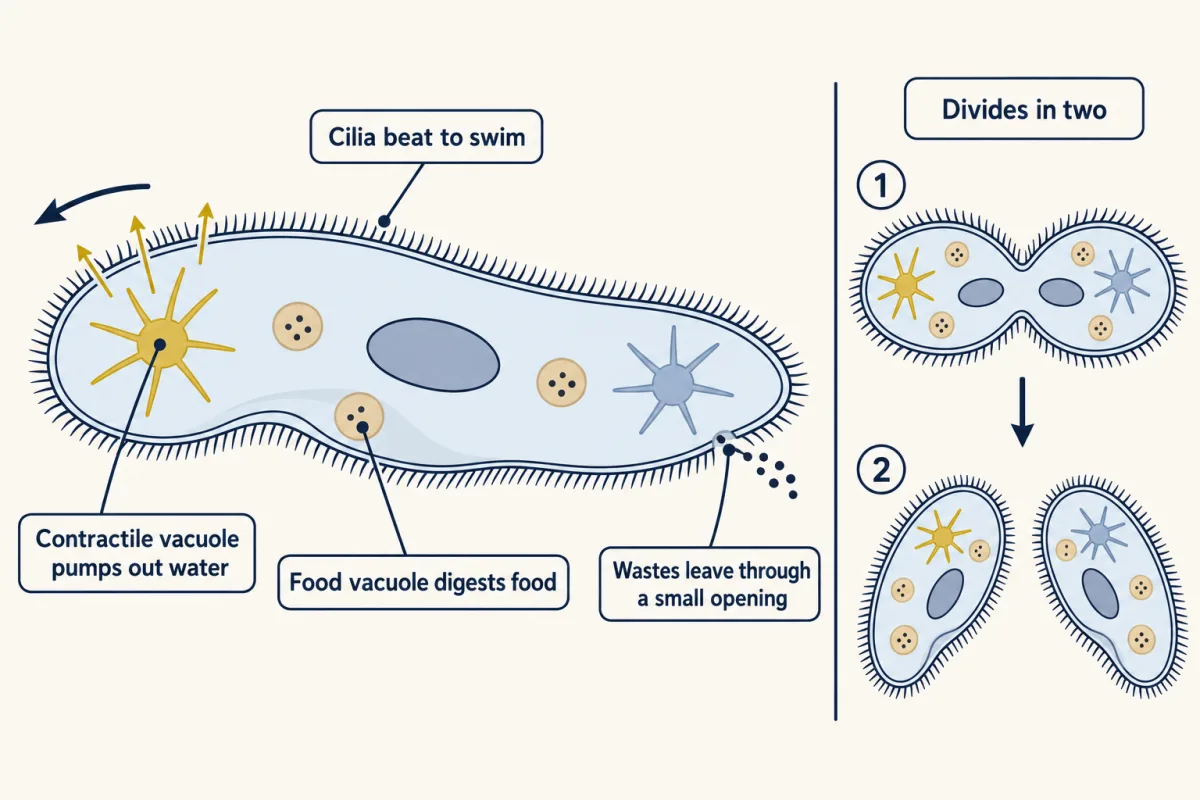
One Paramecium cell does every job on the list, each with the help of its own parts. AI-generated illustration -
Explore: share the jobs
-
Explain: cells, tissues, organs, systems
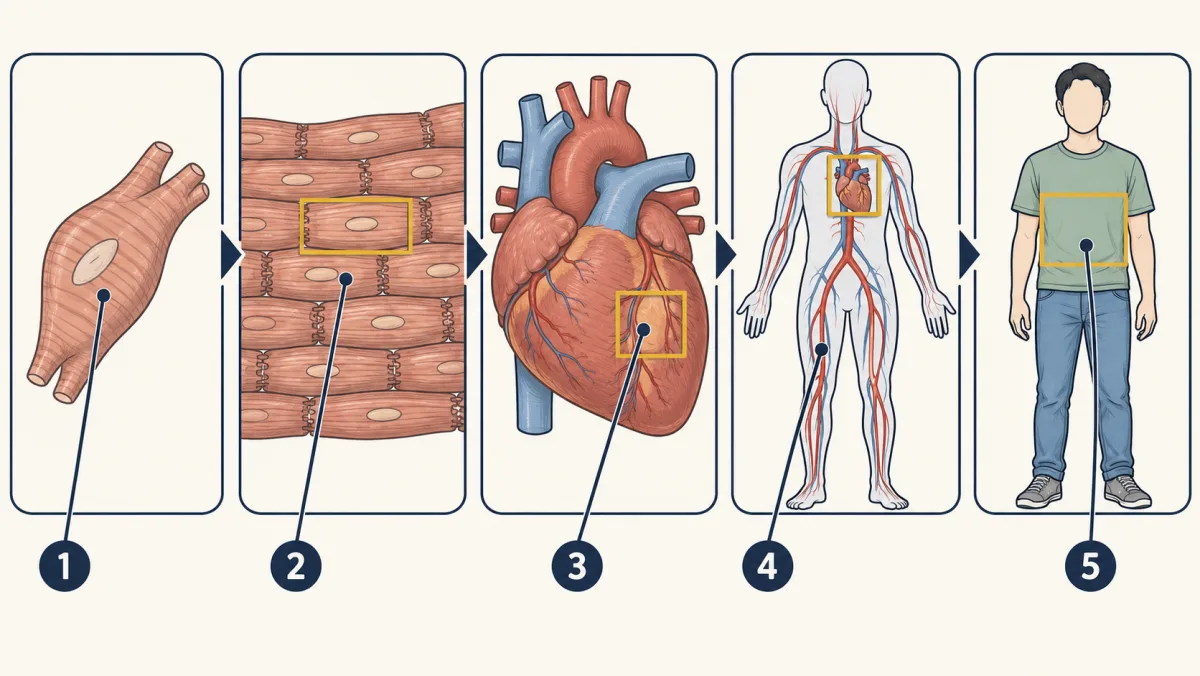
- cell
- tissue
- organ
- organ system
- organism
-
Explain: a shape for every job
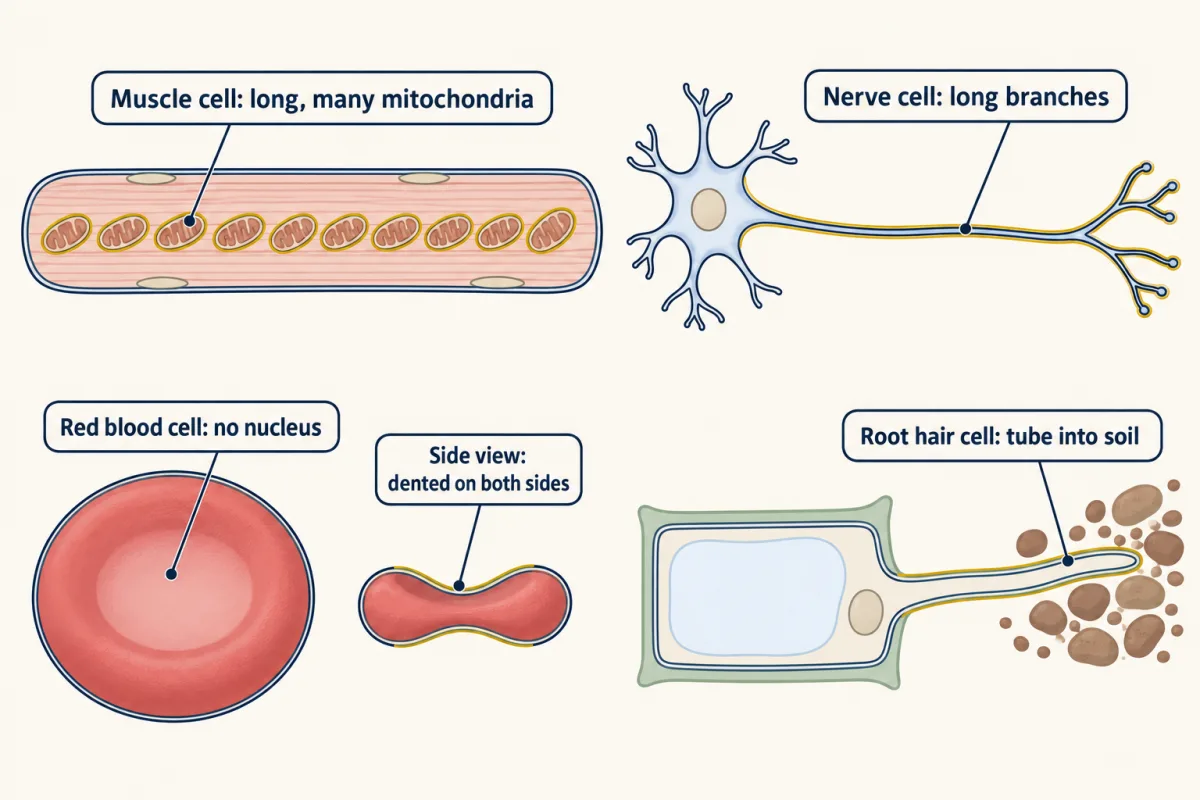
Each specialized cell's shape fits its job; the cells are not drawn to scale. AI-generated illustration -
Elaborate: more cells, more kinds of cells?
-
Evaluate: check your thinking
-
Going deeper
Where this lesson fits
Before thisReview first
- Cells Are EverywhereThis course · Lesson 1
You need to know that living things are made of cells, one or many, before comparing one-celled and many-celled bodies.
- Inside a CellThis course · Lesson 2
You use cell parts such as mitochondria and the idea of parts working as a system to explain specialized cells.
- Diffusion and OsmosisThis course · Lesson 5
Materials entering through the surface and the contractile vacuole's water bailing depend on how substances move across a membrane.
After thisStudy next
- Sorting Living ThingsThis course · Lesson 7
You can now sort organisms, and a key splits one-celled from many-celled kinds using traits like these.
- Domains, Kingdoms and DNAThis course · Lesson 8
Whether an organism is one cell or many is one trait used to place it in a domain or kingdom.
Elsewhere on the siteFilms, simulations and method films in other courses
- One Cell, Many JobsFilm · Biology
It shows how one cell can do every job, or many cells can share them.
Suggested by an AI model from the lessons themselves, then checked. How we use AI