Genetics and Molecular Biology · Skim version
The lac Operon: How Bacteria Regulate Genes
Read the full lesson → Skim the whole course →
The guiding idea
Give E. coli glucose and lactose together and it uses the glucose first, pauses, then starts on lactose. How does one cell choose which genes to express, and when?
In wild-type E. coli, high lac expression requires lactose and scarce glucose.
From the film: When Are the lac Genes High?
- In wild-type E. coli, high lac expression requires lactose and scarce glucose.
- Allolactose lowers the lac repressor's affinity for the operator.
- CAP bound to cAMP helps RNA polymerase start at the weak lac promoter.
- Glucose also reduces lactose entry through inducer exclusion.
From the film: Does the Mutation Stay or Travel?
- DNA sites act in cis; diffusible regulators can act in trans.
- A partial diploid carries a chromosomal lac region and a second copy on F′ lac.
- Find the working lacZ reporter, check the operator beside it, then ask which repressors can reach it.
- Normal LacI can reach normal operators on both DNA copies.
-
The switch: a repressor that lets go
-
CAP and cAMP: the glucose-sensitive input
-
The partial diploid: telling a site from a product
-
The trp operon: a repressor that needs a partner, and a brake on the ribosome
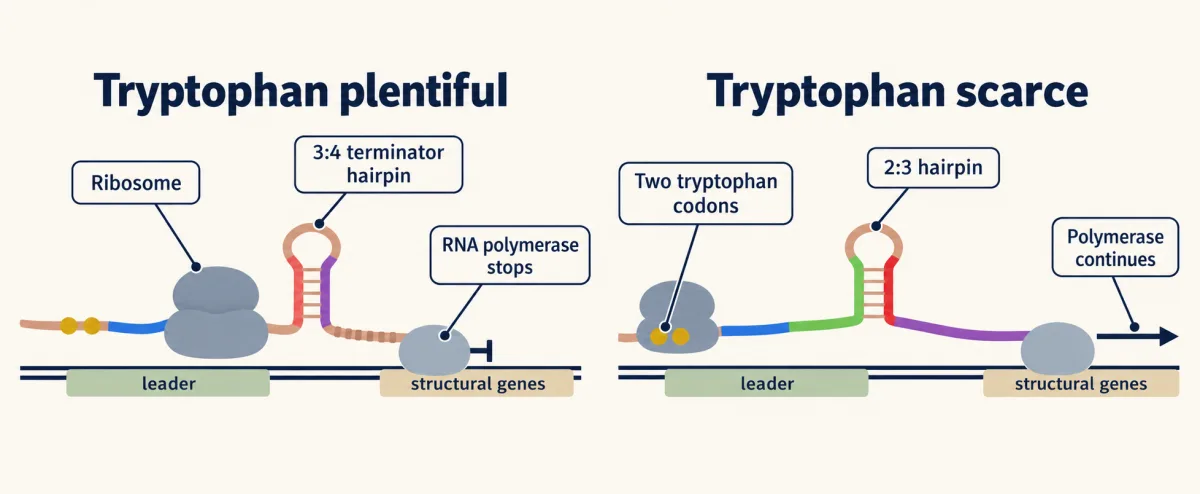
In this model of attenuation, a ribosome on the trp leader is the sensor. With tryptophan plentiful it covers region 2, regions 3 and 4 pair into the terminator, and polymerase stops; with tryptophan scarce it stalls at the two tryptophan codons, 2 pairs with 3, and polymerase continues. AI-generated illustration -
Putting the rules to work: classifying a new mutant
-
Going deeper
Where this lesson fits
Before thisReview first
- Transcription: From DNA to RNAThis course · Lesson 16
You need promoters and RNA polymerase from there to see how a repressor and CAP change the start of transcription.
- Complementation and Gene Function: From Beadle and Tatum to BenzerThis course · Lesson 10
The cis–trans logic used there is what lets partial diploids separate an operator site from a repressor product.
- Bacterial and Phage Genetics: Conjugation, Transduction and TransformationThis course · Lesson 11
F′ plasmids made by conjugation are how the partial diploids here are built.
After thisStudy next
- Eukaryotic Gene Regulation and EpigeneticsThis course · Lesson 20
It takes gene control further, from bacterial repressors and activators to accessible DNA and combinations of regulators in eukaryotes.
- Cancer as a Genetic DiseaseThis course · Lesson 21
It uses regulator logic, such as dominant versus recessive loss, to explain how gene control fails in tumors.
Suggested by an AI model from the lessons themselves, then checked. How we use AI