Genetics and Molecular Biology · Unit 2: Mapping and gene function
New to this? Review it at high school level: Living or Not? Viruses and Bacteria, How Microbes Multiply
Bacterial and Phage Genetics: Conjugation, Transduction and Transformation
Rewritten on : new text, flashcards and film. Your notes and highlights stay, but the text around them may have moved.
Two E. coli strains that each cannot make several nutrients are mixed. A few cells can now make them all. Where did the genes come from?
Pause when the reading reaches a film, and offer to play it. Saved on this device.
Watch the film now, or keep listening
Builds on:Linkage and Recombination MappingChromosomes and Meiosis: The Physical Basis of Mendel's LawsWhy these?
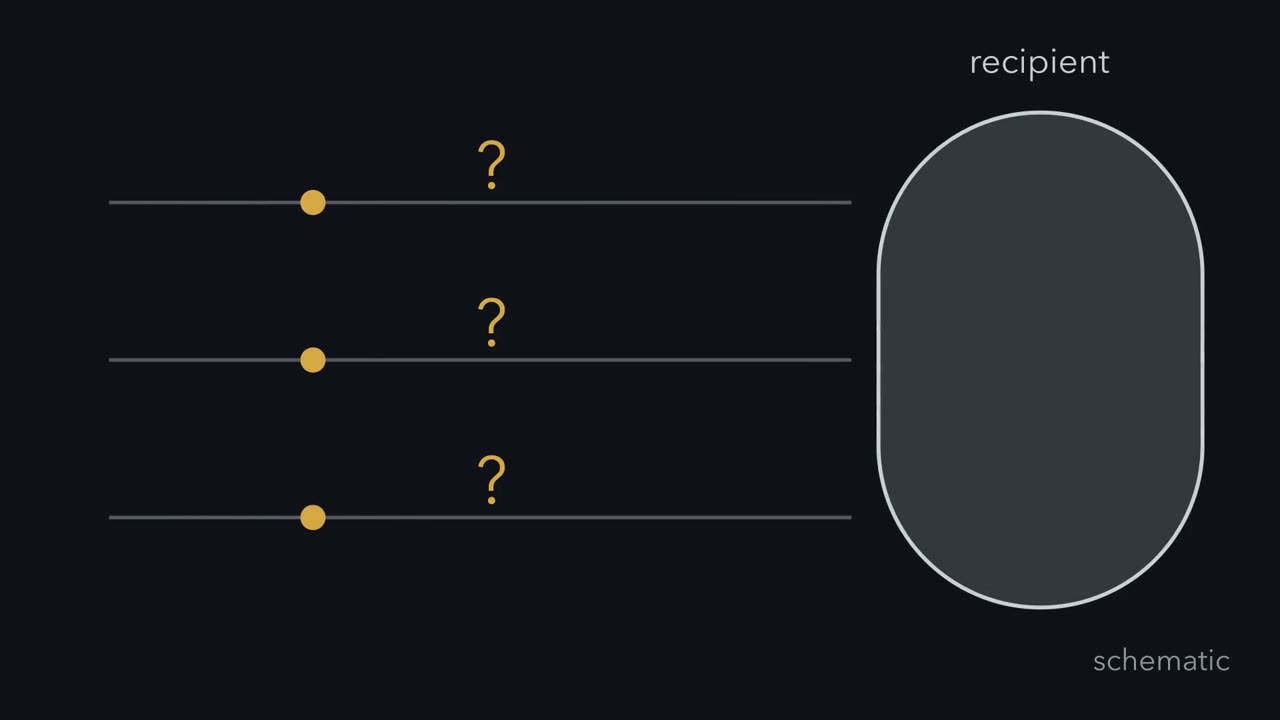 ▶ Watch From DNA Route to Gene Order · 3:35
Read the transcript of “From DNA Route to Gene Order”
Film transcript: From DNA Route to Gene Order
A bacterium gained a useful gene. What carried it there, and can that journey reveal a map? Watch the donor DNA, shown in gold. Bacteria do not make meiotic crosses, yet donor genes can become inherited. One path exposes free DNA for transformation. Another joins donor and recipient for conjugation. The third protects donor DNA inside a phage during transduction.
Competent cells take up the free DNA. A filter that stops cells blocks only the contact path. DNase destroys exposed DNA, but a phage coat protects its cargo. That two-step test turns three pictures into a decision. An unknown transfer survives the enzyme, but stops when cells are separated. Which carrier fits? Follow both clues before choosing. One result rules out free DNA. The other rules out a phage.
Conjugation fits. Its DNA is never exposed, so the enzyme misses it. Separating the cells removes the connection it needs. Both clues point to direct contact, not merely DNA moving through the medium. In E. coli, the F factor is a small DNA circle. Free F transfers itself from a donor to a recipient. One strand crosses from F+ plus to F−, minus, and each cell completes the circle. Chromosomal markers rarely follow. When F joins the donor chromosome, the cell is Hfr. Transfer now pulls chromosomal markers through the same origin in a fixed order. Because pairs usually separate early, recipients receive only part of the chromosome. The remaining F sequence would arrive last.
Break different pairs apart at different times, then score the recipients. Markers nearer the origin appear first. With steady transfer, the time gaps become map distances. Selective plates reveal which recipients inherited each marker. A marker's entry time is the earliest interruption that still yields it. A different Hfr origin can send the same chromosome the other way.
Absolute arrival times change, but matching gaps reveal one circular map. The origin sets the starting time, so absolute times cannot be compared directly across donors. Selection makes rare recipients visible, but a colony reports more than arrival. The donor piece must also be expressed and usually integrated. Incoming linear DNA cannot copy itself with the chromosome.
Recombination can replace the matching recipient segment. The route created the readout. For Hfr transfer, ordered arrival maps gene order. If transfer is roughly steady, time gaps also map distance. Keep the gaps, not the clock's starting values.
From the film
- For Hfr transfer, ordered arrival maps gene order; if transfer is roughly steady, time gaps map distance.
- Transformation uses free DNA, conjugation needs contact, and transduction uses a phage.
- A filter tests for cell contact; DNase tests for exposed DNA.
- A recovered recombinant reports entry, integration and expression.
In 1946, two Escherichia coli K-12 strains, each unable to make several nutrients, were mixed and then spread on a plate that supplied none of them. A few colonies grew. Neither strain alone gave any. Where did the working genes come from?
An auxotroph is a mutant that needs a nutrient added because it cannot make it; the wild type is a prototroph. In Joshua Lederberg and Edward Tatum’s cross at Yale, one strain needed threonine, leucine and thiamine. The other needed biotin, phenylalanine and cystine. A colony on bare minimal medium could make all six, so it carried working genes from both parents. They read this as recombination: one bacterium had inherited genes from another.
Predict 1. A revertant mutates back to a working allele and can imitate a recombinant. What two controls make reversion a weaker explanation here?
Check your prediction
Each parent lacked several abilities, so one lineage would need several reversions. Each parent plated alone also gave no colonies.
The one idea. How donor DNA travels determines the map: ordered arrival maps gene order and time gaps map distance; shared carriage maps proximity because closer genes travel together more often.
Scope: ordered arrival means an Hfr time-of-entry experiment; turning time gaps into distances assumes approximately steady transfer. Shared carriage means generalized cotransduction. A recovered colony also needs the incoming piece expressed and usually integrated.
Three routes, two tests
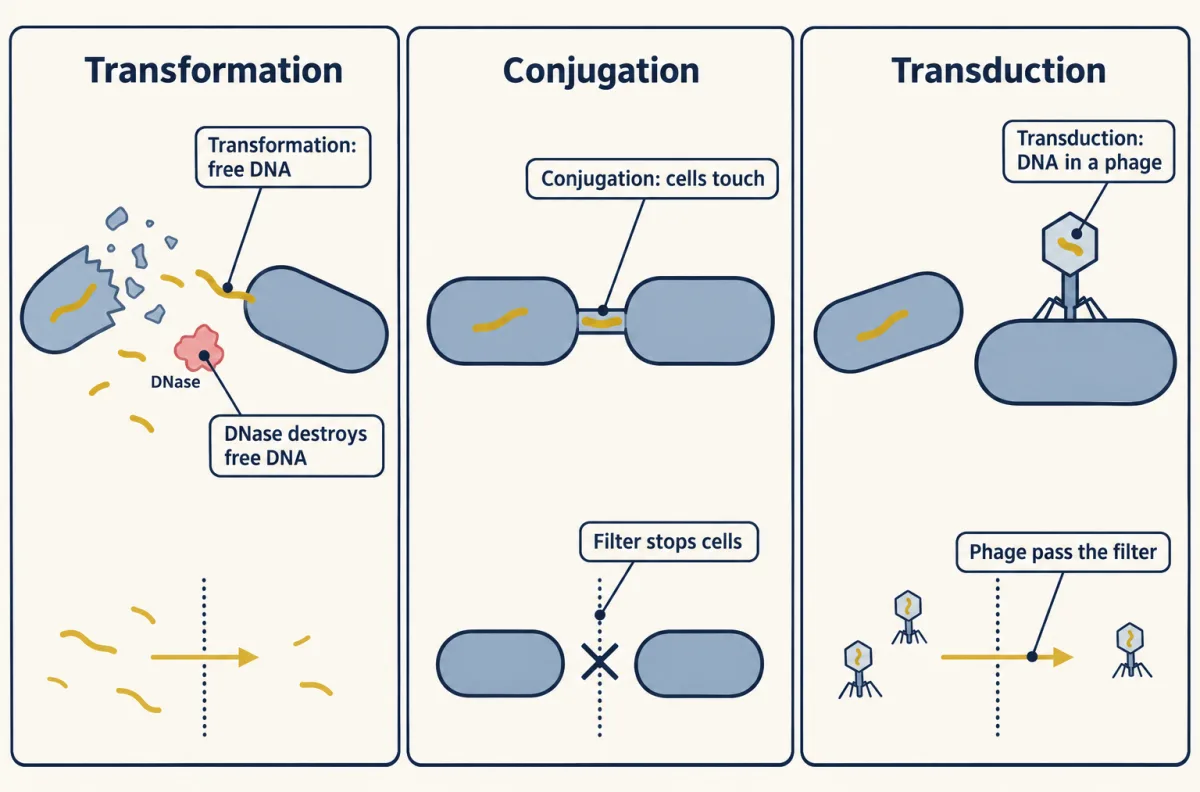
The first film sorted the three routes with two tests: a filter that stops cells, and DNase (deoxyribonuclease), an enzyme that destroys free DNA.
| Route | What carries the DNA | Crosses a cell-blocking filter | Stopped by DNase while DNA is extracellular |
|---|---|---|---|
| Transformation | Free DNA, taken up by a competent recipient | Yes | Yes |
| Conjugation | A donor in direct contact with the recipient | No | No |
| Transduction | A bacteriophage (a virus that infects bacteria) holding bacterial DNA in its coat | Yes | No; the phage coat protects the DNA |
Competence is a physiological state that allows uptake of free DNA. Streptococcus pneumoniae and Bacillus subtilis can become naturally competent; Griffith’s pneumococci and Avery, MacLeod and McCarty’s purified DNA belong to the DNA-as-genetic-material lesson.
Conjugation: a chromosome enters in order
The first film followed the fertility factor, F, from an F+ donor into an F− recipient, then into the chromosome of an Hfr (high frequency of recombination) donor. F, the classic conjugation system of E. coli K-12, is a plasmid, a small DNA circle that replicates separately from the chromosome. It carries genes for a pilus and for DNA transfer; other conjugative plasmids carry their own transfer genes. In an F+ by F− cross, transfer starts from a fixed point on F, the origin of transfer.
Because the rest of F would enter last and mating pairs usually break first, the recipient in an Hfr cross rarely becomes Hfr or F+.
Élie Wollman and François Jacob broke mating pairs apart in a blender at intervals, then plated the recipients on medium where only recombinants grew while streptomycin killed the donors.
Worked problem: interrupted mating
Hfr strains 1 and 2 are each mated with a streptomycin-resistant F− recipient. Assume both transfer at the same steady speed, and that first appearance marks entry. Strain 1 gives a 8 min, b 14 min, c 20 min and d 31 min. Its order is a-b-c-d, with gaps of 6, 6 and 11 minutes.
Predict 2. Strain 2 gives d 4 min, c 15 min, b 21 min and a 27 min. Work out its gaps. Where does its transfer start, relative to d?
Check your prediction
Its order is d-c-b-a, with gaps of 11, 6 and 6 minutes. Strain 2 reads the same map backwards: its origin lies on the far side of d, about 4 minutes before d, and it transfers in the opposite orientation.
a —6— b —6— c —11— d
Hfr strains with different origins and orientations produced overlapping orders that closed into a circle.
The E. coli map runs from 0 to 100 minutes, a scale that came from pooling many time-of-entry measurements, not from a chromosome that always crosses in exactly the same time.
Predict 3. Two Hfr strains give the same marker order but transfer at consistently different speeds. Can their raw time gaps be overlaid as distances without recalibration?
Check your prediction
No. Time becomes distance only under the steady-transfer assumption, and different rates stretch the two time maps by different amounts, even when the marker order agrees.
Arrival is not yet inheritance
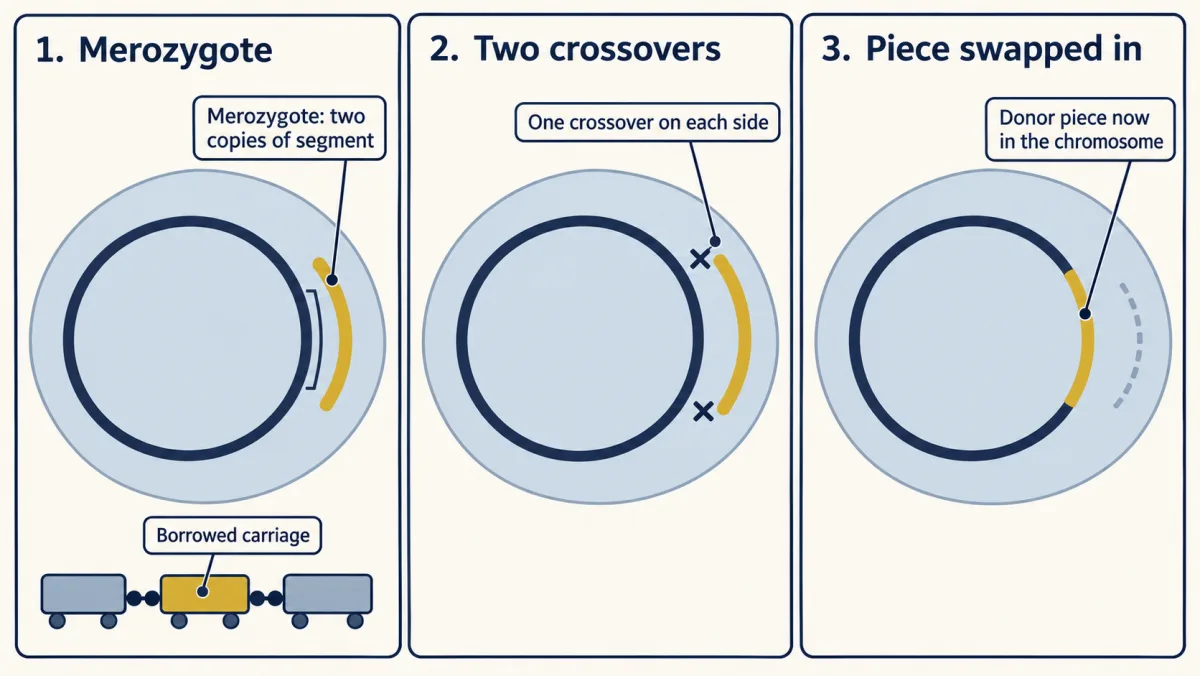
Bacteria make no zygote. E. coli is haploid, with one circular chromosome, so a recipient holding its own segment plus the matching donor segment is only briefly a merozygote, or partial diploid.
In the simple linear-fragment model, stable replacement in the circular chromosome needs an even number of crossovers, at least two, one on each side. After transduction, a piece that is not integrated may still be expressed briefly as an abortive transductant, but it is not copied as cells divide. Integration uses the recipient’s recombination machinery: recipients with a recB mutation yield fewer recombinants in Hfr crosses.
- Markers entered so far
- none
- Gaps between them (min)
- none yet
Each donor gene is recovered only from samples taken after its time of entry, so the order of entry gives the gene order and the gaps give the map in minutes; the gaps, not the absolute times, are the map. This is a sketch of worked problem (a), assuming steady transfer, with first appearance marking entry; a colony also needs the piece to be integrated, and the whole E. coli map runs 0 to 100 minutes, of which only the first 35 are shown.
A linear bacterial fragment delivered by a generalized transducer such as P1 faces the same two-flanking-crossover test. The second film turns to that carrier, whose short load maps close genes.
Read the transcript of “When Genes Share a Phage”
Film transcript: When Genes Share a Phage
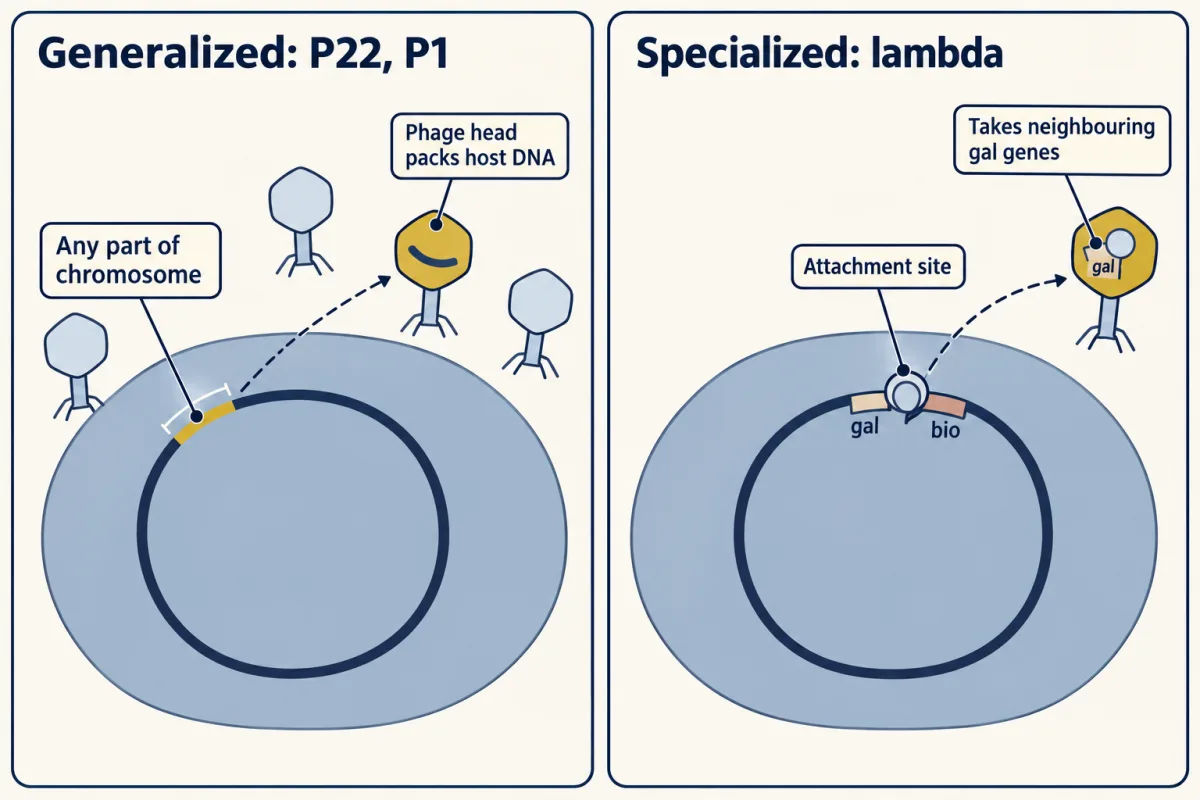
The first film used ordered arrival to map a chromosome. How can a phage reveal which genes sit close together? Keep following gold donor DNA. The carrier has changed, so the readout must change too. Genes can cross a cell-blocking filter inside phage particles, protected from DNase. In generalized transduction, a phage sometimes packages host DNA instead of phage DNA. Any host region can be sampled. The coat reveals the route; the host fragment creates the mapping signal. P22 carries host fragments in Salmonella. P1 does this in E. coli. Each transducing particle delivers only a limited chromosome segment. The phage carries a short window, not the whole circular chromosome.
Specialized transduction follows another rule. Lambda inserts at one preferred site between gal and bio. Inaccurate removal can carry only neighbouring host genes. This is not random sampling across the chromosome; attachment-site position matters. Return to generalized transduction. Two genes can share one particle only when one host fragment covers both. Closer markers fit together in more possible windows. Move the window and count how often both markers remain inside. Two marker pairs produce different shared-carriage bars. One bar is high, and one is low. Which pair lies closer on the chromosome?
Compare only the bars; do not infer direction yet. The pair with the higher shared-carriage bar is closer. More fragment positions can include both markers, so more particles deliver them together. The bar summarizes many particles, not one specially chosen fragment. Researchers select recipients that gained one donor marker. Then they score the fraction that also gained another. That fraction is the cotransduction frequency.
Selection defines the denominator before the second marker is counted. Frequencies against one selected marker rank proximity, but cannot place genes left or right. Three-factor classes settle the order. The same proximity can sit on either side of the selected marker. Shared carriage is not the whole colony. The donor fragment must enter and be expressed. For stable inheritance, it must also recombine into the recipient chromosome. A colony combines transport, recombination, expression, and survival under selection. Interrupted mating maps long chromosome stretches by time. Cotransduction resolves a local interval by shared carriage. Each route creates its own map readout.
Neither readout gives physical base pairs directly in this lesson. For generalized transduction, shared carriage maps proximity. Closer genes travel together more often, within the phage's limited load. Compare markers under the same phage and experimental conditions.
From the film
- Shared carriage maps proximity; closer genes travel together more often.
- Generalized transduction can carry any short region of the host chromosome.
- Specialized transduction carries genes beside a phage's attachment site.
- Frequencies against one selected marker rank proximity but cannot place genes left or right; three-factor classes settle the order.
Transduction: host DNA inside a phage
Norton Zinder, working with Lederberg, found that genes passed between Salmonella typhimurium strains across a cell-blocking filter, and the agent resisted deoxyribonuclease (DNase). They traced it to a temperate phage later called P22. A temperate phage can kill its host or settle as a prophage, usually inserted into host DNA; that settled state is lysogeny.
Lambda is temperate too, but its transduction is specialized because it integrates at a specific attachment site, between the gal and bio genes of E. coli K-12, and can take adjacent host DNA when the prophage excises inaccurately. P22 and P1 are generalized transducers, which occasionally pack a random host-chromosome fragment in place of phage DNA.
Cotransduction as a local map
A transductant is a recipient that acquired a donor marker by transduction, and the cotransduction frequency is the fraction of those selected for one donor marker that also received another. A P1 head holds about 100 kb, roughly 2 minutes of the 4.6-million-base-pair E. coli chromosome, so only genes within that span can ride together.
P1 grown on a wild-type donor infects an x y z triple mutant. Only x+ is selected. Of 500 x+ transductants, 350 are also y+ and 100 are also z+.
Predict 4. Calculate both cotransduction frequencies. Which marker is closer to x, and which gene orders do the numbers allow?
Check your prediction
For y with x, 350/500 = 0.70, or 70%. For z with x, 100/500 = 0.20, or 20%. Both fit within one P1 fragment of x, and y lies closer to x. Two-factor data cannot say which side of x each marker occupies, so x-y-z and y-x-z both fit.
Why bacteria and phage made genetics fast
Both maps follow from how the DNA travelled: ordered arrival places genes around the whole chromosome, and shared carriage places them within one phage load.
A haploid cell has no second allele to mask a recessive mutant genotype, though a phenotype may still lag for a few generations because a growing cell can carry several copies of its replicating chromosome. Cultures hold billions of cells, and E. coli can divide about every 20 minutes in rich medium. Most important, selection does the searching: minimal medium or an antibiotic lets only cells with every selected ability grow, revealing one recombinant among many millions. Many resistance genes ride on plasmids and can encode an enzyme that destroys the drug; plasmids became tools in recombinant DNA.
Each plaque, a clear spot on a bacterial lawn, begins from one infectious unit under the assay conditions, so phage are counted as plaques, and plaque appearance is a phenotype. Two mutant phages infecting one cell can recombine, and their progeny map like a fly cross. Seymour Benzer used a selective host to find rare T4 recombinants among very large numbers of progeny, and mapped mutations within the rII region in the complementation lesson.
Design problem: three-factor transduction
Grow P1 on the wild-type donor, infect the x y z mutant, select x+, and score y and z:
| Class | Count |
|---|---|
| x+ y+ z+ | 95 |
| x+ y+ z | 255 |
| x+ y z+ | 5 |
| x+ y z | 145 |
Predict 5. Which order makes the rarest class, x+ y z+, require four crossovers rather than two?
One way to reason it through
The donor fragment carries x+ y+ z+. For order x-y-z, keeping donor x+ and z+ but recipient y requires exchanges outside x, between x and y, between y and z, and outside z: four.
For y-x-z, the same class needs one exchange between y and x and one beyond z. For x-z-y, it needs one beyond x and one between z and y. Those are two-exchange products, so they should not be the rarest. The order is x-y-z.
Check the margins: y+ is 95 + 255 = 350 of 500, or 70%; z+ is 95 + 5 = 100 of 500, or 20%. The middle gene, y, cotransduces more often than the outer gene z, as the order predicts. Plate the recipient alone and phage alone to control reversion and contamination.
Going deeper
In 1950 Bernard Davis separated E. coli strains in a U-shaped tube by a filter that stopped cells while medium moved back and forth; no recombinants appeared, supporting contact-dependent conjugation. Luca Cavalli-Sforza and William Hayes are usually credited with independently isolating Hfr strains in the early 1950s. A 1976 recalibration set the full map at 100 minutes.
Zinder and Lederberg reported P22 transduction in 1952. M. L. Morse, Esther Lederberg and Joshua Lederberg reported lambda’s restricted transduction of galactose genes in 1956.
Later markers are recovered less often as mating pairs break. Cotransduction frequency also depends on fragment length and on recombination around each marker, so its relation to distance is nonlinear. Base-pair coordinates are now the main frame, but P1 remains useful for moving one region into a clean background to test which mutation causes a phenotype.
Your notes
Select any text in the lesson to highlight it or add a note to it. Your highlights and notes are saved in this browser and collected in your notebook.
This browser is not letting the site save anything (a private window or strict privacy settings), so highlights and notes will be lost when you leave the page.
How we measure it
Selective plating on minimal medium
Cells are spread on a medium lacking the nutrients that the parents need, sometimes with an antibiotic that kills the donor. Only cells that have gained every missing ability grow, so one recombinant can be found among many millions of cells.
Filter (U-tube) test
Two strains are placed on opposite sides of a filter that lets medium, DNA and phage pass but stops cells. Recombinants on the far side rule out a need for contact; their absence points to conjugation.
Interrupted mating
Hfr donors and F− recipients are mixed, and samples are agitated at set times to break the pairs apart before plating. The time at which each donor marker first appears among recombinants orders the genes and spaces them in minutes.
Cotransduction with P1
Phage grown on a donor carries random host fragments into a recipient. Transductants are selected for one donor marker and scored for others; the fraction that also carries a second marker rises the closer the two genes lie.
Practice questions on this lesson (3) → MCAT-style, original, each with an explanation
Where this lesson fits
Before thisReview first
- Linkage and Recombination MappingThis course · Lesson 8
You need to know how recombination frequency turns into map distance before reading distances from entry times.
- Chromosomes and Meiosis: The Physical Basis of Mendel's LawsThis course · Lesson 2
You need the idea of crossing over between homologous DNA to see how an incoming piece gets integrated.
After thisStudy next
- DNA Is the Genetic MaterialThis course · Lesson 12
Griffith's transformation, only mentioned here, is worked through as evidence that DNA carries the heredity.
- DNA Repair and RecombinationThis course · Lesson 15
The recombination machinery that integrates incoming DNA, such as the recB-dependent steps, is explained there.
- Recombinant DNA, Cloning and PCRThis course · Lesson 22
Plasmids and selectable resistance markers from bacterial genetics become the tools for cloning DNA.
Suggested by an AI model from the lessons themselves, then checked. How we use AI
Finish line
Test yourself
8 questions
Practice and MCAT-style, with explained answers.
Next · Lesson 12
DNA Is the Genetic Material
Dead bacteria changed living ones into the dead donor's type. What crossed between them?
Continue →← Lesson 10 · Complementation and Gene Function: From Beadle and Tatum to Benzer