Cell Signaling · Skim version
GTPase Switches: The Timer
Read the full lesson → Skim the whole course →
The guiding idea
After a receptor lets go, what decides how long an already-loaded G protein keeps signaling?
Faster GTP cutting shortens an already-loaded GTPase's time on.
From the film: The Timer Inside the Switch
- Faster GTP cutting shortens an already-loaded GTPase's time on.
- A GEF promotes GDP release so GTP can bind and turn the switch on.
- A GAP accelerates GTP cutting and returns the switch to its GDP-bound state.
- The rule describes one loaded switch; other steps can shape a whole-cell response.
From the film: How the Timer Breaks
- Block GTP cutting to prolong signaling; speed it to shorten signaling.
- Faster GTP cutting shortens an already-loaded GTPase's time on.
- Uncuttable GTP, cholera toxin and some Ras mutations obstruct the off step.
- Extra RGS protein shortens Gi- and Gq-family signals, not Gs; Ras S17N impairs loading.
-
From switch cycle to timer
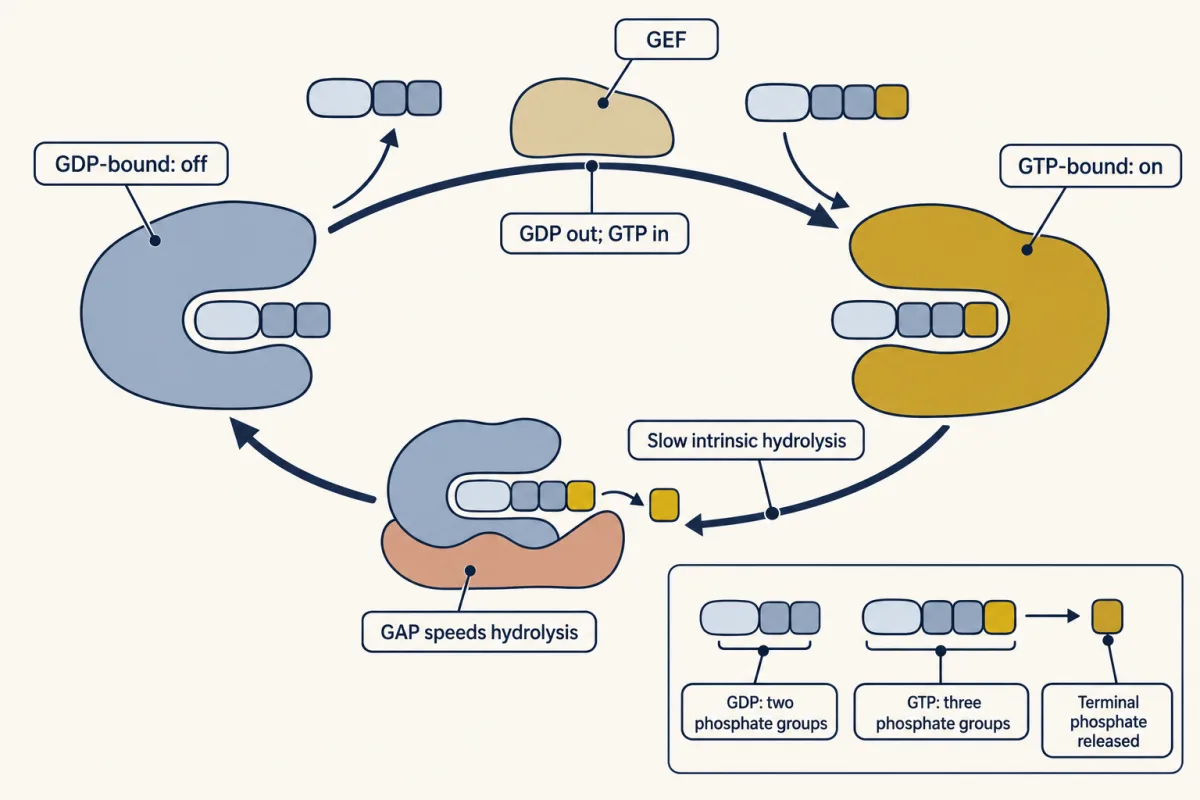
A GEF promotes GDP release and GTP loading, while a GAP speeds GTP cutting and shortens the loaded switch's time on. AI-generated illustration -
Two implementations of the cycle
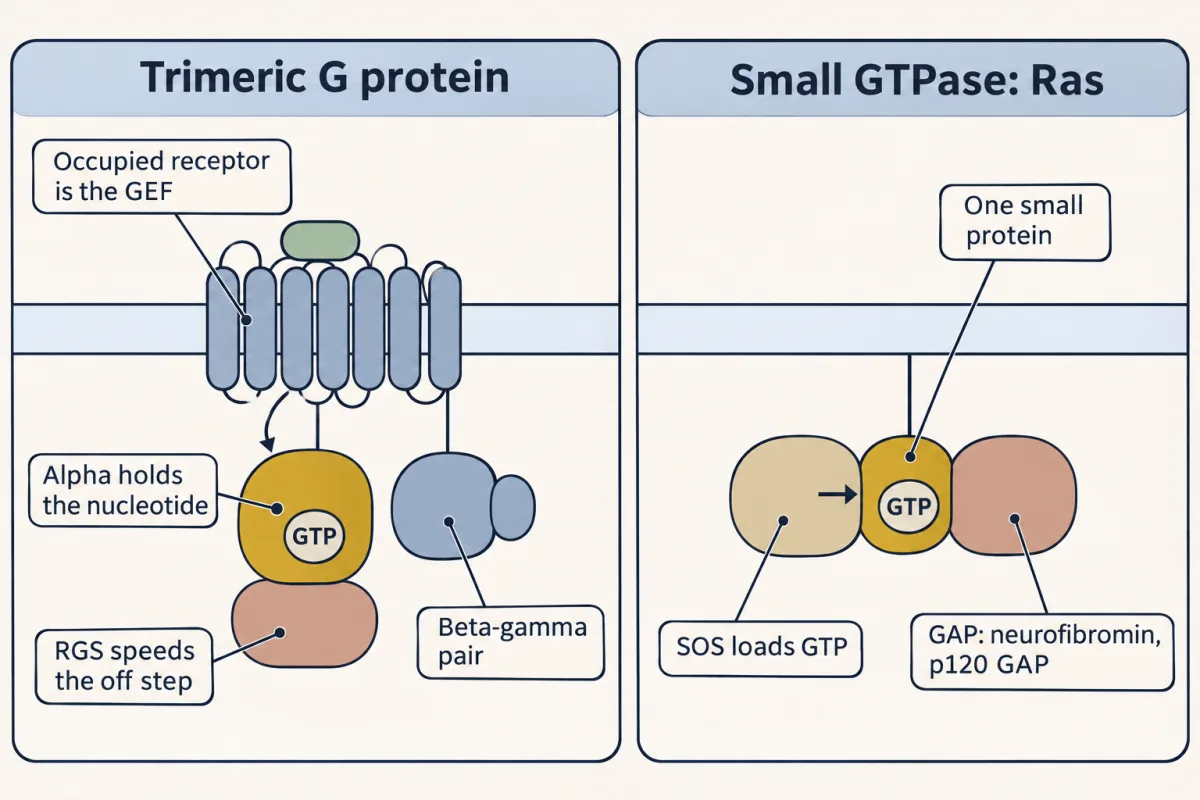
Trimeric G proteins and Ras use different loaders and GAPs to run the same GDP-off, GTP-on cycle. AI-generated illustration -
Breaking the timer
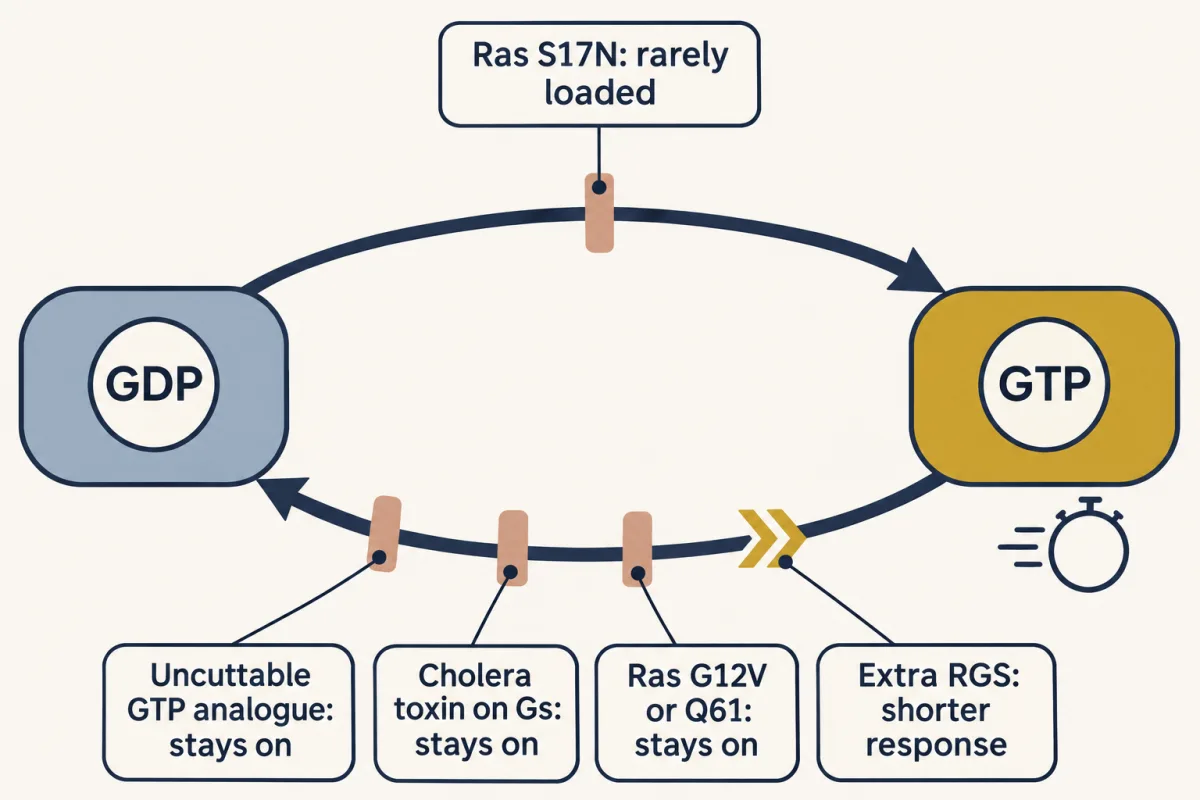
Blocking GTP cutting prolongs signaling, accelerating it shortens signaling, and Ras S17N instead impairs loading. AI-generated illustration -
Going deeper
Where this lesson fits
Before thisReview first
- Binding: Affinity, Occupancy and Dose–ResponseThis course · Lesson 3
You need occupancy and affinity from there to follow how GTP and GDP binding set a switch's state.
- A Field Guide to ReceptorsThis course · Lesson 4
You need the receptor types from there to see why a G protein sits under the receptor.
- Circuits: Amplification, Feedback, Adaptation and SwitchesThis course · Lesson 5
The switches and timing ideas from there are used here to read a switch's duration.
After thisStudy next
- GPCRs and Trimeric G ProteinsThis course · Lesson 12
It applies the GEF, GAP and self-cutting cycle to the receptor and trimeric G protein pair.
- Turning the Signal Off: Arrestins, RGS Proteins and PhosphodiesterasesThis course · Lesson 16
RGS proteins as GAPs are used there to shut off G protein signals.
- Ras to MAPK: The Kinase CascadeThis course · Lesson 19
Ras loaded by SOS and switched off by its GAPs drives the kinase relay here.
Suggested by an AI model from the lessons themselves, then checked. How we use AI