Genetics and Molecular Biology · Skim version
The Genetic Code and Translation
Read the full lesson → Skim the whole course →
The guiding idea
How can one added base regroup every codon that follows, while one substituted base may change no amino acid at all?
Once a start site fixes the reading frame, the ribosome reads nonoverlapping codons in order, and charged tRNAs connect those codons to amino acids.
From the film: The Frame Sets the Message
- A fixed start makes each next triplet a codon.
- A substitution changes one codon; an insertion or deletion that is not a multiple of three moves the downstream frame.
- Frameshift genetics supported a fixed frame; cell-free biochemistry assigned the codons.
From the film: How Codons Become a Chain
- Charged tRNAs connect codons to the growing protein.
- Once a start site fixes the reading frame, the ribosome reads nonoverlapping codons in order, and charged tRNAs connect those codons to amino acids.
- For most tRNAs, a synthetase chooses the amino acid; the ribosome checks codon-anticodon pairing, not the amino acid.
- Elongating tRNAs move from A to P to E; a release factor, not a tRNA, reads a stop.
-
Finding the size and frame of a codon
-
Assigning the codon dictionary
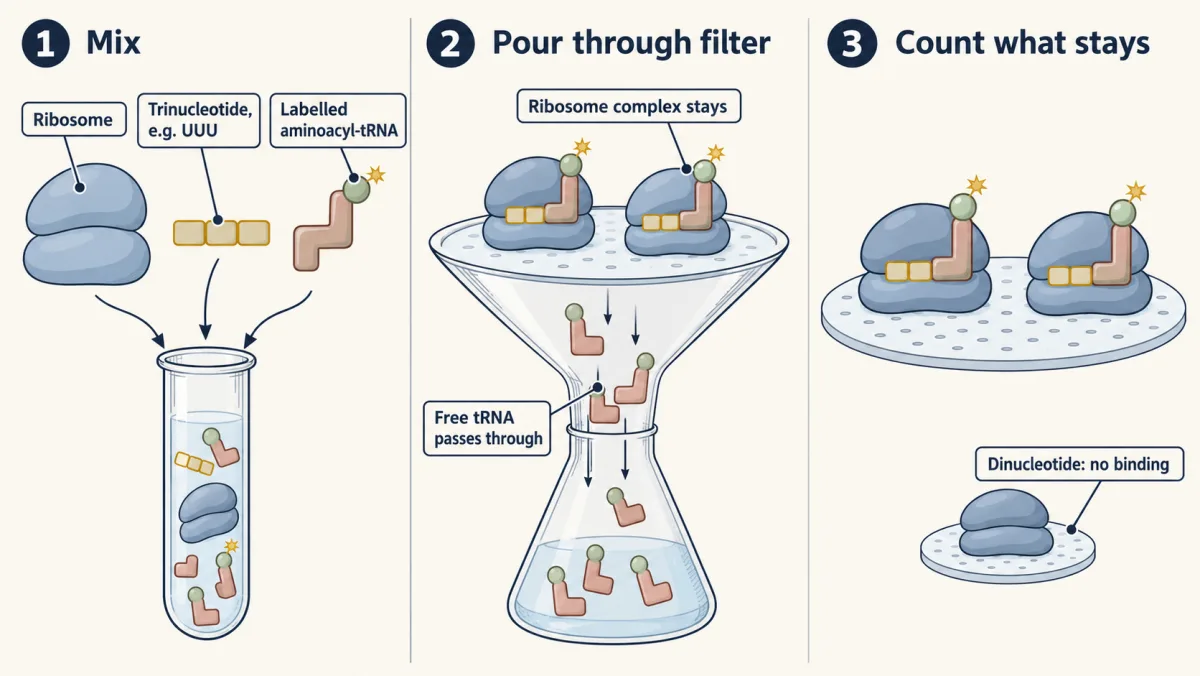
A triplet can recruit its matching aminoacyl-tRNA to a ribosome, so the retained label identifies a codon assignment, while a dinucleotide does not stimulate binding. AI-generated illustration -
Use the frame before changing it
-
Two checks connect codons to amino acids
-
The ribosome sets the start, extends the chain and stops
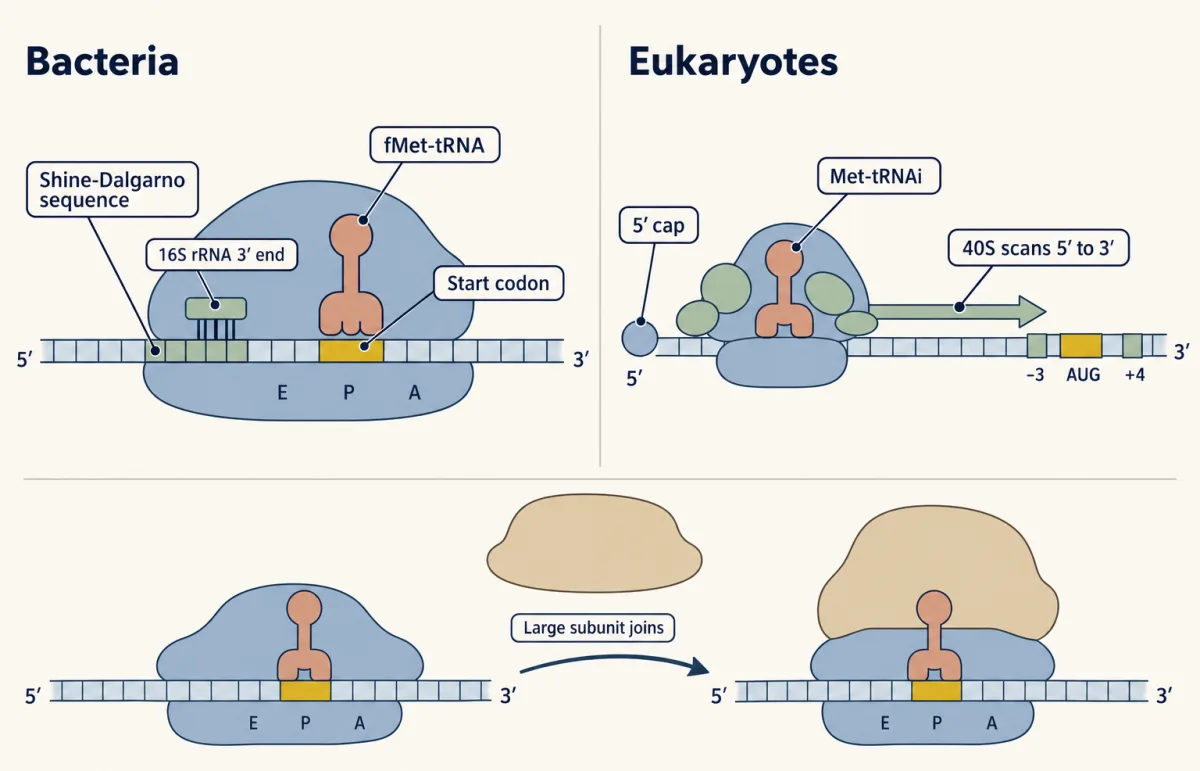
Bacterial alignment and eukaryotic scanning use different routes to do the same job: place the initiator in the P site and set the reading frame. AI-generated illustration -
A premature stop can also destroy the message
-
Design problem: assign codons from repeating RNAs
-
Going deeper
Where this lesson fits
Before thisReview first
- Transcription: From DNA to RNAThis course · Lesson 16
You need to know how mRNA is made from a DNA template before reading it as codons.
- RNA Processing: Caps, Tails and SplicingThis course · Lesson 17
Mature mRNA with its exon junctions is the message translated here, and the premature-stop section uses spliced exons.
- Complementation and Gene Function: From Beadle and Tatum to BenzerThis course · Lesson 10
The T4 rIIB gene and its mutants come from there, and the frameshift work builds on them.
After thisStudy next
- The lac Operon: How Bacteria Regulate GenesThis course · Lesson 19
It shows how bacteria control which genes are transcribed and translated into protein, using the codon-to-protein flow learned here.
- Cancer as a Genetic DiseaseThis course · Lesson 21
Nonsense and frameshift mutations that destroy tumor suppressor proteins are applied there.
- Forward and Reverse Genetics: Screens, RNAi and CRISPRThis course · Lesson 24
Repair of a Cas9 cut often leaves small insertions or deletions that shift the reading frame and knock out a gene.
Elsewhere on the siteFilms, simulations and method films in other courses
- From Gene Copy to Protein ChainFilm · Biology
It follows mRNA codons to an amino acid chain and shows how one changed letter alters a protein.
- Transcribe, translate, mutateSimulation · Biology
You can transcribe, translate and mutate a gene to see silent, missense and frameshift effects.
- One String, One ShapeFilm · Biochemistry
It shows how a changed amino acid in the chain, as in missense mutations, can change protein shape and job.
Suggested by an AI model from the lessons themselves, then checked. How we use AI