Ecology and Evolution · Skim version
Energy Flow and Productivity
Read the full lesson → Skim the whole course →
The guiding idea
In a made-up budget, plants on one square metre fix 12,000 kilojoules a year and the top predators make 40. Where did the rest go?
Energy fixed by plants leaves every feeding step by one of three doors, passed up as production, dropped into detritus or lost as heat, so production shrinks by a product of fractions at each level.
From the film: Three Doors
- Production is a rate, energy fixed or formed per square metre per year; biomass is a stock.
- Net primary production is gross primary production minus what the producers themselves respire.
- At every feeding step energy leaves by one of three doors: passed up as consumer production, dropped into detritus (uneaten, or as feces), or lost as heat.
- Transfer efficiency is consumption times assimilation times net production efficiency; in the made-up budget the first link passed on 6%.
- Because the fractions multiply, production shrinks fast up a food chain, as long as consumers eat no more than the production below them.
From the film: Where the Marsh Grass Goes
- In Teal's Georgia salt marsh, insects and other animals grazing living cordgrass took only a small part of its production.
- Most grass production went to detritus rather than to grazers: it died, broke into fragments and fed bacteria and detritus-feeding animals, which are themselves eaten.
- Energy in detritus can feed decomposers, detritus feeders and their predators, but it never returns to the producers: respiration releases it as heat, and only matter cycles.
- Teal's figure of about 45% of net production available to leave with the tides was a remainder, not a measured export.
-
Production is a rate: GPP, NPP and NEP
-
Measuring it: bottles, harvests and towers
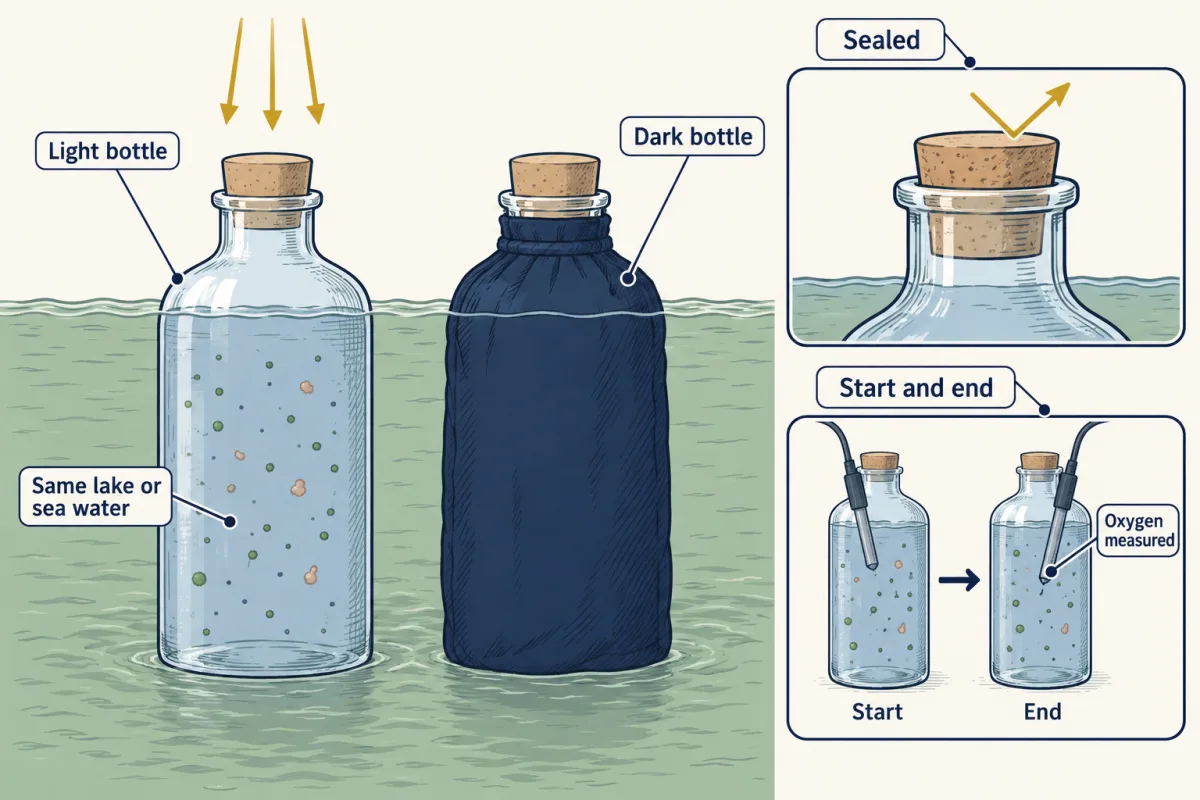
Paired bottles of the same water are sealed and incubated, one in the light and one kept dark, with dissolved oxygen measured at the start and end. The light bottle's change is net community production, because the bottle also holds bacteria and zooplankton. AI-generated illustration 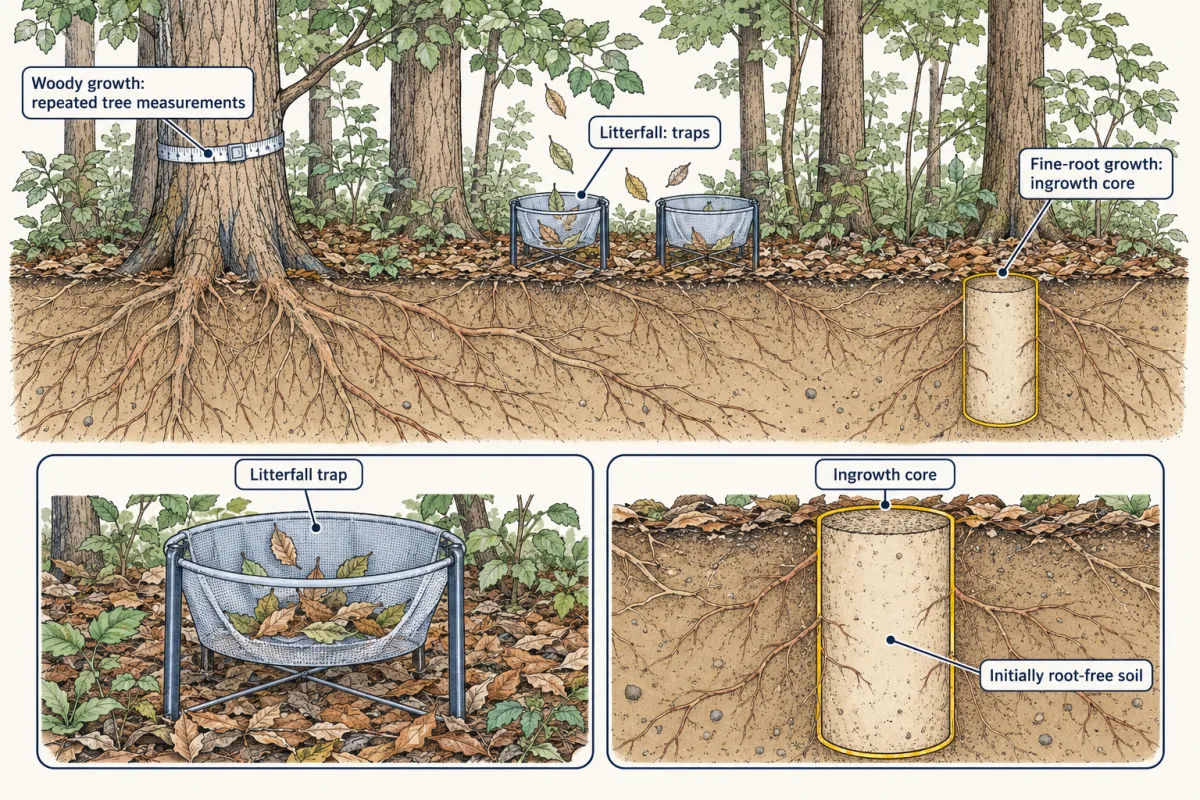
Forest NPP is estimated by adding separately measured parts: woody growth, litterfall and fine-root growth from ingrowth cores. Any part left out is missing from the total, and in nine Korean stands fine roots made up 18 to 44% of the estimated NPP. AI-generated illustration 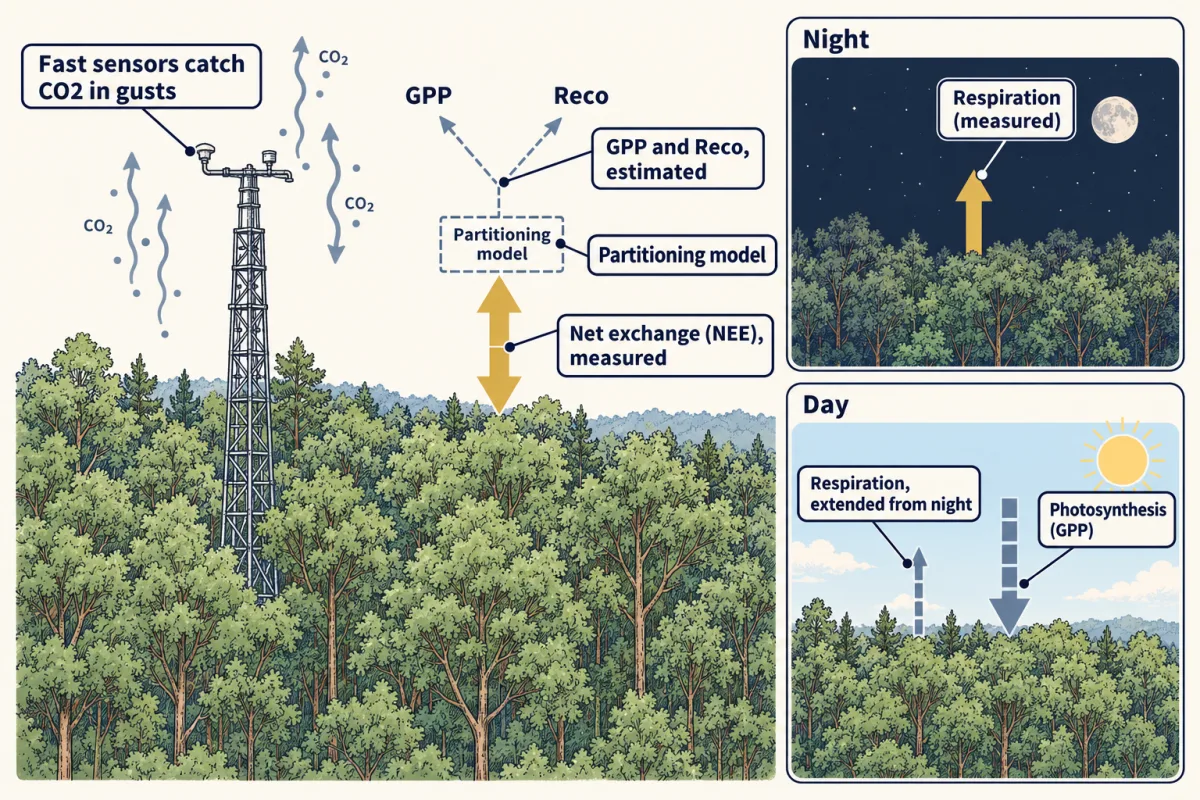
A tower above the canopy measures the net exchange, NEE; GPP and Reco are then separated from it by a partitioning model, often by fitting night-time respiration and extrapolating it into the day. GPP is an estimate with a method attached. AI-generated illustration -
Following energy through a consumer
-
Detritus, transfer efficiency and the 10% rule
-
Going deeper
Where this lesson fits
Before thisReview first
- Predation and Community EffectsThis course · Lesson 17
Feeding links between predators and prey are the pipes that energy moves through in this budget.
- Population Growth and RegulationThis course · Lesson 14
Production as a rate per area per year builds on thinking of growth as a rate.
After thisStudy next
- Nutrient CyclingThis course · Lesson 22
Energy ends as heat, but the matter in detritus returns to producers, which this lesson picks up.
- Biodiversity and Ecosystem FunctionThis course · Lesson 23
It asks how species richness changes production, the rate defined here as NPP.
- Global Change: Species on the MoveThis course · Lesson 24
Warming and changing CO2 shift the production and respiration fluxes defined here.
Elsewhere on the siteFilms, simulations and method films in other courses
- Build an energy pyramidSimulation · Biology
It lets you build an energy pyramid and see production narrowing at each feeding level.
- Why Energy Pyramids NarrowFilm · Biology
It shows why only part of each level becomes tissue the next level can eat.
- Follow the Energy ArrowsFilm · Life Science
It shows energy arrows pointing from food to eater and how little sunlight energy reaches the top consumer.
- The Leaf Pile That Stops GrowingFilm · Life Science
It shows decomposers feeding on dead material and why detritus belongs in an ecosystem's energy flow.
Suggested by an AI model from the lessons themselves, then checked. How we use AI