Why Energy Pyramids Narrow
Read the transcript of “Why Energy Pyramids Narrow”
Film transcript: Why Energy Pyramids Narrow
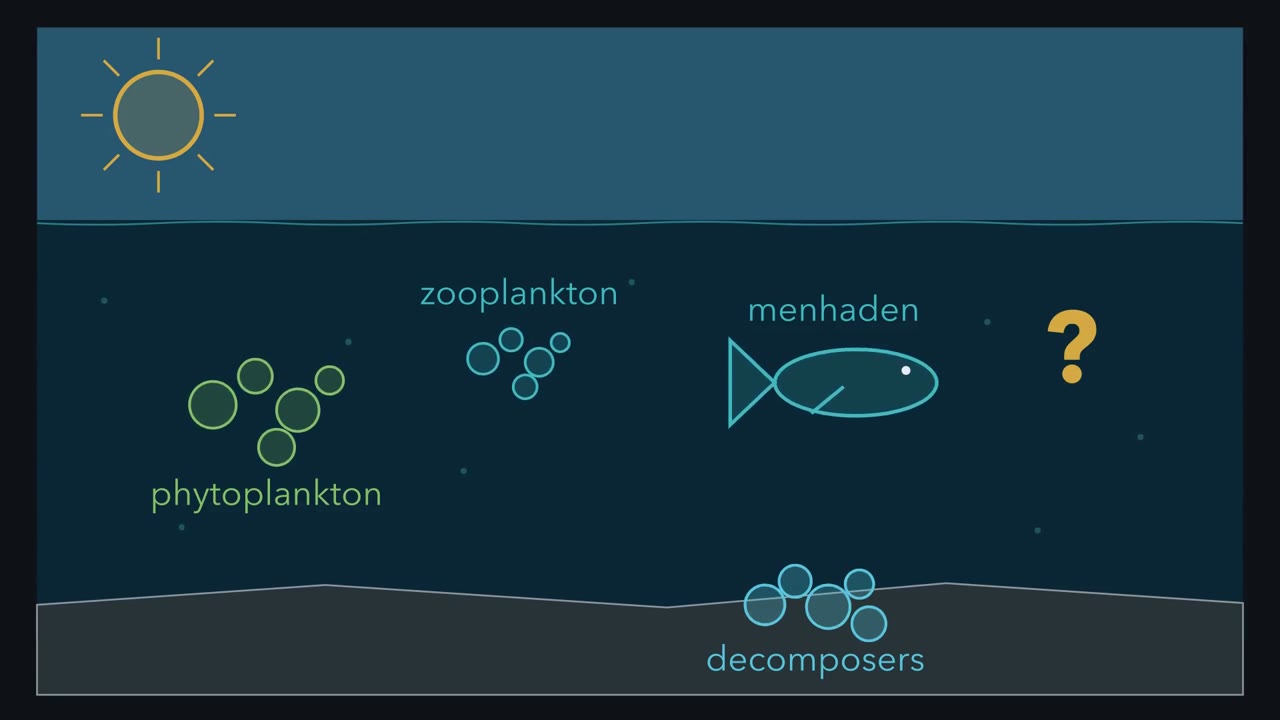
Why does far less of the energy captured by Bay plankton reach the osprey level? Watch a gold band of energy cross the Chesapeake Bay. It enters green phytoplankton from sunlight. Then teal zooplankton, menhaden, and an osprey take turns feeding. The band will change at every step.
Phytoplankton are producers because they capture light energy and store it in food. Animals are consumers because they get energy by eating. Blue decomposers get energy from dead matter and wastes. Gold arrows point from food to eater. Those arrows follow energy, not the animal doing the hunting. When zooplankton feed, the incoming gold band splits.
Cellular respiration releases part as spreading red heat. Uneaten pieces and undigested waste move toward blue decomposers. Only the tissue branch becomes new zooplankton tissue. That branch is available to a menhaden that feeds next. Zooplankton feed is available to a menhaden that feeds next. Now follow the same split inside a menhaden. Which outgoing branch can become osprey tissue? Watch all branches form. Choose before the labels appear.
The branch stored as new menhaden tissue can feed the osprey. Heat has dispersed into water and air. Uneaten or undigested material can still feed decomposers. It does not become osprey tissue through this link. The gold band reaching the osprey is narrower. Ecologists compare levels with energy transfer efficiency. It is the percentage measured at a level that appears at the next. The measurements must match in kind, area, and time. A familiar percentage appears on screen as a rough model. Real feeding steps can be higher or lower. Stack those matching measurements, with producers at the bottom. The result is an energy pyramid. Each bar is narrower because only part became new tissue above.
The shape tracks energy flow, not the body size of any organism. Many small producers can support fewer large predators. A real food web adds branches. Menhaden eat phytoplankton and zooplankton. Striped bass also eat menhaden. An osprey's trophic level can change with the path you follow. The same accounting still works at every link. Follow arrows from each food to its eater. Return to the osprey. Its food energy began with producers capturing sunlight. Along the path, heat spread and other material moved toward decomposers. The energy was transformed, not destroyed. But at each feeding step, only the tissue branch became available to the next consumer.
That is why energy pyramids narrow even when the exact percentage changes. Use the rule before any shortcut percentage. At each step, only part becomes tissue the next level can eat.
An osprey on the Chesapeake Bay eats fish, and the fish eat plankton, so how much of the sunlight the plankton caught ever reaches the osprey?
Continue in the lesson: Energy in Ecosystems →
3:37 · Free, with captions and a transcript. The lesson has the full text, the questions and the sources.
More films from this lesson
How this film was made. Narration: written from this lesson's text and read by an AI narrator voice (Kokoro, af_heart). Animation: AI-generated in code (Manim) by Claude, a schematic with no drawn molecular structures. Captions come from the narration script. See something wrong? Report it.