Life Science · Skim version
DNA: The Code of Life
Read the full lesson → Skim the whole course →
The guiding idea
If strawberries, mushrooms, bacteria and people all have DNA, why are they so different?
DNA sequence helps shape traits; DNA amount does not rank organism complexity.
From the film: Which Part of DNA Is the Code?
- DNA sequence helps shape traits: the order of the bases in the rungs is the code.
- DNA's sugar-phosphate sides are the same in all living things.
- In ordinary double-stranded DNA, A pairs with T and C pairs with G.
- Many genes carry base sequences used to build proteins, and proteins can affect traits.
- Almost every cell in one body carries the same DNA, but each cell type uses different genes.
From the film: Does More DNA Mean More Complex?
- DNA sequence helps shape traits; DNA amount does not rank organism complexity.
- DNA amount counts base pairs in one full chromosome set.
- Every group in the table has DNA: bacterium, fungus, plant and animal.
- An onion chromosome set has about five times the human DNA amount in the table.
- Eight examples can test a claim, but they do not represent all living things.
-
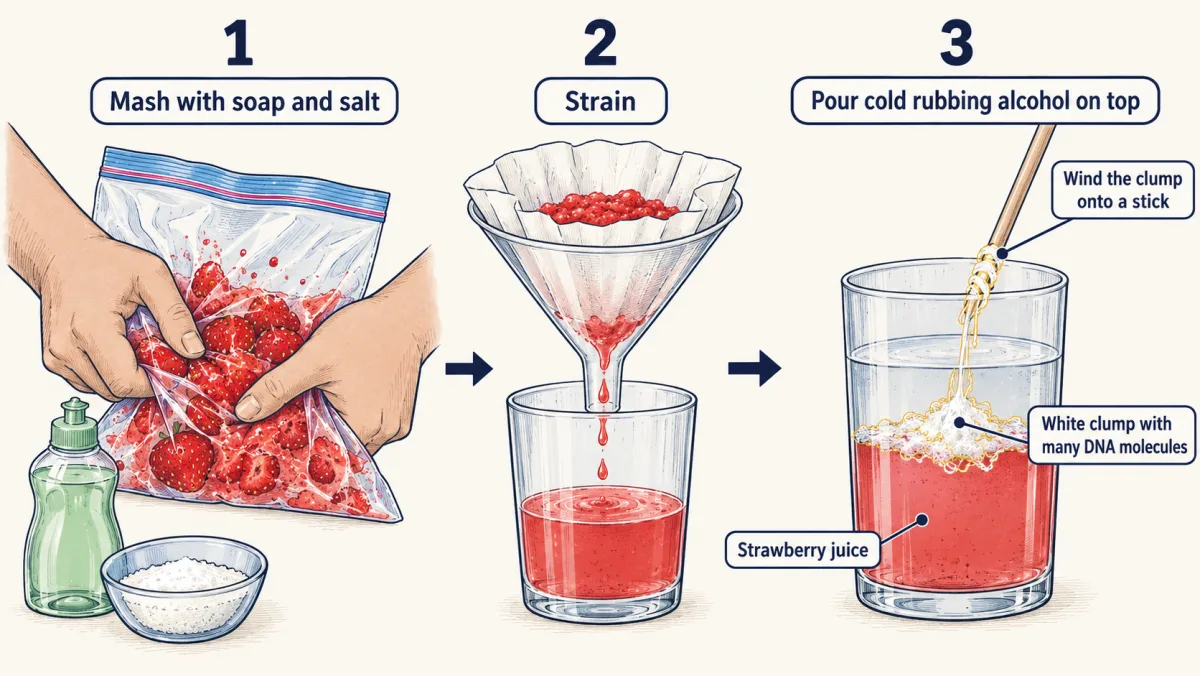
The white clump contains many strawberry DNA molecules, along with some other cell material. AI-generated illustration -
Test the code in a model
-
Use pairing and sequence
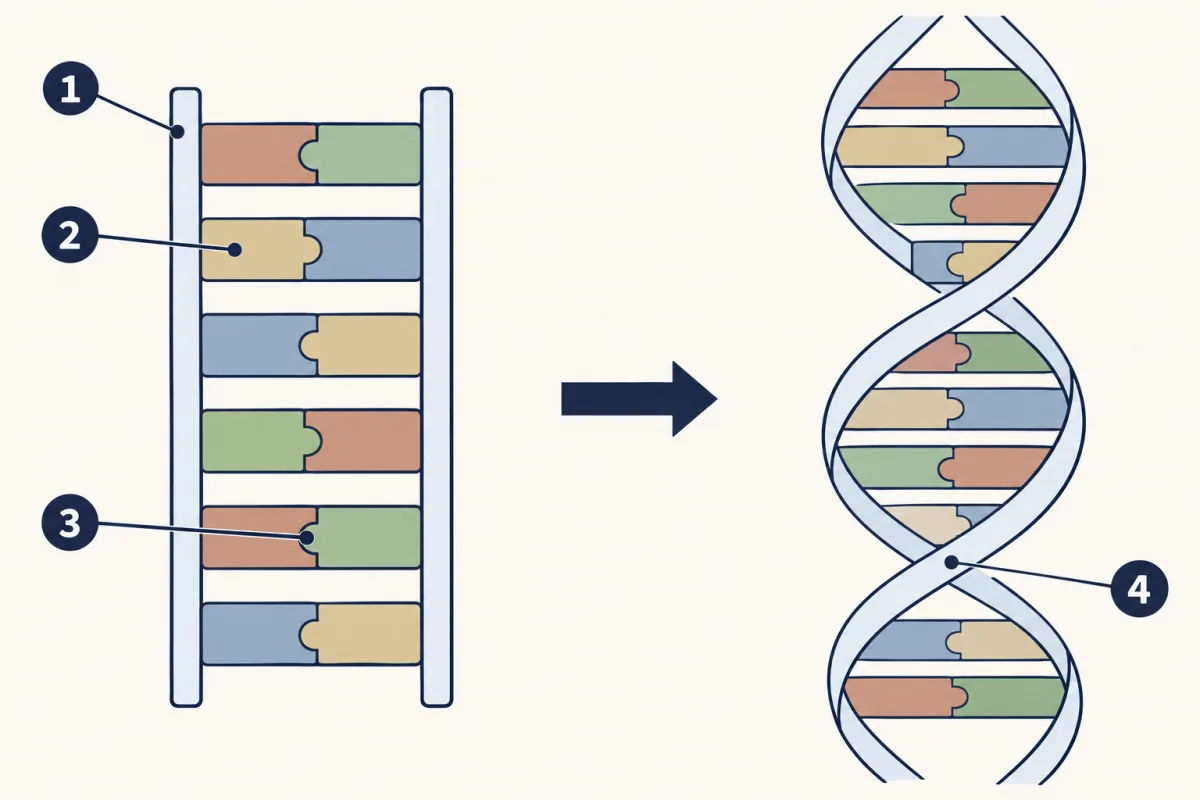
- sugar-phosphate side
- base
- base pair
- double helix
-
Add scale and limits to the gene model
-
Work with the full DNA-amount data
-
Going deeper
-
Check your thinking
Where this lesson fits
Before thisReview first
- Inside a CellThis course · Lesson 2
You need to know the nucleus holds DNA and that cells make proteins to place DNA inside the cell.
- Cells Are EverywhereThis course · Lesson 1
You need to know that all living things are made of cells, which is why every group in the table has DNA.
After thisStudy next
- Reproduction and MeiosisThis course · Lesson 28
It shows how chromosomes of DNA are passed from parents to offspring and shuffled in sex cells.
- Mutations and VariationThis course · Lesson 31
It uses the idea that changing the order of bases can change a protein and a trait.
- Predicting Traits with Punnett SquaresThis course · Lesson 29
It uses genes as sections of chromosomes to predict which traits offspring will show.
Elsewhere on the siteFilms, simulations and method films in other courses
- From Gene Copy to Protein ChainFilm · Biology
It follows how base order in a gene sets the order of amino acids in a protein.
- Transcribe, translate, mutateSimulation · Biology
You can change a gene's letters and see how the protein and trait change.
Suggested by an AI model from the lessons themselves, then checked. How we use AI