Genetics and Molecular Biology · Skim version
Forward and Reverse Genetics: Screens, RNAi and CRISPR
Read the full lesson → Skim the whole course →
The guiding idea
How do you find what a gene does: start from a trait and hunt for the gene, or start from a gene you name and see whether the cell cares?
What you choose first determines what genetics can find; validation determines what it can claim.
From the film: Which Way Do You Run Genetics?
- What you choose first determines what a genetic experiment can find.
- Forward genetics starts with a phenotype and searches for its gene.
- Reverse genetics starts with a chosen gene and asks what phenotype changes.
- A screen finds only what its assay can see.
- A pooled CRISPR screen chooses guides first, then selects cells by phenotype.
From the film: From a Programmed Cut to a Tested Knockout
- A genetic change supports function only when genotype and phenotype agree.
- A guide finds the match; a nearby PAM licenses binding and cleavage.
- Cellular repair can leave several alleles after one targeted cut.
- An allele count is not a cell count.
- Independent perturbations and rescue test whether the phenotype follows the gene.
-
Phenotype first: the forward screen
-
Gene first: knockdown and knockout
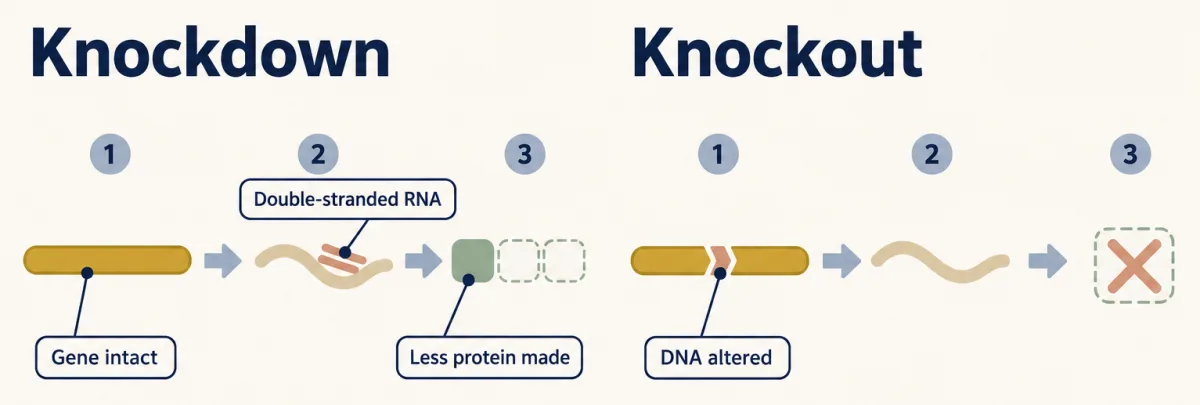
A knockdown lowers output from an intact gene; a functional knockout has lost gene function, which an indel alone does not establish. AI-generated illustration -
CRISPR came from a bacterial immune system
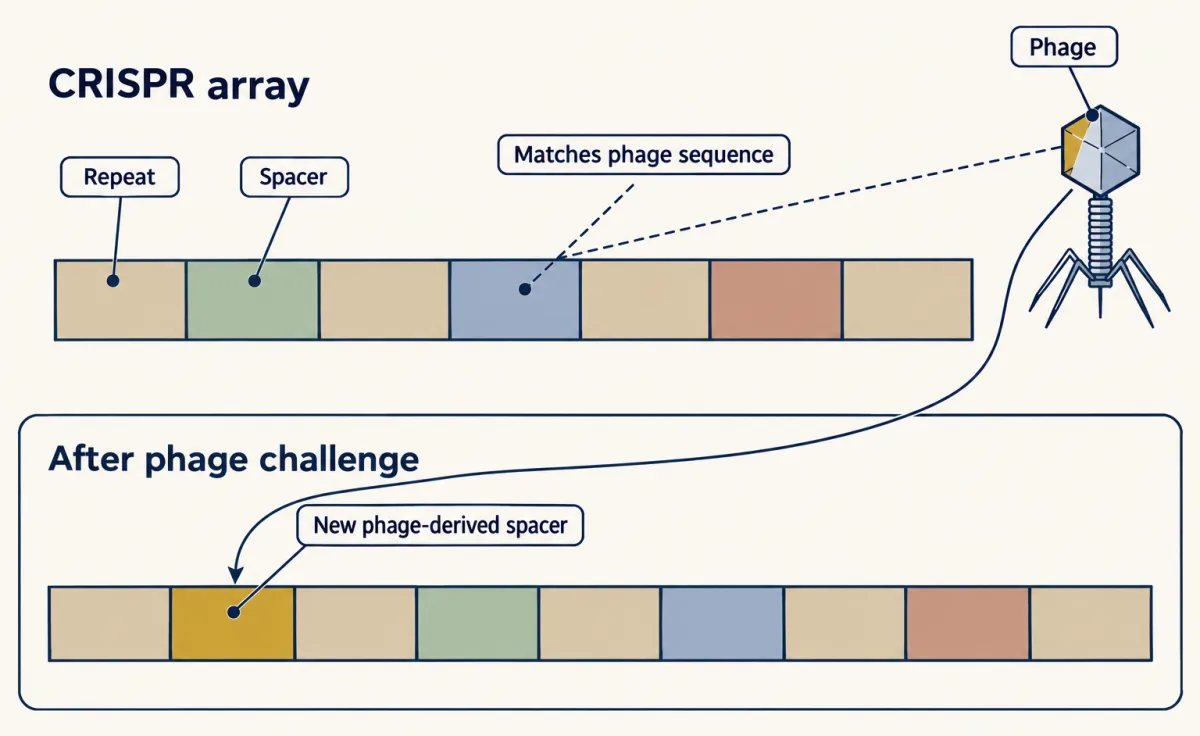
A CRISPR array records phage-derived spacers whose sequence can direct specific resistance. AI-generated illustration -
Programming the cut, and what the cell does next
-
A pooled CRISPR screen uses both directions
-
Somatic, germline, and who decides
-
Going deeper
Where this lesson fits
Before thisReview first
- Complementation and Gene Function: From Beadle and Tatum to BenzerThis course · Lesson 10
Forward screens sort mutants into genes by complementation, which this lesson uses without re-teaching it.
- DNA Repair and RecombinationThis course · Lesson 15
You need end joining and homology-directed repair from there to predict what a Cas9 break leaves behind.
- Recombinant DNA, Cloning and PCRThis course · Lesson 22
Amplicon sequencing and screen libraries here rely on PCR and cloning methods taught there.
After thisStudy next
- Population Genetics: Hardy-Weinberg and Evolutionary ForcesThis course · Lesson 25
It treats allele frequencies in a pool, the same kind of count as the edited-allele table here.
Elsewhere on the siteFilms, simulations and method films in other courses
- Complementation (cis-trans) testMethod film
The lesson uses complementation to show whether two screen mutants hit the same gene.
- Fluctuation test and replica platingMethod film
It shows how mutations arise at random before selection, the idea behind random mutagenesis in a forward screen.
Suggested by an AI model from the lessons themselves, then checked. How we use AI