Ecology and Evolution · Skim version
Conservation and Restoration
Read the full lesson → Skim the whole course →
The guiding idea
In 1995, eight female pumas from Texas were released into the Florida panther population. What did that change, and how would you know?
In a simple model of one population, if the trend, its average yearly change on a log scale, is zero or below, the population reaches the floor in the long run and size only buys time; how soon depends on the trend, the size and the year-to-year swings together, so conservation starts by removing the cause of decline.
From the film: Trend and Chance
- In a simple model of one population, if the trend, its average yearly change on a log scale, is zero or below, the population reaches the floor in the long run; how soon depends on the trend, the size and the swings together.
- In this model, without a trend above zero, a bigger population only buys time: over a long enough span nearly every run reaches the floor.
- Chance in which animals survive and breed matters most when numbers are small, and inbreeding can pull the trend down further.
- A population viability analysis runs a fuller model of the population many times and reports the fraction that falls to the floor within a chosen time.
- So conservation starts by removing the cause of decline; alongside it, numbers, connections and genes can lift the trend or cut the risk.
From the film: Eight Females from Texas
- In 1995 eight female pumas from Texas were released into the small, inbred Florida panther population, a planned genetic rescue.
- By 2010 panther numbers had about tripled and heterozygosity, a measure of genetic variation, had doubled.
- A 2024 follow-up found the genetic benefits lasting through five generations, while the population stabilised and declined during 2016 to 2020.
- Genetic rescue can ease inbreeding and lift the trend, but it does not by itself remove other causes of decline, such as habitat loss, so a population gain from it may not last.
-
Why small populations are fragile
-
MVP and PVA: risk as a probability
-
Census size and effective size
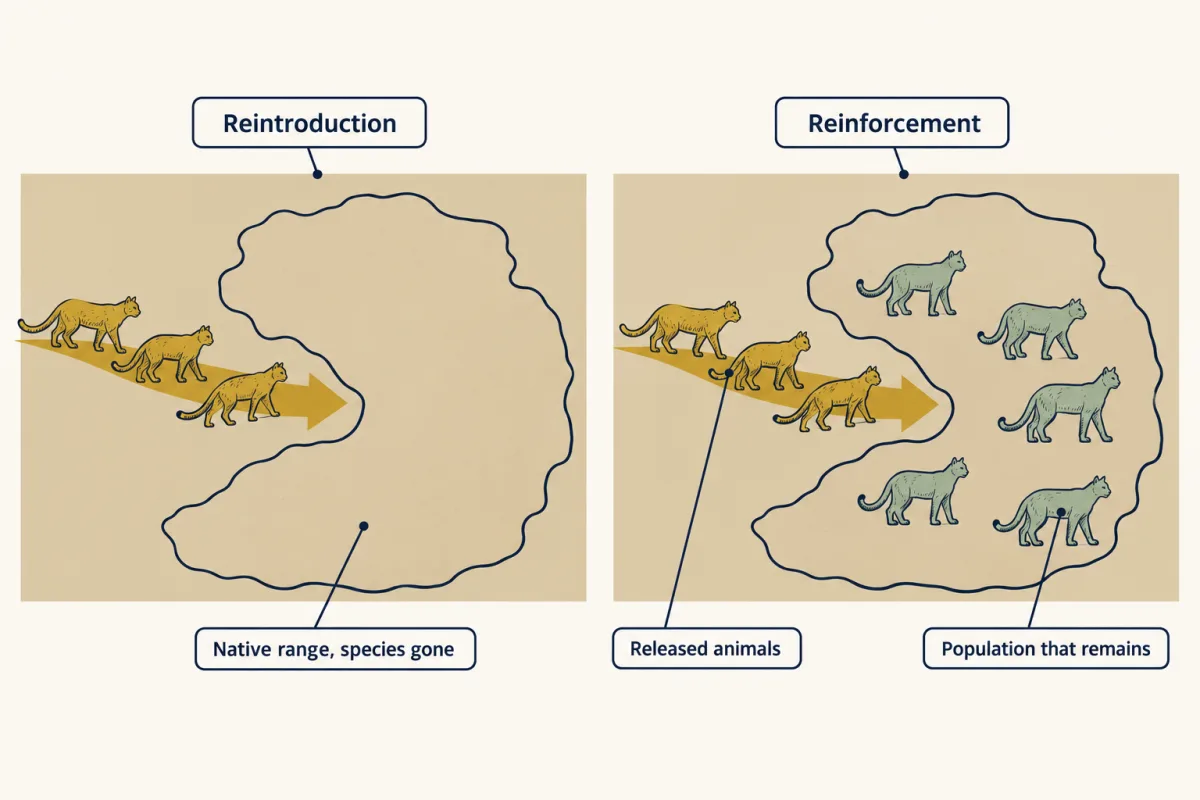
The IUCN separates reintroduction, release where the species has disappeared, from reinforcement, adding animals to a population that remains. The panther release was reinforcement. AI-generated illustration -
Habitat tools: changing the trend and the swings
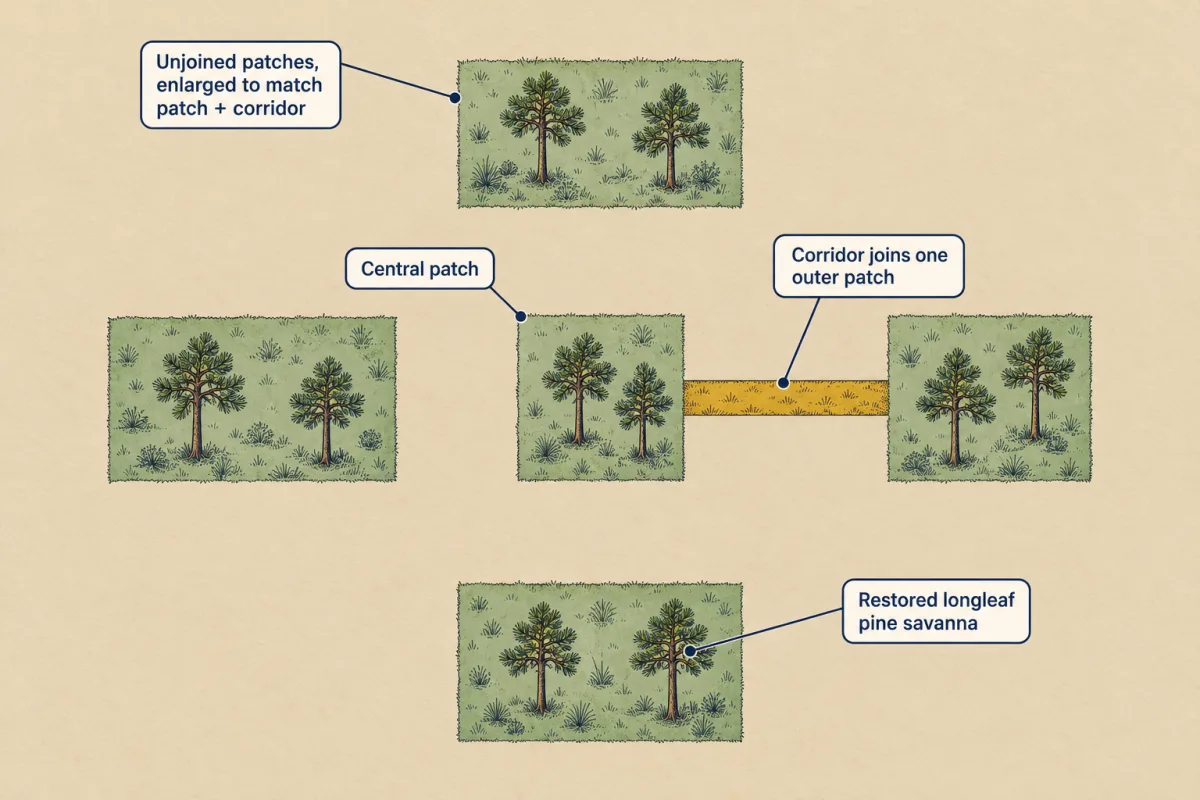
The corridor was assigned at random, and unconnected patches had the same area as a joined patch plus its corridor, so connection can be credited for why connected patches gained species faster and lost them more slowly. Simplified: some real unconnected patches had dead-end side strips. AI-generated illustration 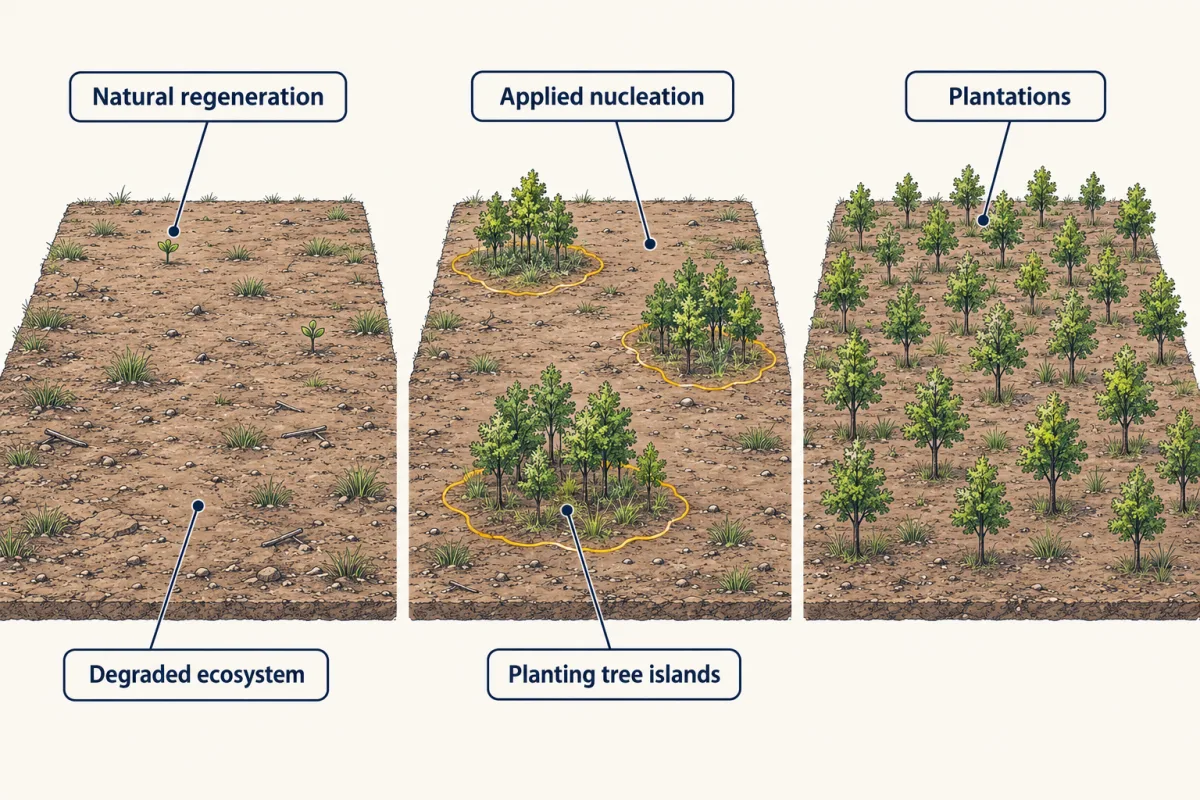
After about a decade, planting (tree islands and plantations) raised recruitment of animal-dispersed trees, yet in every treatment the young trees still differed from reference forest. AI-generated illustration -
Decisions with competing goals
-
Going deeper
Where this lesson fits
Before thisReview first
- Population Growth and RegulationThis course · Lesson 14
You need the per-capita growth rate and its log-scale trend from there to read the trend and swings rule here.
- Drift, Gene Flow and Competing ExplanationsThis course · Lesson 4
Drift, effective size and gene flow from there are what the small-population genetic risks and Ne calculation here use.
- Movement and Spatial PopulationsThis course · Lesson 15
Patch extinction, recolonisation and movement between patches from there explain why corridors are expected to help here.
After thisStudy next
- Integrative Evidence WorkshopThis course · Lesson 26
It practises weighing studies like these, including what an all-negative survey can and cannot show about a species.
Elsewhere on the siteFilms, simulations and method films in other courses
- Grow a population, then add limitsSimulation · Biology
It lets you grow a population and add limits, showing how limits shape a small population's fate.
- Drift and selection: replicate populationsSimulation · Genetics and Molecular Biology
It lets you watch drift and selection in replicate populations, showing how small size loses genetic variation.
- Why Dominance Does Not Spread an AlleleFilm · Genetics and Molecular Biology
It shows why drift in small populations matters for allele frequencies, which underlies inbreeding and effective size.
Suggested by an AI model from the lessons themselves, then checked. How we use AI