Ecology and Evolution · Skim version
Competition
Read the full lesson → Skim the whole course →
The guiding idea
One competitor grows twice as fast as the other. Why does it not always win?
In the Lotka-Volterra competition model, two competitors coexist stably when each can grow when it is rare and the other is at its carrying capacity: each limits itself more than it limits the other.
From the film: Can It Grow When Rare?
- Competition lowers each species' per-capita growth, and alpha converts the other species into units of one's own kind.
- The invasion test asks whether a species can grow when it is rare and its competitor is at carrying capacity.
- In the model, with both species present: if both pass, they coexist stably; if only one passes, it excludes the other from that place; if neither passes, the start decides.
- The growth rate r is not in the rule, so it changes how fast and by what route the populations move, not which verdict the model gives: the faster grower need not win.
- In this model, both coexist stably when each can grow when rare: each limits itself more than it limits the other.
From the film: What Keeps Chthamalus High?
- At Millport, Chthamalus lives above Balanus, and longer immersion, predators or crowding by Balanus could each explain that boundary.
- Connell removed Balanus from a randomly chosen half of each mapped patch and left the other half untouched as the comparison, so better survival on the cleared half is strong evidence that Balanus limited Chthamalus.
- Chthamalus kept free of Balanus survived well at the levels he studied, and Balanus killed it by smothering, undercutting and crushing it.
- So at Millport, competition from Balanus set the lower limit of Chthamalus, whose fundamental niche reaches lower than its realized niche.
- It is one shore and one pair of species; its strength is the design, not the generality. Randomized, controlled removal: better survival is evidence the neighbour was limiting.
-
Kinds of competition
-
Lotka-Volterra: the invasion test in numbers
-
Exclusion is a model conclusion
-
Connell’s barnacles: what the film left out
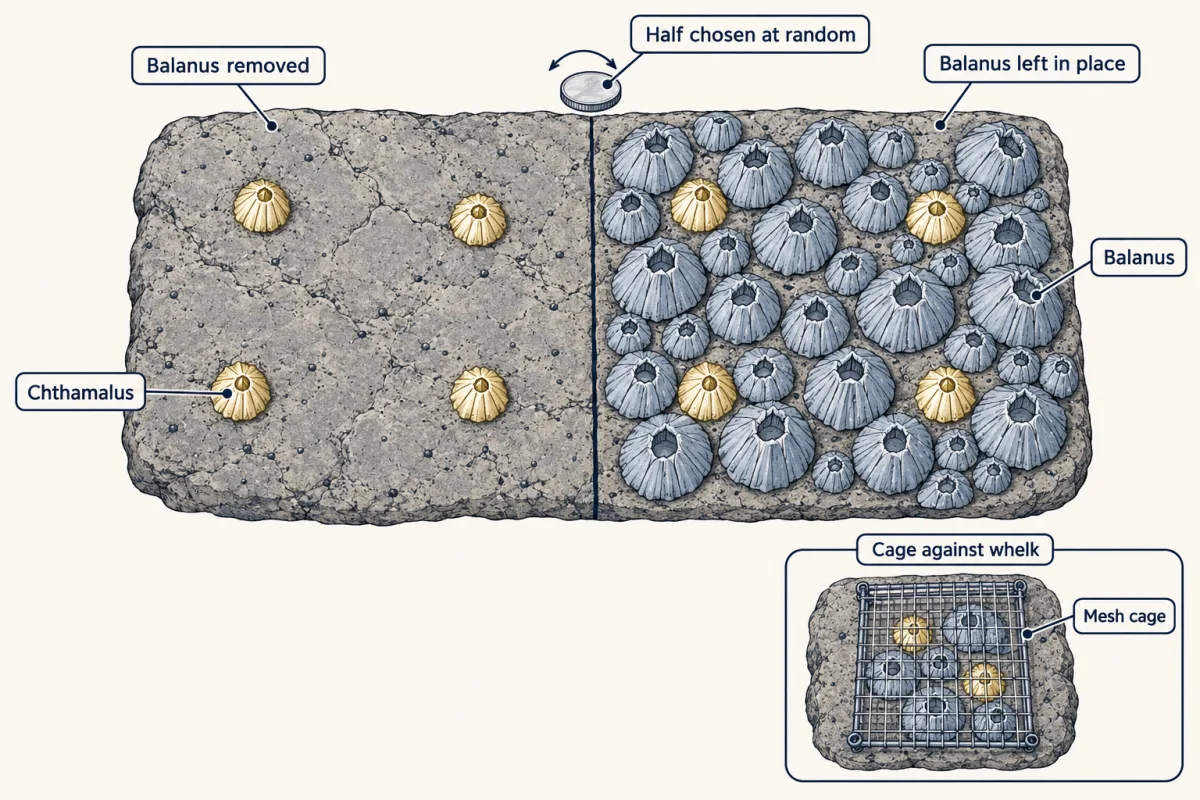
Clearing Balanus from a random half of each mapped patch, beside an untouched half at the same height and weather, gives strong evidence that Balanus limits Chthamalus survival; cages on some patches kept out the whelk Thais. AI-generated illustration -
Partitioning and character displacement
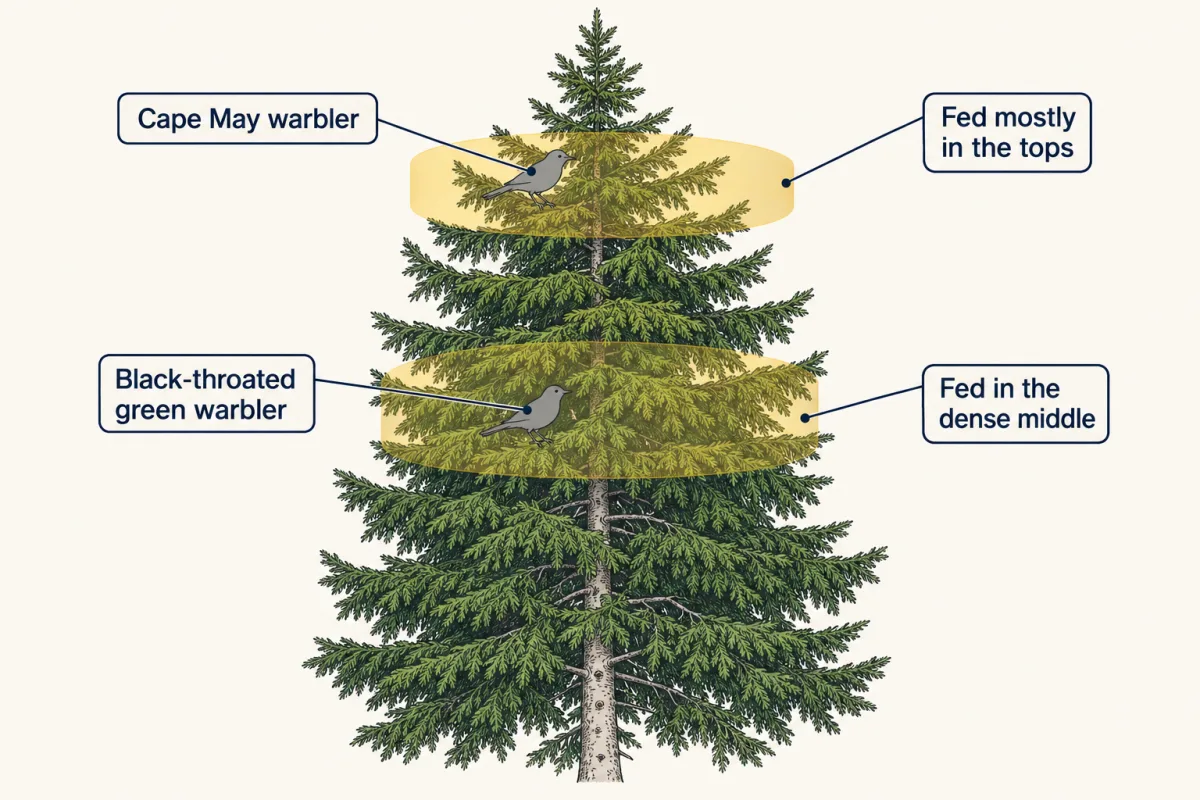
Warblers share one spruce by feeding in different parts of it, Cape May warblers mostly in the tops and black-throated green warblers in the dense middle branches; watching shows partitioning, but it does not test whether competition caused it. AI-generated illustration -
Going deeper
Where this lesson fits
Before thisReview first
- Population Growth and RegulationThis course · Lesson 14
You need the logistic model and carrying capacity K from there, since this model adds a second species to it.
- Distributions, Niches and TolerancesThis course · Lesson 12
You need fundamental versus realized niche from there to read what Connell's barnacle removals show.
- How to Test an Evolutionary ExplanationThis course · Lesson 1
Its tests of evolutionary claims are used here to judge the evidence for character displacement in Grants' finches.
After thisStudy next
- Predation and Community EffectsThis course · Lesson 17
It extends the same two-species phase-plane approach to predators and prey, where one species' loss is the other's gain.
- Diversity, Disturbance and SuccessionThis course · Lesson 19
It uses competition and the coexistence conditions to explain how many species can share a place after disturbance.
- Mutualism, Parasitism and CoevolutionThis course · Lesson 18
It takes the two-species interaction model further by changing the sign of the effect one species has on the other.
Elsewhere on the siteFilms, simulations and method films in other courses
- One Tube, One Shared SupplyFilm · Life Science
It shows how a shared limited resource restricts populations, the starting idea of competition.
- One Forest, Different Ways to LiveFilm · Life Science
It shows how species that eat the same food share a place by using it differently.
- Share a tree with five kinds of birdsSimulation · Life Science
You can share one tree among five bird species and see partitioning of niches at work.
Suggested by an AI model from the lessons themselves, then checked. How we use AI