One Forest, Different Ways to Live
Read the transcript of “One Forest, Different Ways to Live”
Film transcript: One Forest, Different Ways to Live
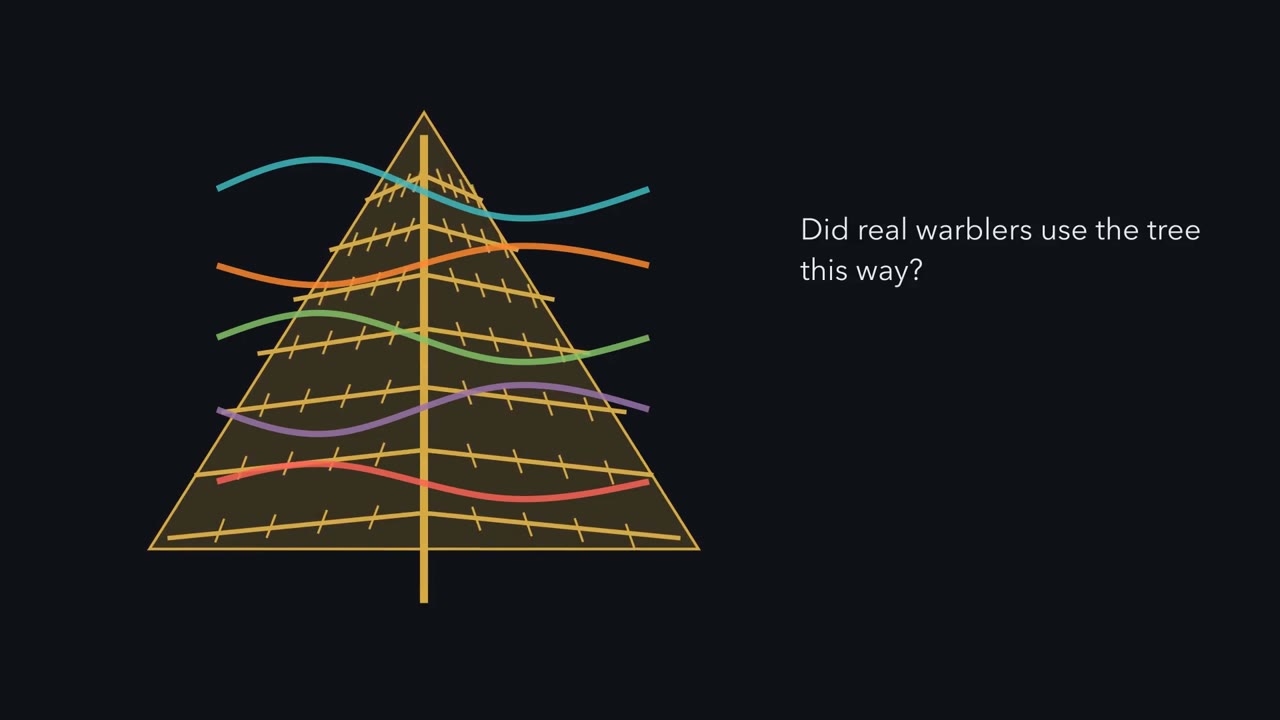
Several kinds of warblers hunt insects in the same spruce forest. How can they share one place without running out of food? Watch the same tree as the birds choose where to search. Gold outlines the shared forest, while each bird keeps its own color.
The spruce forest is their habitat, the place where they live. A niche is different. It is an organism's role: how it lives and uses resources there. Food is part of a niche. So are where and when it feeds, the space it uses, what eats it, and its ecosystem role. A resource is something a living thing needs and takes from its habitat. Food, water, shelter, and space are resources. Each warbler searches spruce needles with its small, thin bill. Finding insects supplies food, and food helps the bird survive. When organisms need the same resource and it is in short supply, they compete.
Competition is a struggle for resources in short supply. If birds search the same branches, they may reach for the same insect. Their niches overlap where their resource use overlaps. A species is one kind of living thing. The warblers are different species, even though their bodies and food look similar.
Competition can leave one kind with enough food and another short. It becomes more likely when their shared resource is scarce. Now predict. Insects become scarce, and every kind searches every branch. Will more birds get enough food, or will more fall short? Keep your answer while the insect dots fade.
With scarce insects and every kind searching everywhere, more kinds are likely to fall short in this simple model. Now let each color favor its own tree zone. The birds still share one forest, but fewer paths cross. Different niches can reduce competition when insects are limited. That can help more kinds share the habitat. The model simplifies nature. Real niches include much more than feeding zones.
Birds also change where they search when food or weather changes. Different use does not remove all competition. It changes the chances of meeting over a limited resource. That gives a testable explanation for the opening puzzle. Shared habitat does not mean identical niche. The next step is evidence: watch where real warblers spent time, then ask what those observations can support.
How can five kinds of small birds that all eat insects share the same spruce trees?
Continue in the lesson: Habitat and Niche →
3:06 · Free, with captions and a transcript. The lesson has the full text, the questions and the sources.
More films from this lesson
How this film was made. Narration: written from this lesson's text and read by an AI narrator voice (Kokoro, af_heart). Animation: AI-generated in code (Manim) by Claude, a schematic with no drawn molecular structures. Captions come from the narration script. See something wrong? Report it.