Genetics and Molecular Biology · Skim version
Chromosome Number and Structure: Aneuploidy and Rearrangements
Read the full lesson → Skim the whole course →
The guiding idea
How can one missed separation give a cell an extra chromosome, and why can a balanced rearrangement still matter?
Chromosome changes matter through DNA dose, gene context, and meiotic balance.
From the film: When Chromosomes Miss Their Turn
- Chromosome-number changes matter through DNA dose.
- Meiosis I separates homologues; meiosis II separates sister chromatids.
- A meiosis I error makes two disomic and two nullisomic gametes in the classical model.
- A meiosis II error makes one disomic, one nullisomic and two normal gametes in the classical model.
From the film: Break, Rejoin, Segregate
- Rearrangements matter through DNA dose, gene context, and meiotic balance.
- Deletions and duplications directly lower or raise DNA dose.
- A balanced translocation can still make unbalanced gametes, by adjacent segregation.
- A balanced exchange can still disrupt or join genes at its breakpoints.
-
From one missed separation to four gametes
-
Which parent, which division?
-
Apply dose: aneuploidy in people
-
Whole extra sets: polyploidy
-
Broken and rejoined
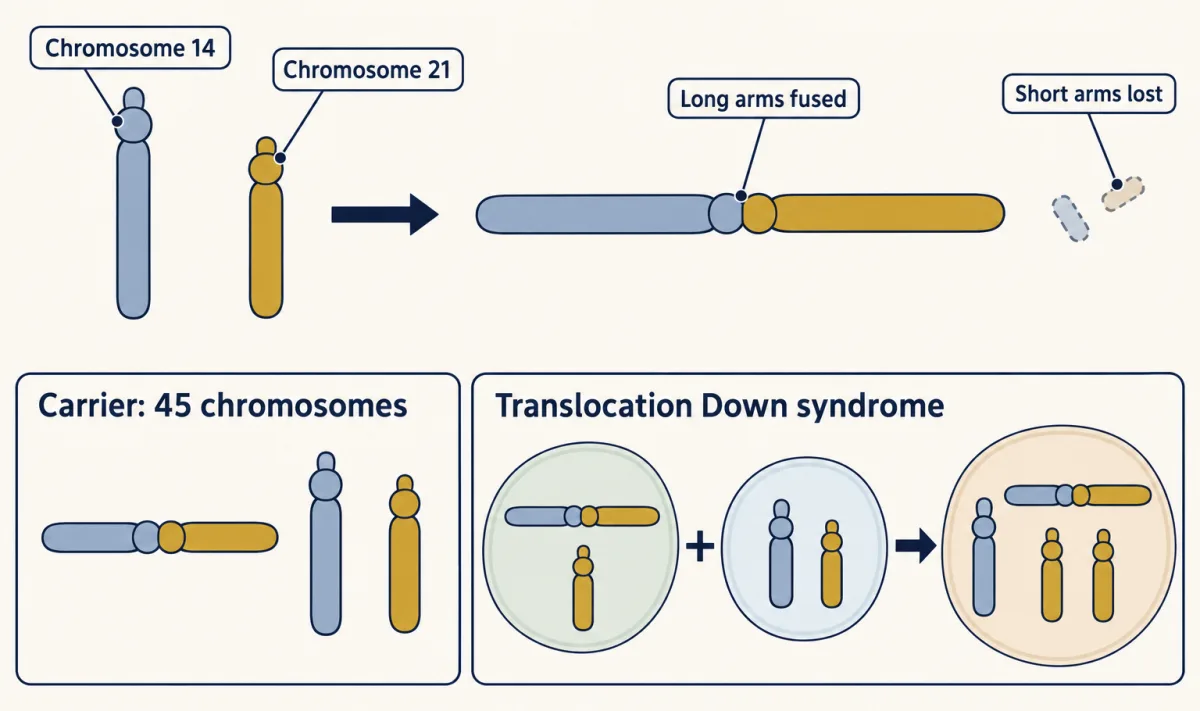
A Robertsonian carrier can have 45 chromosomes and balanced long-arm dose, yet passing a 14;21 fusion with a free 21 gives three doses of chromosome 21 material in a 46-chromosome child. AI-generated illustration 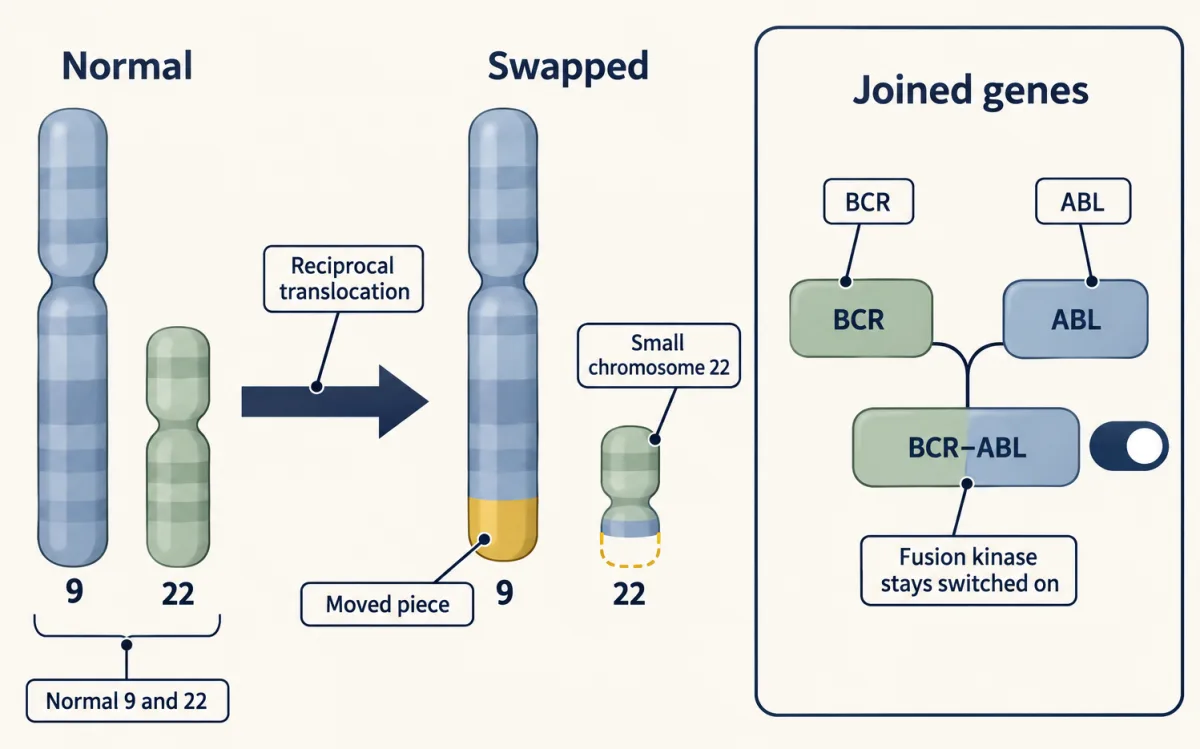
The acquired 9;22 exchange places BCR beside ABL, making a fusion whose tyrosine kinase stays switched on even without a net chromosome-dose change. AI-generated illustration -
Choose a test by the question
-
Going deeper
Where this lesson fits
Before thisReview first
- Chromosomes and Meiosis: The Physical Basis of Mendel's LawsThis course · Lesson 2
You need how homologues and sister chromatids separate in meiosis I and II to follow where a missed separation happens.
- Sex Linkage, Dosage Compensation and Non-Mendelian InheritanceThis course · Lesson 6
Dosage compensation of the X explains why extra or missing sex chromosomes are better tolerated than autosomal ones.
- Reading Pedigrees: Human InheritanceThis course · Lesson 5
Reading family trees helps in the design problem, where a translocation carrier's gametes and children are worked out.
After thisStudy next
- Linkage and Recombination MappingThis course · Lesson 8
Crossing over between a marker and the centromere, used here to infer the error, is the basis of recombination mapping.
- Cancer as a Genetic DiseaseThis course · Lesson 21
The Philadelphia chromosome's joined BCR and ABL genes show how a rearrangement changes gene context in tumours.
- Sequencing and GenomesThis course · Lesson 23
Sequencing resolves breakpoints and hidden losses that a karyotype misses in apparently balanced rearrangements.
Elsewhere on the siteFilms, simulations and method films in other courses
- Cell, primary and explant cultureMethod film
Karyotypes are made from cultured dividing cells arrested in metaphase, so the lesson's tests depend on it.
- Homologs First, Sister Chromatids SecondFilm · Biology
It shows how homologs and sister chromatids separate in meiosis I and II, the steps where errors arise.
- Heal the scrapeSimulation · Life Science
A hands-on look at how copied chromosomes are shared between daughter cells, the process that can go wrong.
Suggested by an AI model from the lessons themselves, then checked. How we use AI