Press play to start at .
The Loop That Makes ATP Alone
From the film
- Per oxygen released, linear flow makes 2 NADPH and 12 lumen protons, but the Calvin cycle spends 3 ATP for every 2 NADPH.
- With a 14-subunit rotor, 14 protons make 3 ATP, so 12 protons make about 2.6 ATP, about 0.4 short.
- In cyclic flow, an electron loops from ferredoxin back through cytochrome b6f to Photosystem I, adding protons and so ATP, but no NADPH.
- Sending about one electron per oxygen round the loop closes the gap, at about 9 photons per oxygen instead of 8.
- Together with other balancing routes, cyclic flow brings the output to the 3 to 2 ratio the Calvin cycle spends.
Read the transcript of “The Loop That Makes ATP Alone”
Film transcript: The Loop That Makes ATP Alone
Tap a sentence to play from there.
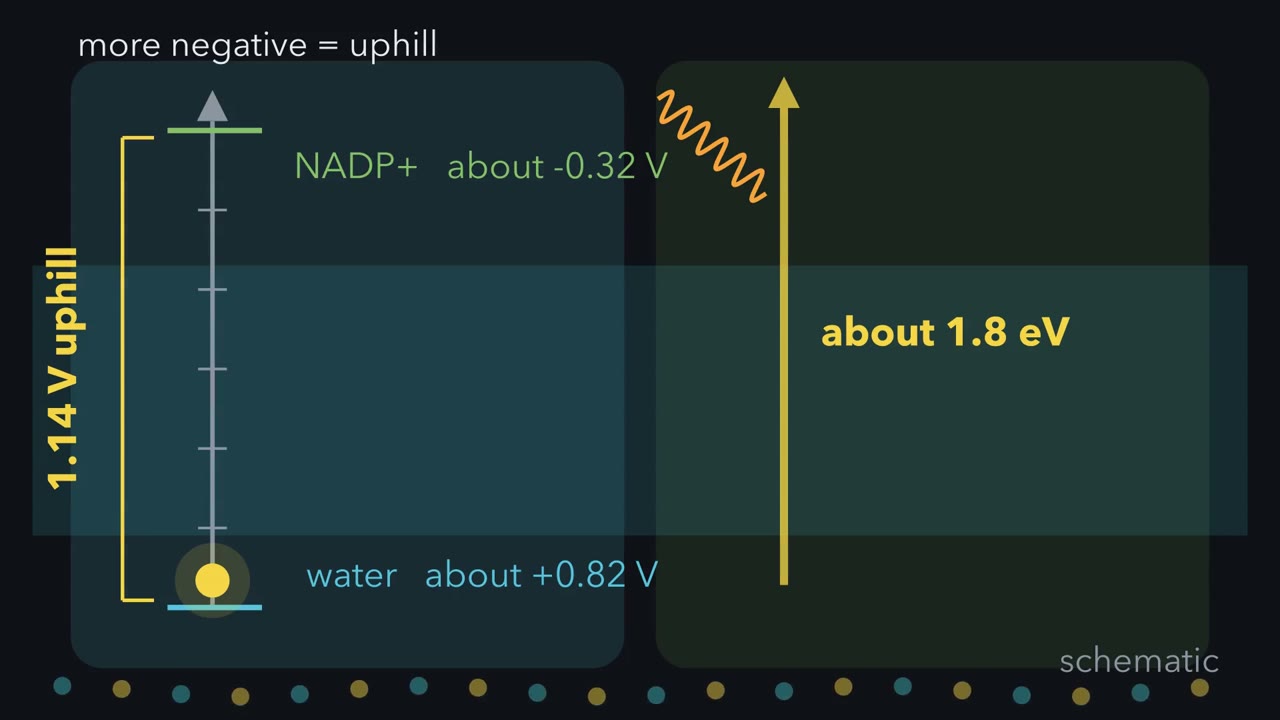
- 0:00 Two light-driven lifts carry each electron from water to NADPH.
- 0:06 The protons left behind make ATP.
- 0:10 But the Calvin cycle needs more ATP than that.
- 0:14 How can a leaf make ATP alone?
- 0:19 Count per oxygen molecule released.
- 0:23 Linear flow makes 2 NADPH and leaves 12 protons in the lumen.
- 0:29 The Calvin cycle spends 3 ATP for every 2 NADPH.
- 0:34 Those protons pay at ATP synthase.
- 0:38 Its rotor has 14 subunits, each carrying one proton across per turn.
- 0:44 One full turn makes 3 ATP.
- 0:47 So 14 protons buy 3.
- 0:50 Twelve protons turn the rotor only twelve fourteenths of the way.
- 0:55 That makes about 2.6 ATP, roughly 0.4 short.
- 0:59 The gap rests on that 14-subunit rotor.
- 1:03 Closing the gap costs two more protons.
- 1:07 Cytochrome b6f pumps two for every electron it passes.
- 1:13 Predict: where could one electron go, to add protons but no NADPH?
- 1:23 Back to cytochrome b6f.
- 1:27 At ferredoxin, the electron turns around instead of reaching NADP+.
- 1:32 It falls through b6f, which pumps its two protons.
- 1:38 Then it returns to Photosystem I, and a photon lifts it again.
- 1:42 Here is the idea. ATP is paid in protons.
- 1:48 NADPH is paid in electrons that reach the end.
- 1:52 So a loop that never reaches the end buys ATP alone.
- 1:57 The chloroplast mixes the two routes.
- 2:00 About one electron per oxygen molecule goes round the loop.
- 2:05 Its two protons bring the total to 14: three ATP.
- 2:10 The price is about 9 photons per oxygen, instead of 8.
- 2:15 Arnon showed that isolated chloroplasts make ATP both ways.
- 2:20 The loop uses only the second lift, one photon per electron.
- 2:25 Alongside other balancing routes, it brings the output to 3 to 2.
- 2:30 So the answer to the opening question is a detour.
- 2:35 Electrons that finish the climb make NADPH.
- 2:39 Electrons that circle only pump protons.
- 2:43 The chloroplast sets its ratio partly by how many circle.
Photosynthesis: the same idea, other levels
A level is a place to start, not a rank. If this loses you, the rung below teaches the same idea, told more simply.
College, upper level · the level you chose
Photosynthesis: The Light Reactions · this lesson
Two photon-driven lifts carry electrons from water to NADPH, and make ATP.
Biochemistry · about 24 min · film 3:18 · 3 practice questions
The Calvin Cycle: Fixing Carbon from Thin Air
Rubisco fixes carbon dioxide, and the ATP and NADPH bill adds up.
Biochemistry · about 24 min · film 3:08 · 3 practice questions
High school · the level you chose
Track each atom from carbon dioxide and water into sugar and oxygen.
Biology · about 40 min · film 3:19 · Virginia BIO.2e
Grade 7 · the level you chose
Photosynthesis Feeds the World
A tree is built mostly from air: the willow that proved it.
Life Science · about 40 min · film 3:26 · Virginia LS.4 a, LS.4 b
Ages 5 to 10 · the level you chose
Grow seedlings in a cupboard and on a windowsill, then compare.
A grown-up runs this one; its safety notes are in the guide.
Biology Together · about 30 min · film 3:38 · Virginia 1.4 a, K.7 a, 4.2 a, 4.2 b
Play the ladder · 5 films, about 16 min, from grade 7 to upper-level college. Each film waits for you to press play.
Next door
- Cellular respiration: Metabolism: Basic Concepts and Design Respiration takes the sugar apart again to get the energy out.
- Food webs: Three Doors · 3:05 · College: the core Every food chain starts with the sugar a producer makes.
- The carbon cycle: The Loop Inside the Line · 3:02 · College: the core Photosynthesis is the door carbon uses to leave the air.
- Water in plants: Pulled From the Top · 3:16 · Starting college The leaf pores that let carbon dioxide in also let water out.
More films from this lesson
Continue in the lesson: Photosynthesis: The Light Reactions →
Free, with captions and a transcript. The lesson has the full text, the questions and the sources.
How this film was made. Narration: an AI narrator voice (Kokoro, af_heart) reading narration written from this lesson's text. Animation: AI-generated in code (Manim) by Claude, a schematic with no drawn molecular structures. Captions come from the narration script. See something wrong? Report it.